
What if the strongest evidence for your VA disability claim isn’t a single record, but the way several pieces fit together? If you’re trying to understand how to prove service connection, it can be hard to know which documents and statements matter, especially when your diagnosis came years after service or some records are missing. A useful starting point is to identify evidence for three things: a current condition, an in-service event, injury, or exposure, and a connection between them.
The evidence that matters depends on how your condition may be connected to service. Service and medical records, private treatment notes, and statements from you or people with firsthand knowledge may each support a different part of the claim. Missing documentation doesn’t automatically mean you have no way to support your claim, but it makes careful organization especially important.
This guide explains what service connection means, what evidence the VA generally considers, and how to match evidence to a direct, presumptive, or secondary claim. You’ll also learn how to address incomplete records and what to consider if the VA denies your claim, so you can approach the process with a clearer plan.
Key Takeaways
- Service connection depends on evidence supporting the link between a current disability and qualifying military service.
- Learn how to prove service connection by matching your evidence to a direct, presumptive, or secondary claim pathway.
- Service, personnel, deployment, and medical records, along with relevant statements, may support different parts of your claim.
- Organize documents by date, source, and the claim element each one may support to make gaps easier to spot.
- If the VA denies your claim, review the decision rationale to see which element was found unsupported and what review option may fit.
What Does Service Connection Mean for a VA Disability Claim?
Service connection is the recognized link between a veteran’s current disability and qualifying military service. For a direct claim, the key question is whether the evidence supports a current condition, an injury, illness, event, or exposure during service, and a connection between them. This plain-language definition is a useful starting point for understanding service-connected VA benefits.
A diagnosis matters, but it doesn’t by itself show that service caused or contributed to the condition. The evidence needs to support the connection under the pathway claimed. These are general proof elements, not a decision about an individual claim. The VA evaluates each case based on its facts and evidence.
For a concise overview of the direct-connection theory, watch this video:
The Three Common Elements of Direct Service Connection
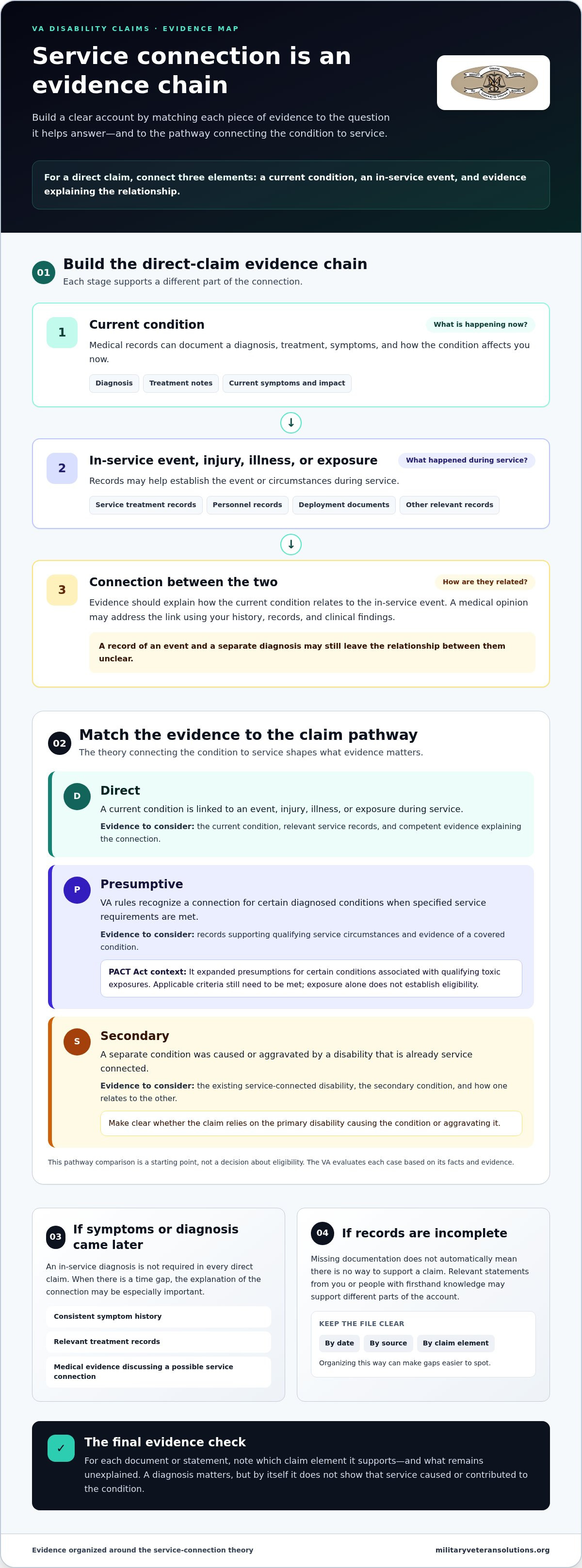
A direct claim generally brings together three parts. Match each part with evidence suited to what it needs to establish:
- Current condition: Medical records can document a diagnosis, treatment, symptoms, and how the condition affects you now.
- In-service event: Service treatment and personnel records, deployment documents, or other relevant records may help establish an injury, illness, event, or exposure during service.
- Connection: Evidence should explain how the current condition relates to the in-service event. A medical opinion may address that link using your history, records, and clinical findings.
Look at the evidence as a connected account, not just a stack of documents. A record showing an event and a separate record showing a diagnosis may still leave the relationship between them unclear.
What If the Condition Appeared After Service?
A condition or its symptoms may become noticeable, or receive a diagnosis, after discharge. An in-service diagnosis isn’t required in every direct claim, but a gap in time may make the explanation of the connection especially important. A consistent symptom history, relevant treatment records, and medical evidence discussing how the condition may relate to service can help clarify the timeline.
To understand how to prove service connection, identify which part of the link each piece of evidence supports. Then note what remains unexplained. This distinction can help you organize the claim and decide where additional documentation may be useful.
Direct, Presumptive, or Secondary: Which Service-Connection Pathway Fits?
The evidence you need depends on the theory connecting your condition to service. Use this comparison to identify the pathway that may fit your circumstances. It’s a starting point, not a decision about eligibility.
| Pathway | Basic theory | Evidence to consider |
|---|---|---|
| Direct | A current condition is linked to an event, injury, illness, or exposure during service. | Evidence of the current condition, relevant service records, and competent evidence explaining the connection. |
| Presumptive | VA rules recognize a connection for certain diagnosed conditions when specified service requirements are met. | Records supporting the qualifying service circumstances and evidence of a covered condition. |
| Secondary | A separate condition was caused or aggravated by a disability that is already service connected. | Evidence of the existing service-connected disability, the secondary condition, and how one relates to the other. |
When Direct or Presumptive Service Connection May Apply
A direct claim asks you to support the link between your condition and a specific in-service event, injury, illness, or exposure. A presumptive pathway can change what you need to establish. When the applicable VA rule covers your diagnosed condition and service circumstances, you may not need to prove the same direct medical causal link. Presumptive status isn’t automatic, however. Eligibility depends on the rules that apply to the condition and your service.
The PACT Act is one example. It expanded presumptions for certain conditions associated with qualifying toxic exposures, but a veteran still needs to meet the applicable criteria. Compare your service history and diagnosis with current VA guidance rather than assuming that an exposure alone establishes eligibility.
How Secondary Service Connection Differs
A secondary claim starts with a disability the VA has already service connected and asks whether it caused or aggravated another condition. For example, the evidence may need to explain whether the primary disability led to the secondary condition or made it worse. The regulation for secondary service connection addresses both causation and aggravation. Make clear which relationship your claim relies on, and organize evidence to support that theory.
Choosing the right pathway helps focus your evidence on the question the VA must evaluate. When records and claim theory are difficult to align, a review of your military records and medical documentation can help clarify what supports the claim and where gaps remain. That’s a practical step in learning how to prove service connection.
Explore VA claims representation for help reviewing the evidence and claim theory.
What Evidence Can Prove Service Connection When Records Are Incomplete?
A missing service treatment record can leave a gap, but it doesn’t automatically make a claim impossible. Start by identifying what each available item may show: a current disability, an in-service event, symptoms over time, or a medical connection. Several records and firsthand accounts may help build a clearer picture, even when no single document tells the whole story.
The VA’s Evidence Needed for a VA Claim guidance describes records that may support a claim, including a DD Form 214, service treatment records, and medical evidence. As you gather documents, consider what each one can establish.
Military and Medical Records That May Support the Claim
Different records can help establish different parts of your account:
- Service treatment records may document in-service symptoms, treatment, or an injury. If they’re missing or silent, personnel files, unit records, deployment documents, or other relevant official records may help establish dates, duties, locations, or circumstances.
- A DD Form 214 and personnel files can provide context about your service. Relevant unit or deployment records may help explain where and when an event or exposure occurred.
- Post-service medical records can document a diagnosis, treatment history, reported symptoms, and changes over time. Records from VA or private providers may help show how the condition developed and whether a medical connection has been addressed.
For help understanding how military documents fit into a claim, see this military record review guide. A careful review can reveal useful context in records that may seem unrelated at first.
Lay Statements, Buddy Statements, and Other Supporting Evidence
Your own statement or an account from a fellow service member, family member, or another person with firsthand knowledge can describe observable facts. A witness might explain what they saw during an incident, when they noticed symptoms, or how your behavior or daily activities changed. Keep statements specific: include approximate dates, locations, circumstances, and concrete examples. Avoid asking a witness to make medical conclusions they aren’t qualified to provide.
Lay evidence can describe experiences and changes. It generally serves a different role from medical evidence that diagnoses a condition or explains its cause. Keep that distinction clear. If records are incomplete, organize what you have by the point it may support, and note what remains unexplained. This gives you a practical foundation for showing how to prove service connection with the evidence available.
How to Build a Clear Service-Connection Evidence File
A clear file shows not only what evidence you have, but what it may establish. Organize records around the claim pathway rather than submitting documents without context. This makes missing information and inconsistencies easier to spot before you decide what to do next.
Use this workflow:
- 1. Identify the pathway. Note whether your claim is direct, presumptive, or secondary.
- 2. List the proof elements. Write down what needs support under that pathway, such as a current condition, qualifying service circumstances, or a relationship between conditions.
- 3. Gather records. Collect relevant service, personnel, deployment, medical, and lay evidence. Keep copies organized by date or source.
- 4. Map each document. Record what each item may support, and avoid treating any one document as conclusive by itself.
- 5. Review the gaps. Flag missing records, conflicting dates, or unanswered questions. Explain them accurately. Don’t alter documents or overstate what they show.
Match Each Record to a Claim Element
Create an evidence table with columns for the document, date, source, and the element it may support. For a direct claim, include separate columns for current condition, in-service event, and connection evidence. A treatment record, for example, may document both a diagnosis and a reported history, but that doesn’t automatically prove the condition is related to service.
Organize evidence around the claimed service-connection pathway so each document’s relevance and any remaining gaps are clear.
Address Medical Opinions and Evidence Gaps Carefully
A medical opinion may help when the diagnosis or relationship to service is disputed or unclear. A nexus letter isn’t automatically required in every claim, and a letter alone doesn’t guarantee approval. Its usefulness depends on the questions addressed and the evidence considered. If symptoms began before treatment, or records give different dates, provide a truthful timeline and context rather than trying to make the accounts appear consistent.
If the VA has already issued an unfavorable decision, review its reasoning and identify which part of the claim needs attention before considering next steps. For help understanding the process, read this VA appeals guide. Military Veteran Solutions, LLC provides claims representation and reviews military records, medical evidence, and VA decisions to help veterans assess their claims. Learn about reviewing your VA claim evidence.
What to Do If VA Rejects Your Service-Connection Evidence
A denial can be discouraging, but the decision letter gives you a place to start: the VA’s stated reasons. Read the explanation closely and identify which part of the service-connection theory the VA found unsupported. The right next step depends on the decision, the evidence already considered, any additional evidence available, and current VA procedures. Don’t assume every denial calls for the same response.
Read the VA Decision for the Specific Evidence Gap
Separate the VA’s findings into the relevant issues. Did it question whether you have a current diagnosis? Did it find insufficient evidence of an in-service event, injury, illness, or exposure? Did it accept both but find the connection between them unsupported? For a presumptive claim, check whether the decision explains how it assessed the applicable service and condition criteria.
Compare those findings with the records and statements you submitted. Note any evidence the decision appears not to address, and check whether the VA’s summary accurately reflects the documents. For example, a denial might acknowledge a diagnosis but explain that the record doesn’t establish a relationship to service. That points to a different evidence gap than a decision disputing whether an in-service event occurred.
Then review the decision notice for available review options and instructions. Procedures and time limits can depend on the decision and the option selected, so verify the notice and current VA guidance rather than relying on a general deadline. If you’re unsure how to prove service connection after a denial, focus first on the stated reason and the evidence that could address it.
Get Support Reviewing a Complex Claim
When records are extensive, incomplete, or difficult to reconcile with the VA’s explanation, a detailed review can help identify relevant documents, overlooked evidence, and issues in the claim theory. Military Veteran Solutions, LLC reviews military records, medical evidence, and VA decisions as part of its claims representation. The firm also offers nationwide virtual consultations.
Take time to understand the denial and your options before deciding how to proceed. For support assessing the decision and evidence, discuss your VA claim with Military Veteran Solutions, LLC.
Take the Next Step With a Clear Evidence Plan
Understanding how to prove service connection starts with matching your evidence to the right claim pathway. A diagnosis alone may not establish the link to service, so organize records and statements around what they show: your current condition, relevant service circumstances, and the connection between them. If the VA denies your claim, use the decision’s reasons to identify what evidence or issue needs closer attention.
Incomplete records or a complicated timeline can make that work difficult. Military Veteran Solutions, LLC provides VA claims representation and nationwide virtual consultations, including reviews of military records, medical evidence, and VA decisions. The firm was founded by a disabled veteran who served ten years in the U.S. Army. A careful assessment can help clarify the issues in your claim and possible next steps.
Discuss your VA claim with Military Veteran Solutions, LLC for support reviewing your evidence and planning what to do next.
Frequently Asked Questions
Is a nexus letter required to prove service connection?
No, a nexus letter isn’t automatically required in every claim. The evidence the VA needs depends on the service-connection pathway and the facts of your case. Service records, medical records, credible statements, and other evidence may all be relevant. A medical opinion can help explain a disputed relationship between a condition and service, but it doesn’t guarantee approval. Review current VA guidance and the evidence already in your claim file.
Can I prove service connection without service treatment records?
Yes, missing service treatment records don’t automatically prevent you from pursuing a claim. Personnel files, deployment documents, post-service medical records, and statements from people with firsthand knowledge may help establish relevant events or symptoms. Explain what records are missing and provide an accurate account of what happened. Assess each alternative record in context, and don’t describe it as proving more than it actually shows.
What evidence does the VA need to establish service connection?
For a direct claim, evidence commonly addresses a current disability, an in-service event, injury, illness, or exposure, and a relationship between them. Presumptive and secondary claims follow different pathways and may involve different evidence. Medical and service records, firsthand statements, and medical opinions may all contribute. To understand how to prove service connection, organize each document around the part of the claim it may support.
How do I prove a condition started during military service?
Gather evidence that helps establish when symptoms or an event began, such as service records, relevant official documents, treatment records, and firsthand statements. Build a timeline describing what happened, when symptoms appeared, and when you sought care. If records are incomplete or treatment came later, explain the circumstances accurately. The VA evaluates the full evidence under the rules that apply to your claim.
Can a condition diagnosed after discharge be service connected?
Yes. A diagnosis after discharge doesn’t automatically rule out service connection. Evidence may support that the condition began during service, followed an in-service event, or meets an applicable presumptive rule. Medical records, a consistent history of symptoms, service documents, and a medical opinion may help explain the timeline. The relevant pathway and its requirements matter, so the diagnosis date alone doesn’t determine the claim.
What is the difference between direct and secondary service connection?
Direct service connection generally concerns a link between a current disability and an event, injury, illness, or exposure during service. Secondary service connection concerns a condition caused or aggravated by a disability the VA has already service connected. Because the theories differ, the evidence should address the relationship relevant to your claim. Identify the pathway that fits your circumstances and review current VA rules before relying on a specific standard.
What should I do if the VA says my condition is not service connected?
Read the decision notice carefully and identify the reason the VA gave, such as a missing diagnosis, insufficient evidence of an in-service event, or an unsupported connection. Compare that explanation with the evidence submitted and note any records that may not have been considered. Then review the notice for available review options and applicable deadlines. The appropriate next step depends on the decision, evidence, and current VA procedures.


