
What if the Gulf War Syndrome presumptive list 2026 isn’t a list of diagnoses that automatically guarantees VA benefits? A presumption may remove the need to prove a direct medical link to service, but you still need to meet the applicable requirements. It doesn’t guarantee service connection or a particular rating.
It’s understandable to be unsure where your symptoms fit. Fatigue, joint pain, headaches, sleep problems, and digestive issues can relate to different claim categories, while some conditions may fall under separate PACT Act rules. “Gulf War Syndrome” itself isn’t a specific claimable diagnosis, so the details of your symptoms, diagnoses, and service matter.
This guide explains the main Gulf War presumptive categories, including undiagnosed illness, medically unexplained chronic multisymptom illnesses, and certain infectious diseases. It also covers service and manifestation requirements, how Gulf War presumptions differ from PACT Act toxic-exposure presumptions, and which details to review in your medical records, service history, and VA decision letter. A careful review can help clarify the issues in a claim, including one the VA has already denied.
Key Takeaways
- The Gulf War Syndrome presumptive list 2026 is a framework for evaluating qualifying chronic disabilities, not a single diagnosis or automatic award.
- Review how your symptoms or diagnosis may fit VA-recognized categories, including fatigue, skin, headache, muscle and joint, neurologic, respiratory, and gastrointestinal issues.
- Gulf War chronic-disability rules and PACT Act toxic-exposure presumptions are separate pathways, and their service or exposure requirements can differ.
- Organize evidence in three groups: records showing qualifying service, documentation of chronic symptoms or diagnosis, and evidence of current disability.
- Use your VA decision letter and military and medical records to identify what the VA considered and what may need closer review.
Gulf War Syndrome Presumptive List 2026: What the VA Actually Presumes
The Gulf War Syndrome presumptive list 2026 is better understood as a set of rules than as a single list of diagnoses. Under 38 C.F.R. § 3.317, the VA may presume that a qualifying chronic disability is related to certain Gulf War service when the veteran meets the applicable service, medical, and other requirements. The regulation covers disability patterns involving an undiagnosed illness or a medically unexplained chronic multisymptom illness (MUCMI), as well as certain diagnosed illnesses addressed separately in the rule.
This section reflects the 2026 framework in the current eCFR text of § 3.317. Because eligibility depends on the regulation’s definitions and qualifying periods, compare the current text with your service and medical records. The presumption can address the link between a qualifying disability and service, but a condition’s name alone doesn’t guarantee approval or a particular disability rating.
What does presumptive service connection mean for Gulf War veterans?
Usually, a veteran must establish that a current disability is connected to service. A presumption can provide that service-connection link when the veteran meets the rule’s criteria, without requiring the same kind of direct medical nexus evidence. The VA still evaluates whether there is a current qualifying disability and whether the veteran meets the applicable service and manifestation requirements. A diagnosis, symptom, or claim label by itself doesn’t settle those questions.
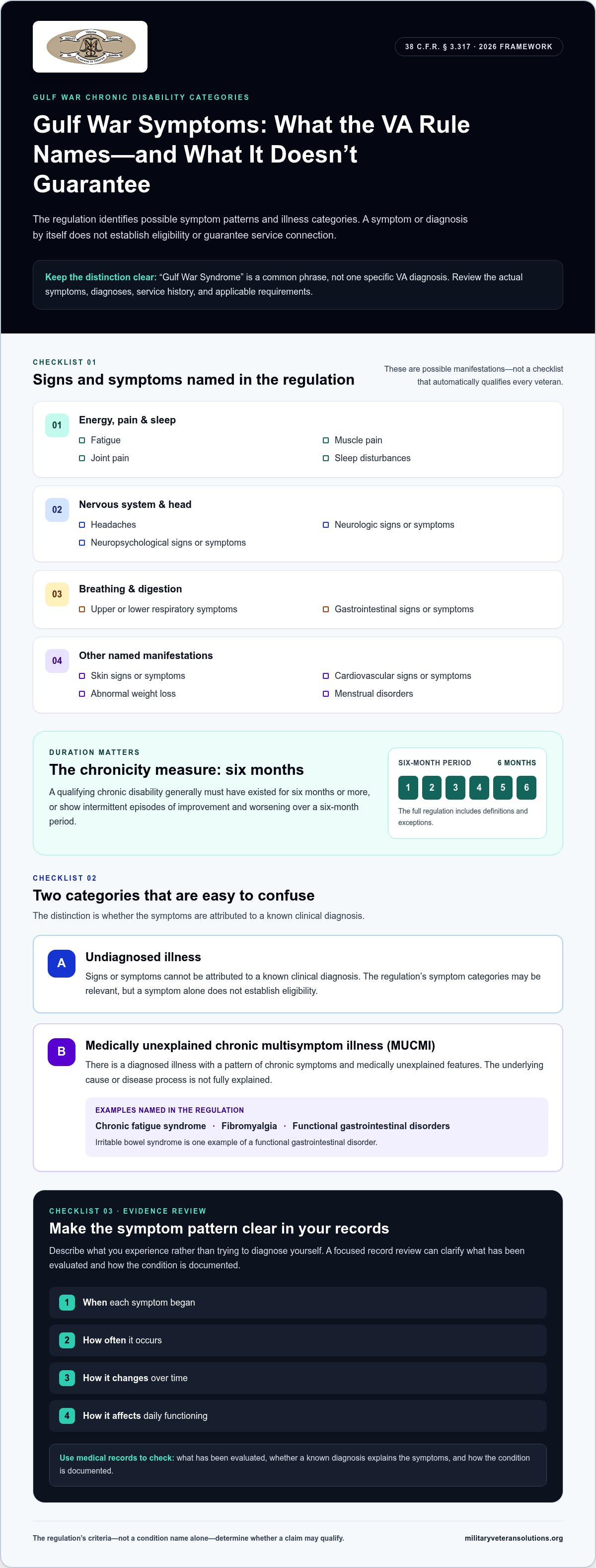
The regulation also explains how chronicity is assessed. For example, a qualifying chronic disability generally must have existed for six months or more, or show intermittent episodes of improvement and worsening over a six-month period. The full rule includes specific definitions and exceptions, so a symptom list alone isn’t enough to determine eligibility.
Is Gulf War Syndrome one condition on the VA list?
No. “Gulf War Syndrome” is a common phrase for varied chronic symptoms or illnesses, not one single VA diagnosis. The regulation instead uses terms such as undiagnosed illness and medically unexplained chronic multisymptom illness. An undiagnosed illness involves signs or symptoms that can’t be attributed to a known clinical diagnosis. A MUCMI is a diagnosed illness defined by a pattern of chronic symptoms with medically unexplained features. These are distinct categories, and the evidence needed to establish each may differ.
For background on the broader history and use of the term, see Gulf War Syndrome. For a VA claim, focus on the actual symptoms, diagnoses, and criteria in § 3.317 rather than assuming the general label determines the outcome.
Which Gulf War Symptoms and Diagnoses May Qualify Under VA Rules?
Under 38 C.F.R. § 3.317, certain chronic signs and symptoms may be considered manifestations of an undiagnosed illness or a medically unexplained chronic multisymptom illness (MUCMI). The regulation names symptom categories, not a checklist that automatically qualifies every veteran. Apply the Gulf War Syndrome presumptive list 2026 alongside your service history, the duration and severity of the condition, and the relevant manifestation requirements.
Undiagnosed illness: which chronic signs and symptoms are covered?
The regulation identifies fatigue; signs or symptoms involving the skin; headaches; muscle pain; joint pain; neurologic and neuropsychological signs or symptoms; upper or lower respiratory symptoms; sleep disturbances; gastrointestinal and cardiovascular signs or symptoms; abnormal weight loss; and menstrual disorders. These are possible manifestations, not diagnoses. A headache or sleep disturbance alone, for example, doesn’t establish eligibility.
Chronicity and timing matter under the rule. A qualifying chronic disability generally must have existed for six months or more, or have intermittent episodes of improvement and worsening over a six-month period. Other requirements may apply, so use the current text of 38 C.F.R. § 3.317 rather than relying on a general symptom list.
Keep a clear record of when each symptom began, how often it occurs, how it changes over time, and how it affects daily functioning. Medical records can show what has been evaluated, whether a known diagnosis explains the symptoms, and how the condition is documented. Describe what you experience rather than trying to diagnose yourself.
MUCMI and named conditions: how do they fit the list?
A MUCMI is a diagnosed illness marked by a pattern of chronic symptoms where the underlying cause or disease process isn’t fully explained. It differs from an undiagnosed illness: in one category, symptoms lack a known clinical diagnosis; in the other, there is a diagnosis with medically unexplained features.
The regulation gives chronic fatigue syndrome, fibromyalgia, and functional gastrointestinal disorders as examples of MUCMIs. Irritable bowel syndrome is one example of a functional gastrointestinal disorder. These names don’t automatically establish a qualifying claim. The VA considers the evidence and whether the specific condition meets the relevant regulatory criteria.
If you’re unsure how your records describe a symptom pattern or diagnosis, a focused review of your medical documentation and VA correspondence can clarify what the claim establishes. Veteran claims representation from Military Veteran Solutions, LLC includes reviewing records and identifying potential claim issues, without assuming a particular result.
Gulf War Presumptions vs. PACT Act Conditions: Which Rules Apply?
Gulf War presumptions and the PACT Act can both matter to veterans with qualifying service, but they are separate routes. The Gulf War Syndrome presumptive list 2026 isn’t a catch-all for every condition linked to toxic exposure. A condition’s name alone won’t tell you which rules apply. Compare the claimed condition and your service history with the criteria for each framework.
| Point of comparison | Gulf War chronic-disability rules | PACT Act presumptions |
|---|---|---|
| Legal framework | 38 C.F.R. § 3.317, covering qualifying chronic disabilities associated with certain Gulf War service. | A separate law that expanded VA presumptions for specified conditions associated with certain toxic exposures. |
| Service or exposure | Requires qualifying service in the regulatory-defined Southwest Asia theater, along with the applicable criteria. | Depends on the exposure and service circumstances specified for the particular presumption. |
| Covered-condition approach | Focuses on undiagnosed illness, MUCMIs, and other categories described in § 3.317. | Uses condition-specific presumptions tied to qualifying toxic exposure; its conditions aren’t automatically part of the Gulf War framework. |
How do Gulf War service rules differ from PACT Act exposure rules?
Section 3.317 sets out its own service criteria and chronic-disability rules. The PACT Act addresses specific toxic-exposure presumptions under a different legal framework. Some veterans may need to consider both, but eligibility under one doesn’t establish eligibility under the other. For an overview of a separate PACT Act claim issue, see this PACT Act denied-claim guide.
Which service dates, locations, and manifestation rules should readers check?
For a § 3.317 claim, compare your orders and deployment records with the regulation’s definition of the Southwest Asia theater of operations. It names locations including Iraq, Kuwait, Saudi Arabia, Bahrain, Qatar, the United Arab Emirates, and Oman, as well as specified nearby waters and airspace. The full definition appears in the current eCFR text of § 3.317. Service during the Gulf War era alone may not establish qualifying service.
Check the current manifestation period and any required level of disability against the regulation and current VA guidance before relying on a date or threshold. Requirements can be specific, and the applicable rule may depend on the condition and claim pathway. Reviewing deployment records, medical documentation, and VA correspondence together can help identify which framework the evidence may support. The VA makes the claim decision.
How to Check Gulf War Presumptive Eligibility and Prepare Your Records
Start by separating three questions: Does your record show qualifying service? Does it document the chronic symptoms or diagnosis you’re claiming? Is there evidence of a current disability? The Gulf War Syndrome presumptive list 2026 can point to a possible claim pathway, but this checklist doesn’t replace VA’s review or determine eligibility. Requirements depend on the specific claim and current VA guidance.
- Gather service records. Collect deployment orders, personnel records, separation documents, and other records that may establish your dates and locations of service. Compare them with the current criteria for the presumption you’re considering. A general reference to Gulf War-era service may not show whether your particular service qualifies.
- Build a symptom and treatment timeline. Note when symptoms began, how they changed, whether they persisted or came and went, and when you sought care. Include relevant treatment records and diagnoses. Mark what you know and where documentation is missing rather than filling gaps with assumptions.
- Identify evidence of current disability. Gather records describing your present symptoms, diagnosis if applicable, and functional effects. The evidence should help show the condition or symptom pattern being claimed, rather than relying only on a broad label.
- Match the evidence to the applicable criteria. Review the regulation and current VA guidance for the relevant service, chronicity, manifestation, and other requirements. The evidence needed can differ depending on whether the claim involves an undiagnosed illness, a MUCMI, or another pathway.
Organizing records by service, medical history, and current impact makes it easier to spot gaps and changes over time. A military record review can help clarify what your service documentation says and how it relates to your claim.
What should you review if the VA has already decided your claim?
Read the decision letter’s reasons and note which criteria the VA addressed. Did it discuss qualifying service, whether symptoms were chronic, the diagnosis, or whether the condition met an applicable manifestation requirement? Compare the VA’s explanation with the evidence submitted and the criteria for the claim. A denial doesn’t necessarily mean every possible route has been considered.
For a broader overview of options after a denial, read this VA appeals strategy guide. Military Veteran Solutions, LLC reviews VA decision letters and records to help identify potential claim issues. Learn about support with your VA claim records and the appeal process.
What to Do Next About a Gulf War Presumptive Claim
A condition that appears on a presumptive pathway, a medical diagnosis, and an approved VA disability claim are three different things. The Gulf War Syndrome presumptive list 2026 can help identify rules worth reviewing, but a diagnosis or symptom label alone doesn’t establish that every eligibility requirement is met. The VA evaluates the evidence and decides the claim.
Take the next steps in order:
- Identify the possible framework. Determine whether the claim may involve Gulf War chronic-disability rules, a separate toxic-exposure presumption, or another basis for service connection.
- Organize your records. Gather relevant military service documents, medical records, symptom history, and any diagnoses related to the claimed condition.
- Review VA correspondence. If you’ve received a decision, read the stated reasons and note which evidence or eligibility criteria the VA addressed.
When can a focused review of records or a VA decision help?
Service records can clarify what your documents establish about dates, locations, and qualifying service. Medical records can show how symptoms or diagnoses were documented over time. If the VA has already decided the claim, a close reading of the decision letter can identify whether it addressed service, the condition, chronicity, or another relevant requirement, and where questions may remain.
This kind of review supports understanding and advocacy. It isn’t medical care and can’t guarantee a claim outcome or disability rating. The applicable rules and evidence depend on the individual claim.
How can veterans take an informed next step?
Before a consultation, gather the records you have and write down your questions. Consider which eligibility framework appears relevant, what your records show about symptom history, and how the VA explained its decision. Clear questions can help keep the discussion focused on your claim.
Military Veteran Solutions, LLC offers virtual consultations and veteran claims representation to help veterans review records and VA correspondence. Explore veteran claims support to discuss potential claim issues and next steps, without a promise of a particular result.
Take the Next Step With a Clearer Claim Picture
The Gulf War Syndrome presumptive list 2026 is a starting point for understanding possible VA pathways, not a guarantee of service connection or a specific rating. First identify which framework may apply, then compare its requirements with your service records, medical evidence, and VA correspondence. A diagnosis, chronic symptoms, and an approved claim are separate parts of the process.
If a decision has left you uncertain, a focused review can clarify what the VA considered and where questions remain. Military Veteran Solutions, LLC was founded by a disabled veteran who served ten years in the U.S. Army, and the organization reports more than 25 years of experience and over two decades of operation.
Request a virtual consultation with Military Veteran Solutions, LLC to review your service records, medical documentation, or VA decision letter and discuss potential next steps.
Frequently Asked Questions
Is Gulf War Syndrome on the VA presumptive list in 2026?
Not as a single diagnosis. “Gulf War Syndrome” is a common label for varied chronic symptoms and illnesses, while VA rules focus on specific categories under 38 C.F.R. § 3.317, including undiagnosed illness and medically unexplained chronic multisymptom illness (MUCMI). The Gulf War Syndrome presumptive list 2026 is shorthand for these legal pathways, not a promise of benefits. The VA still reviews service, medical evidence, and the applicable eligibility criteria.
What conditions are presumptive for Gulf War veterans?
Under Gulf War rules, qualifying chronic disabilities may include undiagnosed illnesses and MUCMIs such as chronic fatigue syndrome, fibromyalgia, and functional gastrointestinal disorders, including irritable bowel syndrome. The regulation also identifies symptom categories such as fatigue, headaches, skin problems, muscle and joint pain, respiratory or gastrointestinal symptoms, sleep disturbances, and neurologic signs. Certain infectious diseases have separate rules. A symptom or diagnosis qualifies only if the applicable criteria are met.
Do Gulf War presumptive conditions require a medical diagnosis?
Not always. An undiagnosed-illness claim may involve chronic signs or symptoms that can’t be attributed to a known clinical diagnosis. A MUCMI, by contrast, is a diagnosed illness with medically unexplained features. Other claims may require evidence of a specific diagnosis. In every case, the VA assesses whether there is a current qualifying disability and whether service and other regulatory requirements are satisfied. Medical records help document symptoms, evaluations, and their effects.
Does the PACT Act Gulf War presumptive list include the same conditions?
No. Gulf War chronic-disability provisions under 38 C.F.R. § 3.317 and PACT Act toxic-exposure presumptions are separate frameworks. The PACT Act provides presumptions for specified conditions associated with qualifying exposures and service. Its conditions aren’t automatically part of the Gulf War list. A veteran may need to examine both pathways because qualifying service, exposure rules, and covered conditions differ. The relevant framework depends on the individual claim.
What service qualifies for Gulf War presumptive benefits?
Eligibility generally depends on meeting the VA’s criteria for a particular presumption, not simply having served during the Gulf War era. For undiagnosed illness and MUCMI claims, 38 C.F.R. § 3.317 defines qualifying service in the Southwest Asia theater of operations. Separate infectious-disease rules may apply to some service in Afghanistan. Compare deployment orders and personnel records with the current regulation and VA guidance to identify which service criteria may be relevant.
Is there a deadline for Gulf War presumptive conditions in 2026?
For many qualifying chronic disabilities, the 2026 guidance identifies December 31, 2026, as the date by which the condition must have become at least 10 percent disabling. This is a manifestation requirement, not simply a deadline to file a claim. Rules may differ by condition and pathway, and legal changes can affect deadlines. Check the current version of 38 C.F.R. § 3.317 and VA guidance before relying on a date or threshold.
Can the VA deny a Gulf War presumptive claim?
Yes. A presumption doesn’t guarantee approval or a particular rating. The VA may find that the evidence doesn’t establish qualifying service, a current disability, chronicity, manifestation, or another required criterion. If your claim is denied, read the decision letter closely to see which issues the VA addressed and what evidence it relied on. That review can clarify whether records are missing or whether an appeal or other claim option may warrant consideration.
What evidence should I gather for a Gulf War presumptive claim?
Organize evidence in three groups: service records documenting dates and locations; medical records describing symptoms, onset, treatment, and any diagnosis; and evidence showing current symptoms or functional effects. A timeline can help show continuity, changes, or periods when symptoms worsened or improved. If the VA has already decided the claim, include the decision letter and related correspondence. Compare these documents with the criteria for the specific pathway you’re considering.


