
What if the "denied" stamp on your VA decision letter isn't actually a rejection of your service, but simply a failure of evidence alignment that we can correct? Receiving a denial after filing for toxic exposure benefits feels like a personal betrayal by the system you swore to protect. You're likely staring at pages of complex legal terminology, wondering how to start a pact act claim denied appeal while feeling the weight of anxiety as deadlines loom. We understand that frustration. It's exhausting to prove what you already know to be true about your health and your service.
You don't have to accept a negative outcome as the final word. This guide provides the exact steps you need to manage your appeal and win your benefits in 2026. With over 1 million PACT Act claims processed and a 2.8% COLA increase now in effect, the stakes for your financial security have never been higher. We'll help you decode your decision letter, identify hidden evidence in your records, and build a concrete plan to overturn the VA's decision. By the time you finish reading, you'll have a clear path forward to confirm your service connection and secure the entitlements you deserve.
Key Takeaways
- Learn why the VA denied your claim by understanding the "three-element rule" and how the PACT Act presumption specifically applies to your medical diagnosis.
- Discover how to audit your decision letter to identify missing evidence and leverage "favorable findings" as the foundation for your pact act claim denied appeal.
- Uncover "hidden" evidence in your service records that standard VA searches often miss, ensuring every concession of toxic exposure is properly documented.
- Compare the three main appeal lanes-Supplemental Claim, Higher-Level Review, and Board Appeal-to select the most effective path based on your evidence and 2026 processing times.
- Understand how professional advocacy can navigate complex rating schedules and remove the technical burden of the appeals process from your shoulders.
Understanding Why PACT Act Claims are Denied in 2026
Receiving a denial letter doesn't mean your health struggles aren't real. It usually means the VA's internal checklist wasn't fully satisfied during the initial review. Under the Honoring our PACT Act of 2022, the VA is required to assume that certain conditions were caused by your service. However, this "presumption" only covers the medical link, or the "nexus." It doesn't prove you have the condition or that you were in the right place at the right time. You aren't just a number on a spreadsheet, and a denial isn't a final judgment on your integrity or your health.
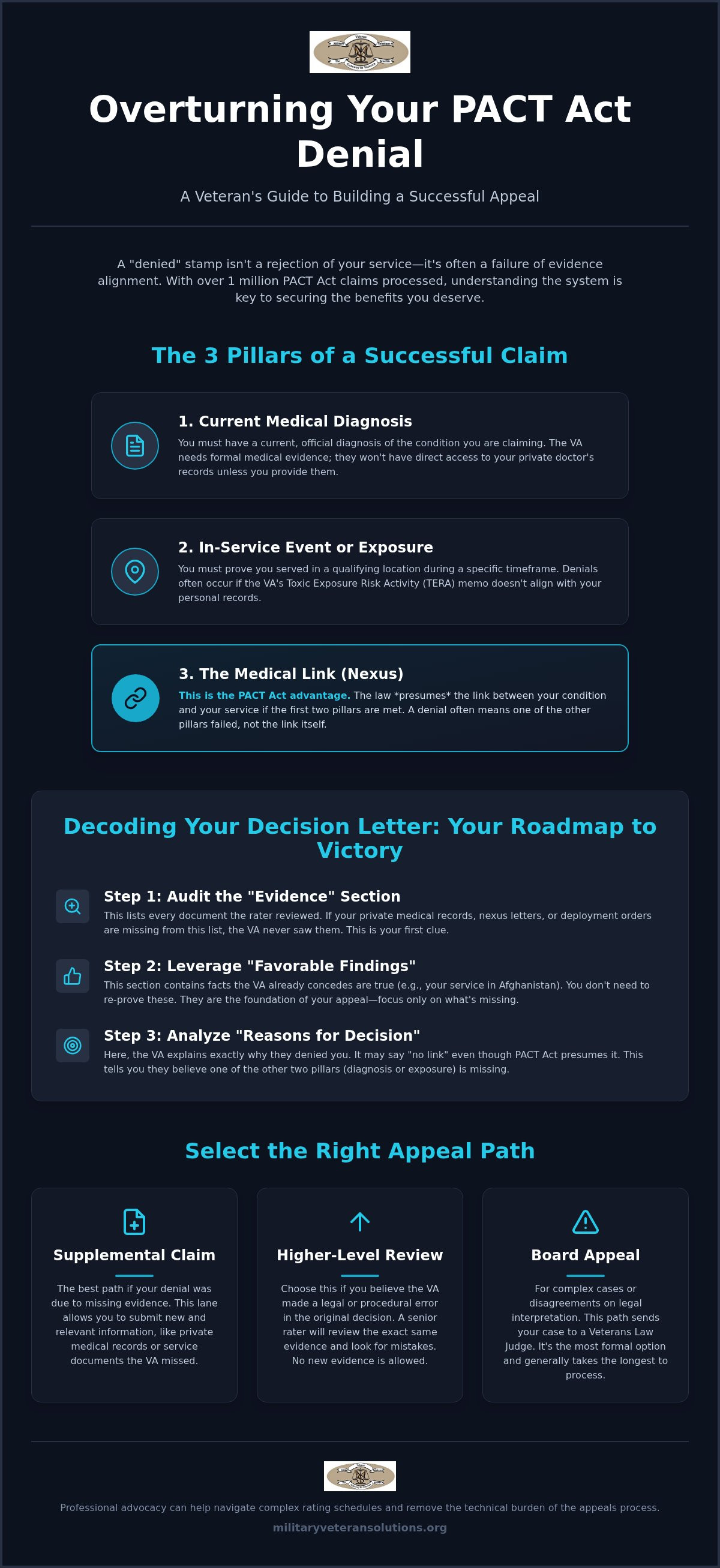
A successful claim requires three specific elements: a current medical diagnosis, evidence of an in-service event or exposure, and a link between the two. For PACT Act claims, the law provides the link, but you must still provide the first two. If any piece is missing or unclear, you'll face a pact act claim denied appeal. In 2026, many denials stem from the Toxic Exposure Risk Activity (TERA) memo. This internal VA document tracks where and when you were exposed. If the VA's memo doesn't match your personal records, they will likely deny the claim despite the presumptive list. A pact act claim denied appeal is often the only way to correct these data gaps.
The 'Presumptive' vs. 'Automatic' Trap
Many veterans believe that because their condition is on the list, the benefits should start immediately. This is the "automatic" trap. The VA doesn't have a direct feed to your private doctor's records. If your diagnosis isn't in their system or is labeled incorrectly, the claim fails. In the context of 2026 VA law, a presumptive condition is a health issue that the VA automatically concedes was caused by military service, provided the veteran served in specific locations during designated timeframes. Don't assume the VA has your full medical history; they often only see what is within their own network.
Common Technical Reasons for Rejection
Small administrative errors lead to big delays. We often see denials based on specific technicalities that have nothing to do with your actual health status. These include:
- Service location discrepancies: Being in the "vicinity" of a burn pit isn't always enough if your boots weren't "on the ground" in a recognized territory according to VA maps.
- Diagnosis timing: Diagnosis dates must align with VA-required windows. This is difficult for chronic conditions that take years to manifest after discharge.
- Administrative slips: Missing signatures on VA Form 21-526EZ or using outdated forms can result in an immediate technical rejection before a medical reviewer even sees your file.
These hurdles are frustrating, but they are fixable. Understanding these specific reasons for rejection allows us to build a stronger, more targeted appeal strategy.
Decoding Your VA Decision Letter for PACT Act Errors
Your VA decision letter is more than just a rejection; it is the blueprint for your victory. When you start a pact act claim denied appeal, the most critical step is reading between the lines of the VA's legal jargon. Start with the "Evidence" section. This is a comprehensive list of every document the rater reviewed. If your private medical records, specific nexus letters, or TDY orders aren't listed, the VA rater likely never saw them. This omission is a common error that can be corrected by submitting a Supplemental Claim with the missing data.
Next, look for the "Favorable Findings" section. These are the facts the VA already accepts as true. For example, if the VA concedes you served in a qualifying location like Kuwait or Afghanistan, you have already cleared one of the three hurdles. You don't need to re-prove your service location in your appeal; you only need to focus on the remaining missing pieces. Understanding the nuances of the PACT Act and Your VA Benefits is essential here, as it helps you identify which findings the VA must concede by law.
The "Reasons for Decision" section is where the VA explains why they didn't grant the benefit. Often, they will claim there is "no link" between your service and your condition, even though the PACT Act should provide that link. If you find the language confusing, a professional VA decision letter analysis can help pinpoint exactly where the rater went wrong. Finally, remember the "Notification of Rights." You have exactly one year from the date on that letter to file your appeal and preserve your effective date for potential back pay.
Spotting Missing Evidence Gaps
The VA often relies heavily on its own C&P examiners while ignoring detailed nexus letters from private providers. Check your evidence list for your private doctor's name. If it's missing, the VA failed to consider your evidence. We also see cases where specific deployment records or "hidden" TDY orders are overlooked. This is common for veterans who weren't stationed in a combat zone for their entire tour but visited toxic locations frequently during their service.
Identifying Procedural Oversights
The VA has a "Duty to Assist" you in gathering evidence. If they failed to request your records or didn't schedule a necessary exam, they violated this duty. Additionally, the "Benefit of the Doubt" rule states that if the evidence for and against your claim is equal, the VA must side with the veteran. If the rater ignored this and chose a negative C&P opinion over your positive private medical evidence, you have strong grounds for a Higher-Level Review.
Strengthening Your Appeal with Military Record Reviews
A standard VA records request, known as a C-File, often fails to capture the full scope of your toxic exposure. It typically contains medical records and high-level personnel documents, but it lacks the granular detail needed for a successful pact act claim denied appeal. We perform an exhaustive audit of your personnel records to find specific "concessions of exposure." These are often buried in unit logs, performance evaluations, or deployment manifests that the VA rater may have skimmed over. Finding even one mention of environmental hazards can be the turning point for your case.
When the paper trail is thin, lay statements or "buddy letters" become your most powerful tools. These accounts from fellow service members fill the gaps left by missing records, providing firsthand testimony of the burn pits or chemical leaks you encountered. Additionally, we look for secondary conditions that can bolster a denied primary claim. If the VA denies a direct link for a respiratory condition, we might identify it as secondary to a service-connected sinus issue. This strategic layering of evidence ensures your claim is as robust as possible.
Uncovering Hidden Service Evidence
We dig deeper than a standard file search to find TDY orders, certificates of achievement, or specific awards that place you in a toxic exposure zone. Your MOS also tells a story. For example, a mechanic or fuel handler has an inherent risk of exposure that is often overlooked if their location wasn't officially labeled a "toxic zone." A military record review is an exhaustive, line-by-line forensic audit of your entire service history to identify specific exposure events that a standard digital keyword search would overlook.
The Power of a Professional Nexus Analysis
A professional review finds links that a standard C&P exam often misses. We connect non-presumptive conditions to toxic exposure through the TERA framework, using current medical literature to support your case. It is vital to match this medical research to your specific service dates and locations to prove the connection. Once this evidence is gathered, you can select from the various VA decision review options to present your new findings. This level of detail transforms a weak pact act claim denied appeal into a compelling argument for the benefits you earned.
Selecting the Right Appeal Path for a PACT Act Denial
Choosing the correct lane for your pact act claim denied appeal is a strategic decision that directly impacts your wait time and your chances of success. In 2026, the VA offers three primary paths: a Supplemental Claim, a Higher-Level Review, or a Board Appeal. If you need a faster resolution, the Supplemental and Higher-Level Review lanes currently average between four and seven months for a decision. A Board Appeal, while thorough, can take anywhere from one year to over two years depending on the docket you choose. You must weigh the urgency of your financial needs against the complexity of the evidence required to win.
The "New and Relevant" evidence standard is the gateway for Supplemental Claims in 2026. This means you must provide information the VA hasn't seen before that specifically addresses the reason for your denial. For many veterans, the PACT Act itself serves as new and relevant evidence if their claim was denied before the law was passed. Strategic timing is everything. If the VA made a clear legal error despite having all the facts, speed is your ally in a Higher-Level Review. If the rater was missing a key medical link, taking the time to gather a new nexus letter for a Supplemental Claim is the smarter move.
Higher-Level Review (HLR) for Legal Errors
Use the Higher-Level Review lane when you believe the evidence already in your file is sufficient to grant the claim, but the rater failed to apply the law correctly. This is the ideal path for addressing "Duty to Assist" violations where the VA failed to schedule a C&P exam or ignored its own TERA memo. You cannot add new evidence in this lane. This limitation is actually an advantage because it prevents the VA from dragging the process out with new exams; it forces a senior rater to look at the existing file with fresh eyes. During the informal conference, be direct. Point specifically to the pages in your records that prove your service location or diagnosis, and explain how the previous rater overlooked them.
Supplemental Claims for New Evidence
A Supplemental Claim is your best option if your denial letter noted a lack of a current diagnosis or a missing medical link. This lane allows you to introduce a new nexus letter or a private medical evaluation that corrects the VA's findings. By filing this within one year of your denial, you keep your original effective date alive, which protects your right to backpay at the 2026 COLA-adjusted rates. If you are unsure which lane fits your situation, we can help you with filing VA appeals that target the specific weakness in your denial. This path ensures that the "missing link" identified in your decision letter is finally bridged with concrete medical proof.
Navigating the PACT Act Appeals Process with Professional Advocacy
The weight of a VA denial often feels heavier than the physical symptoms you manage daily. You've already done the hard work of serving your country; you shouldn't have to spend your energy fighting a bureaucratic machine that uses complex legal language to delay your care. Professional veteran claims representation removes this emotional burden by shifting the technical heavy lifting onto a dedicated ally. We understand the 2026 VA rating schedule changes intimately. These updates often change how chronic respiratory and gastrointestinal conditions are evaluated. Having an advocate who stays ahead of these regulatory shifts ensures your pact act claim denied appeal isn't undermined by outdated information.
The Value of Expert Representation
There is a fundamental difference between a "claims processor" and a dedicated advocate. A processor simply moves your paperwork from one desk to another. An advocate performs a forensic audit of your history to find strategies that even your doctors might miss. For instance, many PACT Act denials occur because the VA looks at a condition in isolation. We look for the "ripple effect" of toxic exposure, identifying secondary conditions like sleep apnea or hypertension that may be linked to your primary service-connected issues. This comprehensive approach ensures that every possible avenue for your rating is explored, maximizing the benefits you've earned through your sacrifice.
Getting Started with Military Veteran Solutions, LLC
Our firm brings over 25 years of advocacy experience to your case. Founded by a 10-year U.S. Army disabled veteran, we approach every pact act claim denied appeal with the urgency and precision of someone who has stood in your boots. Our process begins with a thorough VA decision letter analysis. We don't just read the "denied" stamp; we deconstruct the rater's logic to find the specific evidence gap that caused the rejection. Once we identify the missing link, we help you gather the exact records or nexus letters needed to bridge that gap. This methodical progression turns a confusing administrative hurdle into a clear, actionable plan for victory. Don't let a single letter be the final word on your health and your future. Schedule your virtual consultation with Military Veteran Solutions, LLC today to start the process of overturning your denial and securing your entitlements.
Take Command of Your PACT Act Appeal
A VA denial is often just a request for better evidence alignment rather than a final rejection of your service. By decoding your decision letter and uncovering hidden service records, you can transform a frustrating setback into a roadmap for success. Whether you choose a Higher-Level Review for legal errors or a Supplemental Claim for new medical proof, your path to a successful pact act claim denied appeal requires a strategic, methodical approach. You've fought for your country; now it's time to ensure the system works for you.
You don't have to navigate this complex administrative environment alone. Military Veteran Solutions, LLC was founded by a 10-year U.S. Army disabled veteran who understands exactly what's at stake for your family. With over 25 years of advocacy experience, we provide nationwide virtual consultations to help you bridge the gap between your service and your benefits. Secure your earned benefits with a professional VA decision letter analysis from Military Veteran Solutions, LLC and let us handle the technical heavy lifting. Your service is valid, and your entitlements are within reach.
Frequently Asked Questions
Is a PACT Act denial permanent?
No, a denial is not a permanent rejection of your service or your health. You have the right to challenge the VA's decision through several appeal lanes. As long as you follow the proper timelines and provide the necessary evidence, you can continue to pursue your benefits until you reach a favorable outcome. A pact act claim denied appeal is often the necessary second step to correct initial administrative errors or evidence gaps.
How long do I have to appeal a denied PACT Act claim?
You have exactly one year from the date on your VA decision letter to file an appeal. Meeting this deadline is critical because it preserves your original effective date. This ensures that when your claim is eventually granted, you receive backpay at the 2026 COLA-adjusted rates. If you miss this window, you may lose thousands of dollars in retroactive payments and be forced to start a new claim from scratch.
Can I file a Supplemental Claim if my PACT Act claim was denied before 2026?
Yes, you can file a Supplemental Claim using VA Form 20-0995 to reopen your case. The passage of the PACT Act itself is legally considered new and relevant evidence for conditions that were previously denied. This allows you to seek a presumptive service connection for older claims. In 2026, these supplemental reviews typically take four to six months to process, making them a faster alternative to a full Board Appeal.
Do I need a Nexus Letter if my condition is presumptive under the PACT Act?
Technically, the PACT Act provides the link for presumptive conditions, but you still need a clear medical diagnosis. If your rater claims your condition isn't related to your exposure despite the law, a professional nexus letter can be the deciding factor. It bridges the gap between your current medical status and the legal requirements of the presumptive list. This helps prevent another denial by providing the specific clinical evidence the VA requires.
What happens if the VA says I wasn't in a qualifying location?
If the VA disputes your service location, you must provide secondary evidence to prove your presence in a toxic zone. This includes TDY orders, unit manifests, or awards that mention your duties in a qualifying country. We often find that standard VA records miss these short-term deployments. Providing buddy letters from fellow service members who were with you can also help verify your location and overturn a pact act claim denied appeal.
Can I switch appeal lanes if I'm already in a Higher-Level Review?
You cannot switch lanes mid-stream once the VA begins its review of your file. If you are in a Higher-Level Review and realize you need to submit new evidence, you must either wait for the HLR decision or withdraw that request to file a Supplemental Claim. Strategy is essential because choosing the wrong lane can lock you into a process that doesn't allow the specific evidence you need to win your case.
How does the 'Duty to Assist' apply to my PACT Act appeal?
The VA has a legal Duty to Assist you by gathering medical records and scheduling necessary exams. If the VA denied your claim without requesting your private records or providing an exam for a presumptive condition, they have violated this duty. In a Higher-Level Review, a senior rater can identify this procedural error and send your claim back to be corrected, which often results in the medical exam you were originally denied.
Will an appeal affect my current disability rating?
Appealing a PACT Act denial generally does not put your existing disability ratings at risk. However, any time you ask the VA to review your file, they have the authority to look at all your service-connected conditions. While it is rare for an appeal to lead to a reduction, it's important to ensure your current medical evidence supports your existing ratings. Professional representation helps safeguard your current benefits while aggressively pursuing the new ones you deserve.


