
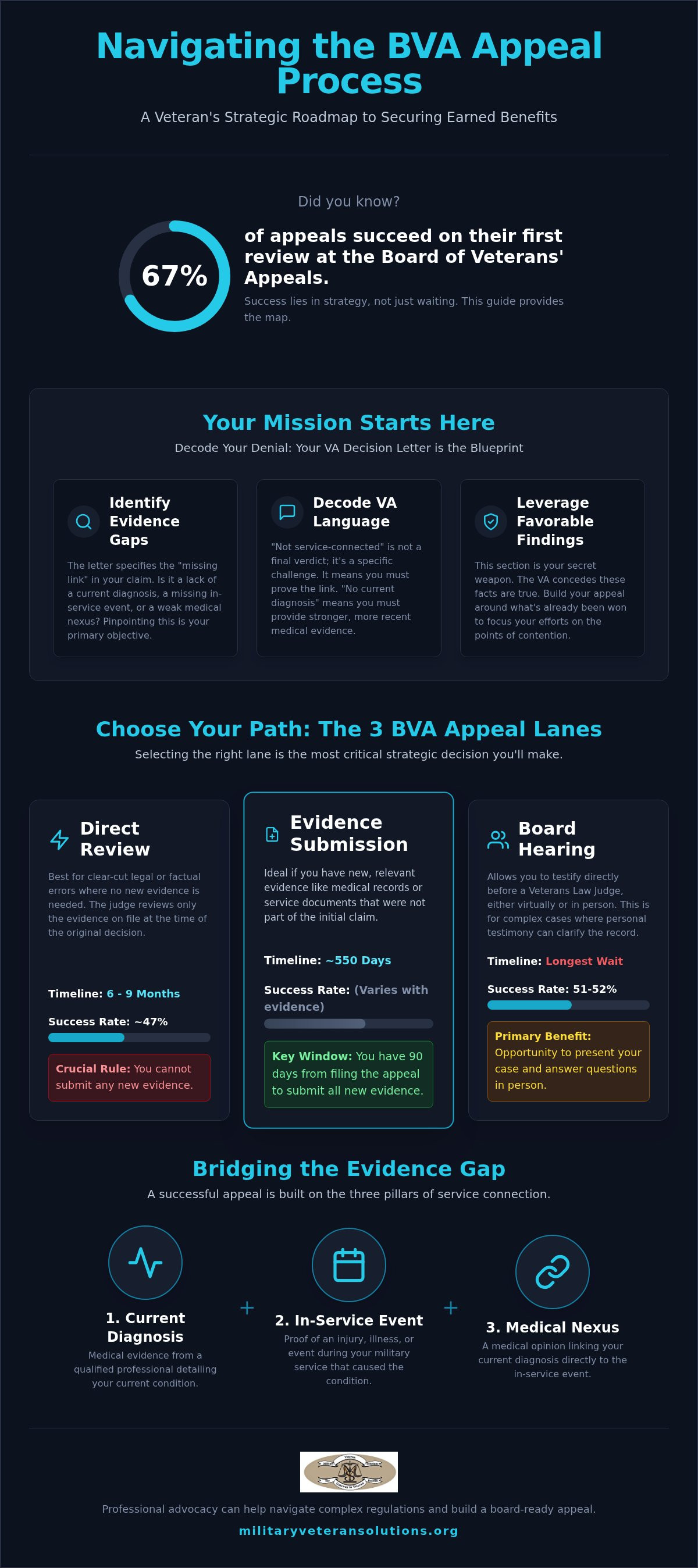
Did you know that nearly 67% of appeals succeed on their first review at the Board? It's a staggering figure that stands in stark contrast to the years of silence and frustration most veterans endure while navigating the BVA appeal process. You've likely spent months, or even years, staring at a VA decision letter that doesn't seem to reflect the reality of your service or your symptoms. It's exhausting to feel like you're shouting into a void, especially when you're forced to choose between complex "lanes" without a clear map.
The BVA appeal process isn't just a legal hurdle; it's a strategic mission to fill the evidence gaps identified in your denial. This guide provides that map, offering an evidence-based roadmap to help you navigate the system and finally secure the benefits you earned. We'll break down the 2026 timelines, explain how to identify the specific errors in your denial, and show you how to choose the right strategy to overturn a VA decision.
Key Takeaways
- Learn how to use your VA decision letter as a strategic blueprint by identifying the specific evidence gaps and favorable findings that will shape your appeal.
- Navigate the three distinct lanes of the BVA appeal process to choose the most effective path based on your current evidence and desired timeline.
- Bridge the critical "Evidence Gap" by understanding the three requirements for service connection and how to establish a strong medical nexus.
- Discover how to transform your medical records into a board-ready narrative that helps a Veterans Law Judge quickly locate and validate your claims.
- Understand the value of professional advocacy and detailed record reviews in overcoming the complex regulatory hurdles of the 2026 veteran benefits landscape.
The Starting Point: Why VA Decision Letter Analysis is Critical
Receiving a denial letter feels like a punch to the gut. It's easy to focus on the "denied" stamp and miss the tactical data hidden in the fine print. You must treat this letter as the specific blueprint for your BVA appeal process. Without a deep dive into the text, you're essentially flying blind into a complex administrative battle. The Board of Veterans' Appeals relies on the record established in these documents, so understanding the "why" behind their decision is your first priority.
Most veterans read the decision letter to find out if they lost, but you need to read it to find out how the VA justifies it. There's a massive difference between a denial based on a lack of a current diagnosis and one based on a missing "nexus" or link to service. A professional analysis often reveals subtle procedural errors or ignored evidence that the average person might overlook. Identifying this "missing link" is the only way to choose the correct appeal lane and avoid wasting years on a strategy that was doomed from the start.
Decoding VA Language: What They Are Really Saying
When the VA writes "not service-connected," they aren't just saying no. They might mean they didn't find an in-service event, or they don't believe your current condition relates to that event. If they claim "no current diagnosis" despite your stack of private medical records, they've likely ignored your evidence entirely. Decision Letter Analysis is a diagnostic tool that identifies these specific evidentiary or legal failures to determine the most effective path for your appeal. Spotting these discrepancies early allows you to challenge the VA's narrative with precision rather than broad, ineffective arguments. It turns a confusing rejection into a checklist of items to fix.
The 'Favorable Findings' Section: Your Secret Weapon
Tucked away near the end of many decision letters is a section titled "Favorable Findings." Don't ignore this. These are the legal facts the VA has already conceded as true. If the VA agrees you have a current diagnosis but denies service connection, you don't need to waste time proving you're ill. You only need to prove the link to your time in uniform.
Use these findings to lock in portions of your claim. By building your strategy around what the Board of Veterans' Appeals already accepts, you narrow the battlefield. This focus ensures your energy goes toward the specific "reasons for denial" rather than retreading ground you've already won. It's about working smarter to secure your benefits by using the VA's own admissions against their final conclusion.
Navigating the Three Lanes of the BVA Appeal Process
The Appeals Modernization Act (AMA) fundamentally changed how you interact with the Board of Veterans' Appeals (BVA). It replaced a one size fits all system with three distinct lanes. Each lane serves a specific tactical purpose. Choosing the wrong one doesn't just lead to a denial; it can cost you years of back pay and valuable time. You must evaluate your case based on the evidence currently in your file versus what you still need to obtain. This decision is the most critical step after receiving your initial denial.
Direct Review vs. Evidence Submission: Which Fits Your Case?
Direct Review is the fastest route within the BVA appeal process. It's designed for cases where the medical evidence is already complete, but the VA adjudicator simply ignored the law or missed a key detail. In 2026, the average wait time for this lane is between 6 and 9 months. While it's efficient, the grant rate sits at approximately 47%. You cannot submit new evidence here. The judge only looks at what was available when the initial decision was made. It's a high speed lane for clear cut legal errors.
If you've discovered new medical records or a missing service record, the Evidence Submission lane is your target. You have a strict 90-day window to submit new documentation after filing your appeal. The trade off for this flexibility is time. You can expect to wait roughly 550 days for a decision in this lane. It's a significant commitment. Many veterans find that a professional record review helps determine if their new evidence is strong enough to justify this longer wait.
The Board Hearing: Is It Worth the Wait?
The Hearing lane is often viewed as the most personal option because it allows you to speak directly to a Veterans Law Judge. Statistically, the grant rates are slightly higher, with video hearings seeing a 51% success rate and in-person hearings at 52%. However, this lane requires the most patience. By mid 2026, the average wait time for a hearing has stretched to approximately 730 days. You're trading speed for the opportunity to provide context to your written records.
Virtual hearings have become the preferred method for many, as they eliminate travel and allow you to testify from home. Success here depends on how well your testimony aligns with your medical records. If your spoken words contradict the clinical evidence in your file, it creates a credibility gap that is difficult to overcome. You aren't just telling your story. You're providing live evidence that must support the data already on record. Preparation is not optional; it's the difference between a remand and a win.
The Evidence Gap: Finding the Nexus in Your Records
Winning an appeal requires more than just showing you're in pain. It requires three specific pillars: a current medical diagnosis, a documented in-service event or injury, and the "nexus" that ties them together. Most denials in the BVA appeal process happen because that third pillar is weak or missing. You might have the diagnosis and the event, but if you can't prove one caused the other, the VA will likely stand by its denial. You must treat your records as a puzzle where the nexus is the missing piece that completes the picture.
Identifying this gap is where many veterans struggle. It's not enough to say, "my back hurts because I was in the infantry." You have to show the clinical or circumstantial path from that ruck march to your current chronic condition. This is why a deep dive into your records is so vital. It's about finding the evidence the VA overlooked or failed to weigh properly in their initial review.
Auditing Your Military Service Records
Don't assume your medical file tells the whole story. Many veterans suffer from "silent" injuries, those incidents where you stayed in the fight instead of going to sick call. Your personnel records, such as your MOS description, deployment history, or combat badges, often provide the circumstantial evidence needed to support physical stress claims. For example, a paratrooper's jump log or a mechanic's daily heavy lifting duties can validate a joint injury even if no specific "event" was recorded at the time. Performing an exhaustive record audit is essential for identifying the underlying service connections required to support claims for secondary conditions.
Lay statements can also bridge these gaps. Statements from family members or fellow service members can document the "continuity of symptomatology." This means they can testify that you've been limping or struggling with sleep since the day you came home, even if you didn't see a doctor for years. These personal accounts provide the human context that raw data often misses.
The Power of New and Relevant Evidence
Under the modern VA Decision Reviews and Appeals framework, the standard for "new and relevant" evidence is more veteran-friendly than the old system. It simply needs to be information the VA hasn't considered before that could prove or disprove a matter at issue. Private medical opinions are often your strongest asset during the BVA appeal process. A private specialist who reviews your entire C-file can offer a more thorough analysis than a rushed C&P examiner who only sees you for fifteen minutes.
To be effective, your doctor's letter must use the VA's specific legal terminology. The judge is looking for the phrase "at least as likely as not" that your condition was caused or aggravated by your service. This means there's at least a 50% probability of a connection. If your doctor's letter is vague or uses non-legal terms like "could be" or "possibly," it won't have the weight needed to overturn a denial. Precision in language is just as important as the medical expertise behind it.
Strategic Preparation: Building a Board-Ready Appeal
Success at the Board requires more than just checking boxes on a government form. You must transition from simply "filing a claim" to building a persuasive, evidence-based narrative. The BVA appeal process is your opportunity to present a complete picture to a Veterans Law Judge, but that judge is often managing a heavy caseload. If your evidence is scattered or your arguments are vague, your strongest points may be overlooked. You need to organize your file so the path to a grant is undeniable.
A critical component of this preparation is VA Form 21-4138, the Statement in Support of Claim. This is your voice. Use it to explain how your symptoms impact your daily life and why the previous VA decisions were factually or legally incorrect. Don't just list symptoms; describe the "functional loss" you experience. If you need help articulating these complex connections, consider a professional VA decision letter analysis to identify exactly where your previous narrative fell short.
Common Pitfalls in the BVA Appeal Process
Administrative errors can derail even the strongest cases. One of the most frequent mistakes is failing to address the specific "reasons for denial" identified in your initial rating decision. If the VA denied you for a lack of medical nexus, but your appeal only focuses on the severity of your pain, you haven't solved the underlying problem. You must also remain vigilant about timelines. You have exactly one year from the date of your decision letter to file a Notice of Disagreement (NOD). Missing this deadline often means losing your original effective date and years of potential back pay. Additionally, choosing the wrong appeal lane can trap your claim in a backlog for years without the ability to add the evidence you actually need.
The Role of Lay Evidence and Buddy Letters
Medical records are vital, but lay evidence provides the human context that clinical data often lacks. Statements from your spouse, family members, or fellow service members can be the deciding factor in proving service connection. Use VA Form 21-10210 for these "buddy letters" to ensure they are recognized as formal evidence. These statements should focus on observable facts, specifically what they saw happen during service or how they see you struggle now. Credibility is your most valuable asset here. If a statement feels exaggerated or contradicts your medical records, it can damage your entire case. Honest, specific accounts of your "continuity of symptomatology" are what build the bridge between your time in uniform and your life today.
Why Professional Advocacy is Your Best Strategy for Success
By 2026, the VA system has become increasingly digital, but it has also become more rigid. You aren't just fighting a denial; you're navigating a set of evolving regulations and evidentiary standards that change frequently. Relying on generic advice or volunteer help often isn't enough when your financial security and healthcare are on the line. Professional advocacy is no longer a luxury. It's a strategic necessity to ensure your evidence is seen and weighted correctly within the BVA appeal process. You've already spent years waiting; you shouldn't have to spend years guessing.
Military Veteran Solutions, LLC acts as the critical bridge between your service history and the complex VA bureaucracy. We don't just assist with paperwork. We conduct exhaustive military record reviews to uncover the clinical and circumstantial evidence the VA often misses. Our mission is to move you away from the cycle of frustration and toward a focused, winning strategy that addresses the specific legal gaps in your claim. We transform your experience into a board-ready case that commands attention.
The Veteran-Owned Advantage
Working with an advocate who has worn the uniform changes the entire dynamic of your appeal. Our firm was founded by a disabled veteran with 10 years of Army service. We speak the language of both the military and the VA fluently. With over 25 years of experience in the veteran benefits space, we understand the nuances that general practitioners or volunteers often overlook. We don't believe in a one size fits all approach. We start by performing our signature decision letter analysis. This deep dive allows us to build a custom roadmap tailored to your specific history, ensuring we target the exact reasons for your denial rather than wasting time on irrelevant arguments. This commitment to thoroughness is the hallmark of peer-to-peer advocacy.
Taking the Next Step Toward Your Benefits
Distance is never a barrier to receiving expert support. We specialize in virtual consultations, which allows us to provide dedicated advocacy to veterans across the country. When you begin a professional record review with us, you're getting a comprehensive evaluation of your entire C-file. We look for the "silent" injuries and the missing nexus links that are the key to overturning a denial. During your initial virtual consultation, we'll discuss the findings of your decision letter and outline the most effective lane for your BVA appeal process. It's time to stop navigating this daunting system alone and start working with an ally who understands the stakes. Schedule your virtual consultation for a BVA appeal analysis today.
Secure the Benefits You've Earned
The BVA appeal process doesn't have to be a source of endless confusion. By using your decision letter as a tactical blueprint, you can identify the exact evidence gaps the VA used to deny your claim. Whether you choose the speed of Direct Review or the personal context of a Board Hearing, your success depends on a board-ready narrative backed by a solid medical nexus. You've fought for this country; you shouldn't have to fight the bureaucracy alone.
Military Veteran Solutions, LLC was founded by a 10-year Army veteran who understands the weight of these decisions. With over 25 years of veteran advocacy experience, we provide the specialized record reviews and analysis needed to bridge the gap between your service and your benefits. We offer virtual consultations nationwide to ensure every veteran has access to expert guidance, regardless of where they live. Don't let another deadline pass or another error go uncorrected.
Get Your Professional VA Decision Letter Analysis Now and start building a focused strategy to win. You've earned these benefits through your service. It's time to secure them.
BVA Appeal Process: Frequently Asked Questions
How long does the BVA appeal process take in 2026?
Wait times for the BVA appeal process in 2026 range from six months to over two years depending on your chosen lane. A Direct Review typically takes 6 to 9 months, while the Evidence Submission lane averages about 550 days. If you request a hearing, the timeline extends to approximately 730 days. These figures reflect the current backlog and the Board's efforts to prioritize faster lanes.
Can I submit new evidence during a BVA Direct Review appeal?
No, you cannot submit any new evidence if you choose the Direct Review lane. The Veterans Law Judge will only consider the evidence that was already in your file at the time of the initial decision. If you've discovered new medical records or nexus letters, you must select the Evidence Submission or Hearing lane instead. This lane is strictly for legal reviews of the existing record.
What happens if the Board of Veterans' Appeals denies my claim again?
You have several legal options if the Board of Veterans' Appeals denies your claim again. You can file an appeal with the U.S. Court of Appeals for Veterans Claims (CAVC) within 120 days of the decision. Alternatively, you can file a Supplemental Claim with new and relevant evidence to keep your original effective date alive. Each path has specific legal requirements that you must follow exactly.
Is a BVA hearing better than a Direct Review?
The superior lane depends entirely on the strength of your existing evidence and your timeline. While hearings had a slightly higher grant rate of 51% to 52% in 2026, the wait is nearly two years longer than a Direct Review. If your medical records are already strong and clear, the speed of Direct Review is often the superior strategic choice. You must weigh speed against the chance to testify.
Can I change my appeal lane after I have already filed?
You generally cannot switch appeal lanes after your formal filing has been processed by the Board. If you realize you chose the wrong path, you would typically need to withdraw your current appeal and refile in a different lane. This is only possible if you're still within the original one year filing window from your decision letter. It's a high stakes decision that requires getting it right.
How much does it cost to have professional representation for a BVA appeal?
Professional representation fees are typically structured as a percentage of the retroactive benefits you receive if your appeal is successful. This contingency model ensures that your advocate's interests are aligned with yours. It's common for these agreements to be filed directly with the VA for oversight. Always ask for a clear explanation of any potential expenses before starting the process to ensure you feel secure in your choice.
What is a 'remand' and what happens if my case is sent back to the Regional Office?
A remand is a legal order that sends your case back to the Regional Office for more evidence development before a final decision. In 2024, nearly 39% of appeals resulted in at least one remanded issue. Your case returns to the local level for further work, such as a new medical exam. Once that work is finished, it goes back to the Board for a final ruling.
Do I need a lawyer for the BVA appeal process, or is an advocate enough?
You don't need a lawyer to succeed, as an accredited advocate can provide the same level of specialized representation for your claim. Professional advocates focus deeply on military record reviews and nexus connections. The most important factor is finding a representative who understands the technicalities of the BVA appeal process and has a proven track record. You need someone who speaks the language of the VA fluently.


