
What if a fibromyalgia diagnosis is only the starting point, not the evidence that decides your VA claim? If you’re unsure how to connect your symptoms, service history, and medical records, you’re not alone. A VA claim for fibromyalgia needs more than a label in your chart: the VA evaluates the applicable service-connection pathway and how the condition affects you.
A stronger claim brings those pieces together. This guide explains what the VA considers, what medical, service, and lay evidence may help show, and how fibromyalgia’s rating criteria work. It also clarifies potential Gulf War presumptive and secondary-claim pathways, so you can consider which may fit your circumstances without treating them as interchangeable.
You’ll learn how to document symptom frequency, flare-ups, treatment, and effects on daily life, as well as what to review if a VA decision doesn’t reflect the condition described in your records. The goal is a practical one: help you prepare relevant evidence and understand your next step, whether you’re building an initial claim or reviewing a decision.
Key Takeaways
- A diagnosis matters, but your VA claim for fibromyalgia also needs a clear connection between the condition and qualifying service.
- Learn how the VA’s rating levels reflect symptom patterns, treatment response, and widespread pain.
- Use medical records, service documents, and accurate personal or buddy statements to build a more complete picture of your condition.
- Before filing, identify the appropriate claim route, organize your evidence, and verify the current application requirements.
- If the decision seems wrong, review what the VA accepted or disputed and determine whether the issue is service connection or the rating.
VA Claim for Fibromyalgia: What Eligibility and Service Connection Mean
A VA disability claim is a request for compensation for a current disability connected to qualifying military service. For a VA claim for fibromyalgia, a diagnosis helps establish that you have the condition, but it doesn’t automatically show that your service caused it or that another qualifying service-connection route applies. Those are separate questions the VA evaluates.
Keep the evidence focused on both parts: what your condition is and how it relates to service. Medical records can document diagnosis, symptoms, and treatment; your service records and other supporting evidence may help explain the connection. For a general medical introduction, see this comprehensive overview of fibromyalgia.
For additional context on VA fibromyalgia ratings, watch this video:
Does a fibromyalgia diagnosis automatically qualify for VA disability compensation?
No. A diagnosis supports the existence of a current condition, but entitlement also depends on the applicable service-connection basis and the evidence supporting it. Records are more informative when they show how symptoms developed over time, what care you received, and how pain, fatigue, sleep problems, or other symptoms affect daily activities and work.
There isn’t one laboratory result or single examination that decides every claim. The VA considers the evidence as a whole, so consistent medical documentation and a clear symptom history can help provide context.
When might direct, presumptive, or secondary service connection apply?
Direct service connection may apply when evidence supports a link between fibromyalgia and an event, illness, or injury during service. The relevant records and medical evidence depend on the facts of your claim; a diagnosis alone doesn’t establish that link.
Gulf War presumptive service connection may be available to veterans whose service and condition meet the applicable rules. Gulf War service by itself doesn’t guarantee an award. Check the VA’s current criteria, including qualifying locations and any other requirements, rather than assuming that a deployment automatically qualifies.
Secondary service connection is a separate route for claiming a condition as caused or aggravated by an already service-connected disability. It requires evidence supporting the claimed relationship. Consider which pathway fits your circumstances, and make sure the evidence addresses that pathway specifically.
How the VA Rates Fibromyalgia Symptoms and Functional Impact
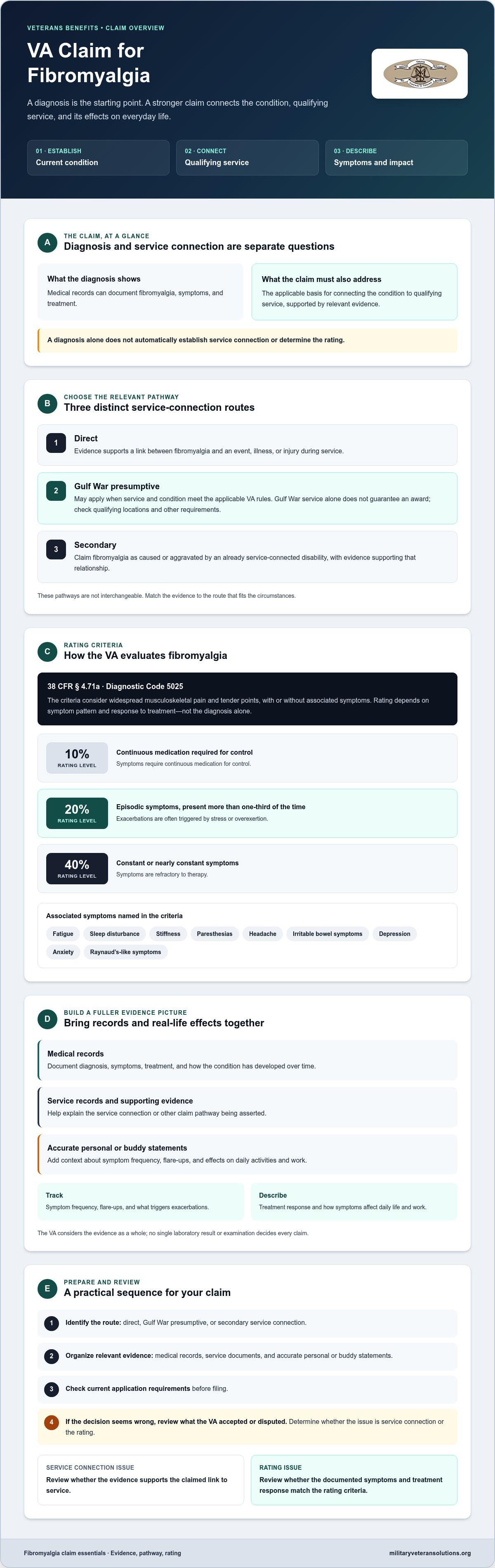
Once service connection is established, the VA evaluates fibromyalgia under 38 CFR § 4.71a, Diagnostic Code 5025. The criteria address widespread musculoskeletal pain and tender points, with or without associated symptoms such as fatigue, sleep disturbance, stiffness, paresthesias, headache, irritable bowel symptoms, depression, anxiety, or Raynaud’s-like symptoms. The rating depends on the pattern of symptoms and their response to treatment, not just the diagnosis.
| Rating | Criteria in plain language |
|---|---|
| 10% | Symptoms require continuous medication for control. |
| 20% | Symptoms are episodic, with exacerbations often triggered by stress or overexertion, but are present more than one-third of the time. |
| 40% | Symptoms are constant or nearly constant and refractory to therapy. |
These summaries reflect the schedule’s criteria; the regulation’s wording describes widespread pain and tender points along with the listed symptom patterns. A rating is not automatic based on one symptom, a medication, or a diagnosis. The VA evaluates the evidence against the criteria. And the rating question is separate from service connection: the VA must first determine whether the condition is connected to service before assigning an evaluation.
If your claimed eligibility involves Gulf War service, the VA describes fibromyalgia as a presumptive condition for Gulf War Veterans. Presumptive service connection concerns the service-connection route; it doesn’t itself determine the percentage assigned.
What symptoms and treatment details can matter to the rating?
Describe widespread pain and associated symptoms that apply to you, and keep a record of how often they occur, whether they’re episodic or persistent, and what treatment you’ve tried. Medical notes about ongoing medication, treatment response, and flare-ups can help clarify the pattern over time. Don’t assume any single symptom or treatment automatically meets a particular rating level.
How should veterans describe day-to-day functional impact?
Be specific and consistent. For example, explain whether pain or fatigue disrupts sleep, limits routine tasks, causes missed work, or makes your ability to complete activities unpredictable. Use personal statements to add accurate context to medical records, not to overstate symptoms.
Rating evidence should show how severe your symptoms are over time, not just how you felt on one particular day.
If you’re unsure how the VA connected your records to its evaluation, a review of your VA decision and supporting records may help you identify what the decision addressed and what it may have missed.
What Evidence Can Support a VA Fibromyalgia Claim?
A well-organized VA claim for fibromyalgia should help the reviewer understand both your current condition and the service-connection route you’re relying on. Evidence needs to fit your circumstances, so there’s no single checklist that applies identically to every veteran. Start with the records you have, then identify what they show and where additional context may help.
Use this checklist to organize the evidence:
- Medical documentation: Diagnosis, treatment notes, medication history, and records describing symptoms and their course.
- Service records: Relevant service treatment and personnel records that may support the claimed connection or route.
- Symptom history: A timeline of symptom frequency, duration, flare-ups, treatment response, and effects on everyday activities.
- Lay statements: Your account, plus statements from people who directly observe how symptoms affect you.
Compare your medical documentation with the Official VA Rating Criteria for Fibromyalgia to understand the symptoms and patterns addressed by the rating schedule. The goal isn’t to fit your experience to a list. It’s to make sure the records accurately describe what you experience.
Which medical and service records should you gather first?
Collect records already available to you, including diagnosis and treatment notes, prescribed medications, and documentation of symptoms over time. Then review service treatment and personnel records for entries that may be relevant to your claimed pathway. An in-service record can be useful, but missing treatment documentation does not automatically decide a claim; other evidence may help explain the history and connection.
Service files can be extensive or difficult to interpret. A professional military record review may help identify relevant entries and put them in context with your claim evidence.
How can symptom logs and lay statements add useful context?
A brief, consistent log can record when symptoms occur, how long they last, and what they disrupt. For instance, note whether a flare affected sleep, completing household tasks, or keeping to a work routine. Use ordinary, specific descriptions rather than broad labels, and keep the timeline consistent with what you report to medical providers.
Personal and buddy statements can describe firsthand observations, such as missed activities or changes in routine. They add context; they don’t replace medical evidence or establish a medical diagnosis. Ask people with direct knowledge to explain what they saw and when, without guessing at medical causes.
Organize evidence around two questions: What records show the current condition? And what supports the service-connection route being claimed? That structure makes gaps easier to spot before filing.
How to Prepare and File a VA Claim for Fibromyalgia
A clear filing process helps you present your evidence and service-connection theory without leaving important details scattered across forms and records. Before you submit a VA claim for fibromyalgia, work through these steps and verify the VA’s current instructions for 2026.
- Identify the service-connection route. Decide whether the evidence supports a direct, qualifying Gulf War presumptive, or secondary claim. Make sure your explanation and supporting records address the route you’re claiming.
- Organize your evidence. Group medical records, relevant service documents, and symptom history so it’s clear what each record helps show. Note records the VA may need to obtain and follow current instructions for identifying them.
- Complete the current application. Use the VA’s latest form and submission guidance. Forms and procedures can change, so check the official VA source before filing rather than relying on an old saved copy or an outdated checklist.
- Review before submission. Confirm that the claimed condition, dates, records, and service-connection explanation are consistent. Check that attachments are legible and included, and keep a copy of what you submit.
What should you review before submitting the application?
Read the application alongside your evidence. If your statement describes symptoms beginning at one time but a record suggests another, clarify the timeline where you can. Make a list of relevant evidence you’re referencing but don’t have, so you can identify it accurately under the VA’s current evidence-submission procedures. For broader preparation context, review this VA claim assistance resource guide.
How should you prepare for a VA examination?
The VA may request an examination as part of evaluating the claim. Describe your symptoms truthfully, including how often they occur, how long they last, what treatment you’ve received, and how they affect your functioning. Explain variability rather than focusing only on a good or bad day. Bring or identify relevant information, but don’t assume the examiner already has every record you consider important.
Before the appointment, review your symptom timeline and medical documentation so you can answer clearly. You don’t need to exaggerate or minimize. Accuracy and consistency matter.
If you want support reviewing your records or understanding the claim process, explore veteran claims representation and virtual consultations with Military Veteran Solutions, LLC. Representation can help you assess and present your claim, but it can’t guarantee a rating or outcome.
What to Do if Fibromyalgia Claim Is Denied or Underrated
A denial or lower-than-expected rating isn’t the end of the review process, but the next step should respond to the VA’s written reasons. Start with the decision letter and identify what the VA accepted, what it disputed, and what it says the evidence didn’t establish. Keep the letter and the evidence considered together as you assess your options.
How can you identify what the VA says is missing?
Compare the decision rationale with the records you submitted and the criteria relevant to your claim. Pinpoint the issue: did the VA question the diagnosis, the connection to service, the severity of symptoms, or whether more evidence was needed? A service-connection dispute calls for a different response than a disagreement with the evaluation assigned after service connection was granted. Focus on the specific finding rather than resubmitting the same material without addressing the stated gap.
Review choices may include a Supplemental Claim, Higher-Level Review, or Board Appeal. In general, a Supplemental Claim is used to submit new and relevant evidence, while Higher-Level Review asks for another review of the existing record. Board Appeal options differ in how evidence and hearings are handled. Check current eligibility, evidence rules, and instructions before choosing. The VA decision letter gives a one-year period from its date to appeal in many cases, so verify the deadline that applies to your decision promptly.
For a broader explanation of the review paths, see this strategic guide to filing VA appeals.
When might professional claim or decision review help?
If the reasoning is difficult to follow, a professional review can help you compare the VA’s findings with your medical documentation, military records, and submitted evidence. The purpose is to understand what the decision addressed and which review path may fit the issue, not to promise a particular result. Military Veteran Solutions, LLC provides nationwide veteran claims representation, VA decision-letter analysis, military record reviews, and virtual consultations.
Before deciding, gather the decision letter and the records tied to the disputed finding. If you want help assessing possible next steps for your VA claim for fibromyalgia, request a virtual consultation. Review support can clarify the process, but no representative can guarantee an approval or rating.
Take the Next Step With a Clearer Claim Plan
A stronger VA claim for fibromyalgia connects a documented condition to a service-connection pathway the VA can evaluate. Medical records, service evidence, and accurate descriptions of symptoms and their daily impact can help present that connection clearly. If the VA’s decision doesn’t match the evidence, review its reasoning and identify whether the issue is service connection, the rating, or missing documentation.
You don’t have to assess every record or decision alone. Military Veteran Solutions, LLC was founded by a disabled veteran who served ten years in the U.S. Army. The firm offers virtual consultations nationwide and reviews military records, medical documentation, and VA decisions to help veterans understand possible next steps. This support can clarify the process, but it can’t guarantee a particular rating or outcome.
If you’d like help reviewing your evidence or decision, request a virtual consultation with Military Veteran Solutions, LLC. A focused review can help you move forward with greater clarity and confidence.
Frequently Asked Questions
Is fibromyalgia a presumptive condition for Gulf War veterans?
It may qualify under VA presumptive rules for veterans with qualifying Gulf War service, but serving in a broadly described region doesn’t automatically establish eligibility. The VA considers applicable requirements, which may include qualifying location, timing, chronicity, and severity. Check the current regulation and your individual service history before relying on this route. If presumptive criteria don’t fit, another service-connection theory may apply depending on your evidence.
What VA disability rating can fibromyalgia receive?
The rating schedule provides 10%, 20%, and 40% evaluation levels under 38 CFR § 4.71a, Diagnostic Code 5025. The criteria consider symptom patterns and treatment response: continuous medication may correspond to the 10% criteria; episodic symptoms present more than one-third of the time to 20%; and constant or nearly constant symptoms resistant to treatment to 40%. A diagnosis or online symptom checklist doesn’t guarantee a rating.
Does a fibromyalgia diagnosis prove service connection?
No. A diagnosis can help show that you have a current condition, but it doesn’t by itself establish how the condition relates to military service. The evidence depends on the service-connection pathway, such as direct, qualifying presumptive, or secondary. Medical records, service records, and other relevant evidence may each help address different parts of the claim. Review the complete record rather than assuming one document settles every requirement.
What evidence should I include with a VA claim for fibromyalgia?
Gather available diagnosis and treatment records, relevant service records, and a clear symptom history describing how the condition affects you over time. Your personal statement can explain your experience and functional limitations, while people with firsthand knowledge may describe what they’ve observed. Evidence needs vary by claim route. Organize records consistently, identify relevant evidence the VA may need to obtain, and verify current submission instructions before filing your VA claim for fibromyalgia.
Can I file a VA claim for fibromyalgia without an in-service diagnosis?
An in-service diagnosis isn’t the only evidence that may support a claim, and its absence doesn’t automatically decide the outcome. The applicable service-connection pathway and full record matter. Review relevant service and post-service records, document your current condition, and consider how the evidence addresses the claimed connection. Don’t assume that one missing record defeats your claim or that other records alone guarantee approval.
What happens if the VA denies my fibromyalgia claim?
Read the decision letter closely and identify the specific reason for denial, such as a disputed diagnosis, service connection, or insufficient evidence. Compare that explanation with the records the VA considered. Then check which decision-review options fit your circumstances and verify current deadlines, eligibility, and evidence rules. The right next step depends on the written findings, so avoid choosing a review path before you understand what the VA says is missing.
Can fibromyalgia be connected to another service-connected condition?
Possibly. Secondary service connection may apply when evidence supports a relationship between fibromyalgia and an already service-connected condition. That relationship isn’t automatic, and the evidence must address the specific connection claimed under current VA requirements. Keep this route distinct from direct or Gulf War presumptive service connection. Review relevant medical documentation and the applicable rules to determine whether the secondary theory is supported by your circumstances.


