
A 100% VA disability rating isn’t automatically permanent. According to the U.S. Department of Veterans Affairs, total disability means a 100% rating; permanent status depends on whether the impairment is reasonably certain to continue throughout your life. Understanding how to make a VA disability rating permanent means showing both that the total-rating criteria are met and that the conditions supporting the rating are considered static.
It’s understandable to want clarity about whether your benefits can continue without routine reexaminations and what evidence may support that determination. The key is more than the rating percentage alone: your medical record must help establish that your service-connected conditions are lasting.
This article explains how VA ratings work, what medical evidence may support permanent and total status, how the 20-year protection rule differs from permanence, and which benefits may apply. You’ll also learn what to look for in a VA decision letter so you can better understand the status of your award.
Key Takeaways
- A 100% rating means total disability, but permanent and total status also depends on whether the conditions are considered lasting.
- Medical records and a treating doctor’s written opinion can help show whether a condition is expected to continue throughout your life.
- Twenty-year protection limits how far VA can reduce a continuous service-connected rating, but it is distinct from permanent and total status.
- Permanent ratings may affect reexaminations and other benefits; TDIU has different work-related limits.
- A professional review of your VA decision letter can help identify whether the award indicates permanence and what claim or appeal options may be relevant.
What’s a disability rating?
A VA disability rating measures the severity of a service-connected condition and helps determine disability compensation. For VA disability purposes, a total disability has a 100% rating, according to the U.S. Department of Veterans Affairs.
100% Ratings and P&T Status
A 100% rating describes the level of disability, while permanent and total (P&T) status also reflects whether the conditions are considered lasting. That difference matters because a 100% rating alone doesn’t establish permanence or rule out future review. Understanding how to make a VA disability rating permanent starts with separating the percentage from VA’s assessment of the condition’s expected duration.
VA ratings are assigned in 10% increments from 0% to 100%. A combined rating isn’t always the sum of individual ratings: two 10% ratings combine to 19%, which rounds to 20%. A veteran rated below 100% may also receive compensation at the 100% rate through total disability based on individual unemployability, or TDIU. That payment route doesn’t, by itself, establish P&T status.
Meaning of Permanent and Total Status
P&T means VA considers a veteran totally disabled and the impairment reasonably certain to continue throughout the veteran’s life. Total describes the disability level; permanent describes its expected duration. The distinction can affect reexaminations and benefits, because permanence is a separate determination from the percentage used to calculate compensation.
VA may consider disabilities static when they aren’t expected to improve. Permanent and total (P&T) status generally reflects both a total disability evaluation and conditions considered permanent. A doctor’s assessment and medical evidence can help explain whether a condition is likely to continue rather than improve during your lifetime. Your rating decision shows how VA characterized the award. For veterans asking how to make a VA disability rating permanent, evidence of lasting impairment is central.
Some disabilities may be considered permanently and totally disabling regardless of the assigned percentage. Examples include loss or loss of use of both hands, both feet, or sight in both eyes. These cases differ from a standard rating calculation, where VA evaluates each service-connected condition and combines the resulting percentages. The applicable criteria depend on the condition and evidence in your record.
VA disability compensation is distinct from a VA pension; the terms don’t describe the same benefit. For disability compensation, the rating concerns service-connected disabilities. A total rating may also arise through TDIU when service-connected conditions prevent qualifying work and the rating criteria are met. P&T is a further determination about permanence, not simply another name for a 100% rating.
If VA proposes reducing a disability rating, it must give the veteran 60 days to submit evidence and 30 days to request a hearing, according to the U.S. Department of Veterans Affairs. Those response periods apply to a proposed reduction; they don’t mean every 100% rating is permanent. Understanding how to make a VA disability rating permanent also means recognizing that a reduction proposal and a permanence decision address different issues.
The rating percentage, permanence finding, and benefit-payment basis answer different questions. A 100% evaluation addresses total disability; P&T adds VA’s finding that the impairment is expected to last throughout life. TDIU may pay at the 100% rate without automatically establishing permanence, so the award’s wording and medical rationale matter.
Medical evidence used to support a permanent and total rating
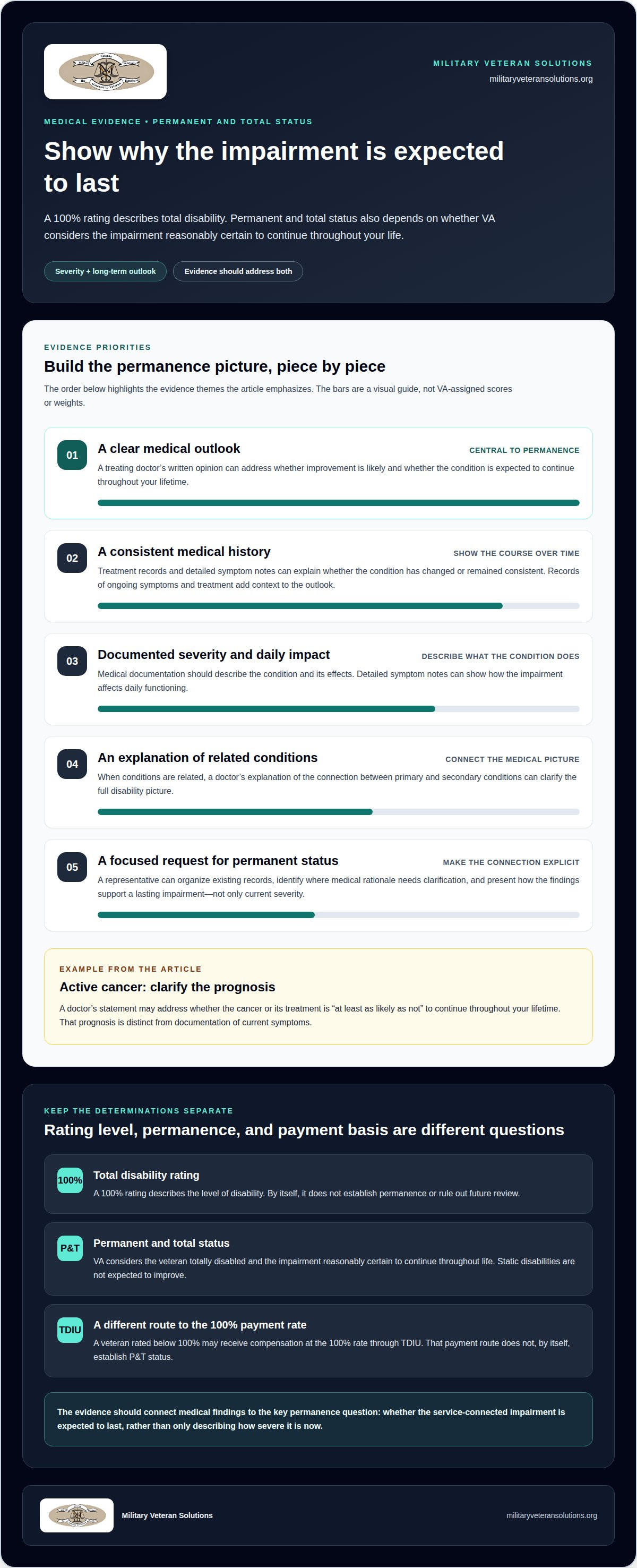
Medical evidence can help show both the severity of a service-connected disability and whether it is expected to last. A focused record connects the diagnosis and its effects with the condition’s outlook over time.
Evidence Used to Decide a Rating
VA considers medical documentation about your condition and its impact when deciding a disability rating. Treatment records and detailed symptom notes can show how the impairment affects daily functioning. The evidence should make the condition’s history clear, including whether it has changed or remained consistent.
For a permanence request, evidence about the expected course matters alongside evidence of current severity. A treating doctor’s opinion can address whether improvement is likely during your lifetime. Records showing ongoing symptoms and treatment provide context. When conditions are related, a doctor’s explanation of the connection between primary and secondary conditions can clarify the full disability picture.
Requesting Permanent Status with Medical Evidence Through a Representative
A representative can organize a disability claim around evidence of severity and long-term outlook, then submit a request asking VA to consider permanent status. This matters because evidence supporting a rating may not explain why the condition is unlikely to improve. A clear presentation connects medical findings to the permanence question. For veterans considering how to make a VA disability rating permanent, that connection is essential.
A representative can review existing records, identify where medical rationale needs clarification, and incorporate a treating doctor’s written opinion. For active cancer, a doctor’s statement may address whether the cancer or its treatment is at least as likely as not to continue throughout your lifetime. The claim should distinguish that prognosis from evidence describing current symptoms. This is one way medical evidence can support a request about how to make a VA disability rating permanent.
Useful evidence has a clear purpose. A doctor’s opinion is stronger when it explains the basis for its conclusion, rather than stating only that a condition is permanent. The medical record can show the diagnosis, treatment history, symptoms, and outlook; the written opinion can explain how those details support lasting impairment. Together, they help VA consider whether the condition should be treated as static.
Building this record may take several years and extensive medical documentation. Consistency is important: treatment notes, symptom records, and medical opinions should tell a coherent story about your condition over time. A representative can identify gaps, arrange the evidence in a clear sequence, and submit it with your disability claim. If you’re seeking how to make a VA disability rating permanent, the evidence must support that conclusion.
For related conditions, the evidence should explain how each fits the overall picture. A doctor’s opinion linking primary and secondary conditions can help VA understand their relationship, while separate records document their effects. Professional claims representation can help present that evidence clearly and direct the request toward the permanence issue.
Twenty-year continuous-rating protection
VA rating protections apply at different points and protect different parts of your record. The twenty-year rule protects a continuous service-connected rating level, while other protections address service connection or examinations. None of these time-based rules, by itself, establishes permanent and total status.
After a continuous service-connected rating has remained at or above its original level for 20 years, VA cannot reduce it below that level unless the rating was based on fraud, according to the U.S. Department of Veterans Affairs. For example, if a rating has stayed at its original level or higher throughout that period, this protection sets a floor. It does not prevent every possible change above that floor.
The time requirement concerns continuity and the level being protected. A later increase doesn’t erase the significance of the earlier continuous rating, but the protected floor depends on your rating history. If you’re assessing a proposed reduction, compare the rating’s effective dates and evaluations rather than assuming that your current percentage alone determines the result. Claims records and prior VA decisions help establish that timeline.
Five-year protection addresses stability, not the same rating floor. The U.S. Department of Veterans Affairs says VA exempts a veteran from future examinations when the condition has persisted without material improvement for five years or more. A rating is also described as stabilized when it remains the same or increases for five consecutive years. Stabilization can affect how VA evaluates a proposed reduction, but it doesn’t make the condition permanently rated.
For a stabilized rating, VA needs comprehensive medical records and more than one C&P exam to support clear, sustained improvement. The evidence must show more than a short-term change in symptoms. Your treatment history and examinations can help place the claimed improvement in context. This protection focuses on the basis for reducing an evaluation, not on whether service connection itself remains in place.
The ten-year rule protects service connection. VA cannot sever service connection for a condition rated for 10 years or more unless there is evidence of fraud, according to the U.S. Department of Veterans Affairs. This differs from the twenty-year rule: the ten-year protection concerns whether the condition remains connected to service, while the twenty-year protection limits a reduction below the original rating level.
A rating in place for 10 years or more may still be reduced, but not eliminated, if medical evidence shows improvement. A total disability rating of 100% may be reduced only if there is material improvement in the veteran’s condition. These rules make the reason for a proposed change important: a reduction in evaluation is different from severing service connection.
Keep the protections distinct when reviewing an evaluation or responding to VA. Five years concerns stability and examination practices; 10 years protects service connection; 20 years protects a continuous rating level against reduction below its original amount, except for fraud. They can strengthen a veteran’s position, but they don’t substitute for evidence supporting permanent status.
Benefits associated with permanent ratings
A permanent rating can affect future examinations, work, and survivor benefits. The practical effect depends on the award: a schedular 100% permanent and total rating differs from total disability based on individual unemployability (TDIU). The rating and payment basis help determine which rules apply. A permanent finding matters, but it doesn’t make every benefit identical for every veteran.
One important effect is that routine reevaluations aren’t required to continue receiving benefits. A veteran with a permanent VA disability rating does not need reevaluations for that purpose. This can reduce uncertainty around periodic reviews of a condition. It doesn’t mean VA can never review a rating, and accurate medical records remain important if symptoms or circumstances change.
A 100% permanent and total rating also allows a veteran to work without income restrictions. TDIU is the exception: the award is based on individual unemployability, and income limits continue to apply even when the veteran is considered permanent and total. So, before assessing the effect of employment, identify whether the VA award is schedular or TDIU. The payment basis, not the word “permanent” alone, is central.
The amount of monthly compensation is tied to the disability rating and applicable factors, rather than permanence alone. VA combines individual evaluations to calculate a combined disability rating, and that rating informs the compensation level. For example, a veteran receiving TDIU is paid at the 100% rate, even if the combined rating is below 100%. P&T status should not be assumed to change the underlying combined calculation.
Survivor benefits may also be relevant. A surviving spouse married to a veteran with a 100% permanent and total disability rating can apply for VA Dependency and Indemnity Compensation (DIC) after the veteran’s death. This is an application possibility, not an automatic payment. The spouse’s eligibility is determined under the applicable DIC requirements, so P&T status is a significant part of the circumstances, not the only detail considered.
When reviewing your award, separate the questions: Is the condition permanent? Is the evaluation total? Is payment based on TDIU? The answers clarify whether work restrictions apply and which benefits may be relevant. They also explain why symptoms, medical evidence, and the rating decision matter: each can affect how VA characterizes your condition and award.
Permanent status can provide continuity, but it doesn’t guarantee every related benefit or a particular compensation amount. A veteran with a schedular 100% P&T award may work without income restrictions, while a veteran paid through TDIU remains subject to income limits. For a surviving spouse, the 100% P&T award may support an application for DIC. The exact benefit turns on the award type and the eligibility rules that apply.
Professional review for permanence indicators in a VA decision letter
A VA decision letter explains the evaluation and the evidence behind it, but permanence may not appear as a simple label. A professional review compares the award language with your medical record and other VA documents. This helps distinguish a total evaluation from a finding that service-connected disabilities are considered permanent and total.
One useful indicator is the VA Benefit Summary and Service Verification Letter. It can state whether you are considered totally and permanently disabled due solely to service-connected disabilities. A professional can compare that statement with the decision letter’s rating, effective date, and explanation. If the documents appear inconsistent, examine the difference carefully before drawing conclusions about your award.
The decision’s examination language also matters. VA generally exempts veterans over 55 years old from future examinations, although exceptions may apply. That age-based exemption alone does not establish P&T status. A reviewer considers it alongside the award’s permanence language, the condition’s status, and any examination or review provisions described in the decision.
A condition rated at the minimum compensable evaluation of at least 10% generally cannot be designated non-static unless a statute or rating-schedule rule requires reevaluation. This can help a professional identify whether the decision’s treatment of a condition as static appears consistent with the applicable criteria. The condition’s percentage alone does not prove that the entire award is permanent and total.
A temporary rating is another important distinction. For example, a veteran may receive a 100% PTSD rating during hospitalization after a suicide attempt, followed by a lower rating after symptoms improve enough for discharge. A professional reviewing that decision would distinguish the temporary evaluation from a permanent award and examine the stated basis for the later rating.
A review also checks whether the letter addresses future examinations or describes a condition as static. Veterans with P&T status generally don’t have regularly scheduled reexaminations, though a non-static condition relevant to Special Monthly Compensation may still be reexamined. A reviewer can compare those details with the full award instead of treating one phrase as conclusive.
A focused VA decision letter analysis can connect the letter’s language to the supporting records and identify whether a missed permanence determination may warrant further action. Military record reviews can also help clarify service documentation relevant to the claim. Request a VA decision letter analysis to have the award language and permanence indicators reviewed.
Military Veteran Solutions
Military Veteran Solutions helps veterans assess VA decisions and pursue benefits supported by their records and medical evidence. If your award doesn’t clearly address permanence, or a decision overlooks relevant evidence, a review can clarify the issue and identify possible next steps.
Through Veteran Claims Representation, VA Decision Letter Analysis, and Military Record Reviews, the firm examines your decision and service documentation. When an appeal is appropriate, it also helps with filing VA appeals. This support can be useful when the rating, permanence finding, or reasoning in your decision doesn’t align with the evidence in your file.
If you’d like support reviewing your VA decision, contact Military Veteran Solutions to discuss your claim.
Move Forward With a Clear Plan
The next step is to turn uncertainty about your award into a focused review of what VA decided and why. Understanding how to make a VA disability rating permanent means identifying the specific unresolved issue, whether it’s the decision’s reasoning, the evidence supporting it, or the route for challenging the outcome. A clear assessment can help you move forward with purpose instead of relying on assumptions about what your rating means.
Military Veteran Solutions can help determine whether a closer review or further action fits your circumstances. Bring your questions and relevant VA decision documents to a virtual consultation, so the discussion can stay focused on your award and the evidence behind it.
Discuss your VA disability claim with Military Veteran Solutions and take a considered next step toward the benefits you earned.
Frequently Asked Questions
Can I be P&T if I am rated under 100%?
Yes, a veteran rated below 100% may qualify for permanent and total status through TDIU. The distinction is between the combined disability rating and the payment basis: TDIU may pay at the 100% rate when service-connected conditions prevent qualifying work. A representative can assess whether the rating record and evidence support that route, and whether the disabilities underlying TDIU are considered permanent.
How can a representative check if I am P&T?
A representative can review your VA decision letter alongside your VA Benefit Summary and Service Verification Letter. The latter may state whether you are considered totally and permanently disabled due solely to service-connected disabilities. The representative can compare that statement with the award’s evaluation, examination language, and any future review provisions. If the documents don’t align, the review can identify which question needs clarification.
How can a representative determine which of my conditions are static?
A representative can examine the rating decision and supporting medical records for language indicating whether each condition is static or may improve. They can compare that language with your treatment history and any scheduled examination information. For example, a condition with ongoing treatment and a medical opinion about its long-term outlook may need to be considered separately from another condition in the same overall award.
What can a representative do if I am being told I have a reevaluation?
A representative can distinguish a scheduled examination from a proposed rating reduction, then review the notice and underlying decision. If VA proposes a reduction, it must allow 60 days to submit evidence and 30 days to request a hearing, according to the U.S. Department of Veterans Affairs. The representative can help organize relevant records and address the stated reason for the proposed change.
Is my P&T status protected?
P&T status is not an absolute bar to review. VA may review a rating in cases involving fraud or clear error, and a non-static condition relevant to Special Monthly Compensation may still be reexamined. Separate time-based protections may apply to the rating level or service connection. A representative can assess which protection fits your history and whether a notice concerns an actual reduction or another review.
What does permanent and total (P&T) VA disability status mean?
P&T indicates that VA considers you totally disabled and your impairment reasonably certain to continue throughout your life. “Total” concerns the disability level; “permanent” concerns its expected duration. The award may be based on a schedular evaluation or TDIU. Knowing which basis applies helps explain related work rules and which details in the decision letter matter to your circumstances.
What criteria does the VA use to grant permanent and total disability?
VA considers whether the veteran’s disability is total and whether the impairment is reasonably certain to continue throughout life. Static conditions may support a permanence finding. A veteran may qualify through static disabilities combining to a 100% schedular rating, a single static 100% evaluation, or static conditions forming the basis for TDIU. Some specific disabilities may also qualify for P&T regardless of percentage.
How can a veteran work with a representative to request permanent and total status from the VA?
You can work with a representative to review your award, medical records, and relevant service documentation, then identify evidence supporting permanence. A treating doctor’s written opinion can address whether your condition is likely to improve during your lifetime. The representative can organize and submit the evidence with the request, explain how it relates to the decision, and identify appeal options if VA has already issued an unfavorable determination.


