
A TDIU award can provide compensation at the 100% rate without changing your underlying disability rating to 100%. The total disability individual unemployability (TDIU) requirements generally include a service-connected disability rated at 60% or more, or, with multiple disabilities, one rated at 40% or more and a combined rating of 70% or more, according to the U.S. Department of Veterans Affairs.
The rating threshold is only part of the decision. The VA also considers whether service-connected disabilities prevent you from maintaining substantially gainful employment. Your work and medical history can matter, and working, including in a protected or marginal job, does not automatically rule out eligibility.
An award also isn’t necessarily permanent. If the VA proposes to reduce TDIU, it gives you 60 days after the initial notice to submit evidence that your condition hasn’t improved, according to the U.S. Department of Veterans Affairs. This guide explains how eligibility works, what evidence may support a claim, how employment affects benefits, and what to understand about permanence and proposed reductions.
Key Takeaways
- Understand how the VA distinguishes substantially gainful employment from marginal or protected work, and why your work circumstances matter.
- Learn which employment, education, and medical records can help show how service-connected conditions affect your ability to maintain a steady job.
- See how extraschedular consideration may apply when standard rating thresholds aren’t met.
- Recognize why a TDIU award may be reviewed and what evidence can matter if the VA proposes a reduction.
- Find out how Military Veteran Solutions’ claims representation, record reviews, decision letter analysis, and VA appeals can help address a benefits issue.
If I’m eligible for Individual Unemployability, will my disability rating change?
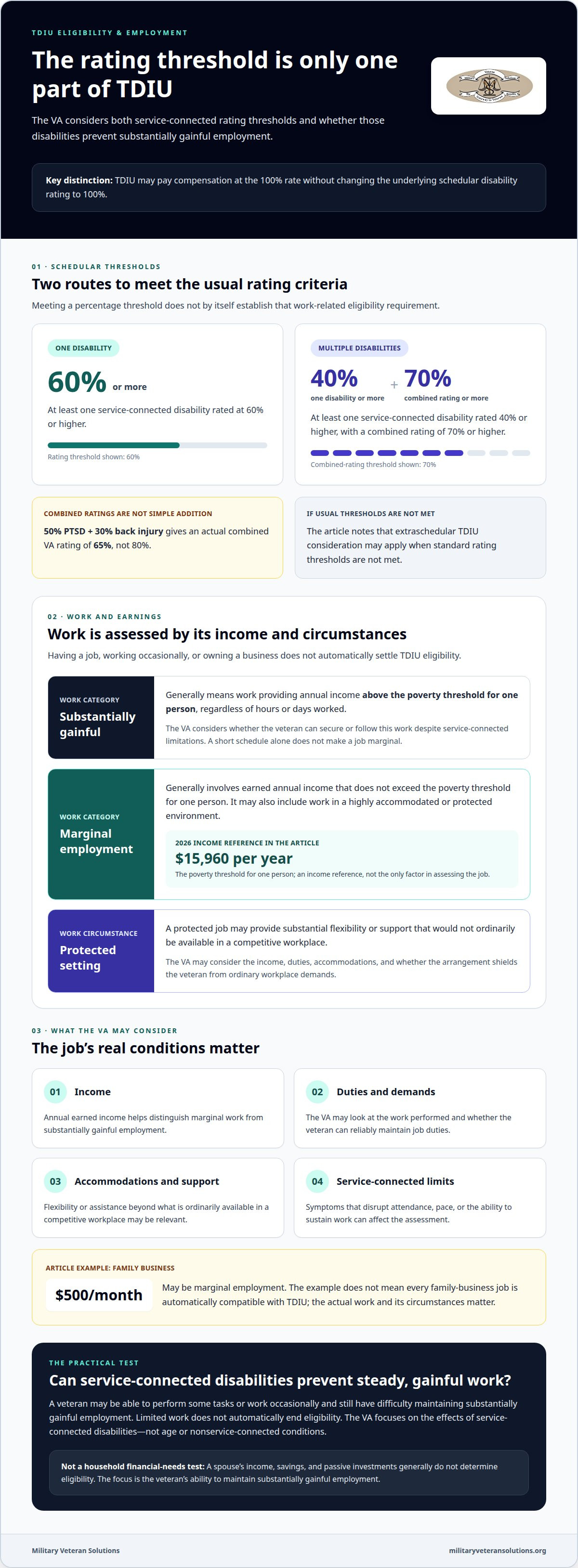
A TDIU award can pay compensation at the 100% disability rate without changing your underlying disability rating to 100%. According to the U.S. Department of Veterans Affairs, a veteran generally needs at least one service-connected disability rated 60% or more disabling to meet the schedular threshold. Meeting that percentage is only one part of eligibility. The VA also considers whether service-connected disabilities prevent you from securing or following substantially gainful employment.
For multiple service-connected disabilities, the schedular threshold generally requires at least one disability rated 40% or more and a combined rating of 70% or more, according to the U.S. Department of Veterans Affairs. The combined rating is not always the result of simply adding individual percentages. For example, a veteran with a 50% PTSD rating and a 30% back injury has an actual combined VA disability rating of 65%, not 80%.
That difference matters. A veteran with those example ratings would be below the usual 70% combined-rating threshold, even though the individual percentages add to 80%. The VA considers the combined disability evaluation when applying schedular TDIU thresholds. The veteran must also show that service-connected conditions affect the ability to maintain substantially gainful work. A qualifying rating alone does not establish that work-related requirement.
These percentages are eligibility thresholds, not a promise of approval. The rating reflects how the VA evaluates service-connected conditions, while TDIU addresses their impact on employment. A veteran could meet the 60% single-disability threshold or the 40% plus 70% combined-rating threshold, yet still need evidence showing how those disabilities interfere with steady work. The VA may consider work history and education alongside disability-related limitations.
Income can also matter when the VA assesses whether employment is marginal or substantially gainful. Marginal employment generally includes annual earned income that doesn’t exceed the poverty threshold for one person. For 2026, that threshold is $15,960 per year. The figure is an income reference, not a substitute for examining the nature of the job, the accommodations provided, and how the work relates to service-connected limitations.
TDIU is not a household financial-needs test. A spouse’s income, savings, and passive investments generally do not determine eligibility. The focus is whether service-connected disabilities prevent the veteran from maintaining substantially gainful employment. Investment income is not the same as wages, and household resources do not replace the VA’s assessment of work capacity.
If TDIU is granted, the compensation rate may match the rate paid to a veteran rated 100% disabled, while the underlying schedular disability rating remains unchanged. That distinction can affect how you understand a decision letter: the TDIU payment level and the disability rating are related, but they aren’t identical. Review both the stated rating and the explanation of the assigned benefit rate.
Can Veterans Work While Receiving TDIU?
Some veterans can work while receiving TDIU, but the type of work and earnings matter. The central question is whether service-connected disabilities prevent them from maintaining substantially gainful employment.
Substantially Gainful Employment
Substantially gainful employment generally means work that provides annual income above the poverty threshold for one person, regardless of hours or days worked. The VA considers whether a veteran can secure or follow that work despite service-connected limitations. A short schedule alone does not make a job marginal. Both income and the circumstances of the employment inform the assessment.
Marginal Work and Protected Environments
Marginal employment generally involves earned annual income that doesn’t exceed the poverty threshold for one person; it may also include work in a highly accommodated or protected environment. Under 38 CFR § 4.16, income is one factor in determining whether work is marginal. A protected job may involve substantial flexibility or support that wouldn’t ordinarily be available in a competitive workplace. Those circumstances can matter even when the veteran performs regular duties.
For example, earning $500 per month at a family business may be marginal employment, rather than substantially gainful work. That example doesn’t make every family-business job automatically compatible with TDIU. The VA may consider the income, duties, accommodations, and whether the arrangement protects the veteran from ordinary workplace demands. Owning a business also doesn’t automatically prevent eligibility. The actual work and its effect on the claim remain important.
Service-Connected Limits on Employment
TDIU may apply when service-connected disabilities prevent a veteran from maintaining substantially gainful employment, even if the veteran can perform some tasks or work occasionally. The question is not whether every possible job is impossible, but whether the veteran can reliably secure or follow gainful employment given the effects of service-connected conditions. Limited work therefore does not automatically end eligibility.
Consider a veteran who can complete occasional tasks but cannot sustain attendance or keep pace because of service-connected symptoms. The VA may weigh how those limits affect the ability to perform and maintain job duties. It considers the effects of service-connected disabilities, not age or nonservice-connected conditions, when assessing work capacity. Details such as missed work, reduced responsibilities, and accommodations can clarify the practical impact.
If you’re working, describe the job’s duties, earnings, schedule, and accommodations accurately in your claim. Explain how service-connected conditions affect your ability to keep that work, rather than relying on a job title alone. A closer review of work history and TDIU evidence can help clarify how those details relate to your claim.
How Can Veterans Use Evidence To Prove TDIU Claims?
A strong application connects medical records, work history, and daily limitations. Each should help explain how a service-connected disability affects the ability to maintain steady employment.
Medical Evidence and Functional Limitations
Medical evidence describes symptoms and explains how they limit specific work activities. A diagnosis alone may not explain why a veteran cannot maintain employment. Records are more useful when they document effects such as difficulty concentrating, standing, lifting, attending regularly, or interacting with others. Relevant limitations depend on the service-connected condition and the demands of the veteran’s work.
Treatment notes, hospitalization records, and descriptions of ongoing care can help establish how limitations affect work over time. The TDIU application also asks about hospitalizations or doctor’s care during the past 12 months. Consistency matters: a record describing recurring symptoms may support an account of missed work or reduced duties. Evidence should connect the limitation to a service-connected disability rather than relying on a general statement that work is difficult.
Evidence Gathering and Application Forms
VA Form 21-8940 is the application for increased compensation based on unemployability. Veterans also submit VA Form 21-4192, which requests employment information in connection with a disability benefits claim. The application asks about employment history for the last five years the veteran worked, not necessarily the five years immediately before applying.
Work and education history help the VA assess how a veteran’s background relates to available employment. Relevant records may include job duties, dates of employment, earnings, attendance problems, and workplace accommodations. If the VA asks a veteran to verify employment status, the veteran must complete the Employee Questionnaire, VA Form 21-4140. Buddy statements supporting a claim can be submitted on VA Form 21-10210. Each form and record should give a consistent account of the veteran’s work capacity.
Vocational Expert Evidence
Vocational expert evidence can explain how documented limitations interact with a veteran’s work history, education, and job skills. It may translate medical findings into practical workplace effects, such as difficulty sustaining concentration or maintaining reliable attendance. This perspective can clarify why the veteran’s background may not readily transfer to other work.
A vocational opinion is most useful when it addresses the veteran’s actual history and documented limitations, rather than offering an unexplained general conclusion. For example, an analysis might consider how recurring symptoms affect duties the veteran previously performed. An attorney may help organize this evidence for an application or appeal, but the central question remains whether service-connected disabilities prevent substantially gainful employment. The evidence should clearly support that connection.
Extraschedular TDIU consideration
Veterans below the usual schedular rating thresholds may still qualify for TDIU when service-connected disabilities prevent substantially gainful employment. Under 38 C.F.R. § 4.16(b), the VA may refer such a claim to the Director of Compensation Service for extraschedular consideration. This route recognizes that a veteran’s combined rating may not reach the standard threshold, even when the work-related impact of service-connected conditions is severe.
Extraschedular TDIU is not automatic approval based on a low rating or unemployment. The central question remains whether service-connected disabilities make the veteran unable to secure or follow substantially gainful employment. The VA considers disability-related barriers to work, not unemployment alone. A veteran out of work for unrelated reasons must still connect the claimed inability to service-connected conditions.
The referral process allows the VA to assess claims that fall outside ordinary schedular thresholds. If the evidence shows an unusual or exceptional disability picture, the VA may consider whether regular schedular standards are impractical. Marked interference with employment or frequent hospitalization may be relevant. These circumstances can help explain why a combined rating may not fully reflect the practical limits on a veteran’s ability to work.
For example, a veteran with a combined rating below the usual threshold might have repeated hospitalizations related to a service-connected condition. Another may face marked employment interference because symptoms disrupt attendance or essential job duties. Neither example establishes eligibility by itself. The evidence must show how service-connected disabilities affect the ability to maintain substantially gainful work, rather than simply describing a difficult employment history.
Evidence for an extraschedular claim should clearly show the impact on work. Medical records can document symptoms and treatment, while employment records may show missed time, reduced duties, or accommodations. A vocational assessment can explain how those limitations affect the veteran’s work background. The connection should be clear: service-connected conditions, functional effects, and barriers to substantially gainful employment should make sense together.
Marginal work also requires context. Earnings and job conditions can help distinguish marginal from substantially gainful employment, while protected or highly accommodated work may be relevant. A veteran need not be unable to perform every task or type of work. The issue is whether service-connected disabilities prevent securing or following substantially gainful employment given the individual’s work history and limitations.
Extraschedular consideration addresses a specific gap between a schedular rating and real-world work capacity. A combined rating below the threshold does not end the inquiry, but the record must support referral and show how service-connected disabilities affect employment. Organizing the facts around work limitations, treatment, and employment history helps clarify the claim’s central issue.
TDIU permanence and benefit reductions
A TDIU award isn’t automatically permanent simply because it provides compensation at the 100% disability rate. The VA may propose a reduction, and the notice gives you a chance to respond with evidence about your condition and work capacity. Treat that notice as time-sensitive: your response can address whether the circumstances supporting the award have changed.
How does the VA calculate TDIU effective dates and retroactive benefits? The VA states an effective date in its decision. Retroactive benefits cover compensation due for the awarded period before ongoing payments begin. The amount depends on the effective date, the compensation rate applied, and the period covered by the award.
If the VA proposes to reduce TDIU, you have 60 days after the initial notice to submit evidence that your condition hasn’t improved, according to the U.S. Department of Veterans Affairs. Read the notice closely and respond within that period. Address the reason for the proposed change directly, rather than sending records without explaining how they relate to your ability to work.
Useful evidence can include recent medical records, treatment history, and statements describing ongoing functional limits. Employment records may also clarify whether a job has changed, accommodations remain necessary, or marginal work is being mistaken for substantially gainful employment. For example, a new job title alone may not show that a service-connected condition improved. The actual duties and support provided add important context.
Focus on changes relevant to the award. If symptoms, treatment, or work circumstances remain substantially the same, organize records showing continuity over time. If a condition has changed, explain how that affects daily functioning and employment. A clear response connects each piece of evidence to the VA’s stated reason for proposing a reduction, helping distinguish a genuine change from a change in paperwork or job description.
Effective dates also matter when a decision grants or changes compensation. Compare the date in the decision with the period covered by retroactive benefits, then review the stated rate and calculation. If the dates or payment period appear inconsistent with the decision, identify the specific discrepancy in a review or appeal. These details can affect compensation even when eligibility is not disputed.
A proposed reduction or disputed effective date can raise separate issues within the same claims history. Get help reviewing a TDIU decision or reduction proposal and organizing the evidence tied to its reasoning.
Military Veteran Solutions
Military Veteran Solutions, LLC helps veterans assess TDIU claims and understand next steps when evidence, records, or a VA decision raises questions. Its Veteran Claims Representation can support a review of how the claim addresses service-connected limitations and work history. Military Record Reviews and VA Decision Letter Analysis can help identify relevant service details or explain a decision’s reasoning. If the VA denied a claim or issued a decision that overlooks important evidence, filing a VA appeal may be a way to seek review.
Consider support when preparing a claim, responding to a difficult decision, or weighing an appeal. Contact Military Veteran Solutions, LLC to discuss your VA benefits concerns through a free initial consultation.
Choose Your Next Step With Confidence
Understanding how the total disability individual unemployability (TDIU) requirements apply to your record is a starting point. Your next step depends on where you are in the VA process: preparing an initial claim, responding to a decision, or challenging a proposed change. Keeping these situations distinct helps focus attention on the issue that needs action now.
Before moving forward, identify the decision or notice you are addressing and the outcome you seek. A careful review can connect your service history and claim record to the VA’s reasoning, then clarify whether representation or an appeal fits your situation. The goal is a deliberate response grounded in your circumstances, not a rushed step based on assumptions.
Military Veteran Solutions offers Veteran Claims Representation, Military Record Reviews, and Filing VA Appeals to support veterans addressing VA benefits concerns. Contact Military Veteran Solutions to discuss your next step. You deserve a clear path forward and support as you pursue the benefits you’ve earned.
Frequently Asked Questions
What Is TDIU?
TDIU is a VA benefit for veterans whose service-connected disabilities prevent them from maintaining substantially gainful employment. It can pay compensation at the 100% rate while the underlying schedular rating stays lower. In practical terms, the VA evaluates both the veteran’s service-connected conditions and their impact on work. The total disability individual unemployability (TDIU) requirements concern this employment impact as well as applicable rating thresholds.
What if I don’t meet the disability ratings requirements?
Falling below the usual schedular thresholds doesn’t necessarily end the inquiry. Under 38 C.F.R. § 4.16(b), the VA may refer a claim for extraschedular consideration when service-connected disabilities prevent substantially gainful employment. For example, records showing recurring absences tied to a service-connected condition may help explain the employment impact. The evidence should address why those conditions prevent maintaining work, rather than relying on unemployment alone.
Am I eligible for this benefit from VA?
Eligibility depends on your service-connected conditions and how they affect your ability to maintain substantially gainful employment. The VA also reviews work and education history when considering a claim. Age is not considered, and a Social Security disability insurance decision does not determine the VA’s outcome because the programs use different rules. For example, a veteran’s job history may help explain how specific limitations affect the work they have performed.
Can You Qualify Below the Usual Rating Thresholds?
Yes, a veteran below the usual schedular rating thresholds may still qualify through extraschedular consideration. The VA may refer the claim to the Director of Compensation Service under 38 C.F.R. § 4.16(b). Evidence of marked interference with employment or frequent hospitalization may help explain why the case warrants consideration outside the usual thresholds. The central issue remains the effect of service-connected disabilities on the veteran’s ability to work.
Can the VA Consider TDIU Even If You Didn’t File a Separate TDIU Claim?
The VA may consider unemployability when evidence in a pending disability claim raises the issue, but a separate application can make the request clear. VA Form 21-8940 is the application for increased compensation based on unemployability. It asks for employment information relevant to the claim. For example, a veteran can use the application to identify work history and explain how service-connected conditions affect the ability to maintain employment.
What is VA Total Disability based on Individual Unemployability (TDIU)?
VA Total Disability based on Individual Unemployability is compensation for a veteran whose service-connected disabilities prevent substantially gainful work. It differs from a 100% schedular rating because TDIU can pay at the 100% rate without changing the underlying disability evaluation. When reviewing a decision, distinguish the schedular rating from the compensation level. They describe separate parts of the VA’s determination.
What are the VA schedular rating requirements for TDIU under 38 CFR 4.16(a)?
According to the U.S. Department of Veterans Affairs, the usual threshold is one service-connected disability rated 60% or more, or multiple disabilities with at least one rated 40% or more and a combined rating of 70% or more. These total disability individual unemployability (TDIU) requirements address schedular ratings. The veteran must also show that service-connected disabilities prevent substantially gainful employment.
Can veterans qualify for TDIU with ratings below the schedular thresholds?
Yes. Under 38 C.F.R. § 4.16(b), the VA may refer a below-threshold claim for extraschedular consideration if service-connected disabilities prevent substantially gainful employment. A veteran’s work records can help show how limitations affect actual duties, attendance, or reliability. The case should explain the connection between the service-connected conditions and inability to maintain work, not simply point to a low combined rating.