
A TDIU award doesn’t automatically require you to give up all work. The answer to “Can I work while on TDIU?” is yes, but VA considers your earnings and the conditions of your work, not just whether a job is part-time or temporary. Work may be marginal if earned income does not exceed the federal poverty threshold for one person. Work in a protected environment may qualify as marginal even when earnings are higher.
It’s understandable to worry that trying to work could put your benefits at risk. The key questions are whether the job shows an ability to earn a living in a regular work setting and whether the circumstances make the employment marginal or protected.
This article explains how poverty thresholds relate to work earnings, what permanent TDIU means if you return to work, and why records of income, accommodations, and work limitations matter. Use this framework to understand the rules and the evidence VA may consider.
Key Takeaways
- You may be able to work while receiving TDIU, but VA considers whether your employment is substantially gainful or marginal.
- The federal poverty threshold is an important reference point for earned income, while protected employment may be assessed differently.
- Part-time or temporary work isn’t automatically marginal; the nature and circumstances of the job matter.
- Permanent TDIU does not mean work-related changes are irrelevant. Understand the rules that apply before making employment decisions.
- Keep clear records of earnings, accommodations, and work limitations so the circumstances of your employment are documented.
What Income Level Qualifies as Marginal Employment With TDIU?
Work while receiving TDIU may be possible when it is marginal rather than substantially gainful. Work in a protected or sheltered environment may also qualify as marginal, even when earnings exceed the poverty threshold.
Substantially Gainful and Marginal Employment
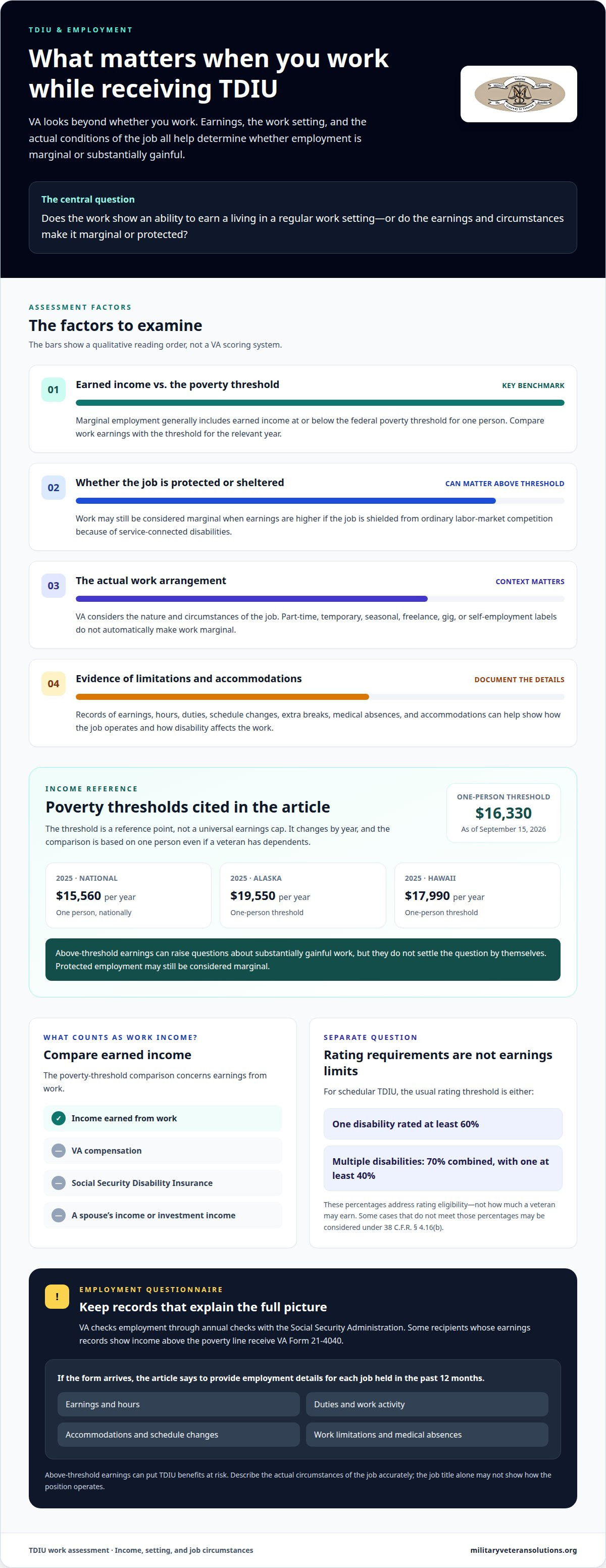
Substantially gainful employment generally means work that produces income above marginal levels and reflects an ability to earn a living. Marginal employment generally means earned income at or below the federal poverty threshold for one person, or work in a protected environment. This distinction matters because TDIU addresses whether service-connected disabilities prevent substantially gainful employment, not whether a veteran does any work at all.
Section 4.16 of Title 38, Chapter I, Part 4 of the Code of Federal Regulations covers TDIU ratings and these employment concepts. Section 4.18 provides additional employability thresholds. Calling a position temporary, seasonal, or part-time does not by itself make the work marginal. VA considers income and the circumstances of the employment.
Part-Time and Self-Directed Work
Part-time, gig, freelance, and self-employment are types of work, not automatic exceptions to TDIU rules. A part-time job may be marginal if annual earned income stays within the applicable threshold. But working few hours alone does not establish that classification. Earnings and actual work conditions matter too.
Self-employment may be possible while receiving TDIU when the work does not exceed the applicable income limit. For example, a freelance worker’s schedule may be flexible, but the label “freelance” does not determine whether employment is substantially gainful. Track income from the work and keep records that show the nature and extent of the activity.
Marginal Employment and the Poverty Threshold
The poverty threshold is a reference point for deciding whether earned income is marginal. As of September 15, 2026, the U.S. Census Bureau poverty threshold for one person was $16,330 per year. Compare annual earned income with the threshold that applies to the relevant year. The threshold is based on one person, even when a veteran has dependents.
The threshold comparison concerns earned income from work. VA compensation, Social Security Disability Insurance, a spouse’s income, and investment income are not earned work income. Earnings above the threshold do not by themselves settle whether a job is substantially gainful, because protected employment may be considered marginal even at higher earnings.
Protected and Sheltered Work Environments
Protected employment is work shielded in some way from ordinary labor-market competition because of a veteran’s service-connected disabilities. Veterans may work in such settings while receiving TDIU, even when income exceeds the poverty threshold. The circumstances matter: an employer may make adjustments that allow work to continue despite disability-related limitations.
Examples include extra breaks or absences for medical reasons. These conditions can show how a role differs from a standard work environment. Keep records of accommodations, schedule changes, and duties, because a job title alone may not show how the position operates.
VA monitors TDIU recipients’ employment through annual checks with the Social Security Administration. Some recipients whose earnings records show income above the poverty line receive VA Form 21-4040, an employment questionnaire. If it arrives, provide employment details for each job held in the past 12 months. Accurate records of earnings, hours, duties, and accommodations can help explain whether work is marginal or protected. Above-threshold earnings can put TDIU benefits at risk, so respond carefully and describe the actual circumstances of the job.
Federal poverty thresholds and earnings limits
The poverty threshold is an important income benchmark for TDIU, but it is not a universal earnings cap. VA also considers disability ratings, the source of income, and whether the work takes place in a protected environment.
Disability rating thresholds
For schedular TDIU, the usual rating threshold is one service-connected disability rated at least 60%, or multiple connected disabilities with a combined rating of at least 70% and one disability rated at least 40%. These percentages determine whether a veteran meets the rating requirements, not how much the veteran may earn while receiving benefits.
A veteran who doesn’t meet those rating percentages may still receive consideration under 38 C.F.R. § 4.16(b). Qualifying cases are referred to the Director of Compensation Service for consideration. The disability evidence must address how service-connected conditions affect the ability to maintain substantially gainful employment. A rating alone does not describe the full work impact.
How the income threshold applies
For marginal employment, VA generally looks to the Census Bureau poverty threshold for one person. The applicable threshold changes by year, so compare work earnings with the figure for the period being assessed. The threshold doesn’t increase because a veteran has dependents. Alaska and Hawaii have different thresholds from the contiguous states; for 2025, the figures were $19,550 per year in Alaska and $17,990 per year in Hawaii, compared with $15,560 per year for one person nationally.
These amounts are reference points, not a complete ruling on employability. Income above the poverty threshold can raise questions about substantially gainful work, but employment in a protected environment may still be marginal. Conversely, earning below the threshold does not make the work circumstances irrelevant. VA considers the arrangement alongside earnings.
Which income counts
The poverty comparison focuses on earned income from work. VA compensation, Social Security Disability Insurance, a spouse’s income, and investment income are not work earnings for this purpose. Keep income sources distinct in your records. For example, separate wages from VA compensation deposits when documenting annual earnings.
For an initial TDIU application, VA Form 21-8940 is the application for increased compensation based on unemployability. The broader review considers disability, work history, and education. SSDI approval doesn’t automatically establish TDIU eligibility, and education or training doesn’t automatically end an existing award.
If a decision misapplies the rating or income evidence, an appeal may address that issue. A focused VA benefits appeal can present how service-connected disabilities and employment circumstances fit the applicable criteria.
Can I Work With Permanent TDIU?
Yes, a veteran may return to work while receiving TDIU, but substantially gainful employment can affect continued eligibility. If you’re asking, “Can I work while on TDIU?” review your award decision and consider how the job’s duties, hours, earnings, and accommodations relate to your service-connected condition.
Working While Receiving TDIU
TDIU provides compensation at the 100% rate when service-connected disabilities prevent substantially gainful employment. A permanent award is not automatically immune from review, and some awards remain subject to review. The word “permanent” should not be treated as permission to ignore changes in employment or VA correspondence.
Returning to substantially gainful work generally cannot be the sole basis for reducing TDIU unless the employment is maintained for 12 consecutive months, according to the U.S. Department of Veterans Affairs. That rule does not mean every work arrangement is irrelevant. The job’s demands and the veteran’s ability to sustain them remain important context.
Full-Time Work While Receiving TDIU
Full-time work may raise a more direct question about whether a veteran can maintain substantially gainful employment. The schedule alone does not tell the whole story: duties, attendance, accommodations, and the effects of the veteran’s condition also matter. A full-time job with extensive disability-related adjustments may differ from an ordinary role with standard expectations.
VA may consider actual employability when reviewing a TDIU award. Under 38 C.F.R. § 3.343(c), clear and convincing evidence of actual employability is required before reducing an award on the basis described in that regulation. This is not a guarantee that full-time work has no effect; it means the employment must be evaluated under the applicable standard.
Planning a Return to Work
If you’re asking, “Can I work while on TDIU?”, first review the TDIU decision and identify any review terms or reporting instructions. Then compare the proposed job’s hours, essential duties, expected earnings, and accommodations with your current limitations. This can clarify what the work may show about your ability to maintain employment.
Keep records as the job unfolds. Useful evidence can include schedules, pay information, attendance records, modified duties, and written accommodation arrangements. If symptoms make a schedule difficult to sustain, records of missed days or adjusted responsibilities can show the difference between starting work and maintaining it.
Respond carefully to VA requests and describe the actual employment rather than relying on labels such as “temporary” or “part-time.” If VA issues a decision proposing or making a change, review its reasons and the evidence it cites. If the decision overlooks important work limitations, a timely appeal may be appropriate.
Documenting work limitations and earnings
Clear records help explain how a service-connected disability affects employment and whether work is marginal. VA reviews work and education history, along with evidence showing whether disability prevents steady employment. A disability rating alone may not describe what happens during a workday, so connect documented limitations to specific duties, attendance, and accommodations.
Keep earnings and work-condition records together. Pay statements show what the job paid, while schedules and attendance records show the hours actually worked. For example, records of reduced shifts or medical absences may explain why a position’s listed schedule differs from your regular work pattern. These details put income in context alongside the poverty threshold.
VA Form 21-4192 is a request for employment information in connection with a disability benefits claim. An employer may use the form to describe accommodations and explain why the role could not exist in a standard work environment. That account can help distinguish ordinary employment from a position adjusted around limitations connected to the veteran’s disability.
For an initial Individual Unemployability application, VA Form 21-8940 asks about work and related history. VA also reviews education history when assessing the claim. Keep answers consistent with employment records; for example, explain how a training background relates to the duties performed, rather than leaving the work history without context.
If VA sends VA Form 21-4040, provide employment details for each job held in the past 12 months. Include the employer, the work performed, and the employment period requested by the form. Compare those details against earnings records before submitting, so dates and amounts describe the same work accurately. A response should explain work conditions, not only report a total.
VA Form 21-4138, a Statement in Support of Claim, can provide information about recent work history. Use it to describe concrete effects of a connected disability, such as difficulty maintaining attendance or completing assigned duties. Tie each explanation to an example and identify any relevant accommodation. Specific descriptions help clarify how the work actually operated.
Before submitting evidence, group records by job and period. Separate income documents from records about duties, attendance, and accommodations. If earnings exceed the threshold but the job was protected, employer information and accommodation records can explain the difference. If the evidence shows difficulty sustaining steady work, describe the limitation plainly and consistently with the forms and work history already provided to VA.
Current TDIU annual income limit for gainful employment
There isn’t a single TDIU earnings cap that automatically determines every case. The federal poverty threshold is a key reference for marginal employment, while VA also considers whether work is substantially gainful and whether it occurs in a protected environment. According to the U.S. Census Bureau, the poverty threshold for one person was about $16,330 per year as of September 15, 2026.
The figure is an annual benchmark, not a promise that earnings below it guarantee TDIU or that earnings above it automatically end benefits. Substantially gainful and marginal employment are evaluated using both earnings and work circumstances. A position adapted around disability-related limitations may be considered differently from work in a standard competitive setting.
How to understand the current threshold
Compare annual earned income from employment with the threshold that applies to the period under review. Keep the year attached to the figure: the $16,330 amount reflects the threshold reported as of September 15, 2026. A prior year’s threshold may differ, so don’t treat a past figure as the current benchmark for another period.
The threshold concerns work earnings, not every household deposit. VA compensation, Social Security Disability Insurance, a spouse’s income, and investment income do not count as work income for this comparison. For example, keep wage records separate from VA compensation records when organizing financial documents. This makes employment earnings easier to identify.
Why income alone doesn’t settle the question
Earnings above the poverty threshold can prompt scrutiny, but the amount alone does not explain the job’s conditions. VA may consider duties, hours, accommodations, and whether the position is protected. Someone earning above the threshold in an adjusted role may have different evidence from someone performing ordinary duties without special conditions.
Part-time, temporary, seasonal, and freelance labels do not create an automatic exemption. The substance of the work and annual earnings matter. Self-employment also involves work income, so records should clearly show the work performed and income earned. Do not rely on a job title or schedule alone to characterize employment.
When earnings trigger questions
VA checks employment through annual data matches with the Social Security Administration. Some TDIU recipients whose earnings records show income above the poverty line receive VA Form 21-4040, an employment questionnaire. If you receive it, provide the requested job details for each position held in the past 12 months and keep your answers consistent with earnings records.
Above-threshold earnings can raise questions about continued eligibility, so preserve pay statements and records of accommodations. If a VA decision interprets your earnings or work circumstances incorrectly, get help reviewing your TDIU income evidence.
Military Veteran Solutions
Military Veteran Solutions, LLC helps veterans assess TDIU decisions and employment-related evidence through Veteran Claims Representation. If a decision does not clearly address work limitations, accommodations, or earnings, a review can help identify what the record says and whether an appeal may be appropriate.
Support includes VA Decision Letter Analysis, Military Record Reviews, and Filing VA Appeals. These services can help when VA questions continued eligibility, interprets work evidence differently, or issues an unfavorable decision. A careful review connects the decision’s reasoning with the records and evidence relevant to your claim.
If you need help understanding a TDIU decision or your next step, contact Military Veteran Solutions, LLC.
Make Your Next TDIU Decision With Care
If you’re weighing whether you can work while on TDIU, consider your longer-term circumstances. Ask whether the role fits your current abilities and whether its expectations are sustainable. A job title alone cannot capture how employment affects your daily functioning or benefits record.
When a VA decision leaves important questions about your claim, Military Veteran Solutions, LLC provides Veteran Claims Representation, Military Record Reviews, and Filing VA Appeals. These services can help you address a decision or pursue an appeal using relevant records and claim evidence. Whether a position affects your award depends on the employment and evidence VA evaluates.
Take the next step with a clear account of your situation and the questions you need answered. Contact Military Veteran Solutions, LLC to discuss your TDIU concerns and available support. You deserve to make employment decisions with a careful understanding of the stakes.
Frequently Asked Questions
Am I Still Eligible for TDIU If I’m Currently Working?
Possibly. Working does not automatically rule out TDIU. VA considers whether the job is substantially gainful or marginal, including whether the work is protected. For example, adjusted duties may make a job different from a standard position. Keep records showing how your service-connected conditions affect attendance, duties, and sustained performance. These details put your employment circumstances in context alongside your earnings.
Am I eligible for this benefit from VA?
You must have a service-connected disability that prevents you from maintaining substantially gainful employment. The usual rating requirements are one disability rated at least 60%, or multiple disabilities with a combined rating of at least 70% and one rated at least 40%. VA may consider some cases below those percentages under 38 C.F.R. § 4.16(b). The evidence should address your work and education history and disability-related limitations.
Can I Volunteer Without Losing TDIU?
Unpaid volunteering does not create earned work income for comparison with the poverty threshold. Still, the activity may provide context about tasks you can perform, such as keeping a schedule or completing assigned duties. Describe it accurately if VA asks about your work or daily functioning. Distinguish volunteer hours from paid employment, and do not characterize unpaid service as wages.
Do I Need To Report Every Type of Work or Income?
Answer VA forms and requests fully, and distinguish work earnings from other income. VA compensation, SSDI, a spouse’s income, and investment income aren’t work earnings for the TDIU poverty-threshold comparison. VA checks employment information annually with the Social Security Administration, and some recipients receive VA Form 21-4040. If you receive that questionnaire, report the requested job details for each position held during the stated period.
How Can I Prove My Part-Time Work Is Marginal?
Use records that show both earnings and the actual conditions of the job. Pay statements establish income; schedules, attendance records, duty descriptions, and accommodation information explain how the work is performed. For example, an employer’s account of modified duties may clarify why a role differs from a standard position. VA Form 21-4192 can provide employer information about accommodations and the work environment.
If I’m eligible for Individual Unemployability, will my disability rating change?
No. TDIU does not change the underlying disability rating, although the monthly compensation payment changes to the level associated with a 100% disability rating. The distinction matters when reading a VA decision: the individual ratings for service-connected conditions remain separate from the compensation paid through TDIU. Review the decision’s explanation of both the assigned ratings and the monthly payment to understand what VA approved.
What is TDIU and who qualifies for it?
TDIU, or Total Disability based on Individual Unemployability, allows eligible veterans to receive compensation at the 100% rate when service-connected disabilities prevent substantially gainful employment. A veteran generally needs one disability rated at least 60%, or multiple disabilities totaling at least 70% with one rated at least 40%. VA Form 21-8940 is the application for increased compensation based on unemployability.
Can you work while receiving VA TDIU benefits?
Yes, some veterans work while receiving TDIU, particularly when employment is marginal or protected. A job’s label alone does not settle the issue; earnings, duties, accommodations, and the ability to sustain the work all provide context. If the work changes, keep a clear record of what changed and why. This can help you respond accurately if VA asks about employment.