
A proposed VA rating reduction is not a final decision, and it doesn’t immediately lower your compensation. If you need VA proposed rating reduction help, start by understanding the response deadlines: according to the U.S. Department of Veterans Affairs, you have 30 days from the proposal date to request a hearing and 60 days to submit evidence. Acting within those windows gives you a chance to respond before VA makes a final decision.
A proposed VA rating reduction can feel like a threat to benefits you rely on, especially when the reason for the change isn’t clear. Start by identifying why VA believes your condition has improved and which protections may apply to your rating. This article explains the proposal process, what the five-, ten-, and twenty-year protections mean, and how evidence and a hearing may support your response.
Key Takeaways
- Track the response deadlines in your notice: the hearing request window and the period for submitting evidence are separate.
- Learn how the length of time a rating has been in place can affect the protections available to you.
- Understand why VA may propose a reduction and what evidence can help address its view of your condition.
- See how additional rules may apply to total disability ratings and TDIU before a proposed change becomes final.
- Find out how professional review of VA decisions, records, and claims can support a response or appeal.
How Does the VA Propose a Disability Rating Reduction?
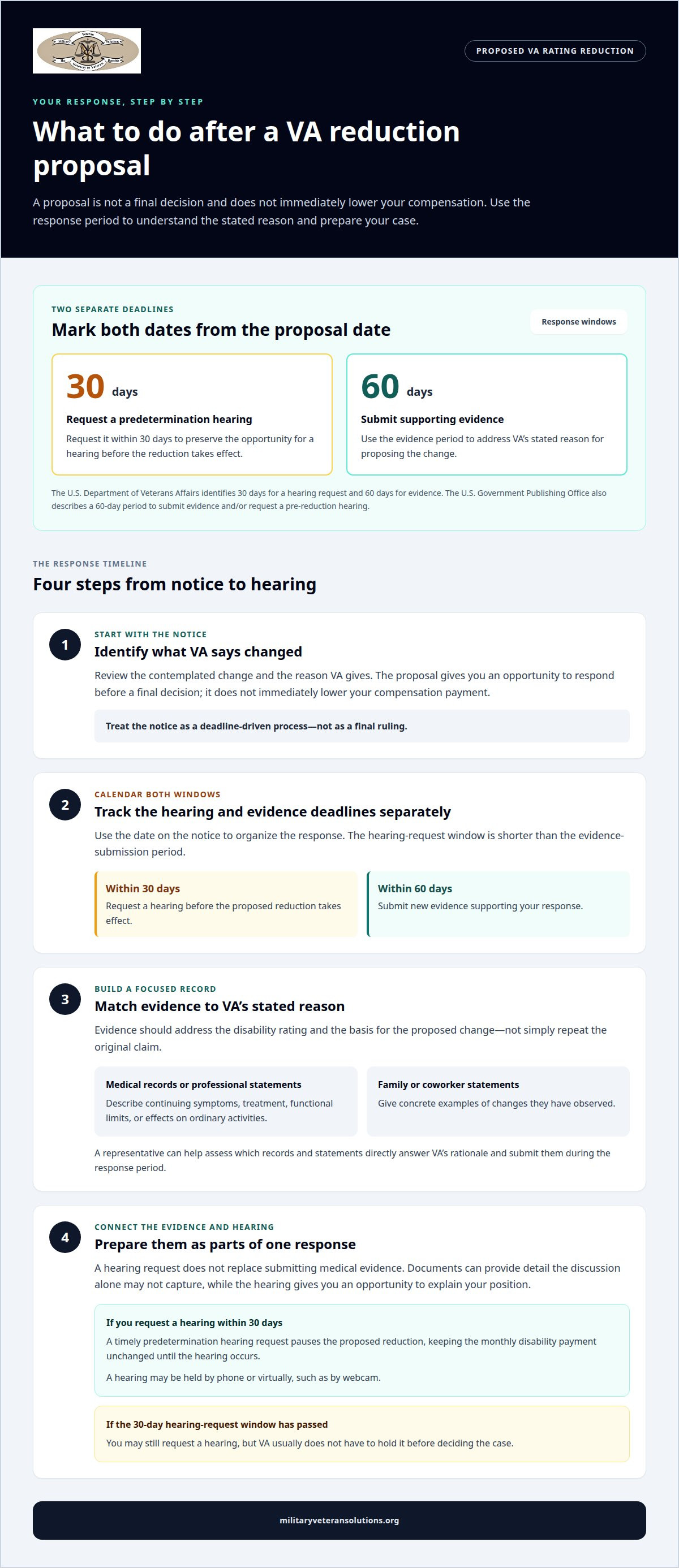
- Review the proposal and identify what VA says changed. A proposed reduction notice explains the contemplated change and gives you an opportunity to respond before a final decision. It does not immediately lower your compensation payment. The response period matters: according to the U.S. Department of Veterans Affairs, veterans have 30 days from the proposal date to request a hearing. A timely predetermination hearing request pauses the proposed reduction, keeping the monthly disability payment unchanged until the hearing occurs. Treat the notice as a deadline-driven process, not as a final ruling.
- Have your representative calendar both response deadlines. According to the U.S. Department of Veterans Affairs, veterans have 60 days from the proposal date to submit new evidence supporting an appeal. The U.S. Government Publishing Office states that, after VA proposes a benefit reduction, the beneficiary has 60 days to submit evidence and/or request a pre-reduction hearing. The hearing-request window is shorter: request it within 30 days to preserve the opportunity for a hearing before the reduction takes effect. Your representative can organize the timeline from the date on the notice and prepare the response accordingly.
- Build evidence that addresses the reason for the proposed change. Evidence should speak to the disability rating and VA’s stated basis, rather than simply repeat the original claim. New medical records or a statement from a medical professional may describe continuing symptoms, treatment, functional limits, or how the condition affects ordinary activities. Statements from family members or coworkers can offer concrete examples of changes they have observed. Evidence that directly addresses the proposed change can help support your response. A representative can assess which records and statements directly answer VA’s rationale, then submit them during the response period.
- Prepare the hearing and evidence as connected parts of one response. A representative can submit supporting evidence before the hearing, organize the record, and help present how the evidence relates to the proposed reduction and service connection. Requesting a predetermination hearing does not replace submitting medical evidence during the response period. The hearing gives you an opportunity to explain your position, but documents can provide detail the discussion alone may not capture. A hearing may be held by phone or virtually, such as by webcam. If the 30-day hearing-request window has passed, a request may still be made, but VA usually does not have to hold the hearing before deciding the case.
Five-year, ten-year, and twenty-year rating protections
Before assessing VA’s proposed action, compare the rating history with the relevant protection periods. Five-year stabilization, ten-year service-connection protection, and twenty-year rating protection address different issues.
-
Review five-year rating stabilization protections
Identify when the current disability rating began and whether it has remained at the same level. According to the Office of the Federal Register, a VA disability rating held at the same level for five years or longer is considered stabilized. This does not completely bar a reduction, but VA generally cannot reduce a rating based on one C&P examination alone.
Compare VA’s proposed reason with the full record, including medical evidence and any scheduled examinations. One examination that appears to show improvement may not establish sustained change in a stabilized disability. If the proposal relies on a single examination, consider whether the evidence reflects the condition’s history and ordinary functioning, rather than just what happened at one appointment.
-
Check rating and service-connection protections
Separate the disability rating from service connection when reviewing VA’s reason. A rating reduction changes the evaluation level; severance challenges whether the condition should remain service-connected. VA generally cannot revoke service connection after it has been in place for 10 years, except when evidence shows fraud surrounding the claim.
Check the service-connection date in the decision history, not just the date of a recent rating increase. The ten-year protection concerns the connection to service, not every possible change in the rating percentage. VA may therefore consider changing a condition’s evaluation even when its service connection has been in place for a long time.
- Confirm whether the twenty-year protection applies. Trace whether the disability rating remained continuously at or above its original level throughout the relevant period. According to the Office of the Federal Register, VA generally cannot reduce a continuous disability rating below its original level after it has remained at or above that level for 20 years, unless the rating was based on fraud.
Use the rating history to distinguish a protected minimum from a blanket bar to reduction. The twenty-year rule protects the original level, but does not automatically prevent every proposed reduction above it. For example, a veteran whose rating rose above its original level may be protected from a reduction below that original level, while VA can still assess a higher evaluation under applicable rules.
- Match each protection to the proposed action. Record the rating’s effective history, the service-connection date, and the specific level VA proposes to change. These dates help determine whether a five-year stabilization rule, ten-year service-connection protection, or twenty-year rating floor is relevant. A decision-letter analysis can help organize those distinctions and identify issues for an VA decision letter analysis.
Reasons the VA may propose a disability rating reduction
- Identify the change VA says supports a lower evaluation. VA may propose a reduction when it believes a service-connected disability has improved. Department of Veterans Affairs regulations contemplate a reduced rating if a veteran’s condition improves under 38 CFR 3.327. A scheduled examination can provide updated information, but the appointment itself does not establish improvement.
Compare the proposal’s stated reason with the prior rating decision. Note whether VA points to fewer symptoms, improved function, or examination findings that differ from earlier records. The question is not simply whether a recent examination sounds more favorable. VA must show an actual change since the previous rating decision before reducing the disability rating.
- Consider why VA may schedule a reexamination. VA generally considers a first reexamination two to five years after a veteran’s first Rating Decision when it believes the disability may improve. A temporary rating may also be scheduled for review, often within two to five years. These reviews help VA assess whether the condition’s current severity still supports its assigned evaluation.
A scheduled examination is a review point, not a final reduction decision. Read the letter to identify the condition under review and the reason for the evaluation. If the proposed change concerns one disability, distinguish it from your other service-connected conditions. This clarifies what VA believes has changed and which medical records or examination findings relate to that condition.
- Assess whether the evidence shows sustained improvement. A proposed reduction should be based on evidence of sustained improvement, not a temporary change or an isolated observation. Review the complete medical history alongside the recent examination. For example, reduced symptoms at one visit may need context from treatment notes documenting recurring limitations or ongoing care.
Consider whether the claimed improvement affects functioning under ordinary conditions and the stresses of life and work. Compare the examination account with relevant medical records and any professional opinion addressing daily limitations. Different wording in two reports does not, on its own, show whether the disability materially improved over time.
- Use focused claim support to assess VA’s reasoning. A representative can compare the rating decision, proposed reduction letter, examination findings, and medical records. The review should identify VA’s specific claim about improvement and assess whether the record supports it. A medical professional’s opinion may clarify symptoms or functional effects that an examination summary overlooked.
Keep your response focused on the condition and evaluation under review. For example, evidence about a mental health condition should address relevant symptoms and their effects, rather than unrelated diagnoses. A focused review can also identify whether the proposal confuses improvement in one symptom with improvement in the overall disability. That distinction helps shape a clear response to VA’s stated reason.
Professional help responding to a proposed VA rating reduction
A representative can organize the record, prepare a focused response, and help you present your position. VA proposed rating reduction help should address both the notice’s reasoning and the evidence relevant to your individual disability.
-
Get professional help responding to the proposed reduction
Have a representative compare the proposal letter with the rating decision and records supporting your current evaluation. This review can identify the specific change VA relies on and whether the decision accurately reflects the disability’s history. A focused response addresses VA’s stated reason, rather than relying on unrelated details that do not explain symptoms or functional limits.
VA proposed rating reduction help can also include organizing medical records and statements from people familiar with your daily functioning. For example, a family member may describe recurring difficulties an examination didn’t capture. Keep supporting material relevant to the condition under review. A larger file is not necessarily a stronger argument.
-
Keep benefits while contesting the reduction
Ask your representative to track the hearing and evidence deadlines separately. According to the U.S. Department of Veterans Affairs, you have 30 days from the proposal date to request a hearing. A timely predetermination hearing request pauses the proposed reduction and keeps monthly disability payments unchanged until the hearing occurs.
The evidence period is separate. You have 60 days from the proposal date to submit new evidence, according to the U.S. Department of Veterans Affairs. A hearing request doesn’t replace submitting medical records or relevant statements. Clear deadline tracking helps prevent confusion between preserving a hearing opportunity and building a complete evidentiary response.
- Prepare a record that explains continuing symptoms. Provide your representative with relevant treatment records, examination reports, and statements describing how the disability affects daily life. Evidence is more useful when it connects specific symptoms with their effects on function. For instance, a statement about recurring difficulty completing routine tasks can add context to a medical record that lists symptoms without describing their practical effects.
A representative can organize documents by date and issue, identify gaps, and prepare a submission that addresses VA’s rationale. The goal is to show how the evidence relates to the proposed change. General statements that the condition remains serious may not explain why the rating should continue.
- Prepare to attend and explain your case. A representative can help organize the points you want to raise at a predetermination hearing, including ongoing symptoms, treatment, and effects on daily life. Keep your explanation consistent with the submitted records. If a medical report uses unfamiliar terms, professional support can help connect its findings to the reduction issue.
As you prepare, identify the records or statements that best explain your position and why they matter. This can help you present a coherent account while VA reviews the proposal. A representative can also help distinguish a response to a proposed reduction from an appeal after VA issues a final decision.
Can VA reduce a total disability rating or TDIU, and what rules apply?
- Check what VA proposes to change. A total disability rating and TDIU are different ways a veteran may receive compensation at the total rate. VA may reduce a 100 percent disability rating only if the evidence shows material improvement in the veteran’s condition. For TDIU, the proposal must also address whether the evidence supports continued unemployability due to service-connected disabilities.
Read the notice to identify the exact benefit VA is reviewing. A proposed change to one disability rating may affect the combined evaluation differently from a proposed change to TDIU. Identify whether VA relies on medical findings, employment information, or both, then compare its reasoning with the record supporting your current benefit.
- Review the full history and examination record. VA must review the veteran’s entire medical history when proposing a reduction and issuing a final decision. Under 38 CFR § 3.344(a), examinations less full and complete than those supporting or continuing payments cannot serve as the basis for a reduction.
Compare the new examination with earlier examinations and records that supported your current evaluation. For a stabilized rating, VA must show sustained improvement. For example, a brief improvement noted at one appointment should be considered alongside treatment history and evidence about functioning under ordinary conditions and life’s stresses.
- Consider age and reexamination rules. Veterans who are 55 years or older are generally exempt from routine VA disability reexaminations. This rule concerns routine examinations, not every possible review or proposed change. Check the notice to understand what triggered the review and which evidence VA cites.
For a total rating, focus on whether VA’s evidence shows material improvement, not merely a different description of symptoms. For TDIU, examine how the record addresses your ability to work. Evidence about daily function, employment, and service-connected limitations can help clarify whether VA’s reasoning reflects the full circumstances.
- Track the effective date if VA issues a final reduction. Under 38 CFR §3.105, a VA compensation reduction generally takes effect on the last day of the month in which the 60-day period following notice of the final rating action expires, according to the Office of the Federal Register. This timing concerns a final action, not the earlier proposal.
Keep the proposal notice, final decision letter, and payment records together. If the final decision reduces a total rating or TDIU, the decision’s stated reasons and effective date matter for the next response. A focused review of those records can clarify the reduction issue and support professional review of a VA reduction decision.
Military Veteran Solutions
Military Veteran Solutions, LLC helps veterans address proposed rating reductions through Veteran Claims Representation, Military Record Reviews, VA Decision Letter Analysis, and Filing VA appeals. A review can clarify VA’s stated reasons, how the decision relates to service records, and what evidence may support a response. Turn to the firm for help assessing a proposal, preparing to contest a reduction, or considering next steps after a final decision. The focus is on understanding the record and VA process, not promising an outcome. If you’re facing a proposed reduction and want professional support, contact Military Veteran Solutions, LLC for a free initial consultation.
Take the Next Step With a Clear Plan
A proposed reduction can put pressure on your finances and make the VA process difficult to manage. Turn the notice and supporting documents into a clear account of what VA believes changed, what the record shows, and which response you want to pursue. An organized approach can help you make informed decisions as the matter moves forward.
Effective VA proposed rating reduction help focuses on your individual record, not a generic response. Military Veteran Solutions, LLC assists veterans through Veteran Claims Representation, Military Record Reviews, and Filing VA appeals. The firm can help bring service records and VA decisions into focus, so your next step is grounded in the evidence and decision at hand.
Contact Military Veteran Solutions, LLC to discuss support for your proposed reduction. You deserve a careful review and a clear path forward.
Frequently Asked Questions
Why Does VA Reduce Ratings?
VA may propose a lower rating when it believes a service-connected condition has improved. A scheduled reexamination can prompt that review, particularly when VA thinks a disability may change. For example, an examination may describe fewer symptoms than earlier records. The key issue is whether the evidence supports sustained improvement, not simply whether one appointment showed a better day. VA regulations contemplate a reduced rating if a condition improves under 38 CFR 3.327, according to the Department of Veterans Affairs.
Can I appeal after VA finalizes the reduction?
Yes. For most VA benefit decisions, you generally have one year from the date on the final decision letter to select a review option, according to the U.S. Department of Veterans Affairs. Check the letter’s date and review options promptly. A Higher-Level Review does not allow new evidence, so consider whether your disagreement concerns the existing record or whether additional evidence is central to your position.
Can the VA reduce my disability rating if my symptoms fluctuate?
Fluctuating symptoms do not automatically establish sustained improvement. VA must consider the disability’s history and whether improvement reflects better functioning under ordinary conditions, not just a temporary change. For example, a report describing fewer symptoms during one appointment may need to be weighed against treatment notes documenting recurring limitations. Evidence about symptom patterns over time can help explain why a brief improvement does not represent a lasting change.
How Does a Medical Examination and Medical Opinion Block a Reduction?
A medical examination or opinion doesn’t automatically prevent a reduction, but it can challenge VA’s reasoning. An examination less full and complete than the examinations supporting or continuing payment cannot serve as the basis for reducing a stabilized rating under 38 CFR § 3.344(a). A medical opinion can also explain how symptoms affect functioning or address why a recent finding doesn’t reflect sustained improvement. Compare its reasoning with the records VA relied on.
What Are Protected Ratings and How Do They Stop a Rating Reduction?
Protections depend on what has remained in place and for how long. The Office of the Federal Register describes a rating held at the same level for five years or longer as stabilized. Service connection generally cannot be revoked after ten years, except in cases involving fraud. After twenty years, a continuous rating generally cannot be reduced below its original level unless based on fraud, according to the Office of the Federal Register.
What Are Your Due Process Hearing Rights for a Proposed Reduction?
You can request a predetermination hearing within 30 days of the proposal date, according to the U.S. Department of Veterans Affairs. A timely request pauses the proposed reduction until the hearing, keeping monthly disability payments unchanged in the meantime. The separate evidence-response period is 60 days. Submit relevant evidence as well as requesting a hearing, because the hearing request alone doesn’t replace written medical or other supporting documentation.
What Rules Must VA Follow Before Reducing a Rating?
VA must review the disability’s medical history and support a reduction with evidence of actual change and improvement. Due process rules provide for notice and an opportunity to respond before a proposed reduction becomes final. A proposal is not itself a final decision. Compare the notice’s stated reason with the examination findings and past records. A difference in one report alone may not establish sustained improvement.
What does a proposed VA disability rating reduction notice mean?
It means VA is considering a lower evaluation but has not issued a final decision. The proposed action does not immediately reduce your compensation payment. Read the notice to identify the disability, the evidence VA cites, and the response deadlines. A request for a predetermination hearing has a shorter window than the evidence period, so keep each deadline distinct as you plan your response.