
A VA rating re-evaluation doesn’t automatically mean your disability rating will change, but it’s important to prepare. The U.S. Department of Veterans Affairs says re-evaluations usually happen every two to five years. Preparing for a VA rating re-evaluation means understanding why an exam may be scheduled and organizing evidence about your current symptoms, treatment, and daily limitations.
If your service-connected condition has worsened, you may be able to request an increased rating. Updated medical records and clear examples of how the condition affects your life can support that request. If the VA schedules an examination, attend and describe your symptoms accurately. If you can’t make the appointment, notify the VA as soon as possible.
This guide explains when re-examinations may happen, how to prepare, what may follow if you miss an exam, and what response opportunities apply if the VA proposes a reduction. You’ll also learn how rating protections work and how to organize records and statements before the review. A clear plan can help you respond carefully and protect your interests throughout the process.
Key Takeaways
- Learn what may prompt a VA reexamination and how the timing can depend on the type of rating and circumstances.
- Understand how age, the stability of a condition, and rating history may affect protections from periodic reviews.
- If you can’t attend a scheduled exam, prompt notice to the VA may help you request a rescheduling.
- A proposed reduction comes with a response period: you can submit evidence within 60 days and request a hearing within the first 30 days.
- Organize evidence around the rating criteria and your condition’s real-world effects so you’re prepared to respond to the review.
1. What Is the VA Disability Reevaluation or Reexamination Timeline?
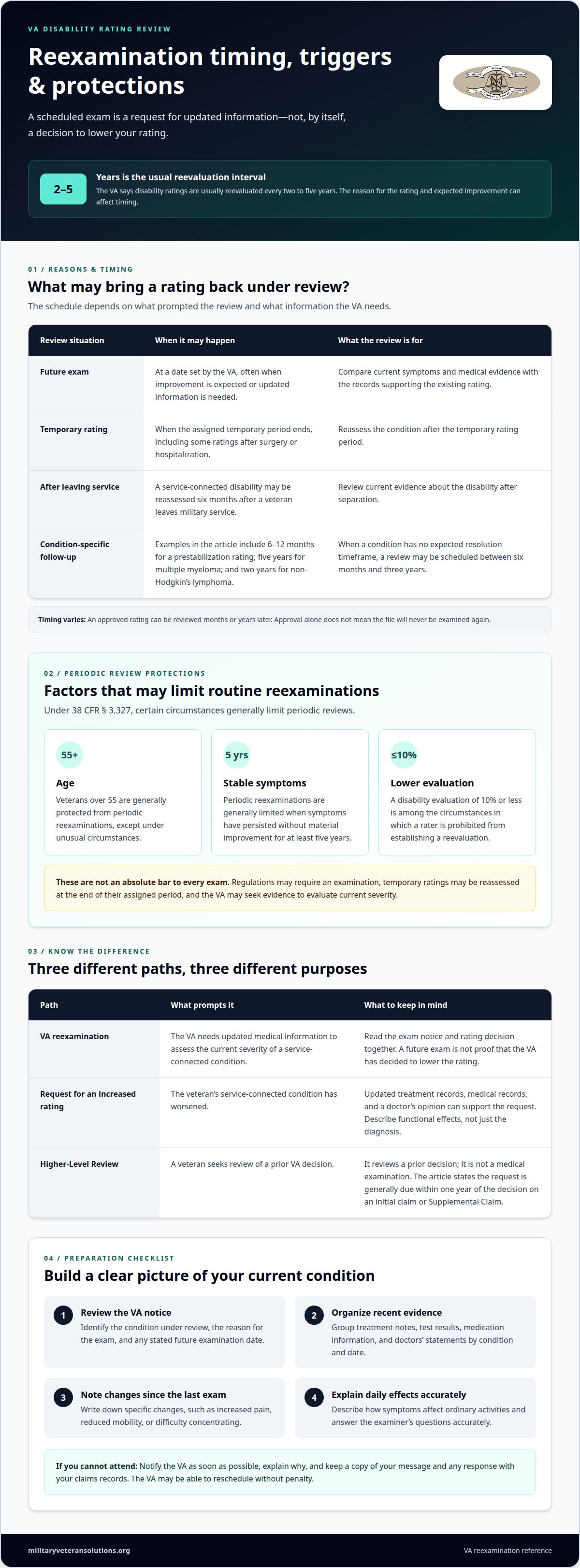
A VA disability rating re-evaluation may be triggered by a scheduled future exam, the end of a temporary rating period, or evidence that a condition has changed. The U.S. Department of Veterans Affairs says disability ratings are usually reevaluated every two to five years. Timing depends on the reason for the rating and whether the VA expects the disability to improve.
A temporary rating may be reviewed when its assigned period ends, including a rating granted after surgery or hospitalization. The VA may also reassess a service-connected disability six months after a veteran leaves military service. An approved rating can be reviewed months or years later, so approval alone doesn’t mean the file will never be examined again.
A future exam may be scheduled when the VA expects a condition to improve or needs updated information to evaluate it. Reexaminations are generally limited to cases where regulations require them; otherwise, compelling evidence or a need to properly evaluate the veteran may support a review. The purpose is to assess the disability’s current severity and whether the existing rating still reflects the evidence.
To check whether a disability is considered static, review the rating decision and VA claim records for a future examination date or a static designation. A scheduled future exam signals that the VA may seek updated information. A static notation can help explain the VA’s view of the condition, but read the records alongside the decision and any later notices. Keep copies together.
A worsening disability is different from a VA-initiated reexamination. If symptoms have increased, updated medical records, treatment notes, and a doctor’s opinion can support a request for a higher disability rating. For example, records describing more frequent pain or reduced mobility may show how the condition has changed since the original rating. Describe functional effects clearly, not just the diagnosis.
Don’t confuse a medical reexamination with a decision review. A Higher-Level Review examines a prior VA decision, rather than serving as a medical exam. According to the U.S. Department of Veterans Affairs, a veteran generally must request a VA Higher-Level Review within 1 year of the decision on an initial claim or Supplemental Claim. The deadline concerns the review request, not the reexamination schedule.
2. How Can I Prepare for a Rating Reexamination?
Start by reading the VA notice and rating decision together. Note the condition under review, the reason for the exam, and any stated future examination date. A routine future exam may be scheduled when the VA expects a disability to improve. It lets the VA compare current symptoms and medical evidence with the records supporting the existing rating.
Not every condition receives periodic reviews. Under 38 CFR § 3.327, veterans over 55 years old are generally protected from periodic reexaminations, except under unusual circumstances, according to the Electronic Code of Federal Regulations. The same regulation generally limits periodic reexaminations when symptoms have persisted without material improvement for at least five years. A disability evaluation of 10% or less is also among the circumstances in which a rater is prohibited from establishing a reevaluation.
These protections don’t mean every review is impossible. Regulations can still require an examination, and a temporary rating may be reassessed when its temporary period ends. The VA may also schedule a review when it needs evidence to evaluate the current severity of a service-connected condition. A future exam is not itself proof that the VA has decided to lower a rating.
Timing can depend on the condition and treatment. For example, a prestabilization rating may require reexamination 6-12 months after separation. The research also identifies reexaminations after treatment or remission for certain cancers, including five years for multiple myeloma and two years for non-Hodgkin’s lymphoma. When cancer or another condition has no expected resolution timeframe, a review may be scheduled between six months and three years.
To prepare, organize recent treatment notes, test results, medication information, and doctors’ statements by condition and date. Write down specific changes since the last exam, such as increased pain, reduced mobility, or difficulty concentrating. At the appointment, explain how symptoms affect ordinary activities and answer questions accurately. If evidence shows worsening, keep those records distinct from evidence about a routine review.
Veterans seeking accredited assistance can ask an accredited representative whether help is available at no cost. An attorney or representative can help explain review options and organize claim evidence. For support with Veteran Claims Representation, consider whether your review involves a rating decision or a scheduled medical examination, since those require different preparation.
3. Consequences of missing a scheduled reexamination
Missing a VA reexamination can affect your disability compensation, so act quickly if you can’t attend. Notify the Department of Veterans Affairs as soon as possible and explain why you’ll miss the appointment. The VA may be able to reschedule without penalty. Keep a copy of your message and any response with your claims records.
If you miss the appointment without good cause, the VA may reduce your disability evaluation after following appropriate due process. A missed exam does not mean the VA automatically lowers your rating. However, without current medical information, the VA may have less evidence to assess the condition, making it harder to support the existing evaluation. Respond promptly to any letter about a missed examination.
A Compensation and Pension (C&P) exam is a medical evaluation used to assess a service-connected disability. The examiner considers your condition and its effects, while the VA reviews the exam alongside your claim records. A C&P exam may be scheduled as part of a reexamination or after a request for an increased rating. It is not the same as ongoing treatment with your own clinician.
Future exams may be scheduled when the VA expects a condition to improve or needs updated evidence. Temporary ratings can also have a review tied to the end of the temporary period. Read the appointment letter closely: confirm the date, time, location, and condition under review. If a detail creates a conflict, contact the VA promptly using the instructions in the notice.
Prepare before the appointment. Gather relevant medical records, treatment notes, and doctors’ statements, then organize them by condition and date. Write down specific examples of how symptoms affect daily activities, such as walking, sleeping, or completing work tasks. At the C&P exam, describe what happens on typical days and during flare-ups. Be accurate and direct; don’t minimize or exaggerate symptoms.
After the examination, the VA reviews the evidence and decides whether the current disability rating remains appropriate. Possible outcomes include keeping the rating or changing it based on the record. If the VA believes a reduction is warranted, it must follow due process before reducing the evaluation. Watch for VA letters, note response dates, and keep copies of every document you submit.
If illness, transportation problems, or another serious conflict prevents attendance, explain the situation to the VA as soon as you can. Include the appointment details and ask about rescheduling. Keep a record of when and how you gave notice. A clear paper trail can help show that you acted promptly rather than ignoring the examination request.
4. Notice and response protections before a rating reduction
A proposed reduction is not the same as a final decision. The VA must follow due process, and the proposal gives you a chance to respond before a reduction takes effect. According to the U.S. Department of Veterans Affairs, you have 60 days from the proposed rating-reduction letter to submit evidence opposing the reduction. Read the letter carefully, identify the condition and proposed change, and note the date immediately.
You may also request a hearing during the first 30 days of the 60-day period after receiving the proposal, according to the U.S. Department of Veterans Affairs. Use the letter’s instructions to make the request, and keep a copy with your records. If you want the VA to consider treatment notes, medical opinions, or other relevant evidence, submit it within the response period and explain how it addresses the proposed reduction.
To challenge the proposal, respond with evidence related to the disability and rating criteria. Current medical records can describe symptoms, treatment, and functional limits. A doctor’s opinion may explain whether an apparent change reflects lasting improvement or a temporary fluctuation. You can also request a decision review and submit further evidence. Address the VA’s reasons rather than simply repeating that you disagree.
Rating protections depend on how long a rating or service connection has been in place. The research identifies five years as a point when protections generally apply to a rating held at the same level. It also identifies protections associated with 10 years and 20 years, but these periods do not mean every rating becomes immune from review. Check the rating history and the basis for the proposed reduction; the exact protection depends on the circumstances and the rule involved.
A permanent and total designation differs from a 100% rating that remains subject to future examination. The cancer example is specific: a 100% cancer rating may continue to be reexamined for up to 20 years if it is not made permanent sooner and remains at 100% throughout. When permanence is established sooner, that stated cancer reexamination period does not apply in the same way.
Cancer reviews can also follow treatment or remission. The VA may schedule a reexamination six months after treatment or remission for several cancers, including breast cancer. Mental health conditions and other disabilities may have different review circumstances, so pay attention to the condition named in the notice. Compare the proposal with your decision letter, examination history, and current medical evidence before deciding how to respond.
Keep a dated copy of every document you send, along with proof of submission. If the VA issues a final reduction decision after considering your response, review its reasons and the appeal options in that decision. A careful record of the proposed change, hearing request, and submitted evidence helps you track each step and protect your opportunity to challenge the outcome.
5. Preparing for a VA rating re-evaluation
Build your preparation around the condition under review and the evidence the VA will assess. Start with the notice and most recent decision. Identify the disability, current rating, examination date, and any reason the VA gives for reviewing the case. This creates a clear reference point for organizing records and describing changes since the initial evaluation.
Next, create a current snapshot of the disability. Gather recent medical records, treatment notes, test results, and relevant doctors’ statements. Arrange them by date, then mark entries that document symptoms, treatment changes, or functional limits. If records describe the diagnosis but not its severity, note that gap and prepare specific examples to explain the condition’s effects during the examination.
A symptom log can make those examples more precise. Record changes in pain, mobility, sleep, concentration, or other symptoms relevant to your condition. Note what activity was affected and how the symptom changed your routine. For example, describe whether a mobility problem limits driving or household tasks. These details help connect medical evidence with the practical impact of the disability.
Prepare a short account of a typical day and any flare-ups. Explain what you can do, what you struggle with, and whether symptoms vary. Be accurate; don’t minimize a difficult day or present an unusual episode as constant. At the exam, answer the examiner’s questions directly and explain any difference between your current symptoms and those documented in older records.
Keep the purpose of your action clear. A scheduled reexamination asks the VA to assess a current disability rating. A request for an increase asks the VA to consider whether worsening symptoms support a higher evaluation. If you are seeking an increase for an already service-connected condition, the research identifies VA Form 21-526b for cases where benefits began over a year ago. A decision review addresses a prior decision, not the same question as a medical exam.
Submit organized evidence with a brief explanation of what each record shows. For example, connect a treatment note to a symptom change, or a doctor’s statement to a limit on daily activities. Keep copies of submissions and VA letters together, especially if the VA requests information or schedules another examination. A well-organized file makes it easier to respond accurately as the claim moves forward over the following months.
Preparing for a VA rating re-evaluation is also a chance to identify whether the decision accurately reflects the evidence. If you need help understanding how the VA explained its rating, request a VA decision-letter analysis to clarify the decision and the issues it addresses.
Military Veteran Solutions, LLC
Military Veteran Solutions, LLC helps veterans understand VA decisions and prepare for the next step when a rating is reviewed. Its Veteran Claims Representation helps you navigate the claims process, while VA Decision Letter Analysis examines the reasons behind a decision. Military Record Reviews can help identify relevant service information, and the firm files VA appeals for veterans challenging decisions.
Consider seeking support if a proposed reduction, confusing examination notice, or decision leaves you unsure how to respond. A focused review can help clarify which records and issues matter to your claim. Military Veteran Solutions, LLC provides claims advocacy, not medical treatment. To discuss your VA claim, contact Military Veteran Solutions, LLC.
Make Your Next Move With Clarity
Keep your claim organized and respond deliberately as the VA process moves forward. Preparing for a VA rating re-evaluation is not about predicting the outcome. It’s about presenting a clear account of your condition and ensuring your response reflects the record, your experience, and the decision under review. When the process feels difficult to manage, Military Veteran Solutions, LLC offers representation and advocacy to help you understand your options before you act.
Military Veteran Solutions, LLC helps veterans address VA claims through representation, military record reviews, and appeals. If you’re weighing a response or need support with your claim, start a conversation with Military Veteran Solutions, LLC. Take the next step with care, and keep moving forward with a clear understanding of your choices.
Frequently Asked Questions
When Can I Increase My VA Disability Rating?
You can request an increase when a service-connected disability has worsened and evidence supports a higher evaluation. Describe changes since the VA’s last decision, such as new treatment needs or greater limits on daily activities. A diagnosis alone may not show how severity has changed. Keep records tied to the condition and explain how they reflect your current functional limitations.
How Does VA Notify Veterans of a Reexamination?
The VA sends an examination notice with appointment information, so read the full letter as soon as it arrives. Check which condition is being reviewed and whether the notice gives instructions for changing or confirming the appointment. If your mailing address has changed, update your VA contact information and monitor correspondence. Keep the notice with related claim records, especially if the exam date changes.
Why Does The VA Need To Reevaluate Your Rating?
The VA may reevaluate a rating to obtain current information about a service-connected condition or to follow a required review. A temporary rating may also be reviewed when its temporary period ends. The examination helps the VA assess current severity against the evidence in the claim. A review notice is not itself a final decision to change compensation; wait for the VA’s decision before determining the outcome.
How Can I Prepare for a Rating Reexamination?
Use the appointment notice to identify the disability under review, then prepare records and examples relevant to that condition. A veteran with a back disability, for example, could note how symptoms affect standing, lifting, or sleep. Bring relevant treatment information and answer the examiner’s questions honestly. If the appointment conflicts with a medical procedure or another serious issue, contact the VA promptly about rescheduling.
How can I check if my condition is static?
Look for a static designation or future examination information in your rating decision and VA claim records. A static notation indicates the VA has treated the condition as not expected to improve, but it does not replace later notices or decisions. If the records use unfamiliar terms, compare the rating decision with the current claim file. Keep both documents available when reviewing any new examination request.
What Is the VA Disability Reevaluation or Reexamination Timeline?
The U.S. Department of Veterans Affairs says it usually reevaluates a disability rating every two to five years. The schedule can vary with the type of rating and whether the VA expects improvement. A temporary rating may be reviewed at the end of its temporary period. Check the decision and any later notice for a future exam date that applies to your condition.
How much notice does VA give before a compensation and pension reexamination?
The appointment notice provides the exam date and instructions, so use that letter to determine how much time you have to prepare. There is no single advance-notice period for every C&P exam. If you receive notice too late to attend, contact the VA promptly, explain the conflict, and keep a record of your request to reschedule.
How should veterans prepare for a VA re-evaluation exam?
Prepare a concise account of how the condition affects everyday life, supported by relevant records. Include examples that clarify frequency, severity, and practical impact, such as needing help with routine tasks or changing how you perform them. Review the appointment notice so your preparation stays focused on the condition being examined. At the exam, describe typical symptoms accurately and mention meaningful changes since prior records.