
A favorable VA appeal is a major step, but it usually isn’t the final step. If you’re wondering what to do after winning a VA appeal, the next step is generally for the Regional Office to issue an implementing rating decision with your disability rating and effective date. That can take several months, and past-due benefits may arrive 10 to 15 days after those details are assigned.
It’s understandable to expect winning a VA appeal to settle everything at once. But the rating, effective date, and any retroactive payment may still need attention, and the decision may point to other benefits to consider. This guide explains what happens next, what to do if the VA’s implementation seems incorrect, and how to approach additional benefits and next steps.
Key Takeaways
- Learn which VA updates can help you follow a favorable decision as it moves toward implementation.
- See what to compare in the implementation decision if the rating or effective date appears inconsistent with the Board’s ruling.
- Explore how a VA award may relate to other federal or state benefits, taxes, and Social Security.
- Understand why deadlines matter if you disagree with a Board decision or want to pursue another benefit.
- Find out how decision letter analysis and claims representation can help clarify your next steps.
Exploring additional federal and state veterans benefits
Additional veterans benefits are federal or state programs separate from VA disability compensation. After a favorable claim decision, consider whether your needs or circumstances point to another benefit category. For example, a veteran whose service-connected condition affects employment may want to explore whether Total Disability based on Individual Unemployability (TDIU) applies. Veterans who qualify for TDIU can receive disability benefits at the same level as someone considered 100% disabled.
Start by identifying the benefit you need, then review that program’s eligibility rules. Are you looking for disability compensation, employment-related support, or a state benefit? State programs differ, and eligibility depends on where you live and the program’s criteria. Don’t assume a favorable VA decision automatically approves a separate federal or state benefit. Keep your decision letter and supporting evidence organized so you can explain the basis of your request.
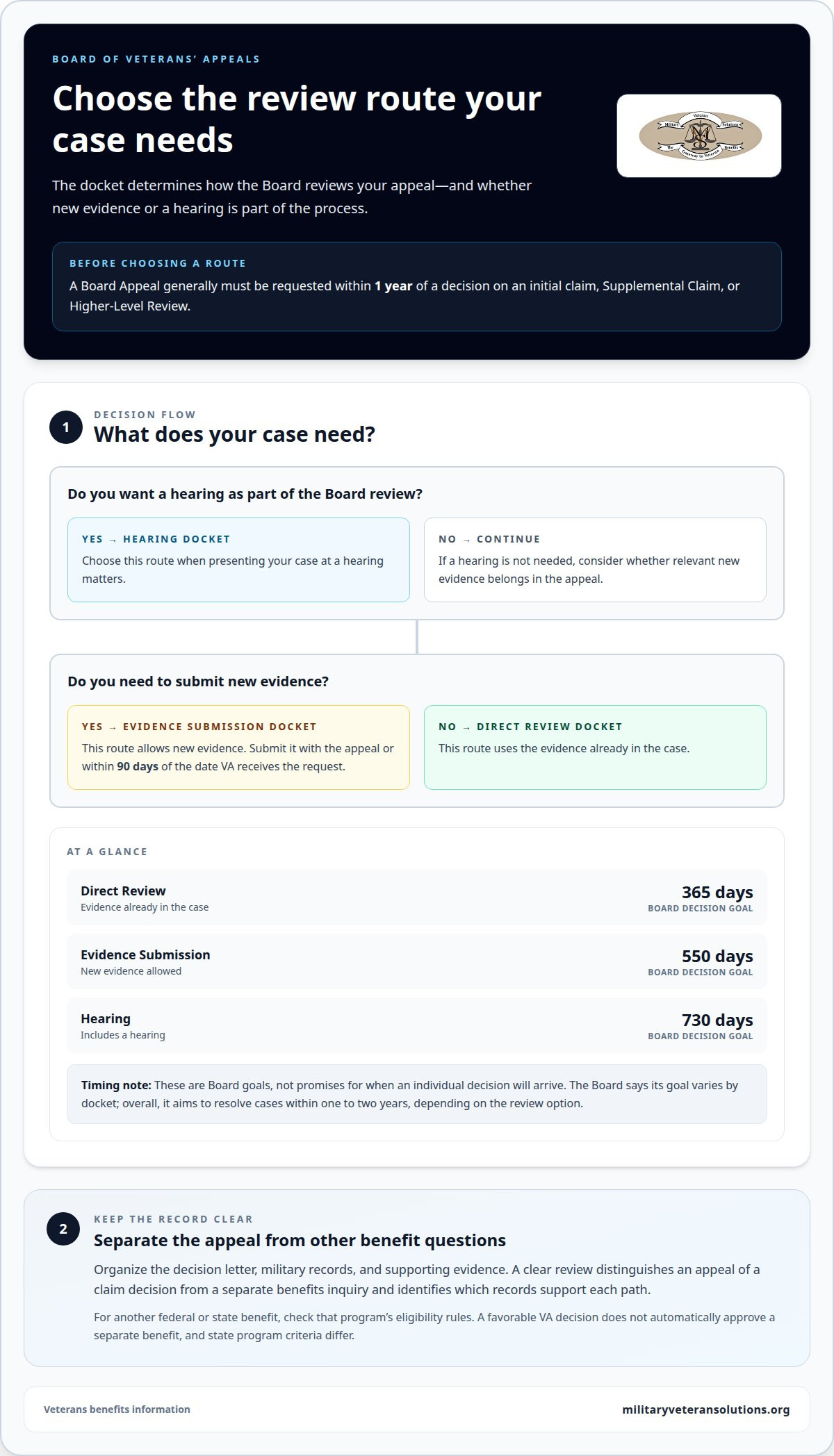
A Board Appeal is a request for a Veterans Law Judge at the Board of Veterans’ Appeals to review a VA claim decision. It may be relevant when a separate claim remains unresolved or a later decision is unfavorable. According to the U.S. Department of Veterans Affairs, veterans generally must request a Board Appeal within 1 year of a decision on an initial claim, Supplemental Claim, or Higher-Level Review.
Board review options are the routes for presenting a case to the Board. The Direct Review docket uses evidence already in the case; the Evidence Submission docket allows new evidence; and the Hearing docket involves a hearing. According to the U.S. Department of Veterans Affairs, Evidence Submission requires new evidence with the appeal or within 90 days of the date VA receives the request. The Board’s stated decision goals vary by docket: 365 days for Direct Review, 550 days for Evidence Submission, and 730 days for a Hearing appeal. These are goals, not a promise of when an individual decision will arrive.
A Board docket determines how the Board reviews your appeal, including what evidence or hearing opportunity applies. Before choosing a docket, consider what your case needs: a complete existing file may suit Direct Review, while relevant new evidence may call for Evidence Submission. A Hearing docket may fit if presenting your case at a hearing matters. The Board aims to resolve cases within one to two years, depending on the review option.
A veterans benefits advocate can help organize claims and evidence and assess possible next steps. Ask how the advocate will analyze your decision letter, military records, and supporting evidence. A useful review distinguishes an appeal of a claim decision from a separate benefits inquiry, then identifies which records support each path. This clarity can help you act before an applicable review deadline passes.
How can I check the status of a favorable VA appeal decision?
A favorable appeal decision grants some or all of the relief you sought. To track what happens next, identify which VA office must act. The Board may resolve the appealed issue, but the Regional Office handles implementation, including assigning a rating and effective date after service connection is granted. Keep the Board decision letter handy; its findings show what the next decision should address.
Your case status means its current stage, not simply whether the appeal was granted. Distinguish the Board’s ruling from the Regional Office’s implementing decision. Record the Board letter’s date, the issues granted, and any directions for further action. Then organize later VA letters by date to see whether the Regional Office has addressed each granted issue.
The Board of Veterans’ Appeals decides issues on appeal but does not implement its decisions or issue benefit payments. That distinction explains why a favorable Board letter may be followed by another VA decision. If the Board granted service connection, look for the Regional Office’s implementing rating decision. It should state the assigned rating and effective date, which determine how the grant applies to your claim.
While waiting for the Board to decide an appeal or a requested hearing, use these steps:
- Keep the decision letter and related VA correspondence together. Note which claim issue each document discusses.
- Respond if the Board asks for more information. According to the U.S. Department of Veterans Affairs, no action is needed while waiting unless the Board requests information.
- After a favorable Board ruling, watch for Regional Office correspondence about implementation. Match each granted issue to the rating decision’s explanation.
When a letter arrives, read its reasoning as well as its result. For example, a grant of service connection may leave the rating or effective date to be assigned. Compare the Regional Office decision with the Board’s findings and the issue it granted. Keep the envelope or delivery record with the letter, since the decision date can matter if you later challenge the implementation.
If the status remains unclear, organize the Board ruling, Regional Office letters, and claim records before seeking help. A focused VA decision letter analysis can help identify what the VA has decided and what remains unresolved. This step is especially useful when correspondence addresses several conditions or uses different dates for separate issues. Keep each document tied to the specific claim issue it concerns.
What should I do if VA does not implement the appeal decision correctly?
Implementation is the Regional Office’s action to put a favorable Board decision into effect. If its rating decision seems inconsistent with the Board’s ruling, compare the documents issue by issue. The Board decides the issue on appeal but does not implement its decisions or issue benefit payments. After the Board grants service connection, the Regional Office assigns the rating and effective date.
Start with the Board decision’s conclusion and any instructions for the Regional Office. Then read the implementing rating decision’s explanation, assigned rating, and effective date. For example, if the Board granted service connection for a condition, check whether the Regional Office addressed it. If the letter covers several claims, make a separate note for each issue. This helps you distinguish an omitted issue from a disagreement with the assigned rating or date.
Build a clear record before responding. Keep the Board ruling, implementing decision, and relevant evidence together. Then:
- Identify the specific Board finding or granted issue that the Regional Office decision appears to have missed.
- Point to the exact rating decision passage that conflicts with the Board’s ruling or leaves an issue unresolved.
- Organize evidence and argument about the proper rating or effective date for the Regional Office’s consideration.
After the Board grants service connection, you can submit evidence and argument to the Regional Office about the proper rating and effective date. Keep your submission focused on the disputed point. Evidence about a condition’s severity may relate to the rating; records showing when the condition or claim began may help address the effective date. Tie each item to the issue it supports instead of sending an unorganized collection of records.
If you disagree with the Regional Office’s decision, identify the review option that fits your evidence. A Supplemental Claim is for new and relevant evidence VA did not have during its earlier review. A Higher-Level Review does not allow new evidence. For most VA disability decisions, a claimant generally has one year from the decision letter’s date to file a Decision Review Request. Read the letter promptly and note its date, because the applicable review window depends on the decision.
For example, if the Board granted service connection but the Regional Office assigned a rating you believe does not reflect the evidence, distinguish that rating disagreement from a failure to carry out the grant. If an issue was omitted, explain the omission. If the issue was decided but you dispute the result, consider the available review path. A careful VA decision letter analysis can help organize the Board’s ruling, the Regional Office’s action, and the evidence supporting your next step.
Do VA appeal awards affect taxes, Social Security, or other benefits?
An appeal award is a VA decision that grants or changes benefits, while tax and other benefit treatment follows separate program rules. Don’t assume the VA decision alone determines how another program treats the award. Review each program separately, using the award letter and payment records to identify what changed and when.
Tax treatment describes how a tax system handles a payment or income source. Before making tax decisions about a VA appeal award, keep the VA decision letter and any payment statement together. Note whether the award concerns ongoing compensation, past-due benefits, or both. These details identify the payment in question, but the award letter is not a tax determination.
Social Security is a federal benefits program with its own eligibility and payment decisions. If you receive Social Security, compare the VA award with the correspondence and records for your Social Security benefit. Separate eligibility questions from payment-calculation questions. A VA rating decision and a Social Security notice, for example, concern different decisions. Keeping them separate helps you avoid assuming one automatically changes the other.
A means-tested benefit is a program that considers financial circumstances when assessing eligibility or assistance. If you receive another benefit, identify the program and review its specific rules. Don’t rely on a general statement about “other benefits,” because each program has its own purpose and criteria. Record the program’s decision date, the VA award date, and any instructions in its notice.
Use this review process to keep the decisions clear:
- Save the VA appeal decision, implementing rating decision, and payment statement.
- List the other programs you receive, such as Social Security or state assistance, and keep each program’s notices in a separate file.
- For each notice, identify the decision being made, the information considered, and any required response or next step.
- Compare dates and payment descriptions, rather than assuming a VA award changes another program automatically.
A past-due payment is compensation for an earlier period, as reflected in VA payment records. If your award includes past-due benefits, keep the VA explanation and payment documentation with the decision letter. Use those records when reviewing tax questions or another benefit’s rules. Don’t treat the payment as a monthly amount or combine it with ongoing compensation unless the VA documents describe it that way.
Keep a written record of questions and answers from each program, including the agency, date, and document discussed. This creates a clear record if a later notice refers to different information. Assess taxes, Social Security, and each additional benefit independently, using the VA award documents and the rules for that specific program.
Your appeal
A VA appeal requests review of a claim decision through an available review path. After a favorable result, identify whether the decision grants the benefit, returns an issue for more work, or leaves another issue unresolved. Each outcome calls for different next steps. Keep the decision letter and related claim records together, then list each issue and its stated outcome.
A Board decision is the written determination from the Board of Veterans’ Appeals. Read the findings and outcome for every issue, not just the first page. A grant can resolve one issue while another remains denied or requires further action. Mark the letter’s date and keep the complete decision, since the date can matter if you disagree with the result.
A court appeal asks a court to review a Board decision. A person who disagrees with a Board decision may appeal to the U.S. Court of Appeals for Veterans Claims within 120 days from the date on the decision letter. Treat that deadline as urgent. Identify which Board finding you dispute and keep the decision letter, relevant evidence, and correspondence organized for review.
A Hearing Board Appeal is a Board review option that includes a hearing. According to the U.S. Department of Veterans Affairs, a veteran may submit new evidence at the hearing or within 90 days after it. Keep a copy of each submission and note how it relates to the claim issue. Evidence should address the point under review, rather than repeat unrelated records.
Use a focused review process after receiving the Board’s decision:
- Separate each claim issue and record whether the Board granted, denied, or returned it for further action.
- For a denied issue, identify the Board’s stated reason and the evidence it discussed.
- For a granted issue, retain the decision and follow later VA correspondence about implementation.
- For a hearing appeal, organize any evidence around the issue and the applicable submission window.
Knowing what to do after winning a VA appeal starts with distinguishing a grant from an unresolved issue. A court appeal concerns disagreement with the Board’s decision; it is separate from the Regional Office’s implementation of a grant. If the VA later issues a separate decision, assess it on its own terms. Understanding what to do after winning a VA appeal also means tying each concern to the decision and review process that applies.
If you’re weighing how to respond to a Board ruling, get support reviewing your VA appeal and organizing the records tied to the disputed issue.
Military Veteran Solutions: Filing VA appeals
Military Veteran Solutions helps veterans pursue VA benefits through claims representation, military record reviews, decision letter analysis, and VA appeals. Turn to the firm when a favorable decision leaves questions about the next step or another claim decision needs careful review. A review of your VA decision letter and service records can clarify the issues and evidence relevant to your claim.
If you’re considering an appeal, representation can help organize your claim and prepare the filing around its specific record. If you’ve already won, a decision letter review can help you understand what the VA decided and what remains unresolved. The right starting point depends on your decision and the support your claim needs.
Contact Military Veteran Solutions to discuss your VA claim and possible next steps.
Carry your decision forward with a clear plan
Knowing what to do after winning a VA appeal means treating the decision as the starting point for your next move. Identify what still needs attention in your benefits record, and keep relevant decision documents organized. If you’re considering another claim or need help understanding an unresolved issue, focused advocacy can help you approach that step with greater clarity.
Military Veteran Solutions offers VA appeals filing, Veteran Claims Representation, and Military Record Reviews. These services can help when you need support preparing an appeal, reviewing your service records, or understanding how your claim fits together. Choose the support that matches your question and keep your immediate priorities clear.
You’ve already taken an important step by pursuing the benefits connected to your service. If you’re ready to discuss the path ahead, contact Military Veteran Solutions. Move forward with a plan that reflects your record, your decision, and the benefits you’re seeking.
Frequently Asked Questions
What happens next?
After a favorable Board ruling, the Regional Office handles the next action for granted issues, while a remanded issue follows its own path. Keep a short list separating grants, denials, and remands. For example, if the Board grants one condition but returns another for more work, track correspondence about each separately so an update on one does not obscure the other.
What happens after winning a VA disability appeal?
The next step depends on what the decision awarded. A grant of service connection may be followed by a rating and effective date, while a favorable rating review may change compensation for an already service-connected condition. Read the outcome for each issue, then keep the Board decision with later VA notices. This makes it easier to see which parts of your claim were resolved and which still need attention.
How long does it take for VA to implement an appeal decision?
After an appeal grants service connection, the Regional Office may take several months to assign a rating and effective date. That interval is separate from the Board’s time to decide the appeal. Keep the decision letter and later correspondence together, and note when a new notice addresses the grant. An issue returned for further action follows a different path from one granted service connection.
How does VA calculate retroactive disability compensation and back pay after an appeal?
Retroactive compensation generally reflects the difference between the amount payable under the award and compensation already paid for the covered period. The effective date, assigned rating, and payment history shape the calculation. For example, an award may cover an earlier period, so the payment record can include past-due benefits as well as ongoing compensation. Review the VA’s payment explanation alongside the decision.
When will VA pay back pay after granting an appeal?
Past-due benefits may arrive 10 to 15 days after the Regional Office assigns a rating and effective date. Keep the implementing decision and payment record together so you can identify which award the payment relates to. If you receive a payment but aren’t sure what it covers, compare its description with the VA decision and the period addressed. Don’t assume a payment amount represents only ongoing monthly compensation.
How do I verify my new VA disability rating and effective date?
Use the Regional Office’s implementing decision to identify the rating and effective date assigned to each granted condition. For example, if the decision covers two conditions, read each section separately rather than assuming they share one rating or date. Keep the full notice and its explanation with your records. This gives you a clear reference if later VA correspondence discusses only one condition or changes part of the award.
What additional VA benefits may I qualify for after a rating increase?
A rating increase may prompt you to explore other benefits, but each program has separate eligibility criteria. Veterans whose service-connected conditions affect their ability to work may want to learn about TDIU. Veterans who qualify can receive disability benefits at the same level as someone considered 100% disabled. State benefits also differ by program and location, so identify the specific benefit you’re considering and its rules.
Should I use a VA-accredited attorney or representative after winning an appeal?
Consider getting help if you’re unsure what a decision means, disagree with an unresolved issue, or need to prepare another claim review. First identify whether you need help understanding a VA decision, organizing evidence, or challenging a Board ruling. These are different needs. Ask a prospective representative to explain their role in your VA matter, and don’t assume a favorable decision means every issue is settled.