
“Complete” can mean the decision letter is already on its way. For other VA claim types, that status means VA has sent the letter by U.S. mail, with details about how the decision was made. For an eligible VA disability claim, the letter includes your disability rating, monthly payment amount, and payment start date. Understanding your VA decision packet means looking beyond the status label to the documents and details behind the outcome.
It’s understandable to feel unsure about what VA decided or what to do next when a packet is full of formal language. The decision letter, rating narrative, and claim status each answer different questions. Knowing how they fit together can help you assess whether the decision matches your claim.
This article explains what to look for in the letter and narrative, what “complete” means as a packet status, and what options may be available if you disagree. You’ll come away with a clearer understanding of the decision and possible next steps.
Key Takeaways
- A VA disability decision letter can show your rating, monthly payment amount, and payment start date.
- The rating narrative explains how the decision relates to the evidence and your claimed conditions.
- A “complete” status can indicate that a decision letter has been sent by mail, depending on the claim type.
- If you disagree with the outcome, the decision packet can help you understand what was decided and which review options may apply.
- VA Decision Letter Analysis can help clarify the decision and identify whether filing an appeal may be a next step.
What Is the VA Decision Rating Letter and Why Do I Need It?
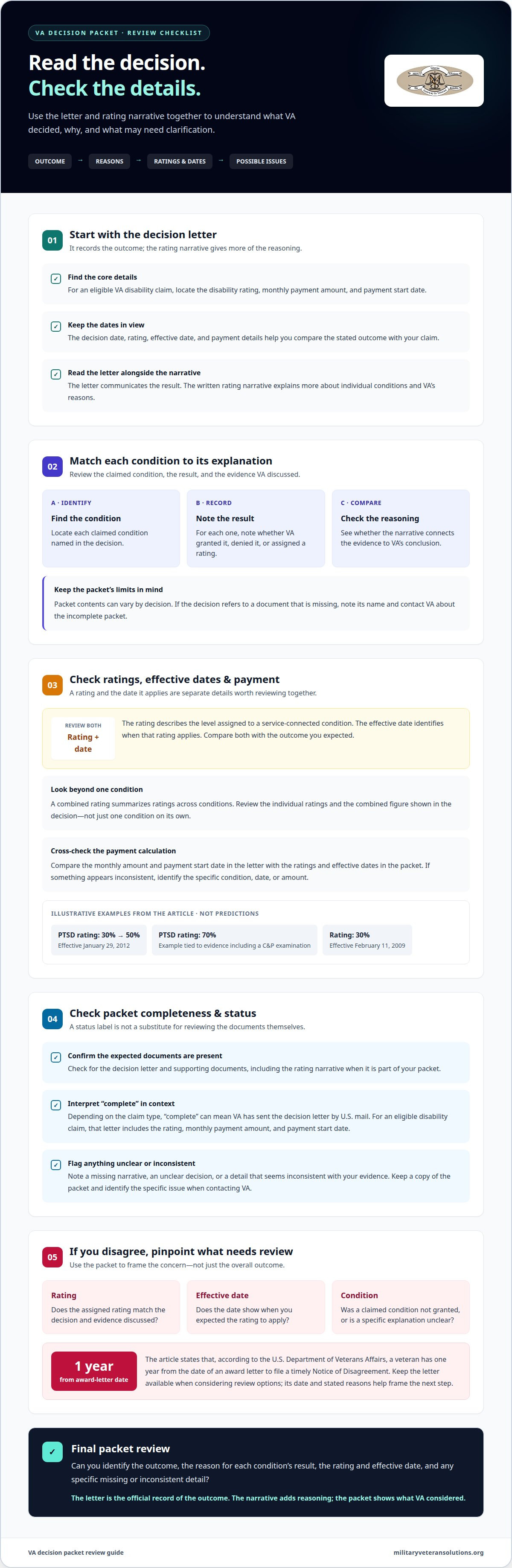
For an eligible VA disability claim, the decision letter states your disability rating, monthly payment amount, and payment start date. Read it alongside the rating narrative to understand what VA decided and why.
Finding and Accessing the Decision Letter
The decision letter records VA’s outcome, while an award letter can document the benefits awarded. After a disability claim is decided, you can review and download the decision letter through the claim status tool. A mailed copy should arrive within 10 business days, though delivery may take longer.
If you need an award letter, start with the online claim status tool for a decided disability claim. You can also request one from a local VA office; obtaining it may take a few days to a week. Keep the letter with your records so you can refer to its decision date, rating, and payment details.
Reviewing the Letter for Missing Documents or Errors
Reviewing the packet means checking that the decision letter and supporting documents are present, then comparing the stated outcome with your claim. A senior reviewer conducts a final review of a VA disability claim and its decision letter, but you should still read the packet carefully. Look for a missing rating narrative, an unclear decision, or a detail that seems inconsistent with your evidence.
If a document is missing or the letter contains an error, contact VA, describe the specific issue, and ask how to address it. Keep a copy of the packet and note which document or detail needs attention.
A decision may affect monthly compensation and may be relevant when considering dependent-related or healthcare benefits. The letter explains the disability decision, but it does not explain every separate benefit’s eligibility rules.
Using the Letter for Appeals
The decision letter is important if you appeal because it identifies the outcome you may challenge and the date tied to that decision. Compare VA’s explanation with the evidence and conditions addressed in your claim. This can help you pinpoint whether your concern is about the rating, the effective date, or a condition VA did not grant.
According to the U.S. Department of Veterans Affairs, a veteran has one year from the date of an award letter to file a timely Notice of Disagreement. Keep the letter available when considering review options, since its date and stated reasons help frame the next step.
When understanding your VA decision packet, treat the letter as the official record of the outcome, not a complete explanation of every possible benefit. The rating narrative provides more reasoning, and the packet shows what VA considered. If you have concerns about a decision, keep the documents and identify the exact point you want reviewed.
Rating decisions and written narratives
A rating decision records how VA evaluated the conditions you claimed and which disability benefits it awarded. Its written reasons help connect the outcome to the evidence VA considered.
Parts of the Rating Decision
A decision packet centers on the decision letter and written rating narrative, which explain the outcome and its basis. The letter communicates the result; the narrative provides more detail about individual conditions and VA’s reasoning.
Read the documents together. For each claimed condition, note whether VA granted it, denied it, or assigned a rating, then find the explanation for that result. Packet contents can vary by decision, so don’t assume every claim includes identical documents. If the decision refers to a document that is missing, note its name and contact VA about the incomplete packet.
Written Reasons for Each Decision
The written narrative explains why VA reached a particular result for a condition. Match the condition named in the decision with the evidence discussed and VA’s conclusion. Then note whether the explanation addresses the evidence you expected VA to consider.
For example, an illustrative decision might assign a 70 percent PTSD rating based on evidence that includes a Compensation and Pension examination. The useful question is how the narrative connects that examination and other evidence to the rating, not simply whether the examination appears in the packet. This comparison can help you identify a specific point that needs clarification or review.
Disability Ratings and Effective Dates
A disability rating describes the level assigned to a service-connected condition, while the effective date identifies when that rating applies. Both matter: a decision can change the rating without applying it from the date you expected.
One illustrative example shows a PTSD rating increasing from 30% to 50%, effective January 29, 2012. Treat that as an example, not a prediction for another claim. In your decision, review each condition’s assigned rating and effective date, then compare those entries with the outcome described in the letter. A pension decision is a separate issue to identify by its own terms; don’t assume a disability rating explains every benefit decision.
Combined Ratings and Compensation Calculations
A combined rating summarizes the disability ratings assigned across conditions. It is not enough to look at one condition alone: review the individual ratings and the combined figure shown in the decision. An illustrative table lists a 30% rating effective February 11, 2009, showing why the date belongs beside the rating when reviewing the result.
To assess the compensation calculation, compare the monthly amount and payment start date in the decision letter with the ratings and effective dates stated in the packet. If the figures appear inconsistent, identify the specific condition, date, or amount and seek clarification from VA. A focused VA decision letter analysis can also help clarify how the written reasons relate to the decision.
What should I do if I disagree with my claim's decision?
First identify the exact issue in the decision, then distinguish a pending claim from a completed one. VA disability claims move through eight listed statuses, from claim received to claim decided. The status shows where review stands, but it does not explain every detail of the decision.
Checking your status online can show whether VA is still reviewing a claim or has decided it. Sign in using Login.gov, ID.me, DS Logon, or My HealtheVet to access the claim status tool. For a supplemental claim, use the same tool to follow its displayed progress and note any request for information. A status update marks progress; it does not replace the decision letter.
Evidence gathering is usually the longest step. VA may need additional evidence, and evidence newly needed or submitted during evidence review, rating, or preparation of the decision letter can return the claim to evidence gathering. That change means VA needs to review evidence again; it does not, by itself, explain the final disability rating. If the status moves backward, consider what evidence VA is reviewing and whether it has requested anything from you.
Claim exams and medical records can help explain the evidence VA considered. Review the decision’s discussion of medical evidence and examinations, then compare it with the records associated with your claim. If the decision refers to an examination or record you don’t recognize, note that specific reference. Keep the issue clear: a missing document, an overlooked record, and disagreement with how evidence was evaluated each call for different clarification.
Most veterans don’t need to act while waiting for a decision packet unless VA requests more information. If VA makes a request, respond and keep a copy of what you submit. If your claim is still pending, don’t treat a status label alone as proof that the decision is wrong. First determine whether VA has decided the claim and what the decision says.
Once VA marks a claim decided, read the outcome alongside its discussion of the evidence. If you disagree, write down the condition involved, the result you dispute, and the evidence or reasoning that concerns you. Reviewing these points can clarify whether the issue is the disability rating, the evidence considered, or another part of the decision. That distinction helps you understand what kind of review to consider next.
If you’re tracking a supplemental claim, watch for requests for more evidence and changes to the displayed status. Submitting evidence after the evidence-gathering stage can send the claim back for review. Respond to actual requests and use the status to understand progress, rather than treating every pause or change as a new decision.
Disagreeing with a decision and appealing
If you disagree with a VA claim decision, first identify the outcome you want reviewed and the notice that explains your options. The decision date matters because it can affect whether a review request is timely.
Notice of Action and Appeal Information
A Notice of Action communicates VA’s decision and explains what happens next. Read it with the award letter, noting the decision date, the conditions addressed, and the review instructions. According to the U.S. Department of Veterans Affairs, a veteran has one year from the date of a VA award letter to file a timely Notice of Disagreement.
Keep the notice with your decision packet. If it describes a different decision or condition than you expected, identify the discrepancy before preparing a submission. Clear records help you explain which part of your VA claim you want reviewed.
Available Appeal Options
For VA rating decisions and award letters issued after February 19, 2019, appeals are processed under the Appeals Modernization Act system. The notice and decision materials help you understand the available review choices and the information each requires.
Before choosing a path, consider what you disagree with. You may question how VA evaluated evidence, for example, or whether the decision addressed a claimed condition. Match the disputed issue to the review instructions, then submit the required information through the stated process.
Before acting, organize your appeal around the exact finding you dispute. Disagreeing with a rating is different from believing VA overlooked evidence or failed to address a condition. State the issue plainly, refer to the relevant part of the decision, and explain what you believe needs review. This keeps your request focused on the decision rather than unrelated questions.
Use the award letter date to track the one-year period for filing a timely Notice of Disagreement. Don’t rely on when you opened the envelope or later discussed the decision; the date on the letter is the reference named by the U.S. Department of Veterans Affairs. Keep a copy of your submitted request and supporting documents with the notice.
Appeals under the modernized system are not simply general requests to reconsider everything. The decision notice identifies available next steps, and the review you choose should address the specific result at issue. If the written explanation appears to conflict with your evidence, identify the gap precisely. Clearly state what VA decided, what you dispute, and why, so your review request has a defined purpose.
Don’t confuse a Notice of Action with the appeal submission itself. The notice communicates information about the decision; you still need to follow its instructions to request a review. Read each requirement closely, keep track of the relevant dates, and make sure your submission addresses the decision you intend to challenge.
Meaning of the decision-packet status
A decision-packet status describes where VA’s notice process stands, not every detail of the outcome. Read the status alongside the decision letter to distinguish a completed mailing from the benefits decision you still need to understand.
For other VA claim types, “complete” means VA has sent the decision letter by U.S. mail. The letter explains how VA made its decision. “Complete” is a meaningful status update, but it does not replace reading the decision itself. The letter explains the result; the status describes its place in the process.
For a VA disability claim, the decision packet should generally arrive within 10 business days after VA prepares it for notification, though the wait may be longer. That interval concerns delivery of the packet, not when compensation will appear. If your status indicates a decision but the letter hasn’t arrived, keep the status and any mailed notice together while you wait for the documents.
“Received” and “complete” refer to different stages. A received claim is earlier in the process than a decided claim, while a complete status for other claim types means VA has sent the decision letter. The distinction matters: an early status does not communicate a decision, and a mailing status does not tell you whether VA granted every issue.
Use the status as a prompt to look for the related document. If the status shows a decision, read the letter for the outcome and explanation. If the packet has not arrived, the status still indicates that VA has moved to notification, but it does not replace the written reasons or show which evidence supported each finding.
A status change alone does not establish that a compensation payment has been issued or received. Check the decision letter for the rating, monthly payment amount, and payment start date, and distinguish those details from delivery status. For example, a completed mailing can mean a letter is on its way, while the letter itself explains VA’s benefits decision.
Keep a record of the status you saw and when you reviewed it. When the packet arrives, compare it with the status and check for missing pages or unclear findings. Separating the process update from the written decision helps you avoid mistaking one for the full explanation of your claim’s result.
If the status says the packet is complete but the decision remains unclear, request VA decision letter analysis from Military Veteran Solutions to review what the letter says and what the decision means.
Military Veteran Solutions: VA Decision Letter Analysis
Military Veteran Solutions provides VA Decision Letter Analysis for veterans who need help understanding how a decision relates to their claim and evidence. A focused review can clarify the stated outcome, highlight questions about the rating or effective date, and help you consider whether filing an appeal may be appropriate.
If your concerns go beyond the letter itself, Military Veteran Solutions also provides Veteran Claims Representation, Military Record Reviews, and Filing VA Appeals. These services help connect the decision with the records and review options relevant to your claim.
For a clear review of your decision and possible next steps, contact Military Veteran Solutions.
Turn Your Decision Into a Clear Next Step
Understanding your VA decision packet is most useful when it helps you decide what to do next. Before acting, write down your specific concern: a finding you don’t understand, evidence you believe needs attention, or a result you want reviewed. A focused question makes it easier to discuss the decision and keep attention on the issue that matters to you.
Keep your decision materials organized so you can refer to the same documents during a review. If you’re considering an appeal or need help interpreting the decision, an advocate can help you assess the packet and consider a path forward. Military Veteran Solutions provides representation and advocacy for veterans seeking clarity with VA claims.
Contact Military Veteran Solutions for support and take the next step with a clearer understanding of your options. You deserve to move forward with purpose and a plan grounded in your claim.
Frequently Asked Questions
What is a VA award letter?
A VA award letter is written notice describing benefits VA has awarded. For an eligible disability claim, it includes the disability rating, monthly payment amount, and payment start date. Use it to understand what VA approved, and keep it with your records. For example, if the letter grants one condition but denies another, read each outcome separately rather than treating the claim as a single result.
How do I find my VA effective date and back pay amount in the decision packet?
Look in the decision letter for the effective date and payment information, then read the rating narrative for the basis of the decision. The payment start date and monthly amount help explain the award, but may not show one total for back pay. If you need to know the amount due, use the payment details VA provides or ask VA to explain its calculation. Keep the letter handy when you ask.
What does it mean when a VA claim is granted, denied, deferred, or remanded?
“Granted” means VA approved the issue, while “denied” means it did not award that benefit for the issue. “Deferred” generally means VA has not finished deciding that issue. “Remanded” means the issue has been sent back for further action or review. Check the decision narrative for the specific condition and next steps, because one packet can include different outcomes for different issues.
What are the deadlines and options for appealing a VA decision?
According to the U.S. Department of Veterans Affairs, a veteran has one year from the date of a VA award letter to file a timely Notice of Disagreement. For rating decisions and award letters issued after February 19, 2019, appeals are processed under the Appeals Modernization Act system. Read the decision notice for the review choices and instructions that apply to your case, then identify the issue you want reviewed.
How can I access or download my VA decision packet online?
For a decided VA disability claim, use the claim status tool to review and download the decision letter. Sign in with a Login.gov, ID.me, DS Logon, or My HealtheVet account. Save a copy where you can find it, and note whether you have the letter and related decision documents. If the packet is incomplete, contact VA about the specific missing document rather than relying on the status label alone.