
What disability percentage will the VA assign to your condition? A diagnosis alone usually doesn’t answer that question. The rating depends on how the VA applies the criteria for a service-connected condition to the evidence in your file, including documented symptoms and their effects on daily functioning. That’s why searching for va disability percentages for conditions can leave you with more questions than answers.
If the percentage in a decision letter seems difficult to connect to your diagnosis or symptoms, start by looking at the VA’s explanation, not just the number. This 2026 guide explains how the VA evaluates condition severity, what medical and other evidence may matter, and why individual ratings don’t simply add up to your combined rating.
You’ll also learn how to read the reasoning in a rating decision and compare it with the evidence and applicable criteria. If something appears inconsistent, reviewing the decision letter alongside the records it discusses can help clarify what happened and which next steps may be worth considering. The goal is to make the rating process easier to understand so you can assess your decision with greater confidence.
Key Takeaways
- Learn how the VA rating schedule evaluates service-connected conditions, and why a diagnosis by itself doesn’t determine the percentage.
- See how evaluation factors differ across selected mental health, musculoskeletal, hearing, and respiratory conditions.
- Understand why va disability percentages for conditions can vary based on the criteria applied and the evidence documenting each veteran’s symptoms and functional effects.
- Review a decision letter by checking the condition, assigned evaluation, effective date, and stated reasons against the applicable criteria and evidence.
- Learn how a VA decision letter and records review can clarify a rating and help identify possible next steps.
What Do VA Disability Percentages for Conditions Actually Mean?
The VA evaluates service-connected conditions using its rating schedule. A disability percentage reflects how the VA applies that schedule’s criteria to the evidence in a veteran’s claim. It isn’t a measure of how deserving someone is, and the diagnosis name alone doesn’t determine the result.
The Veterans Benefits Administration (VBA) administers VA disability compensation. Evaluations are guided by 38 CFR Part 4, the Schedule for Rating Disabilities. The schedule organizes conditions under diagnostic codes and sets out criteria for assessing severity. Because those criteria differ by condition, the same symptom may matter in different ways depending on the condition being evaluated.
How the VA rating schedule and diagnostic codes work
The VA identifies the condition, selects an applicable diagnostic code, and compares the evidence with that code’s criteria. The code and assigned evaluation may appear in the rating decision or related rating documents. In the decision letter, locate the section listing each condition and its evaluation, then read the explanation of how the VA reached its decision. If the code isn’t clear in the letter, review the accompanying rating information or have the decision documents analyzed.
An individual disability rating is the VA’s percentage-based evaluation of how a service-connected condition meets the applicable rating criteria. The VA assigns a percentage to each condition before considering how multiple evaluations combine.
Why a diagnosis does not automatically equal one percentage
A diagnosis can establish what condition is being considered, but it doesn’t, by itself, show that the evidence meets the criteria for a particular evaluation. The VA looks at the applicable schedule and the information in the claim. Depending on the condition, relevant evidence may describe symptom frequency or severity, examination findings, treatment records, and effects on everyday activities or work.
For example, two veterans may have the same diagnosis but records that describe different symptoms or functional limitations. Their evaluations may differ because the evidence supports different levels under the criteria. That difference doesn’t mean the diagnosis is being dismissed. It means the assigned percentage depends on how the documented facts fit the condition’s specific rating rules.
Online lists of va disability percentages for conditions can be a useful starting point, but they can’t tell you what evaluation applies to your claim. Conditions don’t all share the same criteria or rating levels, and a general guide can’t assess your individual records. This article is educational, not a prediction of your rating. For a specific decision, compare the stated evaluation and reasoning with the applicable criteria and the evidence identified in your VA documents.
How VA Disability Percentages Vary Across Common Condition Groups
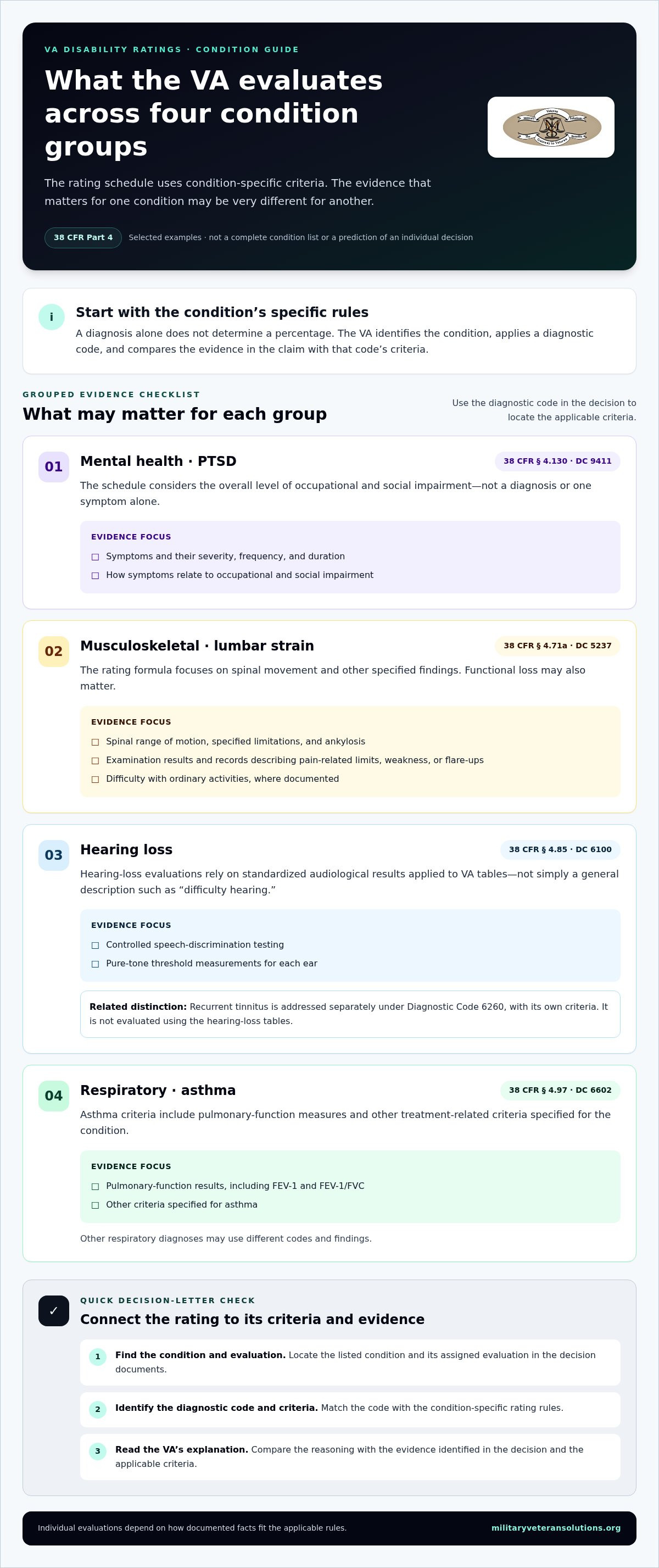
Rating criteria aren’t one-size-fits-all. The VA uses condition-specific rules, so the evidence that matters for hearing loss may differ sharply from what matters for a mental health condition or joint injury. The examples below point to selected provisions in 38 CFR Part 4. They aren’t a complete list of conditions or a prediction of any individual decision.
The VA’s About VA Disability Ratings page explains the general rating process. For a condition-specific review, match the diagnostic code in your decision with the applicable criteria and the evidence cited by the VA.
| Condition group and example | What the VA evaluates | Criteria reference |
|---|---|---|
| Mental health, PTSD | Occupational and social impairment, considered with symptoms and their severity, frequency, and duration. | 38 CFR § 4.130, Diagnostic Code 9411 |
| Musculoskeletal, lumbar strain | Spinal range of motion, including specified limitations and ankylosis; functional loss may also matter. | 38 CFR § 4.71a, Diagnostic Code 5237 |
| Hearing loss | Controlled speech-discrimination testing and pure-tone threshold measurements for each ear. | 38 CFR § 4.85, Diagnostic Code 6100 |
| Respiratory, asthma | Pulmonary-function results, such as FEV-1 and FEV-1/FVC, and other criteria specified for the condition. | 38 CFR § 4.97, Diagnostic Code 6602 |
Mental health and musculoskeletal evaluations
For PTSD, the schedule assesses the overall level of occupational and social impairment, rather than assigning a percentage based on a diagnosis or one symptom alone. For a lumbar strain, the rating formula focuses on spinal movement and other specified findings. Examination results and records describing pain-related limits, weakness, flare-ups, or difficulty with ordinary activities may help show functional impact. The relevant criteria depend on the condition and diagnostic code.
Hearing, tinnitus, and respiratory conditions
Hearing-loss evaluations rely on standardized audiological results applied to VA tables, not simply a general description such as “difficulty hearing.” Recurrent tinnitus is addressed separately under Diagnostic Code 6260, with its own criteria; it isn’t evaluated using the hearing-loss tables. For asthma, the schedule includes pulmonary-function measures and treatment-related criteria. Other respiratory diagnoses may use different codes and findings.
These examples show why va disability percentages for conditions can’t be reduced to a diagnosis-to-percentage lookup. If your decision’s explanation is hard to reconcile with the criteria or evidence, a focused review of the decision letter and supporting records can help clarify the evaluation. Military Veteran Solutions provides VA decision letter analysis to help veterans understand how their evidence was considered.
Why the Same VA Condition Can Receive Different Percentages
A diagnosis doesn’t guarantee that every veteran with the same condition will receive the same percentage. The VA applies the criteria for the specific condition to the evidence in each claim. Those criteria appear in the Schedule for Rating Disabilities, while records may document different symptoms, examination findings, or effects on daily functioning.
For example, two veterans might have the same diagnosed joint condition, but their examination results and records could describe different limits on movement or functional effects. The VA evaluates each claim against the criteria and evidence available for that veteran. A difference in percentage doesn’t automatically mean one person’s diagnosis is more serious or that a particular document was overlooked. The decision’s explanation is where to look for how the evidence was assessed.
What evidence can help explain a condition’s assigned evaluation?
Review the evidence cited in the decision alongside the criteria for the condition. Depending on the condition, relevant documentation may include:
- Medical records describing symptoms, treatment, and changes over time.
- Examination findings that address the measures or observations named in the rating criteria.
- Clear descriptions of how the condition affects ordinary activities, mobility, communication, concentration, or work, when relevant to that condition.
Consistency can make the record easier to understand. For instance, treatment notes and examination findings that describe similar limitations over time may provide context for the claimed functional effects. Still, no single record guarantees a particular evaluation. The question is whether the evidence as a whole supports the criteria applied and whether the decision explains its conclusion.
How individual percentages differ from combined ratings
An individual rating evaluates one service-connected condition. A combined disability rating reflects multiple evaluations, calculated using the VA’s method rather than by simply adding the percentages. As a result, the combined figure may be lower than the arithmetic total of the individual ratings. This can make a rating decision confusing when the condition-level evaluations seem clear but the overall percentage differs from what you expected.
Separate the two questions. First, does the evaluation for each condition match the relevant criteria and evidence? Then, does the combined rating reflect the VA’s calculation method? For more on the second question, see how VA disability ratings combine. Keeping individual and combined evaluations distinct makes it easier to understand what a decision says about va disability percentages for conditions and where a closer review may help.
How to Check Whether a VA Condition Rating Matches the Decision
A careful review can help you understand how the VA reached an evaluation and identify questions that may need attention. You don’t need to assume the decision is wrong. Start with the condition-specific explanation, then compare what the letter says with the applicable criteria and the evidence it discusses.
Where to find the rating and explanation in a VA decision
In your decision letter and accompanying rating information, locate the condition and note its assigned evaluation and effective date. Then find the section explaining the reasons for the decision and the evidence considered for that condition. Read the full explanation, not just the percentage. The VA may discuss examination results, records, or specific criteria that shaped its evaluation.
Use this short review sequence:
- Identify the condition. Check that the condition listed matches the issue you claimed.
- Record the evaluation and effective date. Keep these separate from any combined disability rating.
- Read the reasons and evidence discussion. Note which findings the decision relied on and whether it identifies evidence it found persuasive.
- Compare the explanation with the applicable criteria. Check whether the findings discussed address the criteria relevant to that condition.
What to do when the rating seems inconsistent with the record
If the evaluation doesn’t seem to line up with your records, write down the specific point of concern before deciding what to do next. Ask yourself:
- Does the letter address the examination findings or records you expected it to consider?
- Does the explanation discuss the symptoms or functional effects relevant to the condition’s criteria?
- Are any findings unclear, or is the stated reasoning difficult to reconcile with evidence identified in the decision?
- Is a record or examination detail missing from the discussion?
These questions can help you pinpoint an issue, but they don’t establish by themselves that the VA made an error. Review options depend on the decision and your circumstances, so examine the instructions included with your letter rather than relying on a general deadline. For related guidance, see VA decision letter analysis.
Records can also provide context for what the decision discusses. A military record review for VA claims can help clarify relevant service documentation alongside the medical evidence. Military Veteran Solutions provides decision-letter and records reviews to help you assess your decision. Request a VA decision review to discuss how the evidence relates to your va disability percentages for conditions.
When to Seek Help Understanding VA Disability Percentages
A decision-letter or records review may help when the VA’s explanation is difficult to follow, several conditions have separate evaluations, or evidence you expected the decision to address seems absent. You don’t need to assume the rating is wrong to ask questions. The goal is to understand how the VA connected the condition, criteria, and evidence in your claim.
When a professional review may clarify a condition rating
Consider a closer review if the stated reasoning doesn’t seem to match the examination findings or records discussed in your decision. Decision-letter analysis can help identify what the VA relied on, what it said about the evidence, and which points may need clarification. A difference of opinion alone doesn’t establish that the evaluation is incorrect, but specific questions can help you decide what to examine next.
Military Veteran Solutions reviews VA decisions alongside military and medical documentation. This can put the decision’s explanation in context and clarify how the evidence relates to the assigned evaluation. For broader background on available support, explore these VA claim assistance resources.
How Military Veteran Solutions supports veterans nationwide
Military Veteran Solutions provides veteran claims representation, military record reviews, VA decision-letter analysis, appeals assistance, and virtual consultations nationwide. The organization was founded by a disabled veteran who served ten years in the U.S. Army, bringing personal military experience to its work supporting veterans as they understand and pursue earned benefits.
Support includes reviewing the decision and records, explaining possible paths, and helping you understand your options. It isn’t a promise of a higher percentage or a particular appeal outcome. An informed review can clarify the issues, but the VA makes decisions under the applicable criteria and evidence.
If you’re trying to make sense of va disability percentages for conditions and your decision’s reasoning still feels unclear, take the next step at a pace that works for you. Review the VA claim assistance resources, or discuss your VA claim with Military Veteran Solutions.
Take the Next Step With a Clearer View of Your Rating
VA disability percentages for conditions depend on how the evidence fits the criteria for each service-connected condition, not on a diagnosis name alone. The same condition can receive different evaluations when documented symptoms, examination findings, or functional effects differ. Individual percentages are not simply added together to determine a combined rating.
To understand your decision, identify each condition’s evaluation and effective date, then compare the VA’s stated reasons with the criteria and evidence discussed in the letter. If the explanation remains unclear or seems inconsistent with your records, a careful review can help you understand what the decision says and what options may be available. It can’t promise a particular rating or appeal outcome.
Military Veteran Solutions provides VA decision letter analysis, military record reviews, virtual consultations, and nationwide veteran claims representation. Founded by a disabled veteran who served ten years in the U.S. Army, the organization brings personal military experience to its advocacy. Discuss your VA decision and next steps with a team ready to help you assess the record and move forward with greater clarity.
Frequently Asked Questions
Does the VA assign the same percentage to everyone with the same condition?
No. A diagnosis doesn’t guarantee a fixed percentage for every veteran. The VA applies the criteria for that specific condition to the evidence in each claim, which may document different symptoms, examination results, or effects on daily functioning. Two veterans with the same diagnosis could therefore receive different evaluations. To understand an individual decision, look at the assigned percentage and the reasons the VA gives for how the evidence fits the criteria.
How does the VA decide what percentage a condition receives?
The VA compares evidence about a service-connected condition with the applicable criteria in its Schedule for Rating Disabilities, found in Title 38, Code of Federal Regulations, Part 4. The criteria vary by condition and may address symptoms, examination measurements, treatment, or functional effects. The decision letter explains the VA’s reasoning and identifies evidence considered. Reviewing that explanation alongside the diagnostic code can help you understand how the evaluation was assigned.
Can one VA disability condition receive more than one rating?
Sometimes, separate evaluations may apply when a condition has distinct, separately ratable manifestations and the same symptoms aren’t being counted more than once. The VA generally avoids duplicating compensation for overlapping symptoms, even if different diagnostic codes seem relevant. Whether separate ratings are appropriate depends on the condition, the evidence, and the applicable rules. Review the decision’s codes and explanation to see which manifestations were evaluated and how.
What conditions commonly receive a 0 percent VA disability rating?
A 0 percent rating may apply when a condition is service connected but the documented severity doesn’t meet the schedule’s requirements for a compensable evaluation. Hearing loss and hypertension are examples of conditions that may receive a 0 percent rating, depending on the applicable criteria and evidence. The percentage doesn’t mean the VA found no service connection. Check the decision’s explanation to understand which findings supported the evaluation.
Does a higher individual rating automatically mean a 100 percent combined rating?
No. A higher evaluation for one condition doesn’t automatically produce a 100 percent combined rating. The VA combines multiple service-connected evaluations using its prescribed method rather than simply adding the percentages. The resulting combined rating can differ from their arithmetic total. Check each condition’s individual evaluation separately from the combined rating, and review the VA’s explanation of the combined calculation if the overall percentage is unexpected.
What should I do if my VA disability percentage seems too low?
Start by locating the condition, its evaluation, and the reasons for the decision. Compare the explanation with the applicable criteria and the evidence the VA discusses. Note specific questions, such as whether an examination finding or relevant record appears unaddressed. A concern doesn’t by itself establish that the decision is incorrect. Review the options and instructions included with your decision. A decision-letter or records review can help clarify possible next steps.
Where can I find the VA rating criteria for my condition?
Look in Title 38, Code of Federal Regulations, Part 4, the Schedule for Rating Disabilities. Find the section for your body system or condition and match it to the diagnostic code shown in your rating decision. Read the criteria for that code, not just a general online percentage chart, because requirements differ by condition. The decision letter’s reasons can help you identify which criteria and evidence the VA applied.


