
What if a spouse’s most helpful contribution to a VA claim isn’t an explanation of what caused a condition, but a clear account of what changed at home? If you’re looking for a VA buddy letter example for spouse, it’s understandable to worry that your statement may sound biased or too general. Specific, firsthand observations can make it more useful.
You know your spouse’s daily routines, but you don’t need to diagnose a condition or prove its medical cause. This guide offers a practical example you can adapt truthfully, with details about changes you personally observed, when they happened, and how they affected everyday life. It also explains what a spouse’s lay statement can and can’t establish, so you can avoid speculation and keep the letter credible.
You’ll also learn how to organize the statement with other claim evidence and how VA Form 21-10210 may be used to submit a lay or witness statement. The goal is a focused account that adds context to the record, not an argument that replaces medical evidence.
Key Takeaways
- A spouse’s statement can add context about changes in daily functioning, behavior, or symptoms observed over time.
- Use the VA buddy letter example for spouse as a framework, then replace every prompt with accurate details from your own experience.
- Build credibility with concrete observations and clear timeframes. Identify anything you learned from the veteran rather than witnessed yourself.
- Keep the statement focused on what you observed, not a diagnosis or medical explanation of the condition.
- Before submitting, check current VA instructions for VA Form 21-10210 and organize the statement with relevant claim evidence.
What Is a VA Buddy Letter from a Spouse, and What Can It Show?
A VA buddy letter is a lay statement: a written account of facts a person knows or has personally observed. A spouse may describe what they’ve seen at home over time, such as changes in routines, behavior, sleep, or ability to manage everyday activities. A VA buddy letter example for spouse should show how to report those observations clearly, not turn them into a diagnosis.
A spouse’s account can add context that may not appear in treatment records, especially about daily functioning. The Veterans Benefits Administration (VBA) processes VA disability claims, where a statement may be considered alongside other evidence. It can support the record, but it doesn’t guarantee a particular decision or replace medical evidence where a clinical assessment is needed.
For a related look at concerns that can arise during a VA examination, watch this video:
Can a spouse write a VA lay statement?
Yes. A spouse—or even an ex-spouse—can provide a statement based on personal knowledge and direct observations. Former partners often share valuable observations from earlier years, even if their marital status has since changed; for couples navigating marital transitions, services specializing in divorce document preparation Nevada can assist with the required legal paperwork. In any case, the relationship is relevant context, but it doesn’t automatically make the account unreliable or prove it. The statement is most informative when it describes relevant firsthand details rather than broad praise, assumptions, or conclusions about what the VA should decide. No particular writing style guarantees that a statement will be accepted or given a specific weight.
What can a spouse describe firsthand?
Focus on observable events and changes. For example, you might describe waking when your spouse gets up repeatedly during the night, turning down activities you used to attend together, or changing a routine because your spouse has difficulty completing a task. Explain what you witnessed and, when you remember accurately, when it happened. If you’re unsure of a date, say so rather than guessing.
Separate what you saw from what your spouse told you. You can identify something you learned from them, but don’t present it as a personal observation. Avoid naming a condition, interpreting its medical cause, or asserting that military service caused it. Those are medical questions for qualified clinicians. Your role is narrower and still valuable: give a truthful account of the changes you personally observed, without overstating what the evidence shows.
What to Include in a VA Buddy Letter Example for a Spouse
A clear statement helps the reader understand who you are, what period you can speak to, and what you personally observed. A useful buddy letter is specific firsthand evidence, not a medical opinion. Keep the focus on facts you can describe truthfully, and don’t fill gaps in your memory with guesses.
Start with your relationship and observation period
Briefly explain how you know the veteran, that you’re their spouse, and how often you interact. Then identify the period you can reliably describe. You might say you’ve lived together since a particular year or can speak to changes you observed after a remembered event. If you can’t recall an exact date, give an honest approximate timeframe or say you’re unsure.
Include only the personal identifiers requested by the current form or submission process. The official VA Form 21-10210, Lay/Witness Statement is a VA form for lay or witness statements. Check its current instructions when preparing your statement.
Describe concrete examples and their impact
Replace sweeping claims such as “he always struggles” with an example you directly witnessed. For instance, if accurate, describe a particular occasion when your spouse left a family gathering early, or explain how a change in their routine affected an activity you share. Add frequency, duration, setting, or practical impact only when you know those details.
Make the source of each detail clear. “I saw…” signals firsthand knowledge. If your spouse told you about an event you didn’t witness, identify it as something they shared, not something you observed. Compare different time periods only if you remember the contrast reliably. One grounded example is stronger than a long list of uncertain claims.
- Identity and relationship: State who you are and how you know the veteran.
- Observation period: Give the timeframe you can accurately describe.
- Specific examples: Explain what happened and its observable effect.
- Truthful closing: Confirm that the statement reflects your honest knowledge.
For more form-focused guidance, review The Power of Lay Statements: Using VA Form 21-10210. Once your statement is organized, consider how it fits with the rest of the claim evidence. If you’d like help evaluating that broader record, discussing your VA claim evidence may be a useful next step with Military Veteran Solutions, LLC.
A VA Buddy Letter Example for a Spouse, with Prompts to Adapt
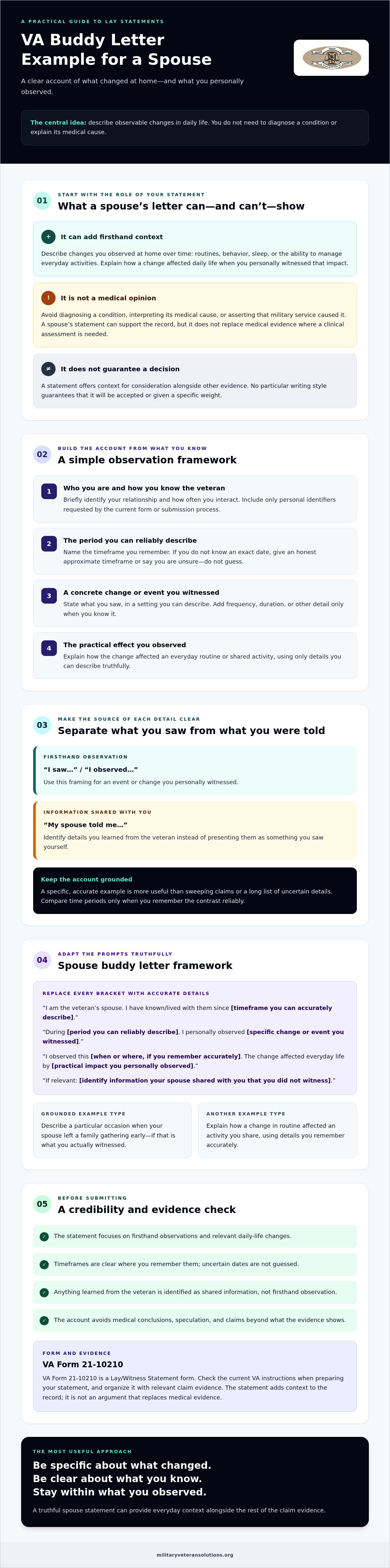
Use this VA buddy letter example for spouse as a framework, not a script. Replace every bracketed prompt with accurate information from your own experience, and delete anything that doesn’t apply. A useful example should be truthful, specific, and limited to what you personally know.
A simple spouse statement template
Statement from [your name]
My name is [your name]. I am [veteran’s name]’s spouse, and I have known them for [length of time]. I have had the opportunity to observe them [describe how often you interact, such as living together or spending time together regularly] during [time period you can reliably describe].
During that time, I personally observed [specific action or change you witnessed]. This happened [timeframe or frequency, if you remember accurately] in [setting or circumstance, if relevant]. I also observed [another firsthand example, if applicable]. These changes affected our everyday routine by [describe the practical effect you directly observed].
[If relevant: I did not witness this directly, but [veteran’s name] told me [briefly identify what they shared].] I’m including this separately from the events I personally observed.
I have written this statement based on my honest knowledge and observations. [Your name] [date, if appropriate]
The official VA Lay/Witness Statement page provides information about the form for submitting a lay or witness statement. Check the current form and instructions before sending your statement, and include any requested details through the appropriate process.
How to personalize the example without overstatement
Delete every prompt that doesn’t fit. Don’t keep a detail simply because it appears in the template. Replace conclusions about a condition with actions you observed. For example, instead of writing “[veteran] has [condition] that prevents [activity],” describe what you saw: “[veteran] [observable action or change] during [timeframe], which affected [specific routine].” Use only details you can stand behind.
If a detail came from the veteran or someone else, label it as reported rather than presenting it as something you witnessed. Before submitting, reread the statement for accuracy, clarity, and consistency with the other evidence being provided. Correct any wording that sounds certain when your memory is not, and remove medical conclusions or unsupported explanations. The finished statement should sound like you, not like an argument written to reach a particular result.
How to Make a Spouse Buddy Letter Specific and Credible
A spouse’s statement doesn’t need legal-sounding language or a particular format to be useful. It needs to explain what the writer actually knows. If you’re adapting a VA buddy letter example for spouse, use it to organize your thoughts, not to add details that don’t match your experience.
Being married to the veteran doesn’t automatically make your account biased or automatically prove its contents. Focus on accuracy: explain your relationship, distinguish what you witnessed from what someone told you, and avoid exaggeration. Before submitting, compare your recollections with relevant records for consistency. If you notice a difference, don’t change a truthful memory to make the accounts match. Clarify what you remember and leave uncertainty visible.
Weak versus useful wording in a spouse statement
Broad language may express concern, but it gives little detail about what happened. A specific observation helps clarify the writer’s firsthand knowledge without requiring a diagnosis or one “correct” writing style. Use the comparison below as a model, replacing each prompt with facts you can honestly support.
| Vague wording | Specific observation | Why it helps |
|---|---|---|
| “Things got worse.” | “During [timeframe I remember], I observed [specific change] when [setting or circumstance].” | Identifies an observation and a timeframe without guessing what caused the change. |
| “It affects everything.” | “I saw [specific action or limitation], which affected [everyday activity I know about].” | Shows a practical effect while avoiding a sweeping claim. |
| “They can’t do [activity] anymore.” | “I observed [what happened during the activity] on [occasion or approximate timeframe, if accurately remembered].” | Describes what the writer witnessed rather than asserting an absolute. |
Does a spouse buddy letter replace medical evidence?
No. Lay evidence and medical evidence serve different purposes. A spouse can describe observable actions, routines, and limitations. A buddy letter isn’t a substitute for a clinician’s diagnosis or medical opinion about what caused a condition. Don’t add a diagnosis, nexus conclusion, or technical interpretation unless you’re qualified to provide it in that role.
Relevant records may offer additional context alongside a spouse’s observations. If you’re unsure how a lay statement fits with military records, medical documentation, or a VA decision, a professional review of your claim evidence can help you consider the broader record. The goal is not to reshape a truthful account, but to understand how the available evidence fits together.
How to Submit a VA Spouse Buddy Letter and Choose Your Next Step
A well-prepared statement still needs to reach the VA through the correct process. It may accompany an initial claim or be submitted during an appeal, but the right submission route can depend on the claim’s status and the type of review. Check current VA instructions before sending anything, especially if a deadline or appeal is involved.
Before submitting the statement
Use this short checklist to keep the submission organized:
- Finalize the statement: Make sure it’s clear, signed as directed, and limited to facts the writer can truthfully support.
- Check current instructions: Review the VA’s official information for VA Form 21-10210, Lay/Witness Statement, and confirm the applicable submission method and requirements.
- Submit with relevant evidence: Follow the instructions for the claim or appeal, and organize the letter so it can be identified as supporting evidence.
- Keep a copy: Save the final statement and note when and how it was submitted.
Don’t assume the same steps apply to every case. If the veteran is appealing a decision, review the appeal instructions that fit their situation. The guide Filing VA Appeals Help: A Strategic Guide to Overturning Denials in 2026 may be relevant for that separate process, but confirm the correct lane and deadlines using current VA guidance.
When to seek help reviewing the evidence
If you’re unsure how the spouse’s statement fits with service records, medical documentation, or a VA decision, consider reviewing the evidence as a whole before submission. A VA buddy letter example for spouse can help organize the writer’s account, but it can’t determine what other evidence a claim may need.
Military Veteran Solutions, LLC provides veteran claims representation, VA decision analysis, and reviews of military records and medical documentation. The firm doesn’t provide medical treatment, and no representative can promise a particular VA decision. If the veteran would like to discuss how the available evidence fits into the claim, they can request a virtual consultation with Military Veteran Solutions, LLC and decide whether representation is right for them.
Prepare a Clear Statement and Take Your Next Step
A spouse’s statement is most useful when it stays grounded in firsthand observations: what you noticed, when you noticed it, and how it affected everyday life. Use the VA buddy letter example for spouse as a starting point, not a script. Replace every prompt with truthful details, distinguish what you witnessed from what someone told you, and avoid medical conclusions. Before submitting, check the current VA instructions and keep a copy of the final statement.
A buddy letter can add personal context to the claim record, but it doesn’t replace medical evidence or guarantee a particular decision. If you’re unsure how the statement fits with other records or a VA decision, a broader evidence review may help clarify your next steps.
Military Veteran Solutions, LLC provides veteran claims representation and virtual consultations nationwide. The firm was founded by a disabled veteran who served ten years in the U.S. Army. If you’d like to discuss the evidence in your claim, request a virtual consultation with Military Veteran Solutions, LLC.
Frequently Asked Questions
Can a spouse write a buddy letter for a VA claim?
Yes. A spouse can provide a statement about relevant facts they personally observed or know, such as changes in the veteran’s routines or activities. Identify your relationship and explain how you had the opportunity to observe the veteran. Keep the account truthful and specific. A spouse’s statement is lay evidence, not a medical diagnosis, and it doesn’t guarantee how the VA will evaluate the evidence or decide the claim.
What should a spouse include in a VA buddy letter?
Include your relationship to the veteran, the period you can reliably describe, and specific firsthand observations relevant to the claim. Explain what happened and, if you remember accurately, how often or in what circumstances. Clearly distinguish what you witnessed from information the veteran or another person shared with you. A VA buddy letter example for spouse can help organize the statement, but don’t add details just to make it sound more persuasive.
Is a spouse buddy letter enough to prove a VA disability claim?
Not necessarily. A spouse’s account can add useful firsthand information, but whether it’s sufficient depends on the claim and the full evidence record. Questions about diagnosis or medical causation may require medical evidence. Describe what you observed without offering unsupported medical conclusions. The VA evaluates the evidence under the rules that apply to the individual claim, so a buddy letter alone can’t guarantee a particular outcome.
Does a VA buddy letter from a spouse need to be notarized?
Don’t assume notarization is required. Check the current VA form and official submission instructions for the statement you plan to use, and follow any signature or certification directions provided there. Requirements may depend on the document and how it’s submitted. Avoid relying on an old template or informal online example as the final word. Confirm the current instructions before filing so the statement is prepared correctly.
Can I use VA Form 21-10210 for a spouse buddy letter?
VA Form 21-10210 is identified as a lay or witness statement form, but verify its current title, purpose, and instructions through official VA sources before using it. The spouse should complete it accurately and focus on firsthand knowledge. If the veteran is submitting other claim forms or appeal evidence, check that the statement is included with the correct submission. Keep a copy of the completed form and submission record.
Can a spouse describe symptoms in a VA buddy letter?
Yes. A spouse can describe experiences, actions, or changes they personally witnessed, using clear and accurate language. For example, explain an observed change in a routine or an activity the veteran stopped attending, if that’s what you saw. Don’t diagnose the veteran, assign a medical cause, or claim certainty about facts outside your knowledge. Medical records and qualified clinicians can address clinical questions and medical opinions.
What if a spouse does not remember exact dates?
Don’t guess or invent precise dates to make the statement seem complete. If you remember the general period, use an honest timeframe, such as a season or approximate year, and make clear that it’s approximate. You can also state that you don’t recall the exact date. Specific details help only when they’re accurate; truthful recollection is more useful than false precision that may conflict with other evidence.


