
Could an independent medical opinion strengthen your VA claim, or simply add another document to the file? If you’re considering an independent medical opinion (IMO) for VA claim evidence, it’s reasonable to ask whether VA will consider it and how it compares with a Compensation and Pension (C&P) exam. A private opinion can address a medical question, but its title alone doesn’t make it persuasive.
The difference often comes down to the details. A useful opinion addresses a relevant gap in the evidence, explains the clinician’s reasoning, and shows how the records support the conclusion. It doesn’t guarantee approval or replace VA’s review of the full claim.
This article explains what an IMO can and can’t do, how it differs from a C&P exam, and what to review about the clinician’s qualifications, records, and rationale. You’ll also learn how to assess whether an opinion fits your claim and how medical documentation relates to the broader evidence. A careful review can help you decide what your file needs next.
Key Takeaways
- An independent medical opinion (IMO) for VA claim evidence should address a specific medical question. Its title alone doesn’t establish credibility.
- Consider whether an IMO addresses an unresolved clinical issue. Missing service records or rating disagreements may call for a different approach.
- Compare an IMO with a C&P exam, nexus letter, and treating-provider opinion by looking at purpose, author, context, and limitations.
- Before adding an opinion to your evidence, check who wrote it, which records they reviewed, how they reasoned, and whether the conclusion fits the record.
- Assess medical documentation alongside the complete claim file, including VA decisions and supporting records, to understand how the evidence fits together.
What Is an Independent Medical Opinion for a VA Claim?
An independent medical opinion is a clinician’s assessment of a specific medical question relevant to a veteran’s disability claim. “Independent” generally means the opinion was obtained separately from a VA-arranged examination, but the label isn’t a quality standard. Providers may use terms such as “IMO” and “nexus letter” differently, so focus on the question the clinician addressed, their qualifications, and the reasoning behind their conclusion.
A medical opinion offers a clinician’s judgment about a health-related question; it does not decide whether VA should grant benefits. The Veterans Benefits Administration handles disability benefits claims, while VA adjudicators determine how the evidence applies to eligibility and rating criteria. An IMO may discuss a diagnosis, the possible relationship between a condition and service, or whether one diagnosed condition may be related to or worsened by another. By itself, it doesn’t establish every element of a claim.
That distinction helps set expectations. An opinion may add relevant medical analysis, but it can’t resolve every kind of claim problem. Missing service records, a procedural issue, or a disagreement about how a condition should be rated may require a different response. Not every claim needs an IMO, and no opinion guarantees a favorable decision.
What questions can an IMO address in a VA claim?
The right question depends on the facts and evidence in your file. A clinician might assess whether your symptoms support a particular diagnosis, whether the medical evidence supports a connection between that diagnosis and service, or whether one condition is medically related to another. An independent medical opinion (IMO) for VA claim evidence is most relevant when it addresses a specific medical issue the existing record hasn’t adequately answered.
Check that the question fits your case. A general statement that a condition is “service-related” may not explain the medical reasoning connecting your history to that conclusion. The question, records, and rationale should align.
Who may provide a medical opinion?
Relevant education, training, experience, and familiarity with the medical subject matter all matter. Under 38 C.F.R. § 3.159(a)(1), competent medical evidence may come from someone qualified through education, training, or experience to offer medical diagnoses, statements, or opinions. Consider whether the clinician’s background fits the question they were asked to address.
A treating relationship can give a clinician useful knowledge of your history, but it doesn’t automatically make an opinion persuasive. A clinician who hasn’t treated you may still offer relevant analysis if their expertise and review support it. Assess the substance of the opinion, not just the author’s title or relationship to you.
When Can an IMO Add Meaningful Evidence to a VA Claim?
An independent medical opinion (IMO) for a VA claim may be worth considering when the existing record leaves a specific medical question unanswered. Start by identifying that gap. A new opinion can add useful analysis if it addresses the issue directly and explains how its conclusion follows from your medical history and documented facts. An IMO’s usefulness depends on its relevance and reasoning, not the title printed on the document.
If you have a VA decision, start with its explanation. Look for what it says was missing, unclear, or insufficient. Then compare that concern with the record: Is there a diagnosis? Relevant service and treatment documentation? An earlier medical opinion that addressed the same question and explained its basis? This comparison can help you determine whether the issue is clinical or whether another type of evidence may be needed.
Signs that a claim may have an unresolved medical question
A decision may identify a medical issue that needs clarification, such as whether the evidence supports a diagnosis or a medical relationship between a condition and service. Review the relevant records alongside the decision explanation. The regulation at 38 CFR § 3.159 describes competent medical evidence. The decision and facts in your file can help you assess what question remains. This review isn’t a diagnosis and can’t predict whether a new opinion will change the outcome.
To address a gap, an opinion should connect its conclusion to the veteran’s documented history and relevant medical facts. A statement that repeats a conclusion already in the file without addressing the question raised by the decision may contribute little.
When another evidence step may be more appropriate
Not every denial points to a need for a clinician’s opinion. If the missing item is a service record, a relevant lay statement, or an administrative document, an IMO may not fill that gap. A disagreement about rating criteria may also call for reviewing the decision and the applicable claim process, rather than adding a medical conclusion that doesn’t address the rating issue.
Before commissioning or submitting another opinion, match the proposed evidence to the reason for the decision. If the next step involves an appeal, review the VA appeals strategic guide for process context. A claims advocate can help you review how medical documentation fits with VA decisions and supporting records. Military Veteran Solutions, LLC offers VA decision and record review as advocacy, distinct from medical care or writing an IMO.
IMO vs. C&P Exam, Nexus Letter, and Treating-Provider Opinion
These terms describe different sources or forms of medical evidence, though they can overlap. An independent medical opinion (IMO) may address a medical relationship, for example, while a nexus letter is a common name for an opinion focused on that relationship. Neither label guarantees a particular format or determines how much weight VA will give the evidence.
| Evidence type | Purpose | Author | Typical context | Limitations |
|---|---|---|---|---|
| IMO | Addresses a specific medical question, which may concern diagnosis, service connection, or another clinical issue. | A medical professional providing an opinion independently obtained by the veteran, or, in a distinct VA process, an expert asked by VA to provide an opinion. | Used when a focused medical assessment may help address a question in the record. | The title alone doesn’t establish relevance, sound reasoning, or evidentiary weight. |
| C&P examination | Provides examination findings or medical information relevant to a claim question. | A VA-contracted examiner. | Arranged through the VA claims process. | Its findings are evidence, not an automatic claim outcome. |
| Nexus letter | Usually addresses whether a medical relationship exists between a condition and service, or another relevant condition. | A medical professional. | Often used to describe a focused medical opinion about connection. | There’s no guarantee the document uses a standard format or provides adequate reasoning. |
| Treating-provider opinion or note | May document symptoms, diagnosis, treatment, or a clinician’s view. | A clinician involved in the veteran’s care. | Created during routine care or specifically to address a claim question. | Routine notes may not explain a claim-specific medical rationale. |
How an IMO differs from a VA C&P examination
A C&P examination is arranged as part of the VA claims process. A private opinion is obtained independently by the veteran. The questions and scope may differ, so one document doesn’t automatically cancel out or outweigh the other. VA evaluates the evidence under applicable standards. A private opinion may be considered, but VA isn’t required to accept its conclusion simply because it comes from a private clinician.
There’s also a regulatory use of “independent medical opinion.” Under 38 C.F.R. § 3.328, VA may seek an advisory medical opinion in cases involving medical complexity or controversy. That is distinct from a veteran independently obtaining a private opinion.
How an IMO differs from a nexus letter or treating-provider note
An IMO and nexus letter may be much the same when both address a medical relationship. The substance matters more than the label. Treatment notes can establish a useful history, but may not explain why a condition is medically connected to service. Relevant military records and service history can provide context for assessing how an opinion fits the full record.
How to Assess an IMO Before Adding It to Your Evidence
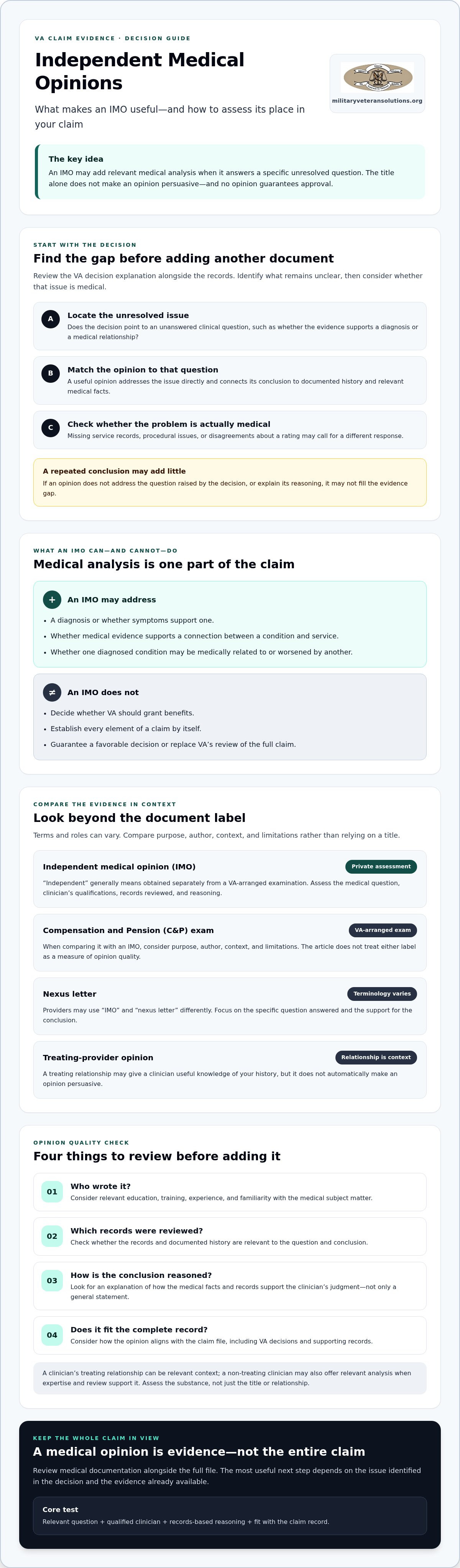
Before submitting an independent medical opinion (IMO) for VA claim evidence, review more than the final conclusion. A practical quality check asks whether the opinion answers the right question, explains its basis, and matches the facts in your file. Use this checklist to guide your review, not to make a medical or legal determination.
- Identify the question. What specific medical issue does the opinion address? Confirm that it relates to the claim concern you’re trying to clarify.
- Check the author. Review the clinician’s education, training, experience, and familiarity with the condition or medical issue discussed.
- Confirm the records reviewed. Does the opinion identify relevant treatment records, service records, test results, or prior opinions? Note any important records that appear to be missing.
- Follow the reasoning. Look for an explanation connecting the documented history and medical facts to the clinician’s conclusion. A bare conclusion or boilerplate language may not show how the author reached it.
- Read the conclusion closely. Does it answer the question clearly, and does the explanation support that answer? Check that the wording doesn’t claim more than the analysis establishes.
- Check consistency. Compare the opinion’s factual assumptions with the records and decision explanation. See whether it acknowledges relevant contrary evidence, gaps, or uncertainty rather than overlooking them.
What makes an opinion individualized and well-reasoned?
An individualized opinion applies medical judgment to the veteran’s documented circumstances. For example, it should explain why particular history or findings matter to the question, rather than offer a general conclusion that could fit any claimant. The author should identify what they reviewed and address meaningful limits in the available history. There’s no universal word count, template, or phrase that guarantees an opinion will be persuasive.
A sound review checks the question, author, records, reasoning, conclusion, and consistency with the rest of the file. Treat that as a guide, not a scorecard. An opinion can be detailed yet rest on an inaccurate assumption, while a concise opinion may explain its reasoning clearly.
What to review before submitting the opinion
Check names, dates, condition details, and whether the document addresses the intended claim issue. Compare its assumptions with relevant treatment and service records, along with the VA decision explanation if available. If a key record conflicts with the opinion, understand the discrepancy before deciding how to use the document.
Confirm current evidence-submission instructions for your claim or review option, and protect any applicable deadlines. For help assessing how an opinion fits with VA decisions and supporting records, request a review of your VA decision and records.
How Claims Advocacy Can Help You Put an IMO in Context
An IMO is one part of a VA claim, not a substitute for the full record. Its significance depends on how it relates to the decision, service history, and other medical documentation. Claims advocacy can help you examine that relationship and identify questions to clarify, without replacing a clinician’s medical judgment.
What a claims representative can review
A claims representative can review VA decision explanations, military records, and medical documentation to understand how the evidence fits together. For example, a decision may identify a missing link between a current diagnosis and service, while the file contains service or treatment records that offer relevant context. A record review can help identify focused questions to raise with an appropriately qualified clinician. Military Veteran Solutions, LLC does not provide medical treatment or issue medical opinions.
For additional background on organizing support for a claim, see the VA claim assistance resource guide. Advocacy and medical assessment serve different roles: an advocate can help you understand the claim record, while a clinician assesses medical questions.
A practical next step for veterans considering an IMO
Before a consultation, gather the relevant VA decision, medical records, service records, and any opinions already in your file. Having these documents together can make it easier to discuss what the decision identified and whether an opinion addresses that issue. You don’t need to assume an IMO is the answer. First clarify what evidence question remains.
If you’re considering obtaining an opinion, ask the clinician about the scope of the assessment, their relevant credentials, which records they’ll review, and any associated costs. Those questions can help you understand what the clinician will provide and whether it aligns with your needs.
A careful review of the record can help bring the next step into focus. Military Veteran Solutions, LLC offers virtual consultations and reviews VA decisions and supporting records as part of its claims-advocacy work. Discuss your VA claim records with Military Veteran Solutions, LLC if you’d like to talk through how an IMO fits into the broader file.
Make Your Next Evidence Decision With Clarity
An independent medical opinion (IMO) for VA claim evidence can be useful when it answers a specific medical question with clear reasoning grounded in the record. Its title alone doesn’t establish its value, and it doesn’t replace VA’s review of all evidence. Before deciding whether an opinion fits your claim, check its author, the records reviewed, its rationale, and its consistency with the rest of your file.
The next step may be a medical opinion, or it may be addressing a different gap in the claim. Reviewing the decision alongside your service and medical records can help clarify what needs attention. Military Veteran Solutions, LLC provides VA decision analysis, records review, claims representation, and virtual consultations. Founded by a disabled veteran who served ten years in the U.S. Army, the firm helps veterans assess how documentation fits into the broader claim record, without providing medical treatment or authoring medical opinions.
If you’d like support reviewing your documents, discuss your VA claim records with Military Veteran Solutions, LLC. A clearer view of the evidence can help you choose a next step.
Frequently Asked Questions
Will the VA accept an independent medical opinion?
VA can consider competent medical evidence from qualified private clinicians, but it doesn’t have to agree with or give a particular weight to every opinion. The opinion’s relevance, factual foundation, and explanation matter. A document that addresses the claim question and explains its reasoning may contribute useful evidence; a bare conclusion may be less informative. Follow the evidence-submission instructions that apply to your claim or review option.
Is an IMO the same as a nexus letter?
Not always, though the terms can overlap. “Nexus letter” commonly refers to a medical opinion addressing a relationship, such as whether a condition is connected to service. “IMO” is broader and may refer to an opinion about nexus, diagnosis, severity, or another medical question. Neither term guarantees a specific format or quality. Check what question the clinician answered and whether the explanation supports the conclusion.
Can I submit a private medical opinion after a C&P exam?
You may be able to submit a private medical opinion after a C&P exam, but the correct process depends on the status and review option for your claim. Check the applicable VA evidence-submission instructions and any deadlines before sending additional documents. A private opinion doesn’t automatically replace or outweigh the exam findings. VA evaluates the evidence in the context of the full record, including how each opinion addresses the relevant medical question.
Does my treating doctor have to write an IMO for my VA claim?
No. Your treating doctor isn’t required to write an IMO, and a treating relationship alone doesn’t establish that an opinion will be persuasive. A clinician with relevant education, training, experience, and familiarity with the medical issue may be able to provide an opinion. Consider whether the author can address the specific question and explain the reasoning based on the records and facts they reviewed.
What should a strong independent medical opinion include?
A useful opinion should identify the medical question, the clinician’s relevant qualifications, and the records reviewed. It should explain how the documented history and medical facts support the conclusion, address important inconsistencies or limits in the available information, and avoid relying on a bare statement. There’s no universal template or phrase that guarantees weight. Review whether the opinion’s assumptions match your service, treatment, and claim records.
Can an independent medical opinion guarantee VA disability benefits?
No. An independent medical opinion can provide medical analysis, but it can’t guarantee that VA will grant benefits or assign a particular rating. VA considers the opinion alongside the rest of the claim evidence and applies the standards relevant to the claim. Before relying on an IMO, assess whether it addresses an actual medical question and whether its reasoning fits the record. Other evidence or claim issues may also matter.


