
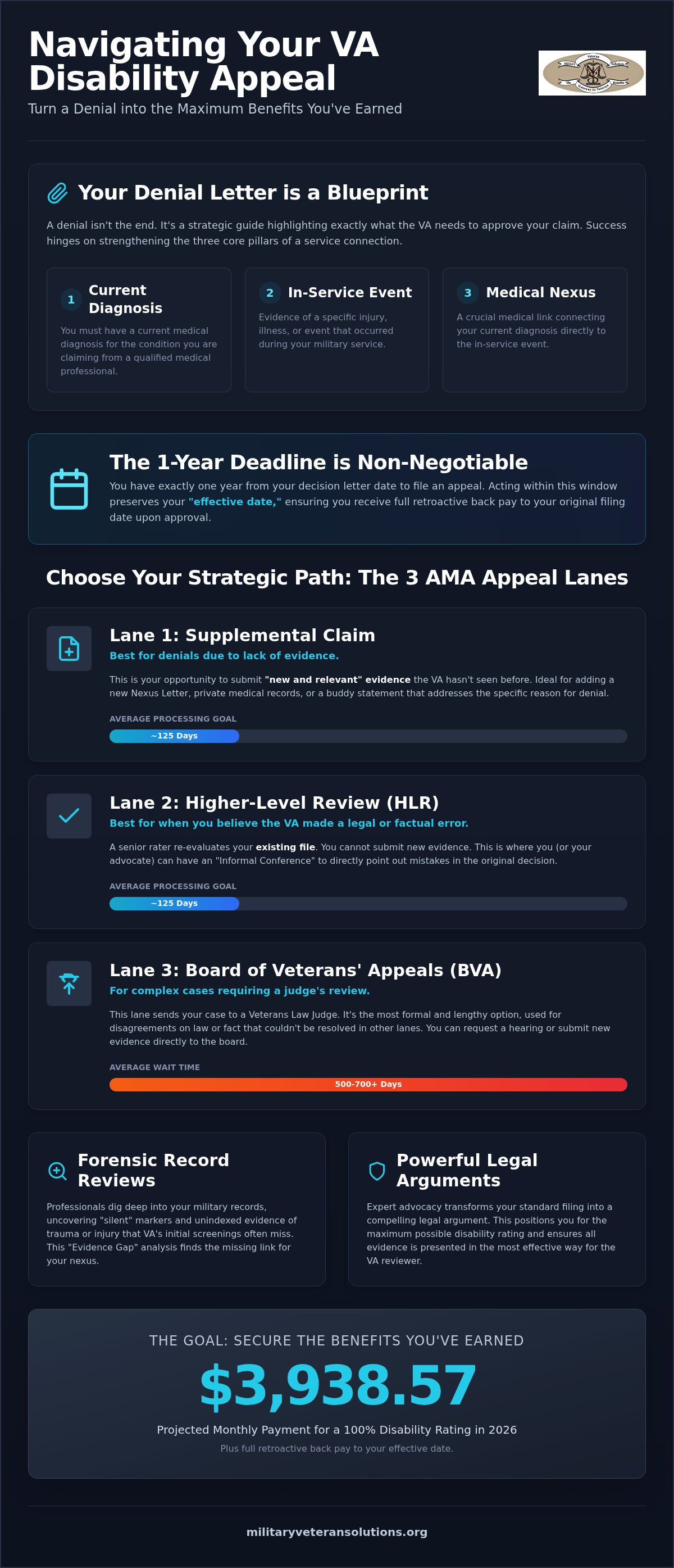
Your VA denial letter isn't a final verdict; it's a roadmap that tells you exactly where the VA thinks your evidence is weak. You've likely spent hours squinting at dense legal jargon, wondering how to prove a "nexus" that feels obvious to you but invisible to a rater. It's exhausting to think about waiting 500 to 700 days for a Board decision while your bills keep coming. Seeking professional filing VA appeals help is often the difference between a stalled claim and a successful service connection.
You deserve more than a generic template. We understand the frustration of feeling like a number in a massive system because we've walked that same path. This guide provides the expert strategies you need to decode that denial letter, find the missing links in your military records, and secure the 2026 disability rates you've earned, including the projected $3,938.57 monthly payment for a 100% rating. We will break down the three AMA appeal lanes and show you how forensic record analysis can turn a "no" into a higher disability percentage with full retroactive back pay.
Key Takeaways
- Learn how to treat your denial as a blueprint by identifying which of the "Big Three" requirements is missing from your file: diagnosis, in-service event, or nexus.
- Navigate the three lanes of the Appeals Modernization Act to determine if you need the fresh evidence of a Supplemental Claim or the expert review of a Higher-Level Review when seeking filing VA appeals help.
- Perform the "Evidence Gap" test to match your specific denial reason with the most effective appeal path, ensuring you don't waste time refiling the same unsuccessful paperwork.
- Discover how forensic record reviews can uncover "silent" markers of trauma in unindexed military records that the VA's initial screening often overlooks.
- Understand why professional advocacy transforms a standard filing into a powerful legal argument, positioning you for the maximum disability rating and full retroactive back pay.
Decoding Your VA Decision Letter: The Foundation of a Successful Appeal
Receiving a VA denial letter feels like a punch to the gut. You served, you suffered an injury, and now a bureaucrat is telling you it didn't happen or doesn't matter. Don't let the frustration lead you to give up. That letter is actually a strategic blueprint. It's a detailed map that shows you exactly where the VA believes your claim is weak. To turn that "no" into a "yes," you must look past the rejection and perform a forensic analysis of the "Reasons for Decision" section.
Winning an appeal requires three specific pillars, often called the "Big Three." First, you need a current medical diagnosis of a disability. Second, you must point to a specific event, injury, or disease that occurred during your military service. Third, and most importantly, you need a "nexus," which is a medical link that connects your current condition to your service. If your letter states you lack a service connection, the VA is usually claiming one of these three pillars is missing. Finding professional filing VA appeals help allows you to identify which pillar is weak so you can fortify it with targeted evidence rather than just refiling the same paperwork.
Identifying the Reason for Denial
Read your letter carefully to distinguish between a "No Service Connection" and a "Low Disability Rating." These are two very different problems. A "No Service Connection" means the VA doesn't believe your military service caused your condition. A "Low Disability Rating" means they agree it's service-connected but think your symptoms aren't severe enough to warrant higher compensation. Check the "Evidence Considered" list at the front of your packet. If you see that a crucial buddy statement or a private medical record is missing from that list, you've found your first major opening for an appeal. The VA can't evaluate evidence they haven't properly indexed.
The 12-Month Deadline: Why Timing is Everything
You have exactly one year from the date on your decision letter to file an appeal. This 12-month window is critical because it preserves your "effective date." As long as you keep your claim active through the Appeals Modernization Act (AMA) lanes within this timeframe, the VA must pay you retroactive benefits back to when you first filed. If you miss this deadline, you may have to start over with a new claim, potentially losing thousands of dollars in back pay. If you have already missed the window, don't panic. We can often help you reopen the case by filing a Supplemental Claim with new and relevant evidence, but acting within the initial year is the most direct path to the benefits you earned.
Navigating the Three Lanes of the Appeals Modernization Act (AMA)
Choosing the right path for your appeal is a tactical decision that dictates how long you'll wait and what evidence you can use. The VA Decision Reviews and Appeals framework offers three distinct lanes. You aren't just filing a protest; you're selecting a legal track. If you choose the wrong lane, you might spend years waiting for a hearing you didn't actually need. Proactive filing VA appeals help ensures you match your specific denial reason to the path of least resistance.
Lane 1: The Supplemental Claim Strategy
The Supplemental Claim lane is your primary tool when the VA denies you based on a lack of evidence. To succeed here, you must submit "new and relevant" evidence. In 2026, "new" means the VA hasn't seen it before, and "relevant" means it addresses the specific reason for your denial. This is the ideal lane for introducing a new Nexus letter or a Disability Benefits Questionnaire (DBQ) that clarifies your symptoms. It's also the correct choice for secondary conditions, such as sleep apnea caused by service-connected PTSD. The VA's goal for processing these claims is 125 days, making it one of the fastest ways to secure a win.
Lane 2: Higher-Level Review (HLR) and Informal Conferences
Sometimes the VA has all the evidence they need but simply made the wrong call. This is where the Higher-Level Review (HLR) becomes your strongest asset. You cannot submit new evidence in this lane. Instead, a senior adjudicator reviews your existing file to see if the original rater made a mistake. We often use the Informal Conference to point out Clear and Unmistakable Errors (CUE) directly to the reviewer. This conversation allows us to argue why your 70% rating should actually be 100% based on the records already in their system. It's a high-stakes lane that requires a deep understanding of VA regulations.
The third option is the Board of Veterans’ Appeals (BVA). This is the "courtroom" lane where a Veterans Law Judge reviews your case. Be prepared for a marathon. As of early 2026, the average wait for a Direct Review decision is approximately 506 days. If you request a hearing, that timeline can easily stretch beyond 730 days. Most veterans don't need the Board; they just need better evidence at the local level. However, if your case involves complex legal questions, the Board is the final authority. You can switch lanes if an initial appeal fails, provided you act within one year to maintain "continuous pursuit." Seeking professional veteran claims representation can help you navigate these lanes without losing your original effective date or your sanity.
Strategic Evidence Selection: Choosing the Best Path for Your Appeal
Success in a VA appeal isn't about how much paperwork you file; it's about the quality and relevance of the evidence you select. Many veterans make the mistake of simply resubmitting the same records, hoping for a different result. This rarely works. To win, you must apply the "Evidence Gap" test. Ask yourself: did the VA miss a fact that is already in my file, or is there a piece of information that simply doesn't exist in my records yet? Determining the answer to this question is the first step in getting the right filing VA appeals help.
The ultimate goal of your strategy is to preserve your "Effective Date." This date determines how much back pay you receive once your claim is finally granted. By choosing the correct lane and maintaining "continuous pursuit" within one year of each decision, you keep that original date alive. If you choose a lane that doesn't fit your evidence, you risk a second denial that eats away at your timeline and delays your access to the 2026 cost-of-living adjusted benefits.
When to Choose a Supplemental Claim Over an HLR
Choosing between these two lanes depends entirely on the nature of the VA's error. If your medical records clearly show a diagnosis but the rater simply overlooked it, a Higher-Level Review (HLR) is your best tool. However, if the VA denied you because a C&P examiner claimed your condition isn't service-connected, you usually need a Supplemental Claim. This lane allows you to introduce new private medical opinions or buddy statements to counter a flawed exam. Under the 2026 standard, new and relevant evidence is information the VA has not previously considered that tends to prove or disprove a matter at issue in your claim. This strategic addition of fresh proof is often what finally bridges the gap to a successful service connection.
The Board Appeal: Direct Review, Evidence, or Hearing?
If local options fail, you may need to escalate your case to the Board of Veterans' Appeals. This path involves a risk vs. reward calculation based on current 2026 wait times. You have three sub-options at the Board:
- Direct Review: The fastest path, currently averaging 506 days. A Judge reviews only the evidence that was already in your file.
- Evidence Submission: Allows you to add new records within 90 days of your appeal. This lane often takes 550 to 713 days.
- Hearing: You speak directly to a Judge. While powerful, this is the slowest track, often taking 730 days to over five years.
A veteran appeals representative is vital here. We help you decide if the long wait for a hearing is worth the potential reward or if a faster Direct Review can secure your back pay more efficiently. Most cases can be won at the Supplemental or HLR level, but when the Board is necessary, a forensic approach to your military records is what wins the day.
Forensic Military Record Reviews: Finding the Missing Link
The VA often claims your records are missing the evidence needed to prove your claim. In reality, those records aren't lost; they're simply unindexed and buried under thousands of pages of digital noise. When a VA rater spends only minutes reviewing your file, they miss the "silent markers" of your injury. Forensic record review is the process of digging through every sick call slip, performance report, and personnel file to find the proof the VA overlooked. This level of detail is exactly why specialized filing VA appeals help is vital for overturning a denial.
We've spent over 25 years navigating these complex systems. We know that a "lost" record is usually just a record that wasn't properly labeled in your C-file. By auditing your personnel records alongside your medical history, we can often find evidence of stressors or injuries that the VA's automated systems simply cannot detect. This forensic approach ensures that no piece of your history is left behind.
Auditing Your Service Treatment Records (STRs)
A successful appeal often relies on connecting a minor in-service event to a current chronic condition. We look for patterns that the VA ignores. A single visit to sick call for a "sore back" might be the only evidence of the stressor that caused your degenerative disc disease today. We also analyze profile changes and temporary duty restrictions. These documents prove that your injury was severe enough to impact your service, even if you "toughed it out" for the rest of your enlistment. Lay statements from buddies or family members then act as the bridge, documenting how that minor complaint never truly went away after you took off the uniform.
Building the Nexus: The Bridge to Your Benefits
The Nexus is the legal "glue" that binds your current disability to your time in service. Without it, your claim will fail every time. A professional analysis of your decision letter often reveals that the VA conceded your diagnosis and your in-service event but denied the claim because there was no medical link between them. This is a Nexus failure. Identifying this gap requires more than just a quick glance. It requires a forensic audit of your entire military history. We look at your DD-214 and performance reports to verify stressors or show a decline in performance that aligns with an injury. Military Veteran Solutions, LLC specializes in identifying the specific evidence that supports a medical Nexus, ensuring your doctor has the facts needed to write a winning opinion. If you're tired of being told the evidence isn't there, it's time for a professional military record review to find the truth hiding in your file.
Why Professional Advocacy is Your Greatest Asset in the Appeal Process
Filing a form is a simple administrative process; winning an appeal is a complex legal strategy. While the VA provides the framework for reviews, they do not provide a guide on how to successfully challenge their own errors. Many veterans who attempt to navigate this system alone find themselves trapped in a cycle of repetitive denials because they aren't equipped to identify the specific legal logic used by raters. Professional filing VA appeals help shifts the power dynamic. It moves you from a position of defense to a position of informed offense, where every argument is backed by the exhaustive forensic record reviews we’ve already established as essential for victory.
The value of an expert advocate lies in their ability to see what the VA chooses to ignore. We don't just look for what is in your file; we look for what should be there and isn't. This specialized oversight ensures that your appeal isn't just another stack of papers, but a targeted strike against the specific reasons for your denial. By utilizing our virtual consultation model, veterans across the United States can access high-level expertise without the need for travel or local office visits. This accessibility ensures that the same standard of dedicated representation is available to you, regardless of your location.
The Military Veteran Solutions, LLC Advantage
Our firm brings a unique blend of 25 years of professional experience and the firsthand perspective of a 10-year Army veteran. We understand that behind every claim number is a person who sacrificed their health for their country. This isn't a high-volume call center environment. We provide personalized advocacy that treats your case with the gravity it deserves. Because our founder is a disabled veteran, we approach the forensic record review process with a level of peer-mentor empathy that traditional law firms often lack. We know the stakes because we’ve lived them.
Starting Your Appeal with Confidence
The first step in overturning a denial is understanding exactly why it happened. During your initial virtual consultation, we perform a deep-dive analysis of your decision letter to build a custom roadmap for your appeal. We don't guess which lane is best; we use the evidence to dictate the path forward. Whether we’re identifying missing stressors in your personnel file or drafting a strategy to counter a flawed C&P exam, we handle every detail with organized efficiency. You’ve already done the hard work of serving. Now, let us do the hard work of ensuring the system works for you.
Reach out to Military Veteran Solutions, LLC today for filing VA appeals help and take control of your claim’s future. We’re ready to help you secure the maximum disability rating and the retroactive back pay you’ve earned.
Take Decisive Action on Your VA Appeal Today
Your denial letter is a hurdle, not a wall. You now understand how to treat that document as a blueprint for victory by identifying evidence gaps and selecting the right AMA lane to protect your effective date. Whether your case requires a Supplemental Claim to introduce fresh medical opinions or a Higher-Level Review to correct a rater's oversight, success depends on tactical precision. Forensic record review remains the most powerful tool for uncovering the "silent markers" of injury that the VA's initial screening often overlooks.
Navigating these complex administrative hurdles is exhausting, but you don't have to fight this battle alone. Seeking professional filing VA appeals help ensures your military history is analyzed with the depth and care it deserves. We've spent decades helping veterans bridge the gap between a denial and a successful service connection. It's time to stop guessing and start advocating with a clear, evidence-based strategy.
Secure your earned benefits with a professional VA decision letter analysis from Military Veteran Solutions, LLC. As a firm founded by a 10-year Army Veteran with over 25 years of advocacy experience, our expert forensic record review specialists are dedicated to your success. You stood for your country; now, let us stand for you. Your path to a higher rating and retroactive back pay starts today.
Frequently Asked Questions
How long do I have to file a VA appeal after a denial?
You have exactly one year from the date printed on your VA decision letter to file an appeal. This 12 month window is critical for preserving your effective date, which is the date the VA uses to calculate your retroactive back pay. If you miss this deadline, you lose the ability to keep your initial claim active and may forfeit thousands of dollars in earned benefits.
Can I submit new evidence during a Higher-Level Review?
No, you cannot submit new evidence when choosing the Higher-Level Review (HLR) lane. This track is strictly for a senior adjudicator to review the evidence that was already in your file at the time of the prior decision. If you've discovered new medical records or obtained a new Nexus letter, you must file a Supplemental Claim instead to ensure that evidence is considered.
What is the difference between a Supplemental Claim and a Board Appeal?
A Supplemental Claim is reviewed by the local regional office and requires you to submit "new and relevant" evidence. A Board Appeal sends your case to a Veterans Law Judge at the Board of Veterans' Appeals. While the Board has more legal authority to overturn complex denials, the wait times in 2026 often exceed 500 days, whereas the VA's processing goal for Supplemental Claims is just 125 days.
How do I find a VA-accredited representative to help with my appeal?
You can search for accredited attorneys, claims agents, and Veterans Service Officers through the VA's official Office of General Counsel database. Many veterans also find success with private advocacy firms that specialize in military record reviews. Seeking professional filing VA appeals help from a firm that understands the forensic side of medical evidence can significantly improve your chances of a successful outcome.
What should I do if my VA disability claim is denied for 'no service connection'?
You must identify which part of the "Big Three" requirements is missing: the diagnosis, the in-service event, or the medical link between them. Most "no service connection" denials are the result of a missing Nexus. You should analyze your decision letter to see if the VA acknowledged your injury but simply didn't see the connection, then use forensic record reviews to find the proof they missed.
How much does it cost to get help with filing a VA appeal?
Most accredited agents and attorneys work on a contingency fee basis, which means they're only paid if your appeal is successful. Their fee is typically a percentage of the retroactive back pay the VA awards you. This structure allows veterans to access high-level filing VA appeals help without paying large upfront costs, as the representative's interests are directly aligned with winning your case.
Can I appeal a VA decision if more than a year has passed?
Yes, but you generally cannot preserve your original effective date for back pay purposes. To reopen a claim after the one year deadline, you must file a Supplemental Claim with "new and relevant" evidence. While this establishes a new effective date, it's a vital path for veterans who have new medical proof for a condition that was denied years ago.
What is a 'Nexus Letter' and do I need one for my appeal?
A Nexus Letter is a formal medical document where a doctor provides their professional opinion that your disability is "at least as likely as not" caused by your military service. You almost certainly need one if your denial was based on a lack of service connection. A strong Nexus Letter uses evidence from your service treatment records to bridge the gap between your time in uniform and your current diagnosis.


