
What if the latest VA average still can’t tell you when your decision will arrive? If you’re asking how long does a supplemental claim take, the honest answer is that there’s no guaranteed decision date. Your claim may move faster or slower depending on the evidence and whether the VA needs additional information or follow-up.
It’s understandable to want a clear estimate, especially if you’re unsure whether your documents were received or whether a delay signals a problem. The VA’s reported average for supplemental claims was 58.7 days in August 2026, while its stated goal is to complete non-healthcare-related supplemental claims within 125 days. These figures offer context, not a promise about your individual case.
This 2026 guide explains how to interpret processing-time estimates, what can affect your timeline, and how to check your claim status. You’ll also learn what to do if the VA requests more information and how to keep track of the evidence you submitted. A longer wait alone doesn’t tell you what decision the VA will make, but staying organized can help you spot and respond to requests.
Key Takeaways
- There’s no guaranteed date for a decision. When considering how long does a supplemental claim take, remember that a VA-wide average can’t predict your individual timeline.
- Check your claim status through VA.gov and review official correspondence for updates or requests that need your attention.
- Incomplete submissions, complex records, requested examinations, and unanswered VA correspondence may affect how long the review takes.
- Keep copies of submitted documents, confirm your contact details, and respond to VA requests by the stated deadlines.
- A careful review of your VA decision letter can help you understand possible next steps, but it can’t promise a faster decision or a particular outcome.
How long does a VA supplemental claim take in 2026?
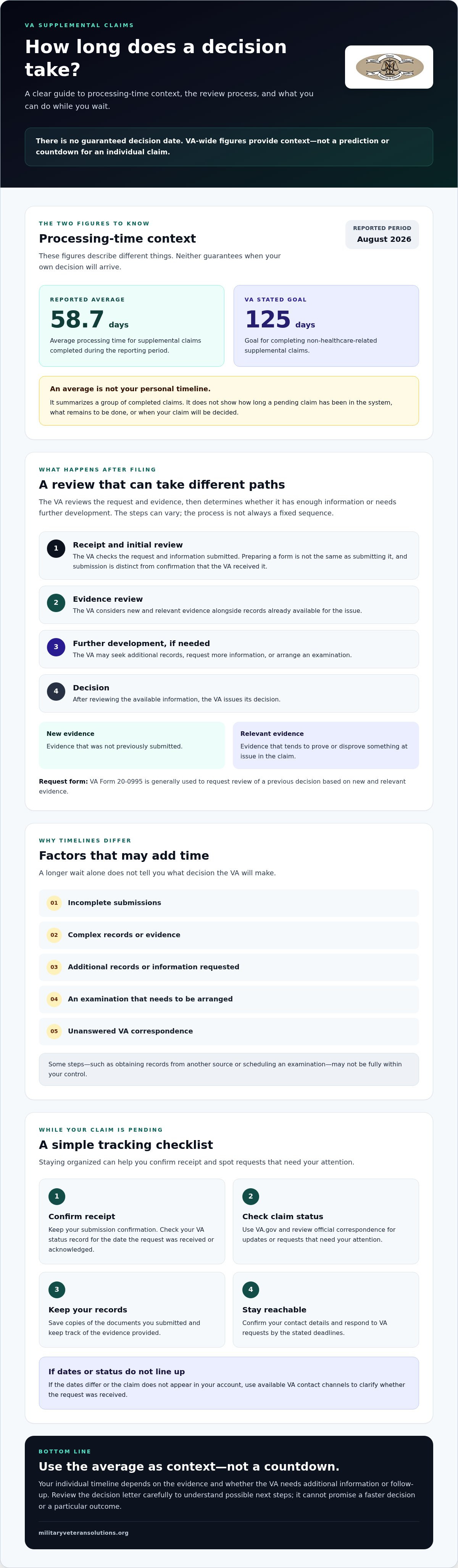
If you’re asking how long does a supplemental claim take, there’s no guaranteed decision date. The VA reported an average processing time of 58.7 days for supplemental claims for disability compensation or pension benefits in August 2026. That figure describes claims completed during the reporting period. It isn’t a deadline or prediction for your case. The VA’s stated goal for non-healthcare-related supplemental claims is 125 days.
For a quick overview of the VA’s role in administering benefits, see this Veterans Benefits Administration (VBA) reference. To hear a discussion focused on supplemental-claim decision timing, watch:
What does the VA’s average processing time actually mean?
An average summarizes the time taken for a group of completed claims. It can change from one reporting period to another, and it doesn’t show how long a pending claim has been in the system or what remains to be done in your case.
A VA-wide average describes completed claims as a group; it is not an estimate of when an individual veteran will receive a decision. Treat the August figure as context, not a countdown. Your timeline may depend on the evidence submitted, the complexity of the records, and whether the VA needs further development, such as requesting records or arranging an examination.
When does the supplemental-claim wait begin?
A supplemental claim asks the VA to review a previous decision based on new and relevant evidence. Veterans generally submit the request using VA Form 20-0995. Preparing the form and evidence isn’t the same as submitting the request, and submission is distinct from confirmation that the VA received it.
Don’t assume there’s one start date that applies to every claim without checking current VA guidance. Keep your submission confirmation and check your VA status record for the date the request was received or acknowledged. If the dates differ, or the claim doesn’t appear in your account, use the available VA contact channels to clarify receipt. A professional review of your decision letter may also help you understand what evidence addresses the prior decision, but it can’t control VA processing speed.
What happens after you file a VA supplemental claim?
After the VA receives your request, it reviews the submission and evidence connected to the issue. It may assess records already in your file, then determine whether it has enough information to make a decision or needs further development. The steps can vary, so the process doesn’t always follow a simple, fixed sequence.
The VA’s page on filing a Supplemental Claim explains the review option and filing requirements. In broad terms, the process may include:
- Receipt and initial review: The VA checks the request and information submitted.
- Evidence review: The VA considers the new evidence alongside relevant records already available.
- Further development, if needed: The VA may seek additional records or request an examination.
- Decision: After reviewing the available information, the VA issues its decision.
A request for records, more information, or an examination can add time. Some steps, such as scheduling an examination or obtaining records from another source, aren’t fully within your control. That’s one reason the answer to “how long does a supplemental claim take” can vary even when two requests concern similar issues.
How new and relevant evidence affects review
A supplemental claim asks the VA to review a previously decided issue using evidence that is new, meaning it wasn’t previously submitted, and relevant, meaning it tends to prove or disprove something at issue in the claim. VA Form 20-0995 is used to request this review. Check the current form instructions and VA guidance as you prepare your submission.
For example, if a prior decision identified a missing connection between a condition and service, evidence that addresses that specific issue may be more useful than unrelated documents. Sending a larger stack of records doesn’t automatically speed up review. Make the evidence easy to identify and connect it to the reason for the prior decision. For broader context on review options, read this guide to filing VA appeals and overturning denials.
Why evidence requests or examinations may add time
If the VA asks you for information, read the notice carefully and respond by any deadline it gives. An unanswered request can leave the record incomplete or delay the next step. Keep copies of what you send and note the submission date. You may not control how long outside records take to arrive or when an examination can be scheduled.
Preparing evidence is one part of the process; the VA’s review and any additional development happen afterward. If you need help understanding a decision or possible next steps, you can explore VA decision-letter analysis and virtual consultations. This support can help clarify your options, but it can’t determine VA processing speed or guarantee an outcome.
What can make a supplemental claim take longer?
No single delay factor determines every claim’s timeline, and an outside representative can’t reliably predict the VA’s workload or administrative routing. Some steps are within your control, such as checking that your submission is complete and responding to official requests. Others, including VA review and examination scheduling, depend on the VA or outside record providers.
| Possible delay factor | What you can reasonably do |
|---|---|
| Incomplete submission or unclear evidence | Review the form instructions and organize relevant records so they address the issue under review. Keep a copy of everything you submit. |
| Complex or extensive records | Make your supporting documents easy to identify and understand. Note which issue each record relates to instead of sending materials without context. |
| Requested examination | Watch for examination notices, confirm the appointment details, and follow the instructions provided. Scheduling is not entirely within your control. |
| Unanswered VA correspondence | Read each notice carefully and respond by any stated deadline. If you’re unsure what’s being requested, use official VA channels to clarify. |
| VA workload or administrative routing | Check official status updates and keep your contact details current. You can’t control how the VA assigns or routes a claim. |
Which parts of the timeline can you influence?
Prepare a clear, relevant submission, double-check that required information is included, and retain proof of what you sent. If the VA asks for something, respond promptly and save a copy of your reply. These steps can help avoid preventable gaps, but they can’t guarantee a faster review. The VA’s workload, internal handling, and decisions about further development remain outside your control.
Does a long wait mean your claim is in trouble?
No. Elapsed time alone doesn’t establish that the VA has found a problem or indicate whether the claim will be approved or denied. Online status information can summarize progress without showing every internal review action. Check your account and correspondence for requests, and confirm the VA has your current mailing address and contact information. You can check your VA claim status through the official status tool.
If you’re still wondering how long does a supplemental claim take, focus on steps you can verify rather than trying to infer a decision from a quiet status page. A review of your VA decision letter may help clarify the issues and possible next steps. You can learn about VA decision-letter analysis and virtual consultations from Military Veteran Solutions, LLC. This support doesn’t control the VA’s timeline or guarantee an outcome.
How to check your claim status and respond to delays
If you’re unsure what’s happening with your supplemental claim, start with the VA’s own records. Status information can help you spot a request that needs attention, but it may not describe every internal review action. Check regularly and keep your own notes so you can track what you’ve submitted and when.
What to check in your VA claim status
- Open the official status tool. Sign in to VA.gov’s claim status tool or use the VA mobile app, if available to you.
- Confirm the claim is listed. Check that the supplemental claim appears in your account, then note the displayed status and last update. If it isn’t visible, confirm your submission details and contact the VA to ask about receipt.
- Review correspondence and requested actions. Look for letters, evidence requests, or examination instructions. Read each notice carefully, including any response date, and follow the directions provided.
- Check your contact details. Make sure the VA has your current mailing address and other contact information so you can receive updates and requests.
- Keep a dated record. Note when you check, submit documents, receive notices, or speak with the VA. Save confirmation details and copies of correspondence.
What to do if the claim appears stalled
A status that hasn’t changed doesn’t necessarily mean no work is happening. First, check VA.gov, the mobile app, and recent correspondence for a newer update or an action you may have missed. If the claim still doesn’t appear to be moving, contact the VA through an official channel, such as the VA benefits hotline at 800-827-1000, and ask whether anything is needed from you or whether the status can be clarified.
Keep the conversation focused: have your claim details available, ask what action, if any, is outstanding, and write down the date and response. Don’t assume a delay means your claim is in trouble. An outside representative can’t reliably predict the VA’s response time or control its workload.
If your question is about what evidence addresses a prior decision, reviewing that decision letter or your records may help clarify possible next steps. Military Veteran Solutions, LLC offers VA decision-letter analysis and virtual consultations for veterans seeking this kind of guidance. This is optional support, separate from checking your claim directly with the VA, and it doesn’t guarantee a faster decision.
What to do while waiting for a supplemental-claim decision
Waiting can feel like being stuck between steps, but you can use the time to keep your records organized and prepare to understand the decision when it arrives. You can’t control the VA’s review schedule, and preparing for possible outcomes doesn’t mean assuming what the decision will say.
- Monitor official correspondence. Check VA.gov and the contact methods associated with your claim for updates or requests.
- Meet any stated deadlines. If the VA asks for information or action, read the notice carefully and follow its instructions by the date provided.
- Keep a complete file. Store the filed request, evidence, submission confirmations, and VA letters together. Keep notes of important dates and communications.
- Keep information current. Check that the VA has your current contact details so you don’t miss a notice.
Prepare for the VA’s decision without guessing the outcome
Use your copy of the claim to remind yourself which issue the VA is reviewing and what evidence you submitted. Write down questions you may want answered after the decision arrives, such as which evidence the VA discussed and how it explained its conclusion. Avoid sending duplicate records just to add more material. If you’re considering sending anything else, make sure it’s relevant to the issue and follow the VA’s instructions for submitting evidence.
When the decision arrives, read the full letter and save it with your claim records. Focus on the reasons the VA gives and any next-step information in the notice. The letter, rather than the time spent waiting, explains the decision and the options it describes. If parts of the record or reasoning are difficult to understand, a VA decision-letter and evidence review may help you identify what the decision says and what questions to consider next.
When professional claim review may help
A professional review can help you examine the stated reasons for a decision, connect them to the evidence in the record, and understand possible next steps. It may also help you prepare questions if the VA’s explanation is unclear. Support with reviewing a decision or evidence doesn’t control VA processing time, guarantee approval, or determine the outcome.
If a consultation would help you understand your options, explore virtual veteran claims consultations. You can also continue checking official VA updates and keep your claim documents together while you wait.
Stay prepared while your claim moves forward
There’s no guaranteed date for a VA supplemental-claim decision. If you’re still asking how long does a supplemental claim take, remember that processing averages provide context, not a personal forecast. The evidence and any additional development can affect the timeline, while the VA’s workload and review process are outside your control.
Keep your claim documents and VA correspondence organized, check for updates, and respond to requests by the stated deadline. A quiet status alone doesn’t reveal the outcome. Once the decision arrives, read the letter carefully to understand the VA’s reasoning and the next steps it describes.
Military Veteran Solutions, LLC provides VA decision-letter analysis and military-record reviews. The company was founded by a disabled veteran who served ten years in the U.S. Army. If you’d like help understanding your decision or possible next steps, explore virtual veteran claims consultations. You don’t have to sort through the process alone, and informed preparation can help you move forward with greater clarity.
Frequently Asked Questions
Can I check the status of my supplemental claim online?
Yes. Sign in to VA.gov and use the claim status tool to look for your supplemental claim, its displayed status, and available updates. Review your VA correspondence as well, since a letter or examination request may require action even if the status summary doesn’t show every detail. You can also check through the VA mobile app. Keep a dated record of updates and anything you submit.
What happens after I file VA Form 20-0995?
After the VA receives Form 20-0995, it reviews the request and evidence, including relevant records already in your file. The VA may decide it has enough information or needs additional records, information, or an examination before deciding the claim. The form requests a supplemental review based on new and relevant evidence. Watch for VA notices and follow any instructions or response dates they provide.
Does submitting more evidence make a supplemental claim faster?
No. Sending more documents doesn’t automatically speed up a decision. Focus on evidence that is new and relevant, meaning it wasn’t previously submitted and helps prove or disprove an issue in the claim. Organize records so their connection to the issue is clear, and follow the VA’s submission instructions. Unrelated or duplicate material may not clarify the record, so prioritize relevance over volume.
What should I do if my supplemental claim is taking longer than expected?
First, check your VA.gov account and correspondence for status changes or requests that need your response. Confirm the VA has your current contact information, and keep copies of your submission and any later documents. If you can’t confirm receipt or need clarification about a requested action, contact the VA through an official channel, such as the benefits hotline at 800-827-1000. A longer wait alone doesn’t show whether something is wrong.
Can a representative make the VA decide my supplemental claim faster?
No representative can control the VA’s workload, routing, or decision schedule, and representation can’t guarantee a faster decision or a particular outcome. A representative may help you understand the prior decision and review how submitted evidence relates to the issue. If you’re uncertain about the reasons for a decision or what records matter, VA decision-letter analysis or a virtual consultation may help clarify possible next steps.
Does a supplemental claim take longer if the VA requests an examination?
An examination can add time because it introduces another step before the VA can complete its review. Scheduling may depend on factors outside your control, so there’s no fixed number of days to add. Read the examination notice, confirm the details, and follow its instructions. Continue checking official correspondence for updates, and contact the VA if you’re unsure whether an action is required from you.


