
Pain may prompt you to file, but it won’t establish every part of your VA claim for plantar fasciitis. A strong claim generally needs evidence of a current condition, an in-service event or onset, and a supported connection between the two. The rating criteria also consider treatment response, so a record that describes symptoms but not treatment or its effects may leave important questions unanswered.
If you’re unsure which records matter or worry that a VA decision doesn’t reflect your day-to-day limitations, you’re not alone. Medical notes, service records, and your own account can each help explain a different part of the claim. The key is to connect the evidence into a consistent timeline.
This guide explains the basic requirements for service connection, the records and lay evidence that may support your case, and how VA evaluates plantar fasciitis under its rating criteria. You’ll also learn the main filing steps and how to review a decision for possible gaps or next steps. A careful evidence review can help you see what the record establishes and what may need clarification.
Key Takeaways
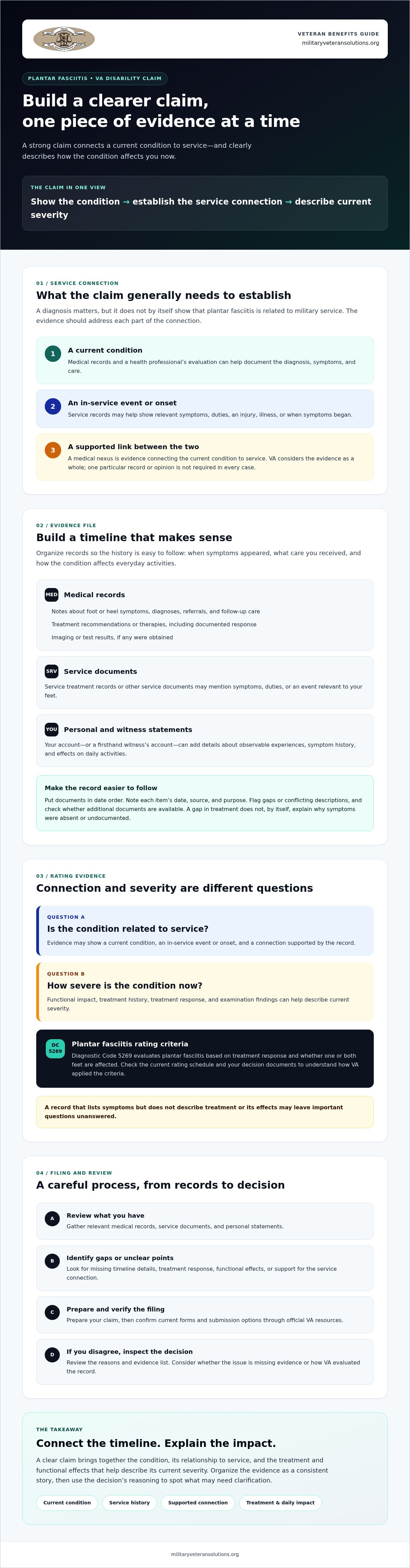
- A VA claim for plantar fasciitis generally needs evidence of a current condition, an in-service event or onset, and a supported link between them.
- Organize relevant medical records, service documents, and personal statements to show symptom history, treatment, and effects on daily activities.
- Diagnostic Code 5269 evaluates plantar fasciitis based on treatment response and whether one or both feet are affected. Check the current criteria when reviewing a possible rating.
- Before filing, review your records, identify missing evidence, prepare your claim, and confirm current forms and submission options through official VA resources.
- If you disagree with a decision, examine its reasons and evidence list to determine whether the issue is missing evidence or how VA evaluated the record.
What a VA Claim for Plantar Fasciitis Must Establish
Plantar fasciitis affects the thick band of tissue along the bottom of the foot that helps support the arch. It can cause heel or arch pain, but general information can’t determine what is causing your symptoms. A health professional’s evaluation and your medical records help establish your individual diagnosis. For a plain-language medical overview, see Plantar fasciitis.
A diagnosis is important, but it doesn’t by itself show that the condition is related to military service. In general, a disability claim must establish three elements:
- A current disability or diagnosed condition.
- An event, injury, illness, or onset of symptoms during service.
- Evidence supporting a connection between the current condition and service.
Generally, a disability claim requires evidence of a current condition, an in-service event or onset, and a supported link between the two.
To learn more about the condition and VA disability claims, watch this video:
How service connection applies to plantar fasciitis
Symptoms may have started during service, or the condition may relate to a documented event or the demands of service. Records created at the time can help show when symptoms appeared, but evidence varies from case to case. A medical nexus is evidence connecting your current condition to service. VA considers the evidence as a whole, so don’t assume that one particular record or type of opinion is required in every case.
What the VA evaluates after service connection
Service connection and the disability rating are separate questions. After deciding whether the condition is related to service, VA evaluates its severity under the applicable rating criteria. Functional impact, treatment history, and examination findings may help explain the condition and its effects. For plantar fasciitis, Diagnostic Code 5269 addresses evaluations based on treatment response and other criteria. Check the current rating schedule and your decision documents to understand how VA applied them.
For a VA claim for plantar fasciitis, keep the questions distinct: what evidence supports the connection to service, and what evidence describes the condition’s current severity? That distinction can help you identify which part of the record may need attention.
Build Evidence for a VA Plantar Fasciitis Claim
A well-organized record makes it easier to follow the history of your foot condition: when symptoms appeared, what care you received, and how the problem affects everyday activities. No single checklist fits every case, and some records may not exist or apply. Gather what’s relevant, then note any gaps rather than assuming a missing document ends the claim.
Medical and service records to gather
Start with records that may show diagnosis, symptoms, and treatment over time. A clinician’s assessment can help document the condition; Johns Hopkins Medicine also explains what may be involved in diagnosing plantar fasciitis. Depending on what’s available and relevant, consider gathering:
- Medical notes documenting foot or heel symptoms, diagnoses, referrals, and follow-up care.
- Records of treatment and response, such as recommendations or therapies documented by your provider.
- Imaging or test results, if any were obtained. Don’t assume imaging is necessary for every claim.
- Service treatment records or other service documents that mention symptoms, duties, or an event relevant to your feet.
Put the documents in date order. Note the date, source, and purpose of each item, then flag gaps, conflicting descriptions, or periods without records. Check whether additional documents are available. Consistency across records can clarify the timeline, but a gap in treatment doesn’t by itself explain why symptoms were absent or undocumented.
Document symptoms and functional effects clearly
Medical records are one part of the picture. Your own statement, or a witness statement from someone with firsthand knowledge, may add details about observable experiences. Lay evidence can describe what someone saw or experienced. It generally shouldn’t be presented as a substitute for a clinician’s diagnosis or opinion about cause.
Be specific and factual. Describe when you recall symptoms beginning, how often they occur, and which activities are affected. For example, explain that heel pain makes standing through a work shift difficult, or that you need to pause during a walk. Avoid unsupported medical conclusions. Instead of asserting that a particular duty caused the condition, describe the duty, when symptoms appeared, and what you noticed.
Medical records, service records, and lay statements can complement one another by documenting the condition, its service history, and its observable effects. For a VA claim for plantar fasciitis, arrange these materials so the timeline is easy to follow, and note what each item helps establish.
If you want help identifying record gaps, you can explore veteran claims representation as a possible next step.
Understand Plantar Fasciitis VA Ratings and Examination Evidence
After service connection is established, VA evaluates how the condition meets the rating schedule. Plantar fasciitis is listed under Diagnostic Code 5269 in the current VA Schedule of Ratings for the Musculoskeletal System. The criteria distinguish between one or both feet and whether treatment has relieved the condition. VA applies the governing schedule to the evidence in your individual record, not to a rating estimate alone.
What Diagnostic Code 5269 says
The schedule assigns ratings based on the criteria below. Examples in the final column are records that may help explain relevant facts. They aren’t separate rating requirements or a promise of a particular evaluation.
| Rating criteria | Evidence that may be relevant |
|---|---|
| 10%: Unilateral or bilateral plantar fasciitis that is responsive to treatment. | Treatment notes describing care and the recorded response. |
| 20%: Unilateral plantar fasciitis that is not responsive to both nonsurgical and surgical treatment. | Records documenting the affected foot, treatment history, and response. |
| 30%: Bilateral plantar fasciitis that is not responsive to both nonsurgical and surgical treatment. | Records showing both feet are affected and documenting treatment response. |
| 40%: Actual loss of use of the foot. | Evidence relevant to whether the regulatory loss-of-use standard is met. |
The regulation also addresses veterans for whom a provider recommends surgery but who aren’t surgical candidates. They’re evaluated under the 20% or 30% criteria, depending on whether the condition is unilateral or bilateral. The 40% criterion is specifically for actual loss of use, not simply severe pain. Review the current regulation and your decision documents to see how VA applied the criteria.
How to prepare for a plantar fasciitis C&P examination
An examination may help VA assess symptoms, treatment response, and functional effects. Describe your experience accurately, including which foot is affected, how symptoms vary, what treatment you’ve tried, and how the condition affects standing, walking, or other activities. If symptoms flare or change, explain the pattern and give concrete examples. Don’t minimize limitations, but don’t overstate them either.
Before the exam, review your relevant records and be ready to identify important treatment or test results. An examination doesn’t guarantee a particular finding or rating. If you later notice that the report or record appears incomplete or inaccurate, identify the specific issue and consider submitting relevant information through the appropriate VA procedure. Keep copies of what you submit, and check your decision documents to see how VA addressed the evidence.
A VA claim for plantar fasciitis should be evaluated against both the applicable criteria and the facts documented in the record. A careful review can help you identify whether the key question is treatment response, which foot is affected, or evidence concerning loss of use.
File a VA Claim for Plantar Fasciitis Step by Step
A clear filing process helps keep your records, claim details, and follow-up in order. The right evidence and submission route can vary with your service history and claim circumstances, so use these steps as a framework, not as a guarantee that one package will fit every case.
- Review your records. Bring together relevant medical documentation and service records. Check whether the timeline is clear, from when symptoms appeared to any diagnosis and care you received. If service records are difficult to locate or need closer review, a professional military record review may help you understand what the documents show.
- Identify gaps. Note missing dates, unclear descriptions, or records you may still be able to obtain. Consider whether additional documents or firsthand statements could clarify your history. Don’t add material simply to make the file longer. Focus on what is relevant to your claim.
- Prepare the application. Describe plantar fasciitis and its service-related history in plain, accurate language. Include dates when you know them, identify the foot or feet affected, and explain how the condition has changed over time. VA’s application for disability compensation is Form 21-526EZ, but check VA.gov for the current form and instructions before completing it.
- Submit through a current VA option. VA accepts claims online, by mail, or in person at a VA regional office, according to current filing guidance. Verify available methods, where to send documents, and which supporting materials apply to your circumstances on official VA resources before submitting. If you’re considering an intent to file, confirm the current rules and one-year completion period with VA.
- Keep records and track updates. Save a copy of the application and every document you submit. Monitor official VA communications for status updates, requests for information, or an examination notice. Respond to requests promptly, and keep proof of what you send. Processing times can vary, so rely on official updates rather than assuming a decision date.
Before submitting, check that your application and supporting documents tell a consistent story. A careful review can help you catch missing details, but it can’t ensure a particular decision. Confirm current forms, filing options, and instructions directly with VA, since those details may change.
If you’d like support reviewing your records or preparing your next steps, explore veteran claims representation.
If the VA Denies or Underrates Your Plantar Fasciitis Claim
A denial or rating that feels too low can be discouraging. Before choosing what to do next, read the decision letter closely. It explains VA’s findings, the evidence considered, and the reasons for the decision. Use that explanation to identify whether the issue concerns service connection, the evaluation of severity, or information VA may not have considered.
Find the issue in the VA decision
Compare the decision’s reasoning with your claim and submitted records. If service connection was denied, check how VA addressed the current condition, relevant service history, and evidence connecting the two. If you disagree with the rating, compare the findings with the applicable criteria under Diagnostic Code 5269 and the examination information discussed in the letter.
Make a short list of specific concerns: a record you submitted that isn’t mentioned, a factual detail that appears incorrect, or a conclusion that doesn’t explain how the evidence was weighed. Separate disagreement with VA’s interpretation of the existing record from a situation where you have additional relevant evidence to provide. For broader guidance on review paths, consult a reliable guide to filing VA appeals.
Decide whether to seek claim or appeal support
The appropriate next step depends on the decision, the evidence available, and the review options and deadlines that apply to your case. VA review processes can include routes for asking the agency to reconsider a decision based on the existing record, submitting new and relevant evidence, or requesting review by the Board of Veterans’ Appeals. The rules and requirements differ. Check your decision letter and current official VA guidance before selecting a route, and act promptly so you don’t overlook a deadline.
If you have additional evidence, identify what it establishes and how it addresses the reason for the decision. If you believe VA overlooked or misread evidence already in the file, focus your explanation on the specific passage or document. Avoid sending a broad disagreement without connecting it to the findings you’re challenging.
Military Veteran Solutions, LLC reviews VA decision letters and records and offers virtual consultations. A focused review may help you understand the decision and consider possible next steps, but it can’t guarantee a reversal or a higher rating. If you’d like to discuss your case, consider requesting a consultation with Military Veteran Solutions, LLC and have the decision letter and relevant records available for review.
Take the Next Step With a Clearer Claim
A well-supported VA claim for plantar fasciitis should connect your current condition to service and clearly document its effects. Organize relevant medical, service, and lay evidence, then check the rating criteria and explain how treatment and symptoms affect your daily function. If VA has already decided your claim, review the letter closely and confirm which review options and deadlines apply before taking action.
You don’t have to sort through every record alone. Military Veteran Solutions offers military record and VA decision-letter reviews, along with virtual consultations. The organization was founded by a disabled veteran who served ten years in the U.S. Army, and its client information states more than 25 years of experience. A review can help you understand your documents and consider reasonable next steps, without promising a particular result.
Request a virtual consultation to discuss your VA claim. With a focused plan and a careful look at the evidence, you can move forward with greater clarity.
Frequently Asked Questions
Is plantar fasciitis eligible for VA disability?
Yes, plantar fasciitis may qualify for VA disability compensation if the evidence supports the applicable service-connection requirements. A current diagnosis is relevant, but it doesn’t automatically show that the condition began during or is related to service. VA considers the individual record, including medical evidence, service information, and evidence supporting a connection between the current condition and service. Each claim is evaluated on its own evidence.
How does the VA rate plantar fasciitis?
VA rates plantar fasciitis under Diagnostic Code 5269. The schedule provides 10% when the condition is responsive to treatment, whether it affects one or both feet; 20% for unilateral and 30% for bilateral plantar fasciitis not responsive to both nonsurgical and surgical treatment; and 40% for actual loss of use of the foot. Check the current regulation and your decision documents to see how the criteria apply.
What evidence do I need for a VA claim for plantar fasciitis?
Potentially relevant evidence includes medical records documenting your condition and treatment, service records showing related symptoms, duties, or events, and evidence connecting the current condition to service. A personal statement or witness statement can describe observable symptoms and their effects, such as difficulty standing or walking. These evidence types can complement one another, but no checklist guarantees approval. Organize the records you have and identify gaps that may need clarification.
Can I file a VA claim for plantar fasciitis years after service?
It may be possible to file years after service, but the time elapsed doesn’t by itself establish or rule out entitlement. The record still needs to support a current condition and a connection to service. Medical history, service documents, and other relevant evidence may help explain when symptoms began and how the condition relates to service. Check current VA filing guidance, and consider qualified assistance if your timeline or records are complex.
What happens if the VA denies my plantar fasciitis claim?
Start by reading the decision letter to understand what evidence VA considered and why it denied the claim. Identify whether the concern is missing evidence, a disputed factual finding, or how VA evaluated the record. Review options and deadlines carefully because they depend on the decision and current VA rules. A focused review of the letter and supporting documents can help clarify possible next steps, but no outcome is guaranteed.
Do I need a C&P exam for a plantar fasciitis claim?
VA may request a compensation and pension examination if it needs more information to evaluate your claim. If scheduled, follow the appointment instructions and accurately describe your symptoms, treatment history, and functional limitations. Be prepared to explain how the condition affects activities such as standing or walking. An examination is one part of the record, not a guarantee of a particular decision. Check official VA communications for updates or instructions.
Can a representative help with a plantar fasciitis VA claim?
A representative may help review military records, medical documentation, and VA decision letters to identify relevant evidence or possible gaps. Before proceeding, ask about the representative’s role, qualifications, and process. Military Veteran Solutions, LLC offers veteran claims representation, VA decision-letter analysis, and virtual consultations. Support can help you understand your records and consider next steps, but no organization can guarantee that VA will grant a claim or assign a particular rating.


