
If you’re researching secondary conditions to sleep apnea, you may be wondering whether hypertension, asthma, GERD, migraines, or depression could be connected to your service-connected sleep apnea. A medical association can be a reason to investigate, but it does not prove a connection in your individual case. The VA considers the evidence specific to your claim.
This guide explains which conditions veterans may want to discuss with a healthcare professional and what evidence may help clarify a potential claim. You’ll learn how diagnosis records, medical history, and a reasoned explanation of causation or aggravation can help address the claimed relationship. You’ll also find practical steps for organizing documentation and reviewing VA decisions. No diagnosis automatically qualifies, and no general medical association guarantees VA approval.
Key Takeaways
- Learn what the VA means by a secondary condition and how an individual claim differs from a general medical association.
- Review conditions veterans may ask about as secondary to sleep apnea, without assuming any one condition automatically qualifies.
- Compare diagnosis records, relationship questions, and supporting documentation to identify what may need further review.
- Prepare by organizing sleep study results, treatment records, medical history, and prior VA decisions.
- Use a practical review sequence to consider next steps, and direct medical questions to a qualified healthcare professional.
What Does “Secondary to Sleep Apnea” Mean in a VA Disability Claim?
A secondary condition is a health condition a veteran claims was caused or worsened by a disability the VA has already service-connected. For a claim involving secondary conditions to sleep apnea, the claimed connection runs from service-connected sleep apnea to another diagnosed condition. Having both conditions in your medical history does not, by itself, establish that one caused or aggravated the other.
Medical research can identify associations between conditions. That association may prompt questions, but it does not prove an individual veteran’s claim. A Sleep apnea overview provides background on the disorder and related health concerns. It cannot determine what caused or worsened a particular person’s condition. That requires consideration of the veteran’s own medical history and evidence.
How is a secondary VA condition different from a direct service-connected condition?
A direct claim asks whether a current disability is connected to an event, injury, or illness during military service. A secondary claim asks whether an already service-connected disability caused or aggravated another condition. Causation means the established disability led to the other condition. Aggravation means it made a separate condition worse. The VA applies its governing criteria, and the evidence needed depends on the claim and current rules.
In either type of claim, a diagnosis alone does not answer the service-connection question. Evidence should address both the diagnosed condition and the specific relationship being claimed. Relevant medical records and a reasoned medical opinion may help explain that relationship, considered in light of the veteran’s circumstances.
Does having sleep apnea automatically qualify another condition?
No. A secondary claim asks the VA to recognize a specific condition as caused or aggravated by a service-connected disability. It is not a guarantee of approval. Even when conditions commonly occur together, the evidence must support the claimed connection in the veteran’s case.
Start by confirming that sleep apnea is service-connected and that the other condition has been diagnosed. Then check whether the medical record explains how sleep apnea caused or worsened that condition, rather than simply listing both diagnoses. A qualified healthcare professional can address medical questions. Reviewing medical documentation and VA records can help clarify what the claim evidence shows. VA criteria can change, so check current requirements before relying on a general explanation.
Which Conditions May Be Considered Secondary to Sleep Apnea?
Veterans may ask whether hypertension, heart disease, GERD, depression, anxiety, headaches, or diabetes could be claimed as secondary to sleep apnea. Other diagnoses sometimes raised for evidence review include asthma, sinusitis, hypothyroidism, tinnitus, and migraines. This is not a list of conditions the VA automatically connects to sleep apnea. Each claim depends on the veteran’s diagnosis, medical history, and evidence addressing the specific relationship.
Can hypertension or heart conditions be secondary to sleep apnea?
Research may describe relationships between sleep apnea and cardiovascular concerns, but a population-level association does not prove what caused one veteran’s hypertension or heart condition. The National Heart, Lung, and Blood Institute discusses possible mechanisms behind increased cardiovascular risk in people with obstructive sleep apnea. This information can help frame questions for a clinician, but it is not an individualized medical opinion or a VA finding.
For a potential claim involving hypertension, coronary artery disease, heart attack, or stroke, check whether the records clarify when each diagnosis began, document relevant health factors, and explain how a clinician assesses the relationship to sleep apnea. A cardiovascular diagnosis alone does not establish secondary service connection.
What about GERD, mental health conditions, headaches, or diabetes?
GERD, depression, anxiety, headaches or migraines, and type 2 diabetes are conditions a veteran may want to discuss with a qualified healthcare professional. The question is not simply whether sleep apnea and another diagnosis coexist. It is whether the evidence supports the claimed connection in that person’s circumstances, including whether sleep apnea caused or aggravated the condition. Broad or evolving medical research should not be treated as proof of an individual connection.
Keep medical questions distinct from claim questions. A clinician can address diagnosis and medical causation. VA claim evidence must also speak to the relationship being asserted under current VA criteria.
Could obesity be relevant to a sleep-apnea claim?
In some claim arguments, obesity may be raised as an intermediate step in a proposed chain connecting a service-connected disability to another condition. That possibility requires careful review of current VA guidance, applicable precedent, and the facts and medical evidence in the individual case. Obesity is not automatically a compensable disability, and mentioning it does not establish a nexus.
Before deciding which secondary conditions to sleep apnea may warrant further consideration, organize the diagnoses and records related to your specific theory. A review of VA claim records and medical documentation may help identify questions to discuss with a qualified professional. No condition on this list guarantees approval.
How to Compare Potential Secondary Conditions and Supporting Evidence
Use this comparison to organize questions about possible secondary conditions to sleep apnea. It distinguishes records that document a diagnosis from evidence addressing whether sleep apnea caused or aggravated it. The table is a starting point for review, not an eligibility test or a substitute for medical judgment.
| Possible condition | Diagnosis evidence to locate | Relationship question | Records to review |
|---|---|---|---|
| Hypertension or cardiovascular condition | Diagnosis, relevant test results, and treatment history | Does a clinician explain whether sleep apnea caused or worsened this condition in this veteran’s circumstances? | Blood pressure and cardiac records, medication history, sleep study and treatment records |
| GERD | Clinical diagnosis and relevant evaluation | Does the medical evidence address a specific causal or aggravating link? | Gastrointestinal records, symptom history, treatment notes |
| Depression or anxiety | Mental health assessment and documented symptoms | Does the opinion consider the veteran’s history and explain the proposed connection? | Mental health and sleep records, treatment history, relevant medication records |
| Headaches or diabetes | Diagnosis and condition-specific testing or clinical records | Is there an individualized explanation of causation or aggravation, rather than just coexisting diagnoses? | Neurology or diabetes records, symptom timeline, relevant sleep and treatment records |
Records showing that a condition exists are important, but they answer a different question from records explaining its relationship to sleep apnea. For example, a treatment note may document hypertension and medication use without explaining why the condition developed or whether sleep apnea worsened it.
What should you look for in the medical record?
Gather current diagnosis records, treatment history, and relevant testing, such as sleep study results or condition-specific diagnostic tests where applicable. Symptom notes and records showing changes over time can provide context, but timing alone does not prove causation. Your statement can describe what you experienced and when. It does not replace medical analysis when the claim depends on a medical relationship.
What should a medical nexus opinion address?
A useful opinion considers relevant medical history and records, then explains whether the evidence supports causation, aggravation, or neither. Look for reasoning tied to your circumstances, not just a conclusion. No single document or wording guarantees approval, and a clinician should determine what medical conclusions the evidence supports.
Research can help frame questions. For example, research on obstructive sleep apnea and cardiovascular disease discusses population-level relationships. It does not establish what caused an individual veteran’s condition. An association in medical studies can guide further review, but it does not by itself establish an individual nexus. Discuss relevant research with a qualified clinician who can assess your full medical record.
Preparing a VA Claim Secondary to Sleep Apnea
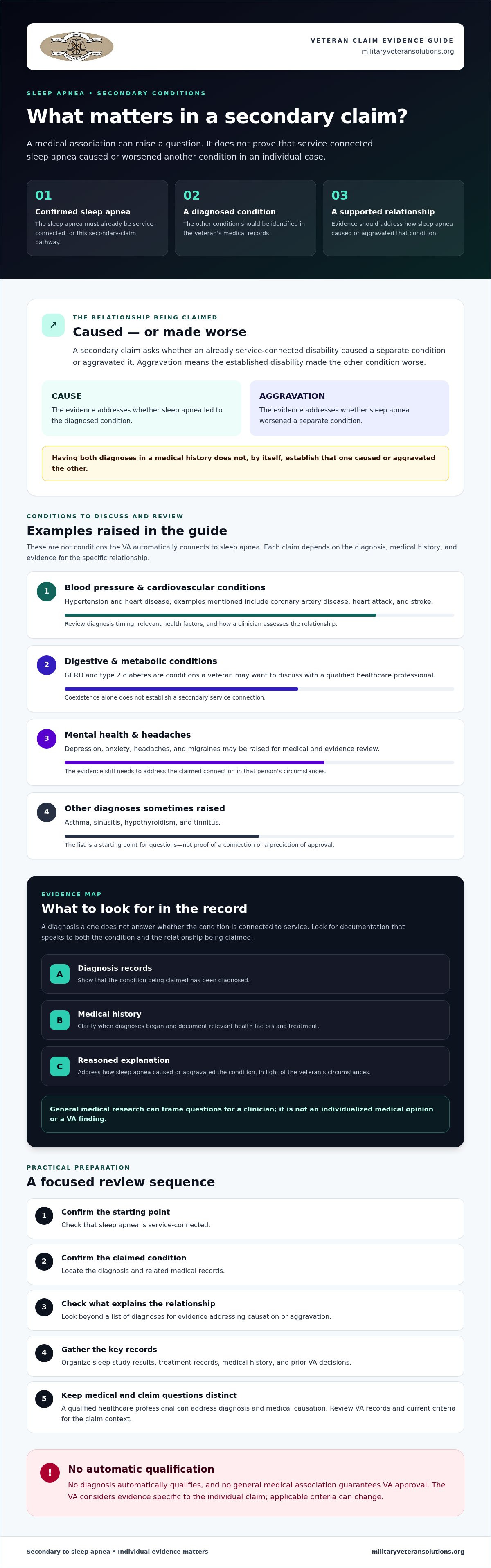
Review the evidence in sequence. First, confirm that sleep apnea is documented and already service-connected, and that the condition you may claim as secondary has its own diagnosis. Organizing the records can make it easier to see what supports the claim and what still needs clarification.
- Confirm the diagnoses and service-connected condition. Locate records confirming sleep apnea and the other condition. Check your VA decision letter to verify how sleep apnea was decided and whether it is service-connected.
- Gather sleep apnea records. Collect sleep study results, diagnosis records, treatment notes, and relevant medication history. Include records that show the course of treatment over time.
- Document the other condition. Assemble diagnosis and treatment records, relevant testing, medication information, and notes showing when symptoms began or changed. A timeline can help identify dates that need clarification.
- Review relevant service and VA records. Include military service or medical records where they inform the claim, along with prior VA decision letters. A broader professional military record review for VA claims may help put those documents in context.
- State the relationship you’re claiming. Identify whether you believe sleep apnea caused the other condition or aggravated it. Then note what the records establish and what they do not explain.
How can you spot gaps before filing or responding?
Separate the evidence into two groups: records that establish the diagnoses and evidence that addresses the claimed connection between them. A gap might be a missing treatment note, an unclear symptom timeline, or no medical discussion of causation or aggravation. Write down questions for your treating clinician or claims representative. An unanswered question is not proof of a connection.
For general process information, review relevant VA claim assistance resources. Before submitting evidence or responding to a VA decision, check the current instructions and deadlines that apply to your situation.
When might a professional claim review help?
If you’re unsure whether your records support a claim involving secondary conditions to sleep apnea, reviewing your medical documentation, service records, and prior VA decisions may help identify unanswered evidence questions. A claim review does not replace medical advice or guarantee a result. Medical questions belong with a qualified healthcare professional.
Military Veteran Solutions, LLC offers virtual consultations and reviews VA decisions, military records, and medical documentation. Learn more about a virtual consultation.
Next Steps: Review Your Sleep Apnea Secondary Claim
Before moving forward, check the foundation of the claim. Confirm that sleep apnea is service-connected and that the proposed secondary condition is clearly diagnosed. Then identify whether you’re claiming that sleep apnea caused the condition or made it worse. Finally, assess whether your records address that specific relationship. A medical association may raise a question to investigate, but the evidence must be considered in your individual circumstances.
What questions should you ask before moving forward?
- Do your records clearly document sleep apnea and the condition you may claim as secondary?
- What evidence explains the claimed causal or aggravating relationship, beyond showing that both conditions exist?
- Do your prior VA decisions identify missing evidence, unclear reasoning, or a specific basis for a denial?
- Are there gaps in dates, treatment history, or medical explanations that you should discuss with a qualified professional?
These questions can help distinguish what the file already establishes from what may need further review. Medical treatment and diagnosis questions belong with qualified healthcare professionals. A claim review can help organize records and clarify what the documentation says, but it cannot replace medical judgment.
VA requirements and rating criteria can change. Before filing or responding to a decision, confirm the current criteria and instructions that apply to your situation rather than relying solely on older guidance. Keeping the relevant decision letter with your medical records can make that review more focused.
How can Military Veteran Solutions, LLC support a claim review?
Military Veteran Solutions, LLC reviews VA decisions, military records, and medical documentation to help veterans assess their claim records and identify questions that may need attention. The firm offers virtual consultations to veterans nationwide. A review can help you understand the evidence and consider next steps, but it cannot guarantee approval or a particular outcome.
For a claim involving secondary conditions to sleep apnea, a review can focus on your documented diagnoses, the relationship you’re claiming, and what the existing evidence does or does not address. Read more about how to discuss your VA claim with Military Veteran Solutions, LLC.
Take the Next Step With a Clearer Claim Picture
A medical connection between sleep apnea and another condition may be worth investigating, but it does not establish an individual VA claim. For secondary conditions to sleep apnea, confirm both diagnoses, identify whether you’re claiming causation or aggravation, and check whether your records address that relationship. VA criteria can change, so verify current requirements before filing or responding.
Military Veteran Solutions, LLC reviews VA decisions and medical documentation to help veterans assess their claim evidence, and offers virtual consultations nationwide. A review can clarify questions and possible next steps, but it cannot guarantee an outcome. Direct medical treatment questions to a qualified healthcare professional.
Frequently Asked Questions
Can sleep apnea cause other conditions for VA disability purposes?
Yes, another condition may be claimed as secondary if evidence supports that service-connected sleep apnea caused or aggravated it. Having both diagnoses, or knowing that research has found an association, does not establish an individual connection. The VA evaluates the evidence and applicable criteria for the specific claim. A qualified healthcare professional can address medical causation or aggravation. Reviewing your records can help identify what they document and what questions remain.
What conditions can be claimed secondary to sleep apnea?
Conditions veterans may ask about include hypertension, cardiovascular disease, GERD, depression, anxiety, headaches or migraines, asthma, sinusitis, hypothyroidism, tinnitus, and type 2 diabetes. This is not an automatic or presumptive list. A claim requires evidence of the diagnosed condition and support for the specific relationship to service-connected sleep apnea. The relevant medical history and rationale matter, so discuss potential connections with a qualified clinician before drawing conclusions from general research.
Is hypertension considered secondary to sleep apnea by the VA?
Not automatically. Research may describe an association between sleep apnea and cardiovascular concerns, but that alone does not establish that sleep apnea caused or aggravated your hypertension. Assess a potential claim using your diagnosis, medical history, symptom and treatment timeline, and evidence addressing the claimed relationship. A clinician can evaluate the medical question in your circumstances. The VA then considers the evidence under the criteria applicable to your claim.
Can GERD be secondary to sleep apnea for a VA claim?
GERD may be raised as a possible secondary condition, but it is not automatically connected to sleep apnea for VA purposes. You would need documentation of GERD and evidence addressing whether service-connected sleep apnea caused or aggravated it in your case. Records showing both diagnoses may help establish that each condition exists, but they do not necessarily explain their relationship. Ask a qualified healthcare professional whether your medical history supports a connection and what records inform that opinion.
Can depression or anxiety be secondary to sleep apnea?
Depression or anxiety may be considered for a secondary claim when the evidence supports a connection to service-connected sleep apnea. A diagnosis alone, or the fact that sleep apnea and mental health symptoms occur together, does not establish causation or aggravation. Relevant records may include mental health evaluations, treatment history, symptom timelines, and sleep-related documentation. A qualified clinician can assess your medical history and explain whether it supports the relationship you’re considering.
What evidence do I need to claim a condition secondary to sleep apnea?
Start with records confirming service-connected sleep apnea and a current diagnosis of the other condition. Sleep study results, treatment records, relevant testing, medication history, and notes documenting symptoms over time can help establish the medical picture. Evidence should also address whether sleep apnea caused or aggravated the other condition. A veteran’s statement can explain personal experiences and timing, but it may not replace medical analysis when the claimed connection requires it.
Does a medical study prove that my condition is secondary to sleep apnea?
No. A medical study can provide background about how conditions may be associated across a population, but it does not establish what caused or worsened your individual condition. An individual assessment should consider your diagnosis, full medical history, and the specific relationship claimed. Discuss relevant research with a qualified healthcare professional who can assess your circumstances. For a VA claim, organize studies alongside your medical records rather than treating general findings as proof by themselves.
Request a virtual consultation with Military Veteran Solutions, LLC to discuss your VA decision, service records, and medical documentation.


