

A condition can appear on the VA’s Agent Orange presumptive list and your claim can still be denied. The agent orange presumptive conditions rule can make it easier to establish a connection between a qualifying illness and military service, but it doesn’t remove the need to show that you have a current diagnosis or meet the service and exposure requirements.
If you’re unsure whether your condition, service location, or dates qualify, this guide can help you check. It explains which conditions the VA recognizes as presumptive in 2026, how the exposure presumption works, and what evidence may affect your claim. You’ll also learn what records to gather, what options may exist if your condition isn’t on the list, and what to review if the VA denies your claim. Comparing your service records and medical documentation with the VA’s decision can help clarify what needs attention next.
Key Takeaways
- Check whether your diagnosis appears among the VA’s current agent orange presumptive conditions, then confirm the requirements for that specific illness.
- Compare your service locations and dates with the VA’s exposure rules. A qualifying disease alone may not establish eligibility.
- Gather medical records and service documentation that support your diagnosis and qualifying service before submitting a claim.
- Presumptive status can help establish service connection, but the VA still reviews the claim requirements and evaluates the disability.
- If your claim is denied, review the decision letter’s reasons before deciding what evidence or review option may be appropriate.
What Agent Orange presumptive conditions mean for a VA disability claim
A presumption can simplify proving a connection between qualifying Agent Orange exposure and a disease the VA recognizes. If your service meets the VA’s exposure criteria and you have a covered diagnosis, the VA may presume the illness is connected to service instead of requiring you to establish that link with separate medical evidence.
Presumptive service connection is a VA rule that recognizes a link between qualifying military service and certain diagnosed conditions, which can reduce the evidence needed to establish that link. The VA explains its Agent Orange eligibility rules on its Agent Orange benefits page. For historical context, see this overview of Agent Orange history and health effects.
To see how the broader rules and claim process fit together, watch this overview:
What does presumptive service connection change?
The presumption can address the connection between a qualifying veteran’s service and a listed disease. It does not automatically confirm every part of a claim. You still need a current diagnosis, and the VA evaluates whether your service meets the applicable criteria, as well as the condition’s severity and other claim requirements.
Keep the distinction clear: presumed exposure is not the same as automatic approval. A reported exposure or a diagnosis alone may not satisfy the rules. The VA must assess whether both fit its criteria. The agent orange presumptive conditions list can change, so check current VA guidance instead of relying on an older list.
Who may qualify based on Agent Orange exposure?
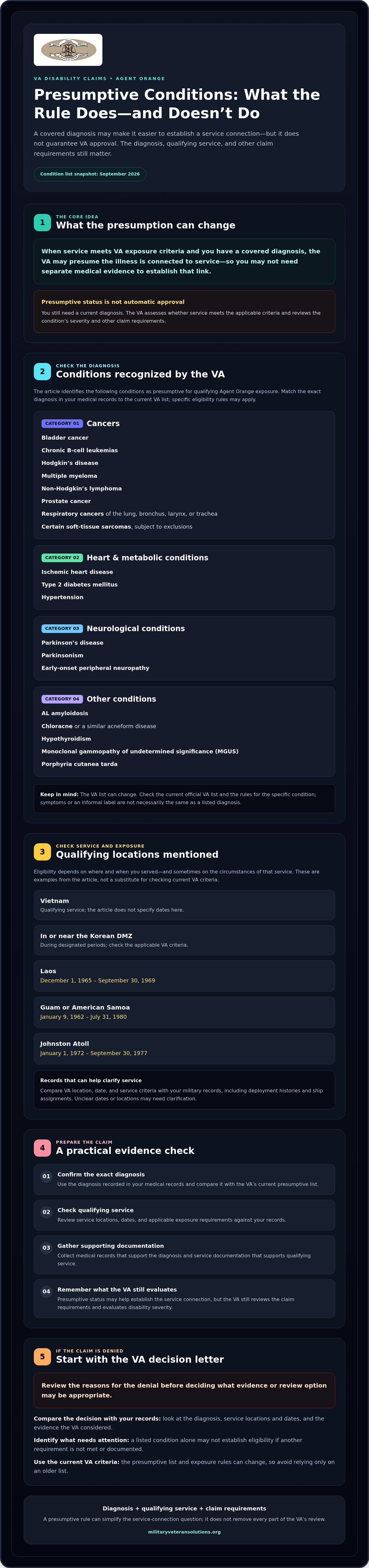
Eligibility depends on where and when you served, and sometimes on the circumstances of that service. VA guidance includes qualifying service in Vietnam and service in or near the Korean DMZ during designated periods. Other covered locations include Laos from December 1, 1965, through September 30, 1969; Guam or American Samoa from January 9, 1962, through July 31, 1980; and Johnston Atoll from January 1, 1972, through September 30, 1977.
These examples don’t settle every case. Check the VA’s current location, date, and service criteria against your records, including deployment histories and ship assignments. If dates or locations are unclear, reviewing your military records may help identify what needs clarification before you file.
Which Agent Orange presumptive conditions does the VA recognize?
As of September 2026, the VA recognizes the conditions below as presumptive for qualifying Agent Orange exposure. Use this list as a starting point and compare your diagnosis with current VA materials. The VA's list of Agent Orange presumptive conditions is the controlling reference and may be updated.
The VA’s Agent Orange presumptive list can change, so check the official list for updates before preparing or reviewing a claim. The table groups recognized agent orange presumptive conditions by category. Specific eligibility rules may still apply.
| Category | Recognized conditions |
|---|---|
| Cancers | Bladder cancer; chronic B-cell leukemias; Hodgkin’s disease; multiple myeloma; non-Hodgkin’s lymphoma; prostate cancer; respiratory cancers of the lung, bronchus, larynx, or trachea; and certain soft-tissue sarcomas, subject to exclusions. |
| Heart and metabolic conditions | Ischemic heart disease; type 2 diabetes mellitus; hypertension. |
| Neurological conditions | Parkinson’s disease; parkinsonism; early-onset peripheral neuropathy. |
| Other conditions | AL amyloidosis; chloracne or a similar acneform disease; hypothyroidism; monoclonal gammopathy of undetermined significance (MGUS); porphyria cutanea tarda. |
How to check whether a diagnosis appears on the VA list
Start with the exact diagnosis in your medical records, not a symptom or informal label. For example, a heart-related symptom is not automatically the same diagnosis as ischemic heart disease. Similar-sounding conditions can have different VA criteria. Ask your treating clinician to clarify the medical terminology, then compare it with the current VA list and any condition-specific notes.
Conditions with specific timing or qualification rules
Some conditions have additional requirements. Chloracne or a similar acneform disease, early-onset peripheral neuropathy, and porphyria cutanea tarda must have been at least 10% disabling within one year of exposure. That timing rule applies to those conditions, not every disease in the table. Certain soft-tissue sarcomas also have exclusions, so confirm the specific diagnosis and current VA criteria rather than relying on a broad category name.
If your diagnosis or service records are difficult to interpret, a review of the documentation may help clarify what to address in a claim. Veteran claims representation is one option to consider when you need support reviewing your claim.
Does an Agent Orange presumptive condition guarantee VA approval?
No. Presumptive status can make it easier to establish service connection, but it doesn’t guarantee that the VA will approve a claim. The presumption may address the link between qualifying service and a recognized diagnosis. The VA still reviews whether your service meets its criteria, whether your medical evidence establishes a covered condition, and whether other claim requirements are met. The VA Agent Orange disability compensation guidance explains the applicable service and condition rules.
Service connection and disability evaluation are separate parts of the process. Even if the VA finds a condition connected to service, it evaluates the condition’s severity to determine the disability rating. A diagnosis on the presumptive list does not establish a particular rating or level of compensation.
| The presumption may help establish | The VA still reviews |
|---|---|
| A connection between qualifying service and a recognized condition | Whether your service meets the location, date, or other applicable eligibility criteria |
| That a separate medical opinion linking the condition to exposure may not be needed to establish that connection | Whether the medical evidence confirms the covered diagnosis and satisfies any condition-specific requirements |
| The service-connection element of a claim | The condition’s severity and the appropriate disability rating |
What the presumption may establish, and what it does not
A qualifying veteran with a covered diagnosis may benefit from the VA presuming a service connection, rather than having to prove that link independently. But a listed diagnosis alone does not confirm qualifying service or satisfy every requirement. If your condition isn’t on the presumptive list, you may still be able to pursue a claim by providing evidence that directly connects it to your military service. That route involves a different evidence question.
Common reasons a presumptive claim may need more review
Details matter. The diagnosis in your medical records may not match the condition named on the VA list, service records may not clearly show where or when you served, or relevant medical or military documents may be missing. These are examples, not a complete list of possible issues. Each decision depends on the evidence in the individual claim and the VA rules that apply.
If the decision is unclear, review its stated reasons and compare them with your service and medical records. A careful review of the VA decision and supporting documentation can help identify what needs attention before you decide on next steps.
How to prepare an Agent Orange presumptive conditions claim
A well-organized claim makes it easier to see how your diagnosis, service history, and supporting documents fit together. Use this sequence to prepare, and check current VA instructions before filing because requirements can depend on your circumstances.
- Confirm the diagnosis. Review your medical records for the exact diagnosed condition. If the wording is unclear or differs from the VA’s list, ask your treating clinician to clarify the diagnosis. Don’t substitute a symptom or informal name.
- Check service eligibility. Compare your locations, dates, and service circumstances with the VA’s current Agent Orange criteria. Service records can help document details that may be difficult to recall or establish from memory alone.
- Gather supporting records. Organize the medical and military documents you already have, then make a list of anything you may need to request.
- Submit the claim. Veterans can use VA Form 21-526EZ to apply for disability compensation. Follow the current form instructions and keep a copy of your completed submission and attachments.
- Track the claim. Save VA correspondence, note communication dates, and respond to requests for information. Keep copies of anything you send.
Records to organize before filing
Start with documents already in your possession, such as medical records showing the diagnosis and treatment history, discharge papers, deployment information, and copies of prior VA correspondence. Then list any gaps. Service personnel or unit records, ship histories, or older medical documents may require a request from the appropriate records custodian. Keep a simple record of what you requested, when you requested it, and what you received.
For more context on preparing or responding to a PACT Act-related claim, see this PACT Act claim and appeal guide.
What to do after a VA decision
Read the decision letter carefully. Identify the evidence the VA considered and the specific reason for its decision, then compare that explanation with your service records, diagnosis, and submitted documents. For example, if the letter says qualifying service wasn’t established, focus on the location and date evidence. If the diagnosis is questioned, check the medical terminology and records. These examples aren’t a complete list. The appropriate response depends on the decision and current VA procedures.
Review the VA appeals filing guide for an overview of the process. If you want help reviewing your service records or VA decision, consider requesting veteran claims representation from Military Veteran Solutions, LLC.
What to do when an Agent Orange presumptive claim is denied
A denial is not a reason to guess at your next move. Start with the VA decision letter. It explains what the VA decided, what evidence it considered, and why it reached that outcome. Let the stated reason guide your review. Options and evidence rules depend on the decision and current VA procedures, so check the instructions and deadlines in your letter before acting.
How to read the denial reason and identify missing evidence
Compare the VA’s findings with your records. If the letter questions qualifying service, check whether your documents show the relevant location, dates, or circumstances. If it disputes the diagnosis, compare the exact condition named in the decision with your medical records. If the VA says evidence was missing or insufficient, identify which record or detail it says was not established.
Flag factual gaps and apparent inconsistencies for careful review. A difference between a service record and the decision’s summary may need clarification, but don’t assume it proves an error. The decision letter is the starting point for determining what needs attention and which response may fit your situation. The VA’s rules for submitting evidence vary by review option, so check the applicable instructions before sending additional materials.
When claims advocacy may help
Claims advocacy can help organize the record around the VA’s stated reasons. A reviewer can compare service documents, medical records, and the decision’s findings to identify questions that may need follow-up. For a closer look at how military records can support a claim, see this professional military record review guide.
Military Veteran Solutions, LLC offers military record reviews, VA decision letter analysis, virtual consultations, and veteran claims advocacy nationwide. This support can help you understand the documentation and decision in front of you, but it can’t guarantee a particular outcome. If you want to discuss your records and potential next steps, request a virtual consultation.
Take the Next Step With a Clearer Claim Strategy
Focus your next step on the evidence and questions specific to your claim. A clear review of your records can help you identify what needs attention and how to move forward.
Military Veteran Solutions, LLC provides military record reviews, VA decision letter analysis, and virtual consultations for veterans nationwide. Founded by a disabled veteran who served ten years in the U.S. Army, the firm supports veterans as they assess their claims. Request a virtual consultation with Military Veteran Solutions, LLC to discuss your situation.
Take the process one step at a time. A clearer understanding of your records can help you approach the path ahead with greater confidence.
Frequently Asked Questions
What are the Agent Orange presumptive conditions?
The agent orange presumptive conditions include certain cancers, such as bladder, prostate, respiratory, and some soft-tissue cancers; chronic B-cell leukemias; Hodgkin’s disease; multiple myeloma; and non-Hodgkin’s lymphoma. Other recognized conditions include type 2 diabetes, ischemic heart disease, hypertension, hypothyroidism, AL amyloidosis, MGUS, Parkinson’s disease or parkinsonism, chloracne, early-onset peripheral neuropathy, and porphyria cutanea tarda. Confirm your exact diagnosis and current eligibility details against the VA’s official list.
Is hypertension an Agent Orange presumptive condition?
Yes. The VA recognizes hypertension, or high blood pressure, as an Agent Orange presumptive condition. That status may help establish a service connection if your service meets the applicable VA criteria and you have a current diagnosis. It doesn’t guarantee approval or a particular disability rating. The VA still evaluates the evidence and the severity of your condition, so check its current service requirements and gather relevant medical and military records.
Do I have to prove exposure to Agent Orange to file a presumptive claim?
You may not need to prove actual exposure separately if your service falls within a VA-recognized location, date range, or circumstance where exposure is presumed. You still need to show that your service meets the applicable criteria. Gather records that support where and when you served, such as personnel or deployment documents. If your service doesn’t meet presumptive exposure rules, you may still explore a claim based on evidence of a direct connection.
Can the VA deny an Agent Orange presumptive claim?
Yes. Presumptive status isn’t automatic approval. The VA may find that the service eligibility criteria aren’t met, that the medical records don’t establish a covered diagnosis, or that another claim requirement hasn’t been satisfied. The VA also separately evaluates the severity of a service-connected condition to determine its rating. If your claim is denied, read the decision letter closely to understand the stated reasons before choosing a response.
What evidence do I need for an Agent Orange presumptive claim?
Useful evidence can include medical records confirming the exact diagnosis and documenting treatment, plus military records that support your service location, dates, and circumstances. You may already have discharge papers, deployment records, or clinic documents; other service or medical records may need to be requested. Keep copies of everything you submit and note VA correspondence dates. The evidence needed depends on your diagnosis, service history, and the applicable eligibility rules.
Do Agent Orange presumptive conditions have time limits for diagnosis?
Some do, but there isn’t one timing rule for every condition. Chloracne or a similar acneform disease, early-onset peripheral neuropathy, and porphyria cutanea tarda must have been at least 10% disabling within one year of exposure under the stated criteria. Other conditions may have different requirements. Check current VA guidance for the exact diagnosis and applicable exposure rules instead of applying one condition’s deadline to another.
What should I do if the VA denies my Agent Orange claim?
Start by reading the decision letter and identifying the VA’s specific reasons and the evidence it considered. Compare those findings with your diagnosis and service records, then note any missing documents or facts that may need clarification. Available review options and evidence rules depend on the decision and current VA procedures, so check the letter’s instructions and deadlines. A careful review of the decision can help you determine what to address next.


