
Could a veteran receive 100 percent VA disability compensation without a combined 100% schedular rating? Yes. The two main pathways are a schedular rating and Total Disability based on Individual Unemployability (TDIU), and each has different VA rules and evidence requirements.
If the rating process feels confusing, you’re not alone. Individual ratings don’t simply add together, and receiving compensation at the 100% rate doesn’t automatically mean the VA assigned permanent and total (P&T) status or that you qualify for every related benefit. The details in your decision letter matter.
This guide explains how VA math works, how schedular ratings differ from TDIU, and what evidence may support an accurate decision. It also covers potential benefits and why eligibility depends on your circumstances and current VA rules. You’ll learn what to check in your decision letter, what questions to ask about the evidence, and how to identify a practical next step if the decision doesn’t reflect your service-connected conditions or their impact. Understanding the pathway can help you focus on the issue the VA actually decided.
Key Takeaways
- A 100 percent VA disability outcome depends on the applicable rating pathway and evidence, not on one universal checklist.
- Review how the VA evaluated each service-connected condition under its rating schedule. Individual percentages don’t simply add together.
- Check the decision letter for the rating basis and any P&T determination. A 100% payment rate alone doesn’t establish permanent status or guarantee every related benefit.
- Gather the decision letter, service records, medical documentation, and relevant lay evidence. Compare them with the evidence the VA considered to identify any gaps or questions.
- Before challenging a decision, confirm which review options and deadlines apply to your case, then choose a next step based on the record.
What 100 Percent VA Disability Means and How the VA Assigns Ratings
A 100% VA disability rating is the highest schedular evaluation for service-connected disabilities. The VA evaluates each service-connected condition under the rating criteria in 38 CFR Part 4. A veteran may receive a schedular 100% evaluation for one condition or through combined evaluations, if the applicable rules and evidence support that result. The Veterans Benefits Administration (VBA), within the Department of Veterans Affairs, administers disability compensation.
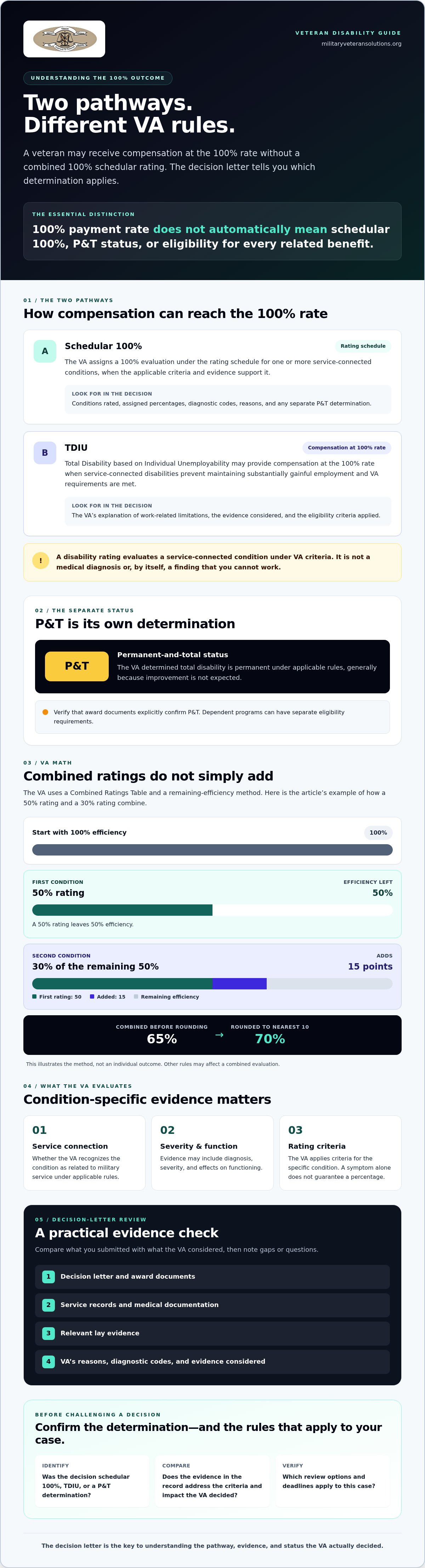
A VA disability rating reflects how the VA evaluates a service-connected condition under its rating schedule. It is not a medical diagnosis or an automatic finding that you cannot work. A 100% schedular rating and payment at the 100% rate through TDIU are distinct determinations, compared in the next section.
For a visual overview of the topic, watch this video from TheCivDiv:
How the VA evaluates service-connected conditions
Service connection means the VA recognizes a condition as related to military service under applicable rules. When evaluating a claim, the VA considers evidence such as diagnosis, severity, and effects on functioning, then applies the criteria for that specific condition. A symptom alone doesn’t guarantee a particular percentage. Rating criteria differ by condition, and the evidence must support the evaluation sought.
Check your decision letter for each condition’s assigned percentage, the reasons for the decision, and any cited diagnostic codes. These details show which criteria the VA applied and can help you identify what evidence it relied on.
Why combined ratings do not add like ordinary percentages
The VA uses the Combined Ratings Table and a remaining-efficiency method, not simple addition. For example, a 50% rating leaves 50% efficiency. A second 30% rating applies to that remaining 50%, adding 15 percentage points. The result is 65%, which is rounded to the nearest 10, or 70%. This illustrates the method, not an individual outcome. Other rules may affect a combined evaluation.
For a step-by-step explanation, see how VA disability ratings combine. Use your decision letter and the applicable rating criteria to understand how the VA calculated your evaluation.
Schedular 100 Percent, TDIU, and Permanent-and-Total Status Compared
A 100% schedular evaluation, Total Disability based on Individual Unemployability (TDIU), and permanent-and-total (P&T) status are related but distinct VA determinations. A 100 percent VA disability outcome doesn’t tell you by itself which pathway applies or whether the VA considers the condition permanent. Check your award documents and decision letter for the exact determination.
| Determination | What it means | What to verify |
|---|---|---|
| Schedular 100% | The VA assigned a 100% evaluation under the rating schedule for one or more service-connected conditions. | Which conditions and diagnostic codes support the evaluation, and whether the decision identifies P&T separately. |
| TDIU | The VA may pay compensation at the 100% rate when service-connected disabilities prevent a veteran from maintaining substantially gainful employment and VA requirements are met. | The VA’s explanation of work-related limitations, the evidence considered, and the current eligibility criteria. |
| P&T status | The VA determined that total disability is permanent under applicable rules, generally because improvement isn’t expected. | Whether the award documents explicitly confirm P&T and which dependent programs have separate eligibility requirements. |
The VA explains how the VA assigns disability ratings. That process differs from an unemployability determination, and a 100% rating alone doesn’t establish P&T status.
What separates schedular 100% from TDIU
A schedular evaluation follows condition-specific rating criteria. TDIU addresses whether service-connected disabilities prevent substantially gainful employment. The VA considers the circumstances and applicable requirements, so employment isn’t always a simple yes-or-no test. Work and income facts may matter, but don’t assume that any employment automatically rules out TDIU or that a schedular 100% rating carries the same work-related standard.
If the VA disputes your evaluation or TDIU eligibility, the reasons and evidence listed in the decision can help you identify the issue. Review VA disability appeal guidance to understand possible review paths. The right option depends on the decision and your procedural circumstances.
What permanent and total status means
P&T isn’t automatic with a 100% rating. It reflects a separate VA determination about total disability and whether improvement is expected. That status may affect eligibility for dependent benefits, including CHAMPVA or Dependents’ Educational Assistance, but each program has its own rules. Confirm the designation in your award documents and verify eligibility with the responsible agency before relying on a benefit.
If you’re unsure how the VA characterized your decision, VA decision letter analysis and claims representation from Military Veteran Solutions, LLC may help you understand what the determination says and what questions to consider next.
Benefits a 100 Percent VA Rating May Provide, and What It Does Not Guarantee
A 100% award may affect compensation and access to other programs, but it isn’t a universal benefits pass. Eligibility depends on the specific VA determination, your circumstances, and the rules of the agency administering each program. Confirm requirements before making financial or healthcare decisions based on an award.
Compensation and dependent-related programs
VA monthly compensation varies with the assigned rating, eligible dependents, and other applicable factors. For 2026, the base monthly rate for a single veteran with no dependents rated 100% is $3,938.58; a veteran with a spouse and no children has a listed rate of $4,158.17. These are examples, not universal payment amounts. Check the official VA compensation rate table for current figures, effective dates, and details that apply to your household.
Dependent additions aren’t automatic in every case. Review your award information and confirm whether the VA has recognized eligible dependents. The VA Schedule for Rating Disabilities governs disability evaluations, but other benefit programs have separate eligibility rules. For example, CHAMPVA and Chapter 35 Dependents’ Educational Assistance may be available to qualifying dependents when requirements are met, which can include the veteran’s P&T status. A 100% rating alone doesn’t establish that status or guarantee eligibility.
State benefits and assumptions to avoid
Potential benefits may also involve VA healthcare, dependent programs, or state-administered tax, vehicle, education, and licensing programs. Requirements, exceptions, and application processes vary. Ask the responsible VA office or agency to confirm your eligibility rather than assuming a rating automatically provides a particular benefit.
If you’re reviewing a 100 percent VA disability decision, start with the award letter. Confirm the payment basis, dependent information, and whether P&T status is explicitly identified. Then verify each benefit directly with the agency that administers it. This can help you distinguish a VA rating from a separate program’s decision.
What Evidence and VA Decision Details Matter When Pursuing 100 Percent
Before deciding what to do next, identify the exact issue in the VA’s decision. A claim for 100 percent VA disability may involve whether a condition is connected to service, how severely it is rated, or whether the evidence supports a different evaluation. These questions call for different evidence. Start with the decision, then match your records to the VA’s stated reasons.
Read the decision letter before choosing a next step
Use this checklist to map the decision:
- Obtain the complete decision letter. Keep the notice and any documents explaining the VA’s findings together.
- List each condition separately. Record the outcome, assigned evaluation, and effective date shown for each one.
- Note the stated reasons and evidence. Identify what the VA says supports its decision and which records it references.
- Compare that discussion with your submitted material. Flag records that appear missing, overlooked, or described differently from what they say.
This review can show whether the central issue is service connection, the assigned rating, or another part of the determination. For more detail on evaluating service records, see professional military record review for VA claims. You can also explore VA claim assistance resources for related support options.
Match evidence to the issue being evaluated
For a service-connection question, evidence may include service records and other material relevant to whether the condition is related to service. For a rating question, focus on evidence about the condition’s current severity and functional impact under the applicable criteria. Medical documentation may help describe diagnosis, treatment history, symptoms, and limitations. Competent lay evidence, such as a clear account of observable symptoms and their effects, may also be relevant when applicable.
Keep the distinction clear: a record that helps establish a connection to service may not, by itself, show the severity needed for a particular evaluation. Organize evidence by condition and by question, and submit it accurately and completely. Don’t alter, fabricate, or selectively withhold information. The goal is to give the VA a clear record to consider, not to reshape the facts.
If you want help comparing your records with the VA’s stated reasons, request VA decision letter analysis from Military Veteran Solutions, LLC. A review can help clarify what the decision addressed and what questions may need further attention.
Next Steps for Understanding or Challenging a 100 Percent VA Decision
A clear next step starts with understanding exactly what the VA decided. A 100 percent VA disability award may reflect a schedular rating or TDIU, and the decision documents should clarify the pathway. Don’t assume the percentage alone answers questions about work, permanence, or whether an issue remains open for review.
- Clarify the determination. Identify whether the VA assigned a schedular 100% rating, granted TDIU, or made a separate P&T determination.
- Review the decision. For each condition, note the outcome, evaluation, effective date, reasons, and evidence the VA considered.
- Organize the record. Gather the decision notice and relevant service records, medical documentation, and other evidence. Note any material you believe the decision didn’t address.
- Check deadlines promptly. Read the notice for the applicable deadline and verify current instructions through official VA sources. Don’t rely on a general timeline from someone else’s case.
When to seek a review of the VA determination
Before choosing a response, compare the VA’s stated reasons with the evidence you submitted. Is the concern about service connection, the evaluation assigned, the effective date, or another issue? The answer may affect which review options are available. Options depend on the specific decision, evidence, and procedural posture, so assess the record before selecting a lane. For an overview of appeal considerations, see VA disability appeal guidance.
How veteran-focused representation may help
Professional advocacy is optional. A representative may help organize military records and medical documentation, examine the VA’s reasoning, and identify questions to consider about the determination. Military Veteran Solutions, LLC provides VA decision letter analysis, military record reviews, veteran claims representation, and virtual consultations nationwide. This support can help you understand and prepare around the record, but it can’t guarantee a higher rating, an appeal win, or a particular benefit.
If you’d like another perspective on your decision and supporting documents, you can discuss your VA claim with Military Veteran Solutions, LLC. The choice to seek representation is yours. Keep your notice, evidence, and deadline information together so your next step is based on the actual decision, not assumptions.
Take the Next Step With a Clearer View of Your VA Decision
A 100 percent VA disability determination can follow different paths, and the percentage alone doesn’t tell the whole story. Confirm whether the VA assigned a schedular rating or TDIU, and check whether P&T status is stated separately. Benefits may depend on additional eligibility rules, so verify them with the responsible agency.
Let the decision letter guide your next move. Compare the VA’s reasons with the evidence it cited, organize relevant records, and check any applicable deadline in the notice and current official instructions. A focused review can help you identify what the VA decided and what questions remain, without assuming one approach fits every claim.
Military Veteran Solutions, LLC offers VA decision letter analysis, military record reviews, and nationwide virtual consultations. The organization was founded by a disabled veteran who served ten years in the U.S. Army and has more than two decades of experience. Advocacy is optional and can’t guarantee a rating or appeal outcome. To discuss your decision and records, connect with Military Veteran Solutions, LLC.
Frequently Asked Questions
What does 100 percent VA disability mean?
A 100 percent VA disability rating is the highest schedular evaluation for service-connected disabilities. The VA may assign it for one condition or through combined evaluations under its rating rules. The percentage alone doesn’t establish that you’re permanently and totally disabled or unable to work. Check your decision letter to see whether the VA granted a schedular rating, TDIU, or a separate permanent-and-total determination.
Can you receive 100% VA disability with multiple conditions?
Yes. The VA can combine evaluations for multiple service-connected conditions using its Combined Ratings Table, rather than adding percentages like ordinary numbers. The final combined evaluation depends on the individual ratings and applicable VA rules. A list of percentages can’t confirm the final result on its own. Review your award decision and current VA guidance to understand how the combined evaluation was calculated.
Is TDIU the same as a 100 percent VA disability rating?
No. A schedular 100% evaluation follows the VA rating schedule, while TDIU is a separate determination based on whether service-connected disabilities prevent substantially gainful employment under applicable VA requirements. TDIU may provide compensation at the 100% rate even when the combined schedular evaluation is lower. Eligibility and employment-related rules depend on the facts of your case, so check current VA criteria and your decision documents.
Does a 100% VA rating mean permanent and total?
No. A 100% rating doesn’t automatically establish permanent-and-total (P&T) status. P&T is a separate VA determination concerning total disability and whether improvement is expected under applicable rules. Check your award documents for an explicit P&T finding. Some dependent programs may require P&T status, while others have additional eligibility criteria. Confirm current requirements with the VA or the agency responsible for the specific program.
Can you work with a 100 percent VA disability rating?
It depends on the rating pathway and your circumstances. A schedular 100% rating isn’t automatically a finding that you can’t work. TDIU, however, involves whether service-connected disabilities prevent substantially gainful employment, and applicable rules may consider individual facts. Don’t assume the same employment standard applies to both pathways. Before making work or benefits decisions, review your award and verify current VA requirements for your specific determination.
What benefits can you get with a 100 percent VA disability rating?
A 100% rating may affect VA compensation and could relate to eligibility for dependent or state programs, depending on your circumstances and the program’s rules. Some benefits may require P&T status, and state property-tax, vehicle, or education benefits vary. Check the current VA compensation table for rates and dependent factors, then verify eligibility with the agency that administers each benefit. Don’t assume every benefit applies automatically.
How do I challenge a VA rating that is below 100 percent?
Start with the decision letter. Note each condition’s evaluation, the evidence considered, and the VA’s reasons for its decision. Compare those reasons with the records you submitted, then check the notice and current VA instructions for applicable deadlines and review options. The right next step depends on the decision and procedural posture. A representative may help review records and explain possible options, but can’t guarantee a particular outcome.


