
Securing dedicated VA disability claim representation isn't about submitting routine paperwork; it demands meticulous evidence extraction that forces adjudicators to recognize your true service-connected limitations. If you're asking whether you actually need professional representation to win your claim or appeal, you aren't alone. You've likely opened a baffling VA decision letter, frustrated by unexpected rating reductions or outright denials after months of waiting. Digging through fragmented service personnel files and dense military medical treatment records can leave anyone feeling depleted, especially when you wonder if an overburdened volunteer has the bandwidth to build an airtight case.
You shouldn't have to fight this institutional battle in the dark. In this guide, you'll discover how professional VA disability claim representation secures your rightful rating, overturns denials, and maximizes lifetime compensation through methodical evidentiary audits. We'll examine the critical differences between representation models, reveal how to navigate modern appellate deadlines, and show you exactly what it takes to protect your earned benefits.
Key Takeaways
- Understand your statutory rights under Title 38 and identify the precise claim stages where professional VA disability claim representation becomes critical.
- Learn how deep military personnel audits uncover decisive service treatment records and incident reports routinely missed by standard intake filers.
- Use an objective vetting checklist to screen advocates, protect your benefits, and avoid unaccredited, predatory claim companies.
- Discover how strategic lane selection under the modern appeals system protects your original effective dates and prevents years of avoidable administrative delays.
- Find out how partnering with an experienced, veteran-led ally provides the methodical focus needed to overturn unfair rating decisions.
VA Disability Claim Representation: When Is It Essential?
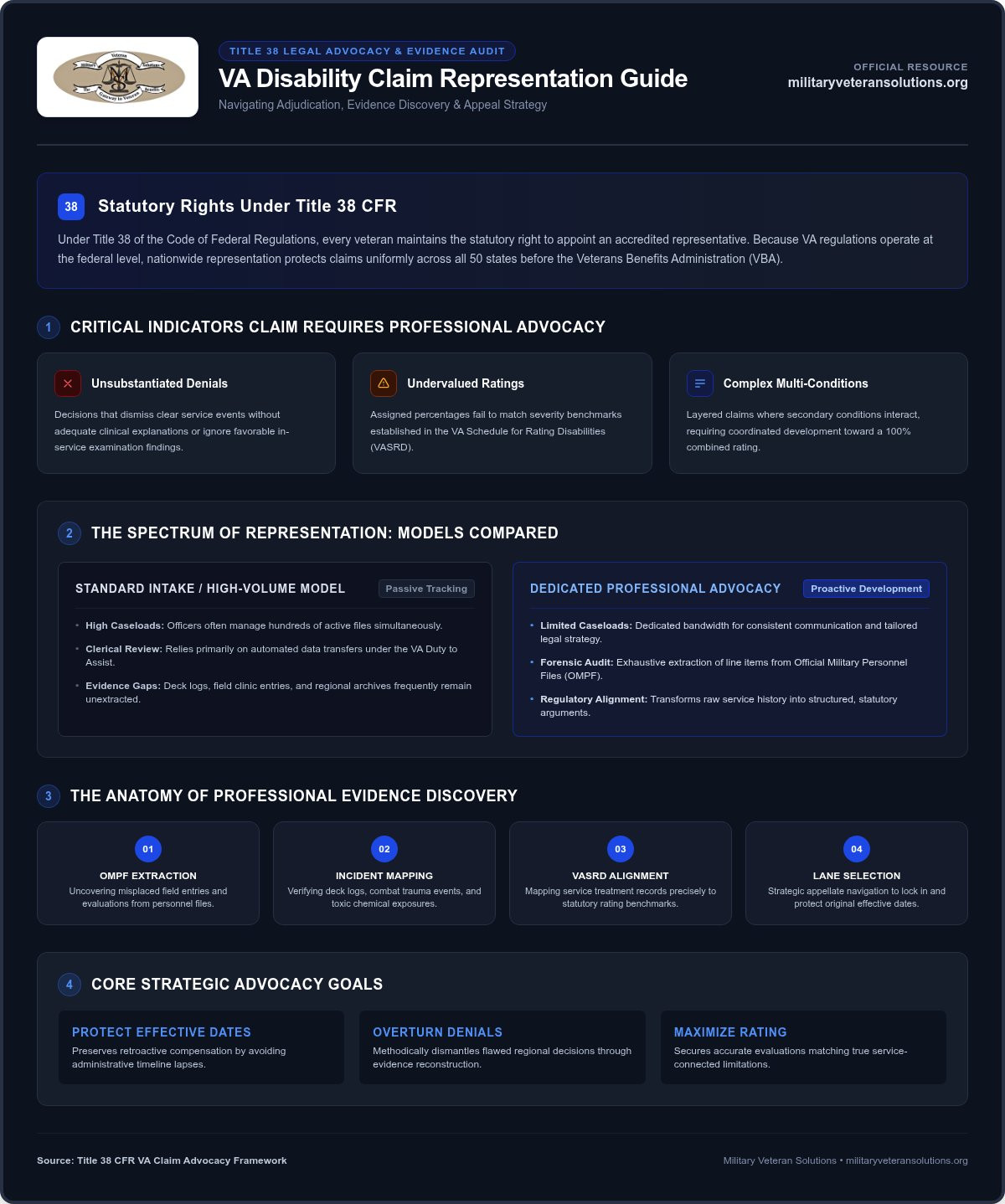
Professional VA disability claim representation is authorized, formal advocacy designed to manage administrative claims before the Department of Veterans Affairs. Under Title 38 of the Code of Federal Regulations, every veteran maintains the clear statutory right to appoint an accredited representative to act on their behalf. This legal framework ensures you don't face federal adjudicators alone. While basic paperwork intake is sufficient for straightforward initial filings, complex matters like secondary service connections, combat trauma, and toxic chemical exposures require rigorous evidence gathering. Because VA regulations are federal, qualified nationwide representation protects your claim equally across all fifty states, regardless of your physical location.
To better understand your representation options and when professional assistance becomes critical, watch this helpful overview:
Strategic advocacy separates passive administrative tracking from proactive claim development. Adjudicators at the Veterans Benefits Administration (VBA) evaluate evidence based strictly on statutory rating schedules; they don't hunt down unlinked medical records for you. An experienced advocate bridges that gap by transforming raw service histories into persuasive, regulatory-compliant arguments.
The Spectrum of Representation: VSOs, Claims Agents, and Professional Advocates
Veterans Service Organizations (VSOs) provide a valuable, no-cost service to the veteran community. However, high claimant volumes often force individual officers to manage hundreds of active files simultaneously. Dedicated professional claims advocates limit their caseloads to deliver consistent communication, aggressive case preparation, and tailored strategies. This distinct focus ensures your records receive an exhaustive evidentiary audit rather than a brief clerical review.
Critical Indicators Your Claim Requires Professional Advocacy Support
Certain administrative roadblocks signal that dedicated VA disability claim representation has become vital to your financial recovery:
- Unsubstantiated claim denials: Rating decisions that dismiss clear service events without adequate clinical explanations or that ignore favorable examination findings.
- Undervalued disability ratings: Assigned percentages that fail to match the severity benchmarks outlined in the VA Schedule for Rating Disabilities (VASRD).
- Complex multi-condition filings: Layered claims where multiple secondary conditions interact, requiring careful coordination to push a combined rating toward 100 percent.
The Anatomy of Professional Evidence Discovery in VA Claims
Filing administrative paperwork without an exhaustive evidentiary audit often leads directly to an unexpected denial. Standard intake processors routinely trust the regional office to collect all relevant files under its Duty to Assist mandate. Unfortunately, that trust frequently backfires when critical service records, deck logs, and field clinic entries remain buried in regional archives. High-caliber VA disability claim representation approaches your case like a forensic investigation. Instead of simply relying on automated data transfers, a thorough representative extracts forgotten line items from your Official Military Personnel File (OMPF) and aligns them precisely with statutory rating criteria.
Comprehensive Military Service and Medical Record Auditing
Proving service connection requires concrete evidence of an in-service incident, stressor, or injury. Many vital documents never transfer to modern digital portals, which makes a Professional Military Record Review Service: Unlocking Evidence for VA Claims invaluable for unearthing misplaced field entries, performance evaluations noting physical decline, and operational movement reports that corroborate combat exposure or chemical hazards.
Establishing the Indispensable Medical Nexus and Secondary Conditions
To win, your evidence must meet the legal threshold showing a disability is "at least as likely as not" connected to military service. Professional advocates excel at connecting primary impairments to secondary conditions, such as chronic lumbar strain creating radiculopathy or tinnitus aggravating sleep issues. Coordinating independent medical opinions and targeted Disability Benefits Questionnaires (DBQs) provides the objective clinical rationale adjudicators demand.
Deconstructing VA Decision Letters to Expose Adjudication Errors
Every denial letter holds vital clues for your next tactical move. Rather than conceding defeat, experienced advocates analyze the specific language in past adjudications to:
- Isolate favorable findings: Identify conceded events or diagnosed conditions that regional raters cannot legally dispute in subsequent reviews.
- Expose inadequate exams: Challenge rushed Compensation and Pension (C&P) examiners who neglected crucial diagnostic metrics like range-of-motion flare-ups.
- Detect clear errors: Uncover misapplied diagnostic codes or blatant oversight of federal records already in the claim file.
Reviewing the official pathways to Get help filing a VA claim confirms your right to designated support, but discovering the underlying evidence requires an exhaustive review. If you suspect missing records caused your low rating, you can schedule a focused evaluation with militaryveteransolutions.org to examine your documentation with an experienced eye.
How to Choose the Best VA Disability Claim Representative: A Vetting Checklist
Selecting effective VA disability claim representation requires objective vetting rather than trusting flashy marketing claims. While large personal injury firms display generic trophy badges and unvetted online outfits promise impossible windfalls, your financial security depends entirely on regulatory competence and dedicated attention. Choosing the wrong advocate can stall your claim for years or expose you to predatory fee structures. Evaluating potential advocates against standard credentials, client access, and ethical benchmarks ensures you partner with a legitimate champion. For an in-depth breakdown of organizational structures, review this Veteran Advocacy Services: 2026 Comparison Guide.
Essential Qualifications and Dangerous Red Flags to Avoid
Working with an authorized VA-accredited representative guarantees your advocate operates under federal standards of conduct. Beware of unaccredited "consulting firms" that operate outside statutory oversight. Immediate warning signs include:
- Demanding portal credentials: Never surrender your personal login credentials for VA.gov or ID.me; legitimate advocates utilize formal power-of-attorney designations instead.
- Guaranteed percentages: Avoid anyone promising a specific rating outcome or quoting guaranteed back pay figures. Federal adjudications depend strictly on clinical facts, not marketing assurances.
- Hidden or exploitative fee models: Legitimate representation adheres to transparent structures that strictly follow federal guidelines for claims and appeals.
High-Touch Dedicated Advocacy vs. Impersonal High-Volume Operations
Mass-market claim factories treat files like conveyor-belt products. They push standardized paperwork through regional offices with minimal human oversight, leaving you stranded with automated call centers when questions arise. In contrast, dedicated veteran advocates maintain manageable caseloads to provide direct communication. You should speak directly with the strategists analyzing your files, ensuring every medical diagnostic code receives the rigorous attention it warrants.
Key Evaluation Criteria for Rating Increases and Denied Claims
Reversing an adverse decision or requesting a rating increase demands specialized diagnostic insight. Before signing an agreement, verify that your representative possesses demonstrated skill in navigating the complex rating schedules for both physical injuries and psychiatric conditions. More importantly, confirm they understand the intricate math behind combined ratings, which is essential when executing strategies on How to Combine VA Disability Ratings for 100% in 2026.
Navigating the VA Appeals Process with Professional Representation
Under the Appeals Modernization Act (AMA), an adverse decision is rarely the end of the road. It is a tactical fork in the path. Selecting the wrong appeal lane can trap your file in multi-year backlogs at the Board of Veterans' Appeals, while strategic lane selection often resolves disputes at the regional level in months. Securing seasoned VA disability claim representation ensures you preserve your original effective date through continuous pursuit while aggressively targeting the specific defects that triggered the initial denial. For a detailed operational blueprint on reversing rejections, consult Filing VA Appeals Help: A Strategic Guide to Overturning Denials in 2026.
Formulating Tactical Supplemental Claims with New and Relevant Evidence
When an initial rejection stems from an evidentiary gap, filing a Supplemental Claim allows you to introduce new and relevant evidence. Professional representatives identify the exact missing link, whether it is an absent in-service stressor or an ambiguous diagnosis. By submitting targeted medical nexus statements, focused Disability Benefits Questionnaires, and detailed lay statements, your advocate re-opens the record and satisfies statutory requirements without forfeiting retroactive benefits.
Leveraging Higher-Level Reviews to Challenge Evidentiary Misapplications
If your evidentiary file was already complete and the regional rater misapplied the law, a Higher-Level Review (HLR) is the proper remedy. Your representative requests an informal conference with a senior adjudicator to systematically point out where the rater overlooked records or miscalculated diagnostic criteria. These conferences frequently uncover Duty to Assist failures, returning the claim for corrected evaluations and fresh medical opinions.
Overcoming Inadequate C&P Exams and Adverse Medical Opinions
Substandard Compensation and Pension (C&P) examinations remain a primary cause of unfair rating decisions. Rushed appointments often downplay functional loss, flare-up pain, and range-of-motion limitations. Dedicated VA disability claim representation counters these flaws by:
- Submitting immediate rebuttal statements: Documenting procedural violations, rushed protocols, and ignored symptoms directly into your claim file before the rating decision is finalized.
- Securing independent clinical opinions: Countering flawed contractor exams with comprehensive private evaluations based on your longitudinal medical history.
- Challenging examiner competency: Exposing when contracted examiners offer speculative rationales outside their clinical specialty.
Don't let procedural missteps or inaccurate examiner notes stall your earned compensation. Take decisive action by working with the experienced advocates at militaryveteransolutions.org to challenge your denial and protect your rightful benefits.
Partnering with Military Veteran Solutions for Your Claims Advocacy
Dealing with the Department of Veterans Affairs requires an advocate who understands both administrative bureaucracy and the military culture that shaped your service. Military Veteran Solutions provides tactical, veteran-centric advocacy that cuts through institutional red tape. Built on direct military experience, the firm delivers authoritative VA disability claim representation tailored to your specific service history and diagnostic records.
Veteran-Led Advocacy Rooted in Military Service Experience
You shouldn't have to explain military terminology or operational realities to the person handling your file. Military Veteran Solutions was founded and is operated by a disabled veteran who served ten years in the U.S. Army. Backed by over 25 years of professional advocacy and military records review experience, the firm evaluates your claims with tactical precision. Every file receives the careful attention of an experienced peer who understands the physical and mental tolls of military service.
Streamlined Virtual Consultations Serving Veterans Across the United States
Geographic distance should never restrict your access to dedicated advocacy. Traditional setups often force veterans to travel long distances, sit in crowded county offices, or navigate impersonal phone trees. Military Veteran Solutions eliminates those obstacles by conducting nationwide virtual consultations across all fifty states. Through secure digital document transfers, you receive comprehensive military record reviews and VA decision letter analyses directly from home. This remote workflow delivers prompt, structured evaluations while safeguarding your claim from costly procedural delays.
How to Initiate Your Comprehensive Claim Review Today
- Organize your paperwork: Assemble your recent rating decisions, denial letters, and any available service treatment records.
- Schedule a virtual consultation: Connect directly with a seasoned specialist to review your procedural deadlines and identify missing nexus evidence.
- Deploy your strategy: Secure dedicated VA disability claim representation to file targeted appeals, overturn adverse decisions, and pursue your rightful rating.
Take Decisive Action to Secure Your Earned Benefits
Winning your rightful disability rating isn't a matter of chance; it's the product of exhaustive evidentiary analysis and disciplined strategy. Whether you must overturn an unfair denial, expose an inadequate C&P examination, or select the correct appeal lane under the Appeals Modernization Act, dedicated VA disability claim representation transforms an overwhelming administrative fight into a clear, methodical path forward.
You don't have to carry this burden alone. Founded by a disabled U.S. Army veteran with 10 years of military service, Military Veteran Solutions brings over 25 years of specialized experience auditing intricate service records and successfully navigating claims. Through nationwide virtual consultations, you receive high-touch, veteran-led advocacy tailored directly to your diagnostic evidence from the comfort of home. Schedule Your Virtual Consultation with Military Veteran Solutions today to review your records, protect your effective dates, and secure every dollar of compensation your service earned.
Frequently Asked Questions
What is the main difference between an accredited representative and an unaccredited claim consultant?
Accredited representatives are legally recognized, formally vetted, and regulated by the Department of Veterans Affairs under Title 38. Unaccredited consultants operate outside federal oversight, often charging unregulated fees and demanding unauthorized access to private login portals. Choosing accredited VA disability claim representation ensures your advocate possesses recognized authority to submit formal appeals, access official claims records through power of attorney, and maintain strict ethical obligations safeguarding your earned benefits.
Can professional claim representation overturn a VA disability denial from several years ago?
Yes, old claim denials can be overturned by filing a Supplemental Claim supported by new and relevant evidence. A skilled advocate audits historical military personnel files and service treatment records to identify missing nexus documentation that the regional office originally overlooked. While older decisions usually reset the effective date to the new filing date, unearthing clear and unmistakable errors can sometimes restore retroactive compensation back to the original claim date.
How much does professional VA disability claim representation cost for veterans?
Costs depend on the type of claim and the stage of representation. By federal law, preparing and filing an initial application is free of charge. For appeals and rating increases, professional representation typically operates on a contingency structure, meaning fees are only collected if your appeal successfully recovers retroactive compensation. Legitimate advocates discuss these arrangements transparently during an initial review, ensuring all terms comply strictly with federal standards without out-of-pocket surprise expenses.
Do I have to live near my representative to receive effective claims advocacy?
No, you don't need to live near your advocate to receive comprehensive support. Because VA disability compensation is governed entirely by federal law, representation applies uniformly across all fifty states. Virtual consultations and secure document uploads enable experienced advocates to audit your military personnel files, analyze decision letters, and manage appeals regardless of where you reside. This remote accessibility ensures you partner with the best specialist for your conditions rather than settling for local convenience.
Can a professional advocate help me increase an existing VA disability rating to 100 percent?
Yes, a professional advocate can evaluate whether worsening service-connected conditions or unfiled secondary issues warrant a combined 100 percent rating. They examine your diagnostic records against the VA Schedule for Rating Disabilities to identify ratable symptoms that regional raters undervalued. By coordinating focused medical questionnaires and highlighting the compounding functional loss of connected disabilities, an advocate builds the objective clinical record needed to reach maximum statutory compensation or qualify for total disability.
What happens if the VA denies my Supplemental Claim or Higher-Level Review appeal?
A denial at the Supplemental Claim or Higher-Level Review stage doesn't end your case. Under the modern appeals system, you can continuously pursue your claim by selecting an alternate lane, such as submitting fresh clinical evidence through another Supplemental Claim or escalating the dispute to the Board of Veterans' Appeals. Maintaining continuous pursuit within one year of each adverse decision preserves your original effective date, protecting your back pay while your advocate remedies evidentiary flaws.
How long does the VA claim representation process typically take from consultation to decision?
Timelines vary depending on the chosen appeal lane and the complexity of your medical evidence. While regional Supplemental Claims and Higher-Level Reviews often resolve in a matter of months, Board appeals can take significantly longer. Professional VA disability claim representation streamlines this process by organizing clean, indisputable records upfront, preventing unnecessary administrative requests for information, and holding regional adjudicators accountable to statutory processing windows from your initial consultation through final resolution.
What if my injury occurred in a civilian vehicle accident rather than during military service?
VA disability compensation is strictly reserved for service-connected conditions, meaning injuries resulting from civilian traffic collisions require separate civil legal representation. If you need help evaluating a collision claim, discover Accident Lawyers Hotline to access case evaluations for victims of car, truck, motorcycle, and pedestrian accidents.
What if a service member or veteran needs assistance with federal immigration issues?
VA disability advocates handle benefit claims before the Department of Veterans Affairs, but service members, veterans, and their families often encounter separate federal legal processes involving residency, naturalization, or status adjustments. For support with immigration filings and visas, MJ Law provides experienced legal counsel to help navigate federal immigration requirements.


