
Free assistance sounds like the obvious choice until your claim sits untouched in an overloaded inbox for months. If you are dealing with unreturned phone calls, puzzling rating denials, and mounting administrative delays, you aren't alone in asking: is a paid VA claim service better than DAV? You already know how frustrating it is to feel like just another file in a backlogged system. When you are managing chronic, service-connected conditions, the last thing you need is radio silence while your benefits remain in limbo.
You deserve clear answers and dedicated advocacy. In this honest comparison, you'll discover the critical differences in caseloads, appeal strategy, and evidence development between busy DAV service officers and paid claim professionals. We will examine when a complex appeal justifies comprehensive military record reviews, how to evaluate your options safely, and how to secure the maximum rating you earned without falling into predatory traps.
Key Takeaways
- Recognize how massive caseload differences between volunteer-chartered VSOs and private advocates directly affect communication, responsiveness, and file preparation.
- Clarify the core question: is a paid VA claim service better than DAV for your specific appeal, or does your case simply require routine initial filing assistance?
- Uncover why overturning an unfair denial requires forensic military record reviews and detailed decision letter analysis rather than basic form resubmission.
- Protect your earned benefits by identifying key distinctions between predatory consulting practices and legitimate, accredited appeals representation.
- Apply a clear decision framework to choose the right representative model with confidence, ensuring you don't leave critical monthly compensation behind.
DAV vs. Paid VA Claim Services: Core Differences Explained
Deciding between free veteran service organizations and private advocacy comes down to understanding how each model handles your file. Neither pathway can legally guarantee a specific rating outcome under Department of Veterans Affairs regulations. If anyone promises an automatic 100% rating, walk away. Deciding whether is a paid VA claim service better than DAV depends entirely on claim complexity, the depth of evidence required, and how much individualized attention your case demands.
The Role and Structure of the Disabled American Veterans
Congress chartered the Disabled American Veterans (DAV) to ensure transitioning service members have access to free representation. DAV National Service Officers (NSOs) act as accredited representatives under a formal power of attorney. They submit initial paperwork, track status updates, and file routine claims without charging a cent. For veterans with straightforward medical documentation clearly matching service records, this zero-cost model offers an accessible, essential starting point.
The Operational Model of Private VA Disability Advocacy
Private advocacy firms operate under a selective casework structure rather than a high-volume intake model. Instead of processing thousands of files simultaneously, private practitioners focus on deep investigative record reviews, targeted nexus development, and tactical appeal strategies. This hands-on approach requires substantial document analysis that free, volunteer-backed charters simply do not have the hours to conduct.
When asking if is a paid VA claim service better than DAV, recognize these operational contrasts:
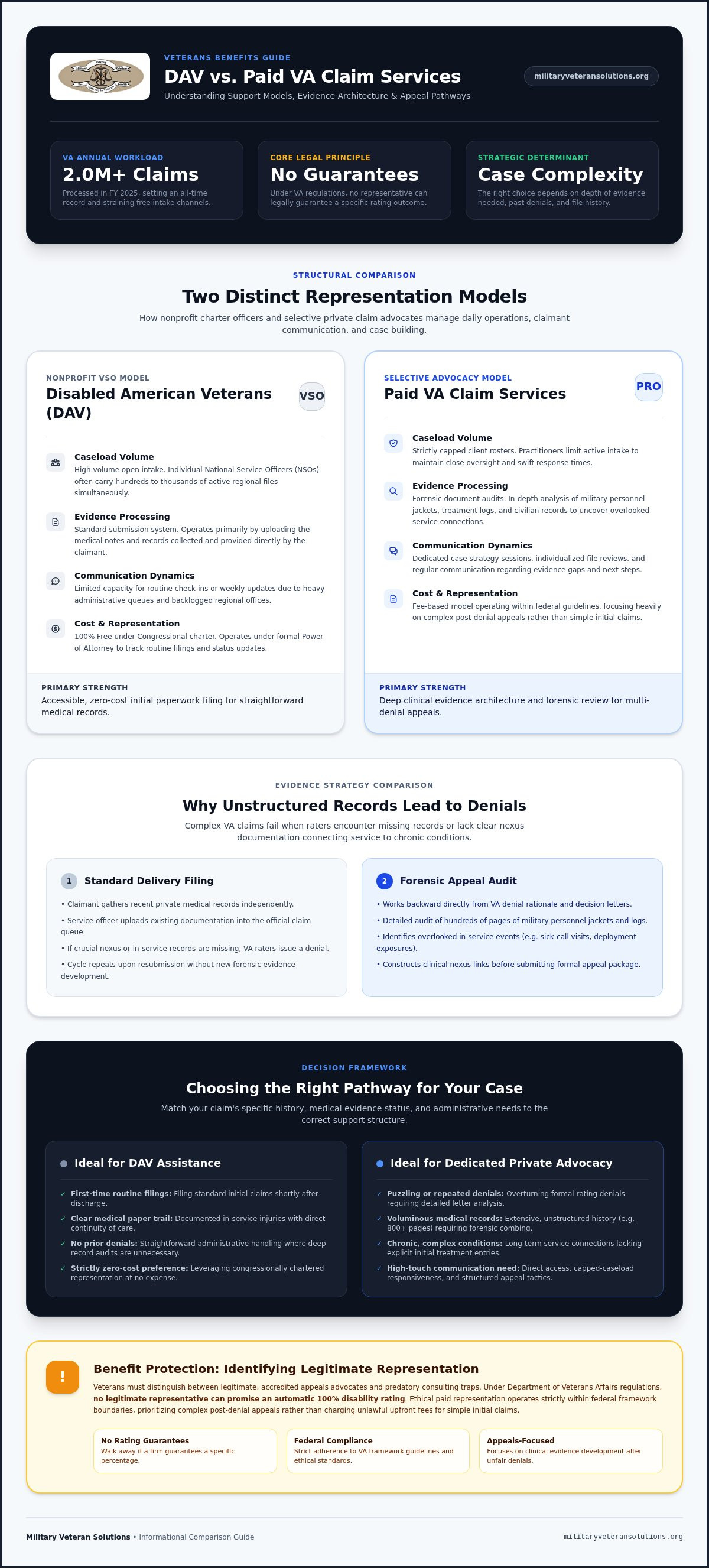
- Caseload volume: DAV representatives often manage hundreds of regional claimant files at once, while private advocates intentionally cap caseloads to maintain frequent communication.
- Evidence development: Nonprofit officers primarily submit the records you hand them; private advocates actively comb your service personnel files, military treatment logs, and civilian records to uncover overlooked service connections.
- Ethical standards: Legitimate paid representation operates strictly within federal framework boundaries, focusing heavily on post-denial appeals rather than charging unlawful fees for simple initial claims.
Basic claims flow smoothly through standard nonprofit channels. Complicated claims with multiple denials need a different engine entirely.
Comparing Support Models: Where Free VSOs and Paid Services Diverge
Most debates around veteran advocacy treat the decision as a strict binary: stay with a free VSO or hire an expensive law firm. That perspective overlooks specialized record review advocates who focus purely on clinical evidence architecture. To determine whether is a paid VA claim service better than DAV for your pending claim, you must look beyond upfront costs and examine how each model manages daily operations.
Caseload Realities: Volume Processing vs. Focused Attention
The Department of Veterans Affairs processed over 2 million disability claims in Fiscal Year 2025, setting an all-time record. This wave hit nonprofit service officers hard. Because DAV provides services free to everyone, individual officers often carry hundreds or even thousands of active files. They simply do not have the hours to call you weekly with strategic updates or spend days combing through 800 pages of unstructured medical history.
Selective private claim advocates restrict their active client roster. Lower volume translates directly into frequent communication, swift document turnaround, and personal strategy sessions. You aren't competing with an entire county's worth of transitioning service members just to get a question answered about your file.
Evidence Gathering and Record Analysis Depth
The standard VSO model functions primarily as a delivery system. You collect your private medical notes, hand them to the officer, and they upload those files into the official VA claim process. If crucial evidence is missing, the rater issues a denial, and the cycle starts over.
Dedicated appeal advocacy works backward from the denial itself. Instead of merely uploading existing papers, private advocates conduct forensic document audits across your entire military personnel jacket and treatment logs. This thorough deep-dive uncovers documented in-service events you might have forgotten: a sick-call visit for a twisted ankle twenty years ago, an exposed deployment location, or an underlying injury that now causes severe secondary issues. Establishing a strong medical nexus for secondary conditions requires precise cross-referencing between your historical records and current clinical diagnoses.
If you're stuck in bureaucratic limbo with unreturned calls, booking virtual consultations with a focused advocacy team can quickly clarify whether your records contain the unmined evidence needed to reverse an unfair decision.
When asking if is a paid VA claim service better than DAV, evaluate what your claim actually requires. Simple filings thrive on basic intake; complicated medical conditions require investigative document deconstruction.
Why Complex VA Appeals Often Fail Without Dedicated Advocacy
Receiving an adverse rating decision letter feels like hitting a brick wall. Most veterans respond by immediately refiling the same paperwork or walking away in disgust. Overworked service officers often submit a rapid Supplemental Claim without addressing why the initial claim failed. This reactive cycle explains why so many complex appeals drag out for years. If you are questioning whether is a paid VA claim service better than DAV, the answer becomes obvious during the appeal stage. Winning a difficult appeal requires forensic document deconstruction rather than routine resubmission.
You have exactly one year from your decision letter notification date to challenge a denial while protecting your original effective date. Choosing the wrong path can waste precious months. Reviewing dedicated guidance on filing VA appeals help shows that strategic lane selection, whether choosing a Supplemental Claim, a Higher-Level Review, or a Board appeal, dictates your ultimate outcome.
Deconstructing the VA Decision Letter
A denial letter is not just a rejection; it is an evidentiary roadmap. The VA is legally required to list both reasons for denial and favorable findings. An untrained eye sees a rejection and assumes all hope is lost. A skilled advocate looks directly at the favorable findings section to see what the VA has already conceded, such as a diagnosed disability or verified qualifying event. The failure point almost always boils down to a missing medical nexus or an inadequate Compensation and Pension (C&P) exam. Countering an inaccurate C&P exam requires picking apart the examiner's clinical rationale line by line using objective medical treatises.
The Value of Meticulous Military Service Record Reviews
Proving continuity of symptoms across decades requires deep archival research. Whether you work with an accredited representative or VSO or hire private advocates, missing service personnel records can ruin your file. Dedicated document reviews consistently uncover critical details that surface-level checks overlook:
- Forgotten treatment logs: Brief entries in field aid-station logs that never made it into modern electronic health archives.
- Line-of-duty determinations: Overlooked administrative findings proving injuries occurred in the line of duty rather than through misconduct.
- Hazardous exposure evidence: Unit deployment manifests, flight records, or ship logs that verify environmental exposures.
This level of archival discovery bridges the gap between active-duty discharge and present-day functional limitations. When evaluating if is a paid VA claim service better than DAV, remember that complex secondary claims rarely succeed without an advocate willing to perform this painstaking forensic legwork.
How to Choose Between DAV and Paid Claim Services for Your Claim
Choosing between nonprofit support and private advocacy should not involve guesswork. Your path depends on the current status of your paperwork, the complexity of your medical conditions, and your tolerance for procedural delays. Deciding whether is a paid VA claim service better than DAV starts with identifying where your file sits in the adjudication pipeline.
When Working with the DAV Makes the Most Sense
Nonprofit service officers excel at standard administrative filings. You should strongly consider DAV representation under these specific conditions:
- First-time filings: You recently separated from service with organized military medical records clearly documenting your injuries.
- Direct presumptive claims: Your condition is conceded under statutory presumptions, such as recognized toxic exposure conditions backed by qualifying deployment orders.
- Broader community needs: You need community assistance beyond disability claims, such as hospital transportation networks or emergency service relief funds.
When to Invest in Dedicated Professional Advocacy
Complicated disputes require targeted strategy, extensive documentation reviews, and clinical depth. Dedicated paid advocacy becomes crucial when you are:
- Overturning prior denials: You face multi-year denials for complex conditions like orthopedic degeneration, toxic neuropathy, or mental health claims.
- Establishing secondary service connection: You must prove how an already connected disability aggravated or caused a secondary medical disorder.
- Filing for TDIU: You are pursuing Total Disability based on Individual Unemployability, which demands extensive vocational and clinical correlation.
Vetting Private Services: Red Flags and Trust Markers
Federal law strictly prohibits anyone from charging fees to assist with an initial VA disability claim. If an organization demands upfront fees for an original claim or insists on accessing your personal VA.gov account credentials, steer clear. These predatory operations exploit frustrated service members without providing actual clinical analysis.
Legitimate advocacy groups prioritize post-decision appeals, maintain complete contract transparency, and employ experienced advocates who understand military culture. When weighing if is a paid VA claim service better than DAV, prioritize organizations led by fellow veterans who have spent decades inside the system. If you want relentless attention on a denied appeal, partner with experienced veteran claims representation that will dissect your military records line by line to secure the benefits you earned.
Partnering with Military Veteran Solutions for Your VA Appeal
When an appeal stalls, you don't just need another form submitted; you need a strategic ally dedicated to untangling administrative errors. Deciding if is a paid VA claim service better than DAV often comes down to individual accountability. Military Veteran Solutions bridges the gap between overwhelmed volunteer-backed organizations and impersonal legal mills by delivering focused, veteran-centered advocacy for complex compensation disputes.
Veteran-Led Advocacy Rooted in Real Service Experience
Military Veteran Solutions was founded by a disabled 10-year U.S. Army veteran who understands the physical and bureaucratic toll of fighting for service connection. Backed by over 25 years of hands-on experience in the claims system, the firm approaches every appeal with tactical discipline. We treat your claim as an individual mission rather than a file number in a massive caseload. This peer-to-peer perspective ensures your voice is heard, your service is respected, and your file receives the relentless attention required to challenge improper rating decisions.
Virtual Consultations and Comprehensive Record Audits
Managing regional office appointments can be daunting, especially when living with chronic pain or mobility limitations. We offer nationwide virtual consultations, connecting you directly with experienced advocates from the comfort of your home. During these focused sessions, we review your procedural history and identify exactly why previous filings were rejected.
Our disciplined methodology centers on forensic document discovery. We conduct exhaustive military service record reviews, uncovering forgotten field logs, personnel files, and service orders that establish decisive continuity of symptoms. Simultaneously, we perform granular VA decision letter analysis to pinpoint overlooked favorable findings and dismantle flawed medical exams.
If you've spent months wondering whether is a paid VA claim service better than DAV, consider how personalized evidentiary audits can change your trajectory. You do not have to fight the system alone. Take the first decisive step toward overturning an unjust denial by scheduling a professional consultation with Military Veteran Solutions today.
Securing the Accurate VA Rating You Earned
Free VSO assistance remains a vital resource for straightforward initial filings, but complex appeals demand specialized evidentiary muscle. Deciding whether is a paid VA claim service better than DAV ultimately hinges on your claim's unique technical hurdles, the depth of medical nexus required, and the individual bandwidth of your advocate. When facing repeated rating denials, routine form resubmissions simply won't get the job done.
Military Veteran Solutions was founded by a disabled 10-year U.S. Army veteran with over 25 years of dedicated advocacy experience. We specialize in exhaustive forensic military record reviews and granular decision letter analysis, pinpointing the unmined evidence necessary to overturn unfavorable ratings nationwide. You don't have to navigate confusing procedural delays alone or settle for an inaccurate evaluation. Request your strategic claim review with Military Veteran Solutions today, and take a decisive, confident step toward securing the full disability compensation you earned.
Frequently Asked Questions
Is a paid VA claim service better than DAV for simple initial claims?
No, paid services are not better than DAV for standard, well-documented initial filings. Federal law prohibits charging veterans fees for initial disability claims, making free VSO representation the appropriate and legal choice. If your medical conditions are clearly documented in your service records, DAV service officers can file your original paperwork efficiently at zero cost.
Can private VA claim companies guarantee a 100 percent disability rating?
No legitimate organization, advocate, or representative can guarantee a specific VA disability rating. Any company promising a guaranteed rating or specific back pay amount violates basic ethical standards and federal guidelines. Reputable advocates conduct thorough forensic audits and present the strongest possible evidence, but final rating determinations rest entirely with the Department of Veterans Affairs.
Why do so many veterans experience communication delays when using free VSOs?
Communication delays stem from massive caseloads rather than a lack of dedication from service officers. With millions of claims moving through the VA system, individual VSO representatives often manage hundreds of open files simultaneously. This heavy administrative burden leaves little time for regular phone check-ins, proactive updates, or hours spent poring over complex medical histories.
How do paid advocacy services uncover evidence that VSOs often miss?
Paid advocates conduct forensic military service record reviews rather than simply submitting the records you hand them. They comb through historical personnel files, field treatment logs, line-of-duty investigations, and deployment records. This investigative deconstruction identifies forgotten in-service events and establishes the clinical links necessary to prove a direct or secondary service connection.
Are paid VA claim consultants legal to use under current VA regulations?
Yes, paid representation is fully legal under federal regulations for post-decision appeals and supplemental claims. While federal statutes prohibit charging fees for original initial applications, professional advocacy firms, agents, and attorneys can legally assist veterans with appeals once an unfavorable decision letter has been issued by the regional office.
What should I do if the DAV represented me and my claim was still denied?
Start by obtaining a thorough VA decision letter analysis to pinpoint the exact evidentiary gaps cited by the rater. When facing an appeal deadline, deciding whether is a paid VA claim service better than DAV depends on your claim's complexity. You have one year from your denial notice to gather missing nexus evidence and select the correct appeal lane.
How does Military Veteran Solutions handle virtual consultations for veterans nationwide?
Military Veteran Solutions provides secure virtual consultations to review appeal strategies with veterans across the country. Founded by a disabled 10-year Army veteran with over 25 years of claims experience, our firm evaluates your prior denial letters and military records remotely. You receive dedicated, one-on-one strategic guidance without needing to travel to an office.


