
A 10% disability rating for your spine is practically guaranteed if you can bend past your knees during an evaluation, no matter how much agony it causes you afterward. If you are frustrated by a decision letter that treats severe lumbar strain like a minor ache, you are not alone. Securing an accurate VA disability for back pain and sciatica often feels impossible when examiners rush through range of motion tests and completely ignore flare-ups. You know the shooting nerve pain and numbness down your legs impact your ability to work and live, yet the VA's rigid rating schedule frequently minimizes your daily functional loss.
You don't have to accept an inadequate rating. In this guide, you will learn how to establish service connection, maximize ratings for thoracolumbar spine conditions and secondary radiculopathy, and overcome low VA ratings. We will walk through the exact diagnostic codes raters use, the mandatory goniometer rules examiners must follow, and the evidence needed to successfully link secondary sciatica to your back condition.
Key Takeaways
- Understand how VA raters evaluate thoracolumbar spine conditions under 38 CFR § 4.71a, where objective degrees of flexion dictate your percentage far more than subjective pain alone.
- Learn your legal protections during a C&P exam, including the mandatory use of a goniometer and proper accounting for flare-ups under the DeLuca criteria.
- Discover how establishing secondary radiculopathy can bypass low orthopedic rating caps and substantially increase your combined VA disability for back pain and sciatica.
- Identify the critical service records and objective medical testing required to establish an undeniable nexus for degenerative disc disease or chronic strain.
- Uncover common rater calculation errors in VA decision letters and determine the most effective appeals pathway to challenge an undervalued claim.
Understanding VA Disability Ratings for Back Pain: 38 CFR Diagnostic Codes
The Department of Veterans Affairs evaluates mechanical spine conditions under 38 CFR § 4.71a. Most veterans assume their disability check will reflect their daily suffering, but the rating schedule operates on mechanical measurement rather than pain tolerance. Raters assign percentages based almost entirely on your objective range of motion (ROM) loss, measuring how far your spine bends before discomfort begins. Understanding this formula is vital when building a claim for VA disability for back pain and sciatica.
To see how spinal nerve roots create secondary functional limitations throughout your lower body, watch this detailed clinical breakdown:
The General Rating Formula for Spinal Conditions
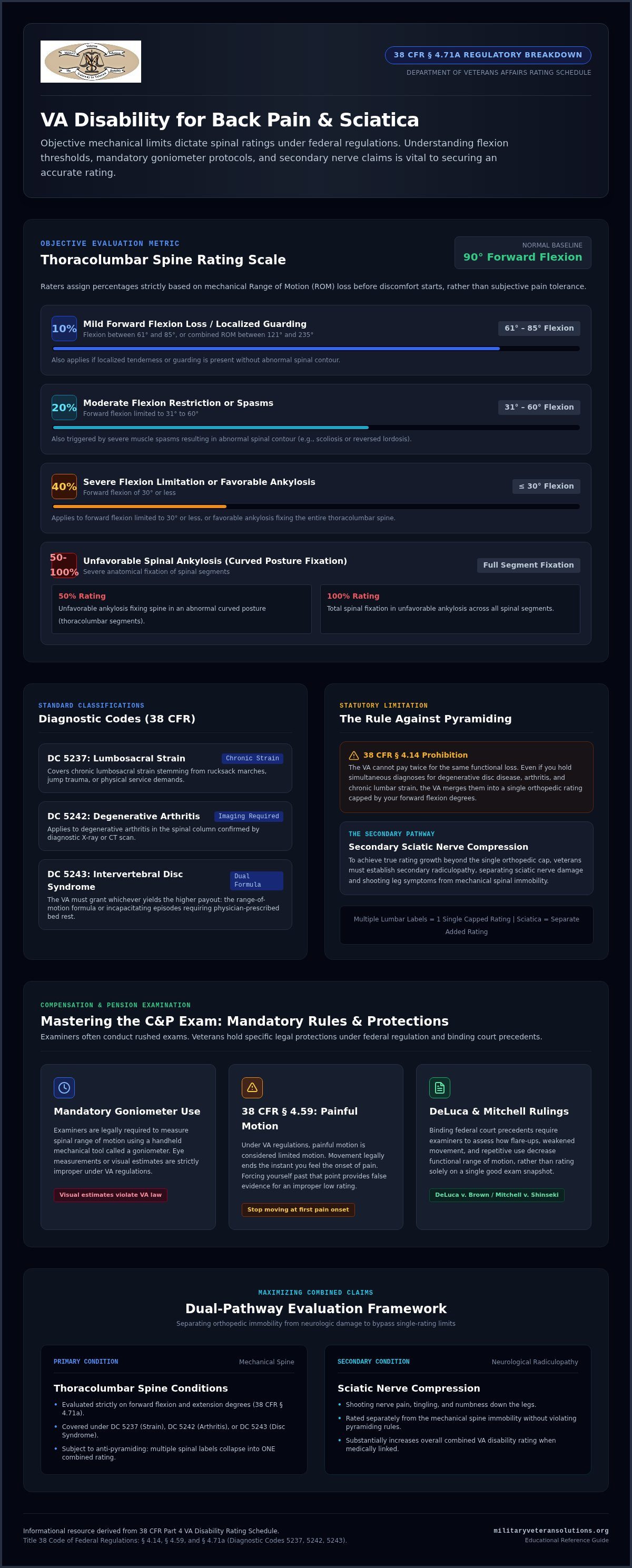
The thoracolumbar spine formula assesses your forward flexion relative to a normal 90-degree baseline. The rating tiers break down into specific motion thresholds:
- 10%: Forward flexion between 61° and 85°, or combined ROM between 121° and 235°. Localized tenderness or guarding that does not cause abnormal spinal contour also qualifies.
- 20%: Forward flexion limited to 31° to 60°, or severe muscle spasms resulting in abnormal spinal contour like scoliosis or reversed lordosis.
- 40%: Forward flexion of 30° or less, or favorable ankylosis fixing the entire thoracolumbar spine.
- 50% to 100%: Unfavorable ankylosis fixing the spine in an abnormal curved posture earns 50% for the thoracolumbar segments, while total spinal fixation reaches 100%.
Common Diagnoses Under Diagnostic Code 5237 and 5242
Your medical paperwork provides the clinical label, but the spine formula remains identical across diagnoses. Diagnostic Code 5237 covers chronic lumbosacral strain stemming from rucksack marches, jump trauma, or physical service demands. Diagnostic Code 5242 applies to degenerative arthritis confirmed by X-ray or CT scan. For intervertebral disc syndrome (DC 5243), the VA must grant whichever formula yields the higher payout: the range-of-motion formula or a calculation based on incapacitating episodes requiring physician-prescribed bed rest.
The Rule Against Pyramiding for Multiple Back Diagnoses
You cannot receive separate ratings for multiple lumbar labels. Under 38 CFR § 4.14, the rule against pyramiding prevents the VA from paying you twice for the same functional loss. Even if you have degenerative disc disease, arthritis, and chronic lumbar strain simultaneously, the VA merges them into a single orthopedic rating capped by your flexion degrees. True rating growth requires establishing sciatic nerve compression and symptoms as a distinct secondary disability, separating nerve damage from spinal immobility to maximize your combined VA disability for back pain and sciatica.
Mastering the C&P Exam for Back Pain: Goniometers and Flare-Ups
Your Compensation and Pension (C&P) exam is the single most influential hurdle when claiming VA disability for back pain and sciatica. Too many veterans walk into these appointments trying to tough it out. They push through the pain to touch their toes, inadvertently handing the rater evidence for a low 10% rating. Under VA regulations, examiners must record your range of motion using a handheld mechanical tool called a goniometer. Eye measurements or visual estimates are strictly improper under the law.
Stop moving the instant you feel the first onset of pain. Under 38 CFR § 4.59, painful motion is considered limited motion. If you begin feeling pain at 35 degrees of forward flexion, that is where your movement legally ends. Forcing your body past that barrier gives the examiner a false impression of your true functional ability.
The Legal Power of DeLuca v. Brown and Mitchell v. Shinseki
A C&P exam captures only a single snapshot of your spine on a relatively good day. Binding federal court decisions protect you from this limitation. In DeLuca v. Brown, the court established that examiners must evaluate functional loss caused by pain, fatigue, weakness, and lack of coordination during repetitive use. Mitchell v. Shinseki expanded this protection, requiring examiners to estimate your additional range of motion loss during severe flare-ups. If you are not in the middle of a flare-up during your appointment, the clinician is legally required to ask about your worst days and estimate that reduced mobility.
What Examiners Look for on the Spine DBQ
During the examination, the clinician completes a standardized Disability Benefits Questionnaire (DBQ) measuring movement against the 38 CFR § 4.71a spine rating criteria. They evaluate six distinct spinal planes:
- Forward flexion, extension, left lateral flexion, right lateral flexion, left rotation, and right rotation.
- The presence of objective muscle guarding, spasms, and localized spinal tenderness.
- Observable gait abnormalities, including limp, antalgic walking patterns, or dependence on canes and braces.
Documenting Incapacitating Episodes for IVDS Claims
If you are evaluated for intervertebral disc syndrome under DC 5243, range of motion is not your only path to compensation. The VA awards higher percentages if you suffer frequent incapacitating episodes, defined strictly as bed rest prescribed by a physician. Having at least two to four weeks of prescribed bed rest in a 12-month window warrants a 20% rating, while six weeks or more justifies a 60% evaluation. Keep personal treatment logs and doctor slips to verify these bed-rest orders. If you need help gathering your historical records, a professional military record review service can help uncover critical service-treatment notations. When building your claim strategy, scheduling a consultation through militaryveteransolutions.org provides clarity on the medical evidence raters require.
Connecting Sciatica as a Secondary Disability to Service-Connected Back Pain
When a primary back condition caps at 10% or 20%, secondary claims offer the most reliable pathway to fair compensation. Sciatica occurs when disc herniation, degenerative disc disease, or arthritis compresses the L4, L5, or S1 nerve roots in the lumbar spine. Beyond clinical claims, patients managing chronic nerve symptoms often explore specialized chiropractic directories such as Upper Cervical Care to locate doctors focused on overall spinal alignment and nerve health. Establishing secondary service connection creates an entirely separate rating stream, allowing your combined VA disability for back pain and sciatica to compound instead of stalling under a single orthopedic cap.
Diagnostic Codes and Severity Ratings for the Sciatic Nerve
Under 38 CFR § 4.124a, the VA rates sciatic nerve dysfunction under three distinct diagnostic categories based on physical presentation:
- Neuralgia (DC 8720): Covers sensory symptoms like tingling, burning, or dull radiating pain without measurable reflex or motor loss. Mild symptoms rate at 10%, while moderate symptoms reach a regulatory cap of 20%.
- Neuritis (DC 8620): Evaluates chronic nerve inflammation with objective sensory and tendon reflex impairment. Ratings are assigned at 10% (mild), 20% (moderate), or 60% (severe).
- Paralysis (DC 8520): Evaluates motor impairment and muscular weakness. Mild incomplete paralysis rates at 10%, moderate incomplete at 20%, moderately severe at 40%, and severe incomplete paralysis with foot drop or muscular atrophy warrants 60%.
Applying the Bilateral Factor to Maximize Combined Ratings
Spinal disc pathology rarely stays isolated to a single side. If your back injury radiates down both legs, you are entitled to two distinct sciatic nerve ratings. Under 38 CFR § 4.26, the bilateral factor combines your left and right leg ratings first, then adds a 10% bonus to that subtotal before combining it with your spinal rating. Read our guide on how to combine VA disability ratings for 100% to see how this formula accelerates your overall percentage. The official rules for VA disability ratings and compensation allow these distinct orthopedic and neurological ratings to exist side by side without violating anti-pyramiding rules.
Establishing the Medical Nexus Between Spine and Nerve Pain
Winning a secondary claim requires three pieces: an established primary back condition, a current diagnosis of radiculopathy, and an authoritative medical nexus. Diagnostic imaging showing disc herniation or neuroforaminal stenosis provides the physical evidence of nerve root impingement. When supported by electromyography (EMG) testing or clinical reflex checks, a doctor's statement confirming your sciatica is at least as likely as not caused by your service-connected back completes a bulletproof claim for VA disability for back pain and sciatica.
Essential Evidence Checklist: Proving In-Service Cause and Current Severity
Winning a claim for VA disability for back pain and sciatica requires building a complete evidentiary bridge. Under the Caluza triangle, the VA requires three core elements: an in-service injury or event, an active diagnosis, and a medical nexus connecting them. Many veterans suffer an initial denial not because their spine is healthy, but because decades have passed without clear medical records linking their civilian back treatment to military service. Consistently seeking care from spine specialists and chiropractors not only helps alleviate chronic nerve pain and alignment issues, but also establishes ongoing clinical records; learn more about modern chiropractic approaches to back and sciatica relief.
Auditing Service Treatment and Personnel Records
Field conditions rarely allow for extensive medical documentation. Even so, service treatment records (STRs) frequently contain overlooked evidence that raters miss. Audit your records for specific markers:
- Sick call slips noting lumbar strain, muscle relaxant prescriptions, or light duty profiles following field training exercises.
- Personnel records establishing physical trauma, such as parachute jumps, heavy artillery operation, mechanical maintenance, or vehicle collisions.
- Separation physicals that report recurrent lower back stiffness, even if recorded as minor or non-disabling at the time of discharge.
Drafting Persuasive Lay and Buddy Statements
When service treatment records are sparse, personal lay testimony bridges the gap. Under the precedent set in Jandreau v. Nicholson, veterans and their families are legally competent to report visible, observable symptoms. Use VA Form 21-4138 to outline your symptom timeline since leaving active duty. Spousal statements carry substantial probative weight by describing observable limitations, such as groaning when standing, difficulty putting on shoes, or sleepless nights caused by severe sciatica. Buddy statements from service members who witnessed a fall or heavy lifting injury verify the initial event occurred in the line of duty.
Securing High-Probative Value Medical Nexus Opinions
Objective imaging turns a subjective pain dispute into verifiable pathology. Private MRI scans demonstrating neuroforaminal stenosis or herniated discs validate nerve root impingement, while electromyography (EMG) studies confirm radiculopathy. A private physician's nexus letter must explicitly state that your sciatica is at least as likely as not caused by your military back condition, accompanied by reasoned medical rationale. Review the strategies outlined in this VA claim assistance resource guide to align your evidence with rater expectations. If you are struggling to identify past service connection or uncover lost medical logs, request a virtual claims review at militaryveteransolutions.org to examine your military personnel files and build an airtight case for VA disability for back pain and sciatica.
What to Do If Your VA Back Claim Is Denied or Rated Low
Receiving a decision letter with a flat denial or an insulting 10% rating feels like a slap in the face. It isn't the end of your fight. Adjudication mistakes are exceptionally common in spinal claims, especially when raters overlook secondary nerve complications. A denial is simply the VA's initial position; the Appeals Modernization Act (AMA) provides structured pathways to overturn flawed evaluations for VA disability for back pain and sciatica.
Analyzing Favorable Findings in Your VA Decision Letter
Turn directly to the "Favorable Findings" section of your rating decision. The VA often concedes two of the three elements needed for service connection, such as acknowledging an in-service injury or verifying a current diagnosis. Under 38 CFR § 3.104(c), favorable findings are legally binding on subsequent adjudicators unless clear evidence refutes them. Pinpoint the exact missing element. If the VA conceded your current lumbar disc disease and in-service event, your entire strategy narrows down to supplying the medical nexus.
Choosing Between Higher-Level Review and Supplemental Claim
Selecting the correct appeal lane prevents wasted months. Choose a Higher-Level Review (Form 20-0996) if the rater committed a clear procedural error, such as relying on an examiner who omitted flare-up estimates or failed to use a goniometer. Because HLR closed-record reviews do not accept new evidence, use them strictly to argue existing record errors. Conversely, choose a Supplemental Claim (Form 20-0995) when you need to introduce new medical records, an independent nexus opinion, or updated imaging. Review our tactical breakdown on filing VA appeals help to overturn denials to protect your effective date and back pay.
Pursuing Total Disability Individual Unemployability (TDIU)
Severe spinal damage frequently ends a veteran's working career long before scheduler ratings reach 100%. Under 38 CFR § 4.16(a), Total Disability based on Individual Unemployability (TDIU) awards compensation at the 100% rate if you meet schedular criteria and cannot maintain substantially gainful employment. Stacking a 20% lumbar spine rating with bilateral sciatica activates the bilateral factor and frequently pushes you past the required 70% threshold. Severe nerve pain eliminates prolonged sitting, while mechanical back instability prevents prolonged standing or lifting. When combined disabilities destroy your occupational capacity, seeking experienced assistance through virtual consultations helps document your complete functional impairment and secure the maximum compensation you earned.
Take Control of Your Spinal Disability Claim
A low evaluation does not define your service or the real physical toll on your body. Remember, spinal ratings hinge on strict range of motion limits at the first onset of pain, not how much agony you can endure. When primary lumbar claims stall, establishing secondary radiculopathy unlocks the bilateral factor and provides the compounding compensation your condition warrants. A flawed decision letter is never the final word; it is simply your roadmap for an appeal.
You don't have to navigate this complex administrative system alone. Military Veteran Solutions, LLC was founded by a 10-year disabled U.S. Army veteran dedicated to fighting for fellow service members. Backed by over two decades of national experience dissecting service records and winning difficult VA appeals, our team knows how to expose procedural rater errors and uncover missing nexus evidence. Request a Comprehensive Decision Letter and Records Review today to take charge of your claim and secure the full VA disability for back pain and sciatica you earned.
Frequently Asked Questions
Can I get separate VA disability ratings for back pain and sciatica?
Yes, you can receive separate ratings for your thoracolumbar back condition and sciatica without violating anti-pyramiding regulations. Under 38 CFR § 4.71a, neurological conditions stemming from spinal trauma must be evaluated separately. Your back is rated under orthopedic range of motion codes, while sciatica is rated under nerve codes 8520, 8620, or 8720. If both legs are affected, you receive two distinct nerve ratings plus the bilateral factor bonus.
What is the average VA disability rating for lower back pain?
Most veterans receive an initial rating of 10% or 20% for lower back conditions. Because the general rating formula requires forward flexion between 31 and 60 degrees for a 20% evaluation, the vast majority of mechanical strains fall into this bracket. Achieving a 40% rating requires forward flexion limited to 30 degrees or less. Overcoming this common ceiling generally requires properly rating radiating secondary nerve conditions like sciatica.
How does the VA test for sciatica during a C&P exam?
Examiners evaluate sciatica through physical neurological tests, sensory mapping, and muscle testing rather than simple range of motion. They typically perform the Straight Leg Raise test to detect radicular nerve pain. The clinician will also test deep tendon reflexes at your knees and ankles, check light touch sensation along the L4, L5, and S1 dermatomes, and measure calf circumference to document muscle atrophy and motor weakness.
What if my C&P examiner didn't use a goniometer during my back exam?
An exam conducted without a goniometer is legally inadequate under VA regulations and binding federal precedent. Visual estimates of spinal motion violate 38 CFR § 4.46. If your examiner eyeballed your movement or told you to bend past the onset of pain, you should immediately submit a lay statement challenging the exam's adequacy and consider requesting a Higher-Level Review once your decision letter arrives.
Can I claim secondary conditions caused by sciatica like foot drop or gait changes?
Yes, you can claim secondary conditions that develop as a direct consequence of your service-connected nerve damage. Chronic sciatica frequently causes an altered walking gait, leading to compensatory joint issues in the opposite hip, knee, or ankle. Severe sciatic paralysis can also manifest as complete foot drop, rated up to 80% under DC 8520. Documenting these secondary complications maximizes your overall compensation for VA disability for back pain and sciatica.
Does degenerative disc disease automatically qualify for VA disability benefits?
No, an MRI or X-ray diagnosis of degenerative disc disease does not automatically grant VA disability compensation. To win service connection, you must establish an in-service injury or event and obtain a medical nexus linking your current spinal degeneration to your military duty. The VA does not pay based on the diagnostic label alone; your monthly payout depends strictly on documented range of motion loss or incapacitating episodes.
Can back pain and sciatica qualify a veteran for 100% TDIU?
Yes, combining severe back pain and radiculopathy is one of the most reliable routes to securing Total Disability Individual Unemployability (TDIU). A 20% back rating combined with bilateral sciatica frequently surpasses the 70% combined schedular threshold under 38 CFR § 4.16(a). When mechanical back instability prevents prolonged standing and radiating nerve pain destroys your ability to tolerate sedentary sitting, you meet the legal criteria for 100% compensation.


