
Did you know that sleep apnea is one of the top three most frequently denied health conditions in the VA benefits system? It's a staggering reality for thousands of veterans who struggle with exhaustion every day. If you've faced a denial or feel overwhelmed by the requirement for a medical nexus, you aren't alone. Seeking sleep apnea VA claim help shouldn't feel like an uphill battle against a faceless bureaucracy. You deserve a rating that reflects your service, especially when a 50% rating for CPAP use can provide $1,132.90 in monthly tax-free compensation.
We understand the frustration of being told your condition isn't service-connected simply because you weren't diagnosed while on active duty. This guide will show you exactly how to bridge that gap. You'll learn the specific evidence and secondary service connection strategies required to win your claim or appeal in 2026. We'll break down the latest rating schedule updates, the role of obesity as an intermediate step, and how a meticulous review of your military records can uncover the winning strategy the VA missed.
Key Takeaways
- Master the three essential legal pillars—diagnosis, in-service event, and nexus—needed to overcome the high denial rate for post-service sleep apnea claims.
- Explore why secondary service connection through conditions like PTSD or rhinitis is often the most successful strategy for securing sleep apnea VA claim help in 2026.
- Learn the specific clinical language and peer-reviewed citations required in a Nexus Letter to successfully link your sleep disorder to your military service.
- Determine whether a Higher-Level Review or a Supplemental Claim is the right move for your specific appeal based on the evidence you have available.
- Discover how a dedicated military record review can uncover overlooked service events that prove your condition began during your time in uniform.
Why Sleep Apnea VA Claims are Frequently Denied (and How to Fix It)
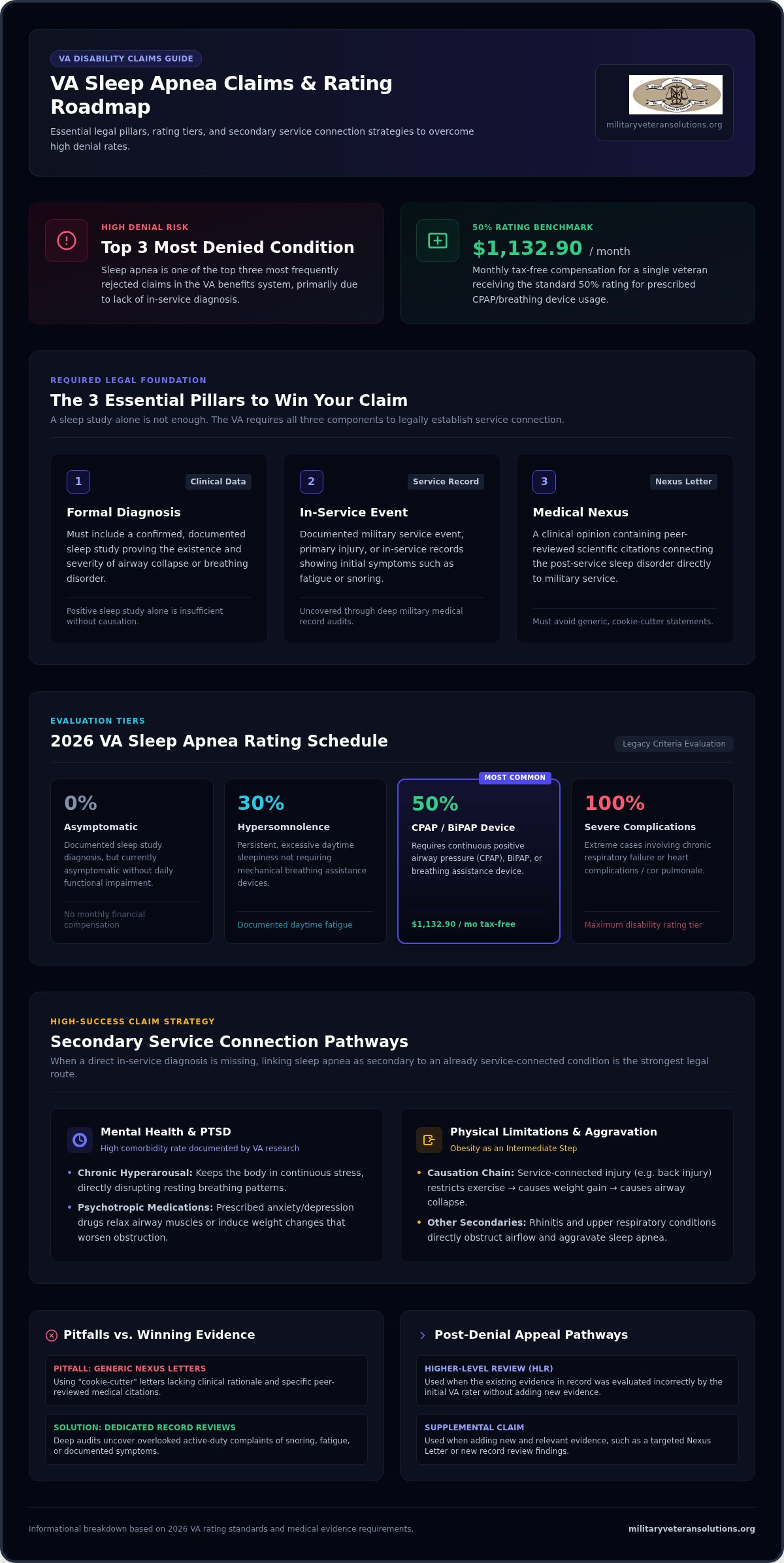
Winning a VA claim for sleep apnea requires more than just a doctor's note. The VA looks for a specific three-part foundation: a formal medical diagnosis, an in-service event or injury, and a medical nexus linking the two. Most veterans fail because they focus only on the diagnosis. If you're searching for sleep apnea VA claim help, you've likely realized that a post-service diagnosis is often met with an automatic rejection. The rater simply assumes the condition developed after you left the military.
A common misconception is that a positive sleep study is enough to secure benefits. It isn't. While understanding the clinical overview of sleep apnea helps you identify symptoms like airway collapse or daytime fatigue, the VA rater only cares about legal service connection. You must prove your military service caused the breathing disorder. Without that link, the most severe diagnosis in the world won't result in a single dollar of compensation.
To better understand how these elements come together, watch this helpful video:
The 2026 VA Rating Schedule for Sleep Apnea
As of late 2026, the VA continues to use legacy criteria for sleep apnea evaluations. This means your rating depends heavily on your treatment requirements and symptom severity. The 0% rating applies if you're asymptomatic but have a documented sleep study. A 30% rating is assigned for persistent daytime hypersomnolence, or excessive sleepiness. The 50% tier remains the most common, granted to veterans who require a CPAP, BiPAP, or other breathing assistance device. For a single veteran, this 50% rating provides $1,132.90 per month in tax-free support. The 100% rating is reserved for extreme cases involving chronic respiratory failure or heart complications.
Common Pitfalls in Initial Sleep Apnea Filings
Many veterans fall into the trap of using "cookie-cutter" medical statements. These generic letters often lack the specific clinical rationale a rater needs to see. Another major hurdle is missing service records. If your files don't show the initial complaints of snoring or fatigue, the VA will claim there is no evidence of an in-service event. Professional sleep apnea VA claim help focuses on uncovering these hidden details through deep record audits. We identify the evidence you didn't even know was there, ensuring your nexus is backed by facts rather than just hope.
The Power of Secondary Service Connection for Sleep Apnea
Winning a direct service connection for sleep apnea is notoriously difficult if you weren't diagnosed while in uniform. Most veterans don't undergo a sleep study until years after separation. This is where secondary service connection changes the game. A secondary condition is any disability that's caused or aggravated by an existing service-connected issue. The VA is legally required to compensate you for these resulting health problems. For many, this is the most reliable form of sleep apnea VA claim help available today.
The aggravation theory is particularly powerful for veterans with physical limitations. If a service-connected back injury prevents you from exercising, and that leads to weight gain that causes airway collapse, the VA must recognize that link. While obesity isn't a standalone disability, it serves as a critical intermediate step in your causation chain. This path allows you to connect the dots between an old injury and your current breathing struggles, even if they seem unrelated at first glance.
Connecting Sleep Apnea to Mental Health Conditions
The biological ties between the mind and the airway are profound. VA research on PTSD and sleep apnea shows a high rate of comorbidity among veterans. Chronic hyperarousal keeps the body in a state of stress, which can disrupt normal breathing patterns during rest. Additionally, many psychotropic medications used to treat anxiety or depression cause weight gain or relax the throat muscles, directly worsening obstructive sleep apnea. Your personal statement must clearly detail how your mental health symptoms or treatments have made it impossible to get a restful night's sleep. We help you articulate these struggles to ensure the VA rater understands the full scope of your condition.
Respiratory and Orthopedic Links
The PACT Act has opened new doors for veterans exposed to toxins during service. If you have service-connected rhinitis or sinusitis, these conditions often obstruct the nasal passages, forcing mouth breathing and aggravating sleep apnea. Orthopedic injuries like chronic knee or lumbar strain also play a role. When pain limits your mobility, weight gain often follows, which is a primary driver of obstructive sleep apnea. Identifying these subtle links requires a deep VA claim evidence analysis of your medical history. We look for the exact moment your health started to decline to build a bulletproof case. If you're tired of denials, it's time to find an advocate who understands how to connect the dots. You can start by reaching out for a virtual consultation to review your options and secure the rating you've earned.
Essential Evidence: Record Reviews and Nexus Letters
Most veterans approach their claim by simply handing over a current diagnosis. This approach is why so many claims fail. To secure sleep apnea VA claim help that actually works, you must look backward into your history to find the evidence the VA rater says doesn't exist. This evidence isn't just a single document; it's a combination of clinical opinions, service records, and lay evidence that creates an undeniable link. When the VA denies a claim, it's usually because they don't see the "bridge" between your time in uniform and your current health struggles.
What Makes a Strong Nexus Letter?
A nexus letter is the bridge between your military service and your current disability. For the VA to accept it, the letter must contain the specific legal phrase "at least as likely as not." This means there's a 50% or greater probability that your condition is service-connected. However, a doctor's signature isn't enough on its own. The physician must state that they've reviewed your entire C-file, including every service treatment record and private medical file. We've seen countless claims fail because a doctor didn't explicitly mention this review.
If a doctor issues an opinion without looking at your history, the VA will likely dismiss it for having low "probative value." This is a common trap that leads to immediate denial. A winning medical opinion provides a clear clinical rationale, citing peer-reviewed studies and specific incidents from your time in uniform. It's about showing the rater that your breathing issues aren't just a coincidence; they're a direct result of your service.
The Role of Professional Record Audits
The foundation of a successful appeal often lies in the details you've forgotten. Professional record audits involve searching for "hidden" entries in your service treatment records, such as complaints of chronic fatigue, morning headaches, or buddy reports of loud snoring during deployment. These small notations prove that an in-service event occurred, even if you weren't officially diagnosed at the time. Finding these needles in the haystack is what separates a winning claim from a frustrating denial.
Analyzing VA decision letters is the first step in this process. By identifying exactly where the rater went wrong, we can target the missing evidence required to overturn the denial. This meticulous approach forces the VA to acknowledge service-connected aggravation that they previously ignored. It's a methodical way to build a case that the VA cannot simply dismiss.
Beyond medical records, "Buddy Statements" or lay evidence play a vital role. When your medical records are thin, statements from spouses or fellow service members who witnessed your sleep disturbances can fill the gaps. These statements provide the human context that medical codes often miss. To understand the full VA decision reviews and appeals process, you must recognize that evidence is the only currency the VA accepts. We help you gather and organize this evidence so your claim stands on solid ground.
Navigating the Appeal Process After a Sleep Apnea Denial
A denial letter from the VA feels like a door slamming shut, but it's actually the start of a strategic chess match. You have exactly 365 days from the date on that letter to file an appeal and preserve your back pay. Choosing the right lane is the most critical decision you'll make. Most veterans seeking sleep apnea VA claim help are forced to decide between a Supplemental Claim and a Higher-Level Review (HLR). Picking the wrong one can waste months of your time and delay the benefits you need to manage your health.
Supplemental Claims: Adding the Missing Piece
If the VA denied you because they didn't see a "nexus" or a current diagnosis, the Supplemental Claim is your best path. This lane allows you to submit "new and relevant" evidence that wasn't in your file during the previous decision. This is the time to introduce a more robust nexus letter or a recent sleep study that clarifies the severity of your condition. You must ensure the new evidence directly addresses the specific reason for your denial. Using professional VA claim assistance helps you organize this evidence package so a rater can't ignore the facts. In 2026, a well-organized Supplemental Claim remains the most effective way to fix evidentiary gaps.
Higher-Level Review (HLR) Strategies
The Higher-Level Review is a different beast. You cannot add new evidence here. Instead, a senior adjudicator performs a de novo review of your existing file to look for errors. This lane is ideal if the VA ignored evidence already in your record or misapplied the rating schedule. The most powerful tool in this lane is the Informal Conference. This is your chance to speak directly with a senior rater to point out where the previous rater failed their duty to assist. We often find that raters overlook secondary links or fail to account for how service-connected orthopedic pain led to weight gain. If the evidence is already there, an HLR can force the VA to correct their mistake without starting from scratch.
Waiting for an appeal decision in 2026 requires patience, as timelines for these reviews often stretch several months. However, the wait is worth the potential back pay and the security of a service-connected rating. Don't let a single letter stop you from pursuing what you've earned. If you're ready to challenge a denial, you can schedule a virtual consultation to analyze your decision letter and build a winning appeal strategy today.
How Professional Advocacy Secures Your Earned Benefits
When you're fighting for your benefits, you don't need a high-volume "claims factory" that treats your service history like a assembly line. These large firms often lack the personal touch required to find the subtle evidence that wins a case. You need an advocate who has sat in the same C&P exams and felt the same frustration of receiving a denial letter. Military Veteran Solutions, LLC was founded by a disabled veteran with 10 years of Army service and brings over 25 years of experience to the table. We don't just file paperwork; we perform deep audits to find the missing links the VA ignored.
The VA's bureaucratic system is designed to be difficult. It's easy to get lost in the complex "VA Math" or miss a critical deadline while you're struggling with the exhaustion of sleep apnea. Our virtual consultations allow us to provide dedicated sleep apnea VA claim help to veterans across the country, regardless of where they're located. We act as a bridge between the formal professional service you expect and the personal mentorship you deserve. We understand the technicalities of the system intimately but remain firmly independent to better serve your interests.
The Military Veteran Solutions Advantage
Our process begins with a comprehensive review of your C-file and previous decision letters. We don't just look at the final answer; we analyze the rater's logic to find clinical or procedural errors. This meticulous record analysis is where we identify secondary service connections you might have missed. Perhaps a service-connected orthopedic injury led to weight gain, or your PTSD medications are relaxing your airway. We find these connections and build the evidentiary scaffolding necessary to support them. You get direct advocacy from someone who has served in the trenches and knows how to speak the VA's language to get results.
Next Steps: Get Your Claim Evaluated
Preparing for a virtual consultation is straightforward. You simply need your most recent decision letters and any service treatment records you have on hand. The most important thing you can do is act quickly. The VA's 365-day appeal window is strict, and once it closes, you risk losing years of potential back pay. We help you organize your evidence package so you can file with confidence. Don't let the weight of medical record requirements or the confusion over 2026 rating changes stop you from securing your future. You've earned these benefits through your service. Schedule your professional VA claim consultation today and let a seasoned ally guide you through the process.
Secure the Rating Your Service Earned
Winning your sleep apnea claim isn't about luck; it's about the strategic alignment of medical evidence and military history. We've explored how identifying secondary service connections and performing deep record audits can transform a denial into an approval. Whether you're connecting sleep apnea to PTSD or navigating a Supplemental Claim, the foundation of success is a meticulous review of your C-file. You don't have to face this complex bureaucratic system alone.
Military Veteran Solutions, LLC is here to provide the sleep apnea VA claim help you need to move forward. Founded by a disabled veteran with 10 years of Army service and backed by over 25 years of advocacy experience, we understand the nuances of your records. Our virtual consultations are available nationwide, ensuring you have access to expert support regardless of your location. Don't let your appeal window close while you're still searching for answers. It's time to take control of your health and your benefits. Get Expert Help with Your Sleep Apnea Appeal Today. You've served your country with honor, and now it's time to ensure your country serves you.
Frequently Asked Questions
Can I get VA disability for sleep apnea if I was never diagnosed in the military?
Yes, you can still secure a rating even without an in-service diagnosis. Most successful claims today are filed as secondary service connections to conditions like PTSD, rhinitis, or orthopedic injuries. You must provide a medical nexus that links your current sleep apnea to a condition already service-connected. Our deep military record reviews often find hidden evidence, such as complaints of fatigue or snoring, that helps prove the condition began during your time in uniform.
What is the VA rating for sleep apnea with a CPAP machine in 2026?
In 2026, the VA continues to assign a 50% disability rating for sleep apnea if you require the use of a breathing assistance device like a CPAP or BiPAP machine. This rating provides $1,132.90 in monthly tax-free compensation for a single veteran with no dependents. While the VA previously proposed changes to this schedule, those rules remain unfinalized. Your rating is currently protected under the legacy criteria as long as medical necessity is documented.
How do I prove sleep apnea is secondary to PTSD?
Proving this link requires a nexus letter that details the neurobiological relationship between mental health and airway obstruction. PTSD symptoms like hyperarousal and REM sleep fragmentation can directly impact breathing patterns. Additionally, many psychotropic medications used to treat PTSD cause weight gain or muscle relaxation in the throat, which aggravates sleep apnea. A strong medical opinion must state it's at least as likely as not that your PTSD caused or worsened your sleep disorder.
What evidence is needed for a successful sleep apnea supplemental claim?
A successful supplemental claim requires new and relevant evidence that wasn't considered during your previous decision. This often includes a professional nexus letter, a more recent sleep study, or buddy statements from those who witnessed your symptoms. Organizing this evidence is where professional sleep apnea VA claim help makes the difference. We analyze your previous denial to identify the specific evidentiary gaps and provide the exact documentation needed to overturn the rater's decision.
Can the VA reduce my sleep apnea rating if my symptoms improve?
The VA can technically reduce your rating if there's material medical improvement shown under ordinary conditions of life. However, veterans with established ratings are protected under 38 C.F.R. § 3.951. The VA cannot reduce your rating simply because the rating schedule changes in the future. As long as you continue to require a CPAP machine and your symptoms haven't significantly resolved, your 50% rating should remain secure against arbitrary reductions by the agency.
How long does a VA sleep apnea appeal take in 2026?
Appeal timelines in 2026 vary depending on which lane you choose. Higher-Level Reviews and Supplemental Claims typically take four to six months to process. If your case moves to the Board of Veterans' Appeals, the wait can extend to a year or longer. Using sleep apnea VA claim help ensures your package is complete from the start, which can prevent unnecessary delays caused by the VA's duty to assist errors or missing documentation in your file.
Is a nexus letter mandatory for a sleep apnea claim?
While a nexus letter isn't a legal requirement for every claim, it's practically mandatory if you weren't diagnosed during service. The VA rarely grants sleep apnea claims based solely on a diagnosis and a statement of service. You need a licensed medical professional to bridge the gap with a clinical rationale. This letter provides the at least as likely as not link that raters look for when deciding whether to grant service connection for your condition.
What happens if my sleep apnea claim is denied again?
If your claim is denied again, you still have options under the Appeals Modernization Act. You can file a new Supplemental Claim with different new and relevant evidence or move your case to the Board of Veterans' Appeals. A denial isn't the end of the road; it's a signal that your evidence package needs to be stronger. We specialize in analyzing these decision letters to find the specific errors that lead to a successful appeal for veterans.


