
Why is the VA still denying claims for illnesses they've already admitted are linked to your service? You've spent decades dealing with the health consequences of your time in Southeast Asia, yet the process of securing benefits often feels like a second war. It's exhausting to navigate changing rules like the PACT Act while your health and financial security are on the line. We understand that frustration because we've seen how easily a legitimate claim can stall due to a missing medical record or a misunderstood regulation.
This guide allows you to discover the fully updated list of presumptive conditions for Vietnam veterans 2026 and provides the clarity you need to secure the disability compensation you earned. We'll break down the 19 recognized conditions, explain how the 2026 COLA rates increase your monthly payments, and show you how a methodical military record review can uncover the evidence required to overturn a past denial. You'll gain a clear strategy for navigating the 365-day appeal window and understanding how current laws affect your specific situation. This is about more than just paperwork; it's about the dedicated advocacy you deserve to finally get the results you've been waiting for.
Key Takeaways
- Learn how presumptive status removes the complex legal burden of proving a direct medical nexus for your service-connected illnesses.
- Access the comprehensive list of presumptive conditions for Vietnam veterans 2026, including critical updates to hypertension and respiratory cancer criteria.
- Identify the specific "Location" and "Diagnosis" gaps that lead to VA denials and discover how to bridge them with clinical evidence.
- Master a two-step audit of your military records to align your unit assignments with recognized herbicide exposure zones and spray missions.
- Discover why a professional Decision Letter Analysis is the most effective way to identify hidden errors in a denied claim and secure your full entitlements.
Understanding Presumptive Service Connection for Vietnam Veterans in 2026
For decades, Vietnam veterans fought two battles: one in the jungle and one at the VA. Presumptive service connection changes that dynamic. It's a legal shortcut that removes the requirement to provide a medical "nexus" letter linking your illness to a specific event in service. If you have a diagnosed illness on the approved list and served in a recognized location, the VA must assume your condition was caused by your service. This is vital because proving a direct connection for 50-year-old injuries is often impossible without this legal framework.
To better understand how these rules have changed to benefit you, watch this helpful video from the VA:
The landscape for presumptive conditions for Vietnam veterans 2026 has shifted significantly as the PACT Act has matured. This law didn't just add new illnesses; it fundamentally changed how the VA views toxic exposure. Today, federal mandates ensure that Vietnam-era claims remain a top priority for adjudicators. While direct service connection still exists for unique injuries, most veterans find success through the presumptive path because it bypasses the most common reason for denial: the lack of contemporaneous medical evidence from the 1960s or 70s.
The Role of Agent Orange and Herbicide Exposure
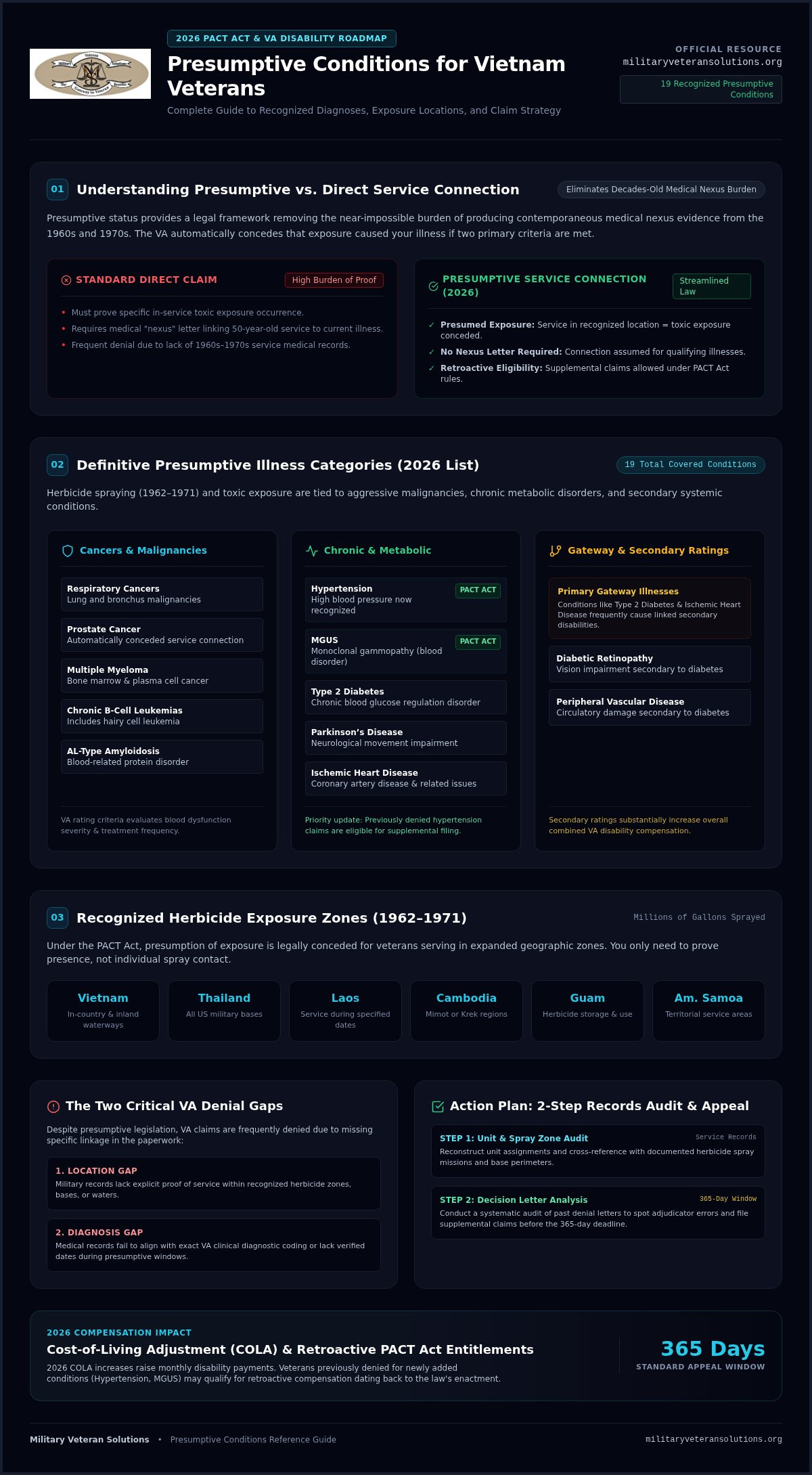
Understanding the military use and health effects of Agent Orange is essential for any veteran filing a claim today. Between 1962 and 1971, the U.S. military sprayed millions of gallons of herbicides across Southeast Asia, leading to severe long-term health consequences for those on the ground. Presumption of exposure is the legal assumption that any veteran in-country was exposed to toxins. This means you don't have to prove you were personally sprayed; you only need to show you were there.
The Impact of the PACT Act on Vietnam-Era Claims
The PACT Act of 2022 expanded the map for presumptive conditions for Vietnam veterans 2026, finally acknowledging those who served in Thailand, Laos, Cambodia, Guam, and American Samoa. It also added hypertension and monoclonal gammopathy of undetermined significance (MGUS) to the list of recognized conditions. If you were previously denied for high blood pressure, 2026 is a critical year to file a supplemental claim. The VA now recognizes that these conditions are tied to herbicide exposure, and you may be eligible for retroactive compensation dating back to the law's passage.
The Definitive List of 2026 Vietnam Veteran Presumptive Conditions
The updated list of presumptive conditions for Vietnam veterans 2026 reflects decades of advocacy and scientific research. It now encompasses a wide range of aggressive malignancies and chronic metabolic disorders. Cancers such as Multiple Myeloma, Prostate Cancer, and Respiratory Cancers (including lung and bronchus) are automatically conceded as service-connected for those with qualifying service. Beyond oncology, the VA recognizes chronic illnesses like Type 2 Diabetes, Parkinson’s Disease, and Ischemic Heart Disease. These diagnoses often act as gateways to secondary service connections. For example, a veteran rated for diabetes might also secure ratings for diabetic retinopathy or peripheral vascular disease, significantly increasing their overall compensation. As you navigate these health concerns, it is also wise to consider the legal aspects of long-term care; you can discover Coastal Legacy Law to learn how life care planning and elder law services can protect your family's future.
AL-Type Amyloidosis and Chronic B-cell Leukemias (including hairy cell leukemia) are complex blood related disorders that qualify for presumption. Symptoms often include extreme fatigue, swelling, or unexplained weight loss. The VA rating criteria focus on the severity of the blood dysfunction and the frequency of required treatments. Proving your diagnosis dates during the presumptive window is essential for securing the correct effective date. If you're managing several of these illnesses, it's vital to understand how to combine VA disability ratings to reach the maximum monthly compensation of $3,930.96 for a single veteran in 2026.
Respiratory Cancers and Soft Tissue Sarcomas
Soft tissue sarcomas are a group of diverse cancers that start in the tissues that support and connect the body. While most qualify, the VA specifically excludes certain types like mesothelioma and osteosarcoma from this presumptive list. If you are facing a diagnosis excluded from the presumptive path, you can visit Weitz & Luxenberg to learn about specialized legal support for asbestos-related illnesses. Precise medical coding in your records is mandatory to ensure your diagnosis matches the VA presumptive conditions for Agent Orange exposure. A single clerical error in a pathology report can lead to an immediate denial, making a thorough review of your medical documentation a necessity before you file.The inclusion of hypertension was a hard-fought victory that now impacts thousands of pending claims. In 2026, even a 0% non-compensable rating for high blood pressure is a win; it establishes a service connection that allows you to claim secondary conditions like heart disease or stroke later. Monoclonal Gammopathy of Undetermined Significance (MGUS) is another critical addition. While MGUS itself may not show symptoms, its recognition provides a clear path for veterans who have abnormal protein levels in their blood. If you've faced past denials for these conditions, a virtual consultation is the first step toward identifying the evidence needed to reopen your claim and secure the benefits you earned.
Why the VA Denies Presumptive Claims (And How to Appeal)
Receiving a denial letter for a condition that is clearly on the list of presumptive conditions for Vietnam veterans 2026 is a gut punch. It feels like a betrayal after decades of waiting for recognition. Most denials don't happen because you aren't sick; they happen because of technicalities in your paperwork. The "Location Gap" is a primary culprit. Even with the PACT Act expansions, the VA often denies claims if your records don't explicitly show you were in a recognized exposure zone. If you were stationed "near" but not technically "in" a conceded area according to their outdated maps, they'll reject the presumption immediately.
The "Diagnosis Gap" is equally dangerous. Your private doctor might use general terminology like "heart problems" when the VA specifically looks for "Ischemic Heart Disease." Without that exact coding, the automated systems trigger a denial. There's also the "Date of Service" trap. For conditions like early-onset peripheral neuropathy, the VA requires proof that the disability manifested to at least 10% within one year of your discharge. Missing this window by even a few days can lead to a rejection. To fix these errors, seeking filing VA appeals help is the most effective way to build a winning strategy.
Analyzing Your VA Decision Letter
Your decision letter is the roadmap to your eventually approved claim. You must look past the boilerplate language to find the specific "reason for denial." Usually, it's a missing link between your unit assignments and your current diagnosis. Many veterans find that a VA decision letter review service is the only way to decode the VA's reasoning. This professional analysis identifies exactly which piece of evidence is missing, allowing you to target your appeal effectively. You have exactly 365 days from the date of that letter to initiate the VA decision reviews and appeals process without losing your original effective date.
Winning the PACT Act Appeal in 2026
PACT Act filings often fail because veterans assume the law does all the work for them. It doesn't. Common mistakes include failing to submit a formal diagnosis or providing incomplete service records that don't cover the full duration of your exposure. If your PACT Act claim denied appeal is handled correctly, you can often secure years of back pay. The key is finding the specific evidence the VA overlooked during the initial review, such as deck logs or unit morning reports. Don't let a single letter stop you from getting the compensation you earned through decades of health struggles.
How to Audit Your Military Records for Presumptive Evidence
Securing the benefits you earned for presumptive conditions for Vietnam veterans 2026 depends on your ability to prove precisely where and when you served. The VA frequently challenges the "Nexus" of a claim by questioning service dates or specific geographic locations. You must conduct a systematic audit of your own records to identify the evidence they've missed. This process requires a methodical approach that goes far beyond a simple review of your discharge papers.
- Step 1: Scrutinize your DD214 for specific unit assignments. Look for attachments to divisions or vessels that operated in conceded exposure zones.
- Step 2: Cross-reference your service dates with known herbicide spray missions. Records from the National Archives can often place your unit in the direct path of tactical spraying.
- Step 3: Identify "hidden" medical entries. Look for "silent" mentions of skin rashes, respiratory distress, or fatigue in your old service treatment records that were ignored at the time.
- Step 4: Secure "Lay Evidence." Statements from fellow service members can verify your presence in a location when official travel orders are missing from your file.
Unlocking Proof in Personnel Files (OMPF)
Your Official Military Personnel File (OMPF) contains the granular data the VA often overlooks during initial reviews. You should request your full file via Standard Form 180 to find Temporary Duty (TDY) orders. These orders frequently place you in exposure zones, such as Thailand or Laos, that never made it onto your final DD214. Pay close attention to your awards and citations. A Bronze Star or Commendation Medal citation might describe a specific operation in a province known for heavy herbicide use. These documents provide the definitive proof of presence that the VA claims is missing from your record.
The Critical Role of Medical Record Audits
Medical record audits involve connecting your current presumptive condition to entries in your old service treatment records. Small notes about minor health issues from decades ago can serve as the foundational evidence for a modern claim. A professional military record review service provides the specialized expertise needed to uncover these hidden links. We find the evidence that automated VA systems ignore. If you've been denied before, start your virtual consultation today to begin the process of auditing your records for the truth.
Strategic Advocacy: How to Secure Your Vietnam Veteran Entitlements
Filing a claim for presumptive conditions for Vietnam veterans 2026 might seem straightforward, but the reality is often a years-long cycle of delays and low ratings. The VA system is built on rigid administrative rules that don't always favor the veteran. When you file alone, you're responsible for identifying every piece of missing evidence and interpreting complex decision letters. This burden often leads to missed opportunities for higher compensation levels that you've earned through your service. You deserve an ally who knows how to navigate these hurdles with precision.
Understanding the landscape of assistance is the first step toward success. Veteran Service Officers (VSOs) are often dedicated individuals, but they frequently handle hundreds of cases at once, leaving little time for the deep-dive analysis your record requires. Advocacy firms like Military Veteran Solutions, LLC operate differently. We are a veteran-owned firm with over 25 years of combined experience. We specialize in Military Record Reviews and VA Decision Letter Analysis to find the hidden evidence that moves a claim from a denial to an approval. Our focus is on the thorough evaluation of your history, not just the filing of forms.
Our approach combines professional authority with the perspective of someone who has walked in your boots. We recognize that many Vietnam veterans face mobility challenges, which is why our virtual consultations are a cornerstone of our service. You get expert representation from the comfort of your home. This ensures that distance or physical limitations never stand in the way of your entitlements. We take the time to see you and understand your situation before offering a clear path forward.
Maximizing Your Combined Disability Rating
Winning a single presumptive claim is often just the beginning of your journey. To secure the maximum monthly compensation, you must identify secondary conditions that stem from your primary illness. For instance, if you're rated for Type 2 diabetes, you may also qualify for ratings related to peripheral neuropathy or kidney disease. These "gateway" conditions are essential for reaching a 100% rating through multiple presumptive links. You can find a detailed breakdown of how different providers handle these complexities in our veteran advocacy services comparison guide.
Next Steps: Your 2026 Action Plan
If you have a diagnosis but no rating, your priority is gathering evidence for a Supplemental Claim. Start by requesting your full personnel file and identifying specific unit locations that align with herbicide exposure. If you've recently received a denial, don't wait for the 365-day clock to run out. Gather your medical records and your most recent VA decision letter for a thorough evaluation. The most effective way to protect your retroactive pay and secure your presumptive conditions for Vietnam veterans 2026 benefits is to Schedule a virtual consultation with Military Veteran Solutions today. Let us use our expertise to turn your past denials into a definitive victory.
Secure the Benefits You Earned in 2026
You've carried the physical and emotional burden of your service for over fifty years. Don't let a clerical error or a misunderstood regulation in a VA decision letter stand between you and the compensation you deserve. The expanded list of presumptive conditions for Vietnam veterans 2026 offers a vital opportunity to secure your future, but success requires more than just a diagnosis. It demands a meticulous audit of your military records and a strategic approach to the appeals process. Identifying the specific gaps in your service history is the only way to turn a frustrating denial into a definitive approval.
Military Veteran Solutions, LLC is a veteran-owned and operated firm dedicated to helping you win this final battle. With over 25 years of advocacy experience, we specialize in uncovering the "hidden" evidence within your personnel files that automated systems often miss. We offer nationwide virtual consultations to provide expert guidance regardless of your location or mobility. It's time to stop fighting the system alone and start working with an ally who understands the technicalities of your claim. Get a Professional Analysis of Your VA Decision Letter today to begin your journey toward a successful outcome. You've served your country with honor; now, let us serve you.
Frequently Asked Questions
What are the presumptive conditions for Vietnam veterans under the PACT Act?
The PACT Act recognizes 19 specific conditions as presumptive for those exposed to herbicides. These include various cancers such as prostate and lung cancer, along with chronic illnesses like Type 2 Diabetes and Parkinson’s Disease. Most recently, the law expanded to include hypertension and monoclonal gammopathy of undetermined significance (MGUS). This designation removes the need for a medical nexus letter, provided you have a formal diagnosis and verified service in a recognized location.
Is hypertension now a presumptive condition for Vietnam veterans in 2026?
Yes, hypertension is a recognized presumptive condition for Vietnam veterans 2026. This change allows veterans who served in the Republic of Vietnam, Thailand, or other recognized locations to secure service connection for high blood pressure without proving a direct link to their service. Even if you receive a 0% non-compensable rating, establishing this connection is vital for claiming secondary conditions like heart disease or stroke later in life.
Can I get back pay for a newly added presumptive condition?
You may be eligible for significant back pay if you file a claim for a newly added condition. For conditions added by the PACT Act, the VA may award retroactive benefits to the date the law was signed or the date you originally filed a previously denied claim. Securing the earliest possible effective date requires a precise analysis of your past decision letters and a thorough review of your military personnel records to identify previous informal claims.
Does the VA recognize Blue Water Navy veterans for presumptive benefits?
The VA officially recognizes Blue Water Navy veterans who served on vessels operating within 12 nautical miles of the Republic of Vietnam between 1962 and 1975. These veterans are entitled to the same presumptive service connection for herbicide exposure as those who served on land. Proving eligibility often requires auditing digitized ship deck logs to verify the vessel's coordinates during your specific dates of service, a process where professional record reviews become essential.
What locations besides Vietnam are recognized for Agent Orange exposure?
Beyond the Vietnam mainland, the VA recognizes exposure in several other locations. These include any U.S. or Royal Thai military base in Thailand between 1962 and 1976, as well as specific service in Laos, Cambodia, Guam, American Samoa, and Johnston Atoll. Veterans who served in or near the Korean Demilitarized Zone between 1967 and 1971 also qualify. Each location has specific date ranges that must be verified through your Official Military Personnel File.
How do I prove I was exposed to Agent Orange if it is not on my DD214?
Proving exposure when your DD214 is incomplete requires a deep dive into your full personnel records. You should look for Temporary Duty (TDY) orders, unit morning reports, or specific award citations that place you in a recognized exposure zone. Lay evidence, such as buddy statements from fellow service members, can also verify your location. A professional military record review can help uncover these hidden documents that the VA's automated systems often miss during initial processing.
Can the VA deny a presumptive disability claim if I have the diagnosis?
Yes, the VA can and does deny claims even when a veteran has a confirmed diagnosis. Denials often occur because of a Location Gap where service records don't clearly place the veteran in an exposure zone. They may also deny claims for non-qualifying variants of a disease, such as certain soft tissue sarcomas. If you receive a denial, a professional analysis of your decision letter is the first step toward identifying the specific evidence needed for an appeal.
How long does a VA appeal for a presumptive condition take in 2026?
The timeline for an appeal varies based on the pathway you choose under the Appeals Modernization Act. Higher-Level Reviews and Supplemental Claims typically take four to five months for a decision. However, appeals to the Board of Veterans’ Appeals can take significantly longer, sometimes lasting several years. Using a methodical approach to gather new and relevant evidence before filing a Supplemental Claim is often the fastest way to resolve a denial and secure your benefits.


