
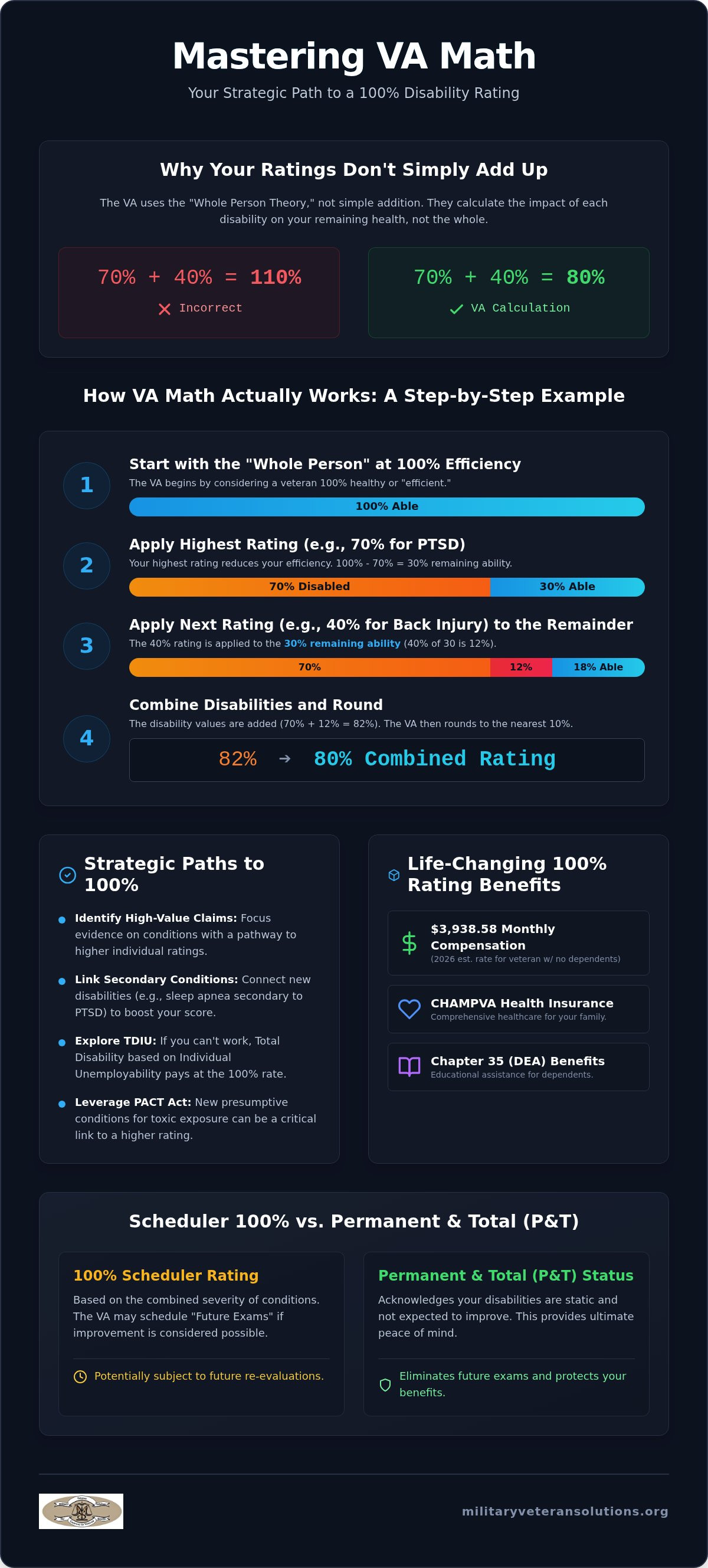
Adding 70% and 40% together equals 110% in a standard classroom, but under the VA's "whole person theory," it actually results in an 82% rating that rounds down to 80%. This confusing calculation is often the reason veterans feel low-balled by their decision letters while facing the heavy financial strain of service-connected injuries. You shouldn't have to feel like a number in a system that seems designed to minimize your sacrifice. Understanding how to combine va disability ratings to get 100 is the first step toward securing the $3,938.58 monthly compensation you've earned.
We're here to help you master the complexities of VA Math and discover the strategic pathways to your 100% rating. It's time to move past the anxiety of the appeals process and take control of your claim. In this guide, we'll explain how the 2026 COLA adjustments affect your bottom line. We'll also detail how to use secondary conditions to boost your score and explain the specific requirements for TDIU if your disabilities prevent you from maintaining gainful employment.
Key Takeaways
- Learn why the VA uses the "Whole Person Theory" instead of simple addition, ensuring you understand exactly how your ratings are calculated from highest to lowest.
- Discover how to combine va disability ratings to get 100 by identifying high-value claims and strategically linking secondary conditions to your existing service-connected disabilities.
- Explore Total Disability based on Individual Unemployability (TDIU) as a powerful alternative for veterans who cannot work but don't yet meet the 100% schedular threshold.
- Master the appeals process by using decision letter analysis to choose between a Higher-Level Review or a Supplemental Claim for a successful rating increase.
- Stay ahead of the 2026 landscape by leveraging PACT Act expansions and updated COLA rates to maximize your monthly compensation and long-term security.
Understanding the 100 Percent VA Disability Rating in 2026
A 100% rating is more than just a number; it's a formal recognition by the Veterans Benefits Administration (VBA) that your service-connected conditions have reached a level where the government considers you "totally disabled." In 2026, this translates to a monthly payment of $3,938.58 for a veteran with no dependents. This figure reflects the 2.8% COLA increase that officially took effect on December 1, 2025. While the financial support is vital, learning how to combine va disability ratings to get 100 also unlocks a massive suite of ancillary benefits, including full dental care through the VA and significant property tax exemptions in many states.
The landscape for reaching this threshold shifted significantly with the PACT Act expansions. These changes added dozens of presumptive conditions related to toxic exposures, making it easier for many veterans to bridge the gap between a partial rating and the 100% mark. If you've been stuck at 70% or 80%, these new regulations might provide the missing link in your evidence chain. You deserve to have every symptom accounted for.
Why the 100% Rating is a Life-Changing Milestone
Securing a 100% rating provides security that extends far beyond your own bank account. Your family gains access to CHAMPVA, a comprehensive health insurance program that covers the cost of covered health care services and supplies for eligible beneficiaries. Additionally, your dependents may qualify for educational assistance under Chapter 35 (DEA), which provides monthly stipends for degree and certificate programs, apprenticeship, and on-the-job training. A 100% disability rating serves as the definitive threshold for maximum federal veteran support, ensuring both you and your loved ones are protected from the financial burdens of your service-connected injuries.
Total Disability vs. Permanent and Total (P&T) Status
Not all 100% ratings are created equal. A "Scheduler" 100% rating is based on the combined severity of your conditions, but the VA may still schedule "Future Exams" if they believe your health might improve. In contrast, Permanent and Total (P&T) status means the VA acknowledges your disabilities are not expected to get better during your lifetime. This status is crucial because it often eliminates the stress of re-evaluations and triggers additional state-level benefits. Under the "Five-Year Rule," the VA generally cannot reduce a rating that has been in place for five years unless the condition has shown sustained improvement. Knowing how to combine va disability ratings to get 100 is often the first step, but securing P&T status is what provides the ultimate peace of mind. When your file no longer lists future exams, you can finally focus on your health without the looming anxiety of a potential reduction.
Demystifying 'VA Math': How Multiple Ratings Are Combined
The most common source of frustration for veterans is the realization that 50% plus 50% does not equal 100%. This logic defies standard arithmetic because the VA uses a "Whole Person Theory" to determine your level of disability. They don't view your injuries as a simple list of numbers to be added. Instead, they view you as a pie chart of efficiency. Once a disability takes a "slice" of your health, the next disability can only take a slice of what remains. This is why understanding how to combine va disability ratings to get 100 requires a shift in how you view your claim.
Order of operations is everything in this system. The VA doesn't just pick ratings at random. They rank your disabilities from the highest percentage to the lowest percentage before starting the calculation. If you have a 70% rating for PTSD and a 10% rating for tinnitus, the 70% is applied first. This ranking ensures that the most severe conditions have the largest impact on your final score. If you feel your primary condition was underrated, a VA decision letter analysis can help determine if the math was applied correctly to your specific situation.
Rounding rules also play a massive role in your final compensation. The VA always rounds your combined rating to the nearest 10% increment. This creates a high-stakes environment where a single percentage point can change your life. For example, a combined score of 84% is rounded down to 80%. However, a score of 85% is rounded up to 90%. That 1% difference can result in hundreds of dollars in lost monthly benefits. You must be precise with your evidence to ensure you land on the right side of that rounding line.
The Efficiency Principle: Calculating the 'Whole Person'
Think of your body as 100% efficient when you enter service. If you receive a 50% rating for a back injury, the VA considers you 50% disabled and 50% efficient. If you then claim a 30% rating for a knee condition, the VA doesn't take 30% from the original 100. They take 30% of the remaining 50% efficiency. That equals 15%. When you add that 15% to your original 50%, your combined rating is 65%. Under the rounding rules, that 65% rounds up to 70%. You've added a 30% condition but only saw a 20% increase in your total rating. Each subsequent rating becomes harder to move the needle because there's less "healthy" percentage left to take from.
Using the VA Combined Rating Table Correctly
You can find the math pre-calculated in the official VA combined ratings table. This grid uses X and Y axes to find the intersection of two different ratings. You start with your highest rating on one axis and your second highest on the other. The number where they meet is your new combined starting point. You then use that new number to find the intersection with your third highest rating. This continues until all service-connected issues are accounted for. The VA always rounds to the nearest 10% increment at the very end of this sequence. Mastering this table is essential for anyone learning how to combine va disability ratings to get 100, as it reveals exactly how much more evidence you need to reach the finish line.
Strategic Paths to Reach a 100% Combined Rating
Knowing the mechanics of "VA Math" is only half the battle. To cross the finish line, you need a roadmap that prioritizes high-value claims and uncovers hidden service connections. Many veterans struggle to reach the 100% mark because they focus on individual 10% ratings that barely move the needle. Instead, your strategy should center on conditions like mental health, sleep apnea, and chronic back issues. These are often rated at 50% or higher, providing the heavy lifting needed to climb the VA's official combined rating table efficiently. A single 70% rating for PTSD, for instance, significantly reduces the number of smaller claims required to reach your goal.
The PACT Act of 2022 has fundamentally changed the environment for veterans exposed to toxic substances. If you served in specific locations and now suffer from respiratory conditions or certain cancers, these are now considered presumptive. You no longer have to prove a direct link to a specific event in your service. Leveraging these presumptives is a powerful way to add significant percentage points to your file. However, the foundation of any successful increase is a thorough military record review. We often find that veterans have documented injuries from decades ago that were never officially claimed. These "lost" records are frequently the key to unlocking how to combine va disability ratings to get 100.
The Bilateral Factor: Boosting Your Combined Score
The bilateral factor is a sophisticated "bonus" that can make or break your 100% goal. Under 38 C.F.R. § 4.26, if you have disabilities affecting both arms, both legs, or paired muscle groups, the VA adds an extra 10% to those combined ratings before they are merged with the rest of your conditions. This isn't a flat 10% addition to your total score. Instead, it's a 1.9% boost to the combined bilateral rating itself. While it sounds small, this tiny adjustment is often enough to push an 84% rating up to an 85%, triggering the rounding rule that secures a 90% or 100% total disability check.
Secondary Conditions: The Often Overlooked Path to 100%
If your primary service-connected condition caused a new medical issue, you have a secondary condition. This is one of the most effective ways to bridge the gap to 100%. For example, chronic back pain often leads to clinical depression or anxiety due to limited mobility and constant distress. Alternatively, years of taking NSAIDs for a service-connected knee injury may result in GERD (acid reflux). The key is the "nexus" requirement. You must provide a medical opinion proving that your secondary issue is "at least as likely as not" caused or aggravated by your primary disability. Stacking these 10% and 20% secondary ratings is a proven method for veterans learning how to combine va disability ratings to get 100 when their primary ratings have hit a ceiling.
Alternative Routes: TDIU and Individual Unemployability
Reaching a 100% scheduler rating through "VA Math" can feel like an impossible climb when you're stuck at 80% or 90%. If your service-connected conditions prevent you from working, you don't necessarily need to find more "slices" of the efficiency pie to get paid at the maximum rate. Total Disability based on Individual Unemployability (TDIU) is a specific benefit that allows the VA to pay you at the 100% rate, even if your combined rating is lower. It's often a more direct path than struggling with how to combine va disability ratings to get 100 through a dozen smaller claims. You deserve to be compensated for the true impact your injuries have on your life and livelihood.
The core of a TDIU claim is proving you can't maintain "substantially gainful employment." For 2026, the federal poverty level for an individual is $15,960. If you earn less than this amount, the VA typically considers your work "marginal employment," which does not disqualify you from receiving TDIU. Winning this claim requires more than just medical records. You need strong vocational evidence and detailed employer statements. These documents must clearly show that your service-connected disabilities, rather than your age or external economic factors, are the reason you cannot hold a steady job. If you are struggling to prove the vocational impact of your injuries, a virtual consultation can help you identify the specific evidence needed to bridge that gap.
Eligibility Requirements for TDIU
To qualify for schedular TDIU, you must meet the "60/40 rule." This means you need one service-connected disability rated at 60% or higher, or a combined rating of at least 70% with at least one individual condition rated at 40% or more. If you don't meet these specific percentages but your disabilities still make working impossible, you can apply for "extra-schedular" TDIU. This requires your case to be sent for a special review to determine if your situation is unique enough to warrant the 100% payment rate. TDIU serves as a safety net for veterans whose service-connected disabilities prevent substantial gainful employment.
TDIU vs. Scheduler 100%: Pros and Cons
The primary difference between TDIU and a scheduler 100% rating is your ability to work. With a scheduler 100% rating, you can earn as much money as you want without jeopardizing your benefits. TDIU, however, comes with strict income caps. If you start earning above the poverty threshold, the VA may move to reduce or terminate your TDIU status. It's also common for the VA to grant TDIU automatically during a claim for a rating increase if the evidence shows your conditions have worsened to the point of unemployability. Many veterans use TDIU as a temporary solution while they continue to build their medical evidence, eventually transitioning to a scheduler 100% rating as more secondary conditions are service-connected.
Navigating the Appeals Process for a Rating Increase
Receiving a decision letter that falls short of your expectations is a major setback, but it isn't the end of the road. It's actually the starting point for your next strategic move. Every decision letter contains the specific reasons why the VA denied your claim or assigned a lower percentage than you deserved. To master how to combine va disability ratings to get 100, you must treat this document as a diagnostic tool. If the VA conceded a service connection but gave you a 10% rating, they've identified the specific symptoms you must document to reach the next level. You have exactly one year from the date of that letter to file an appeal and preserve your effective date for back pay.
Your choice of appeal lane depends entirely on the nature of the VA's mistake. A Higher-Level Review (HLR) is the best option when you believe the evidence already in your file supports a higher rating, but the rater simply missed it. This is frequently the case when "VA Math" is miscalculated or the bilateral factor is left out of the equation. If you have new medical evidence, such as a fresh Nexus Letter or a completed Disability Benefits Questionnaire (DBQ), a Supplemental Claim is the right path. These documents provide the definitive medical link between your current symptoms and your time in service. Because we provide virtual consultations nationwide, we help veterans identify these critical appealable errors from the comfort of their homes.
Common Errors in VA Decision Letters
The VA is a massive bureaucracy, and administrative errors are incredibly common. One of the most frequent mistakes is the failure to apply the bilateral factor correctly, which often costs a veteran the single percentage point needed to round up to 100%. Raters also frequently overlook their "Duty to Assist." This happens when they fail to schedule a necessary C&P exam or ignore relevant records that were clearly mentioned in your file. Perhaps most importantly, the VA often miscalculates effective dates. If they ignore the date of your original intent to file, you could lose out on thousands of dollars in back pay based on the $3,938.58 monthly rate confirmed for 2026.
Why Professional Representation Matters for Complex Ratings
Navigating the three lanes of the Appeals Modernization Act is complicated. A comprehensive military medical record review often uncovers "low-hanging fruit," such as injuries documented during service that were never officially claimed. We focus on identifying these missed service connections to build a more robust total rating. Our team has the expertise to spot the technical errors that raters miss, ensuring your evidence is presented in a way the VA cannot ignore. Let us analyze your VA Decision Letter and build a winning strategy so you can finally secure the full benefits you've earned.
Take Command of Your VA Disability Rating in 2026
You've served your country with honor, and you shouldn't have to fight a second battle just to receive the compensation you've earned. We've explored how the "Whole Person Theory" dictates your final score and why strategic secondary claims are often the key to moving the needle. Whether you're leveraging PACT Act presumptives or pursuing TDIU as a pathway to 100% compensation, the difference between success and a denial often comes down to the depth of your medical evidence.
Mastering how to combine va disability ratings to get 100 is about identifying every missed service connection in your file. Military Veteran Solutions, LLC was founded by a 10-year disabled Army veteran who understands the weight of these administrative hurdles. We provide comprehensive military record reviews and national virtual advocacy to ensure your story is told accurately. Secure your earned benefits with a professional VA Decision Letter Analysis today.
Don't let a confusing system stand in the way of your family's long-term security. You've already done the hard part; now let's make sure the VA recognizes the full extent of your sacrifice. You have a powerful ally in this process, and your 100% rating is within reach.
Frequently Asked Questions
What is 'VA Math' and why is it so confusing?
VA Math is the method defined in 38 C.F.R. § 4.25 that combines disabilities based on your remaining efficiency rather than simple addition. It's confusing because it doesn't use standard arithmetic. Instead, a 50% rating leaves you 50% "able," and the next rating is taken from that smaller piece. This ensures no veteran can ever be more than 100% disabled. Understanding this calculation is the foundation of learning how to combine va disability ratings to get 100 effectively.
Can I get a 100% rating for a single condition?
Yes, you can receive a 100% rating for a single condition if it meets the highest criteria in the VA's Schedule for Rating Disabilities. Conditions such as active service-connected cancers, total blindness, or specific severe cases of PTSD are often rated at 100% individually. If your single condition doesn't reach 100%, you must rely on combining multiple ratings or pursuing TDIU to reach the maximum compensation level you deserve.
What happens to my benefits if I reach 100% P&T?
Reaching 100% P&T (Permanent and Total) status provides the highest level of security and protection available. It means the VA has determined your conditions are not expected to improve, which typically eliminates the requirement for future re-examination. You also gain access to CHAMPVA for your family, Chapter 35 educational benefits, and significant state-level perks like total property tax exemptions. It's the ultimate goal for long-term stability and peace of mind.
Is it possible to work while having a 100% VA disability rating?
You can work without any income limits if you have a 100% scheduler disability rating. However, if you receive 100% compensation through TDIU, your earnings are generally restricted to the federal poverty level, which is $15,960 in 2026. Veterans with a scheduler rating can pursue "substantially gainful employment" while keeping their full $3,938.58 monthly check, provided their work doesn't prove their disability has actually improved.
How long does it take to get a decision on a rating increase?
Decision timelines for 2026 vary based on the complexity of your file and the type of claim filed. On average, a Supplemental Claim takes 4 to 6 months, while a Higher-Level Review (HLR) typically takes 4 to 7 months. If your case requires a Board Appeal with a hearing, you could wait 18 to 24 months or more. Staying organized and submitting "fully developed" claims can sometimes help speed up this administrative process.
What is a Nexus Letter and do I need one for 100%?
A Nexus Letter is a formal medical document written by a healthcare provider that links your current disability to your military service. While not always mandatory, it's often the "missing link" needed to bridge the gap to 100%, especially for secondary conditions. A strong Nexus Letter uses specific legal language, like "at least as likely as not," to provide the medical evidence the VA requires to grant a service connection for your symptoms.
Does the PACT Act make it easier to get to 100%?
The PACT Act significantly simplifies the path to 100% by establishing presumptive service connections for toxic exposures. This means you don't have to prove your service caused certain respiratory illnesses or cancers; you only need to show you served in a covered location. These presumptives often provide the additional ratings needed when you're looking for how to combine va disability ratings to get 100 without a long, difficult legal battle.
What should I do if my claim for an increase was denied?
If your increase is denied, your first step should be a thorough analysis of the VA decision letter to identify the specific evidence gaps. You have one year from the decision date to file a Supplemental Claim with new evidence or a Higher-Level Review if you believe the rater made an error. Don't let a denial discourage you. Most successful 100% ratings are achieved through persistence and the strategic use of the appeals process.


