
A single piece of paper can often carry more weight than years of missing medical records when it's drafted with strategic precision. You've likely felt the sting of a VA denial letter that claims a "lack of evidence," even though you live with the daily reality of your service-connected disability. It's frustrating to know that your official files don't tell the whole story of that training accident or the gradual shift in your behavior. Using va form 21-10210 correctly allows you to break that silence by bringing in the voices of those who were actually there to witness your struggle firsthand.
We understand that navigating these administrative hurdles feels like a second battle, but you don't have to fight it alone. This guide will help you master the art of the lay statement to provide the vital evidence the VA needs to grant your service connection. We'll explore how to use the June 2021 version of the form to create a clear "Nexus" and corroborate service events that your medical records might have missed. By the time you finish reading, you'll have a roadmap to turn vague observations into competent lay evidence that significantly increases your chance of claim approval.
Key Takeaways
- Learn how to bridge the gap between missing medical records and your current disability by establishing a clear "Nexus" through firsthand accounts.
- Understand the specific requirements of VA Form 21-10210 and why the VA now requires this specialized form for all third-party buddy statements.
- Master a narrative framework that focuses on observable facts and behavioral changes, ensuring your witness statements meet the legal standard for competent evidence.
- Discover how to use professional record reviews to identify exactly where lay evidence is needed to overturn a previous claim denial.
The Critical Role of Lay Evidence in VA Disability Claims
Medical records are often incomplete. They capture what happened in a clinic, not what happened in the field or at home. If you've received a denial due to a "lack of evidence," it's likely because the Veterans Benefits Administration didn't see a clear link between your service and your current condition. This link is known as the "Nexus." When official paperwork is missing, va form 21-10210 becomes your most powerful tool to provide the missing narrative that clinical notes simply can't capture.
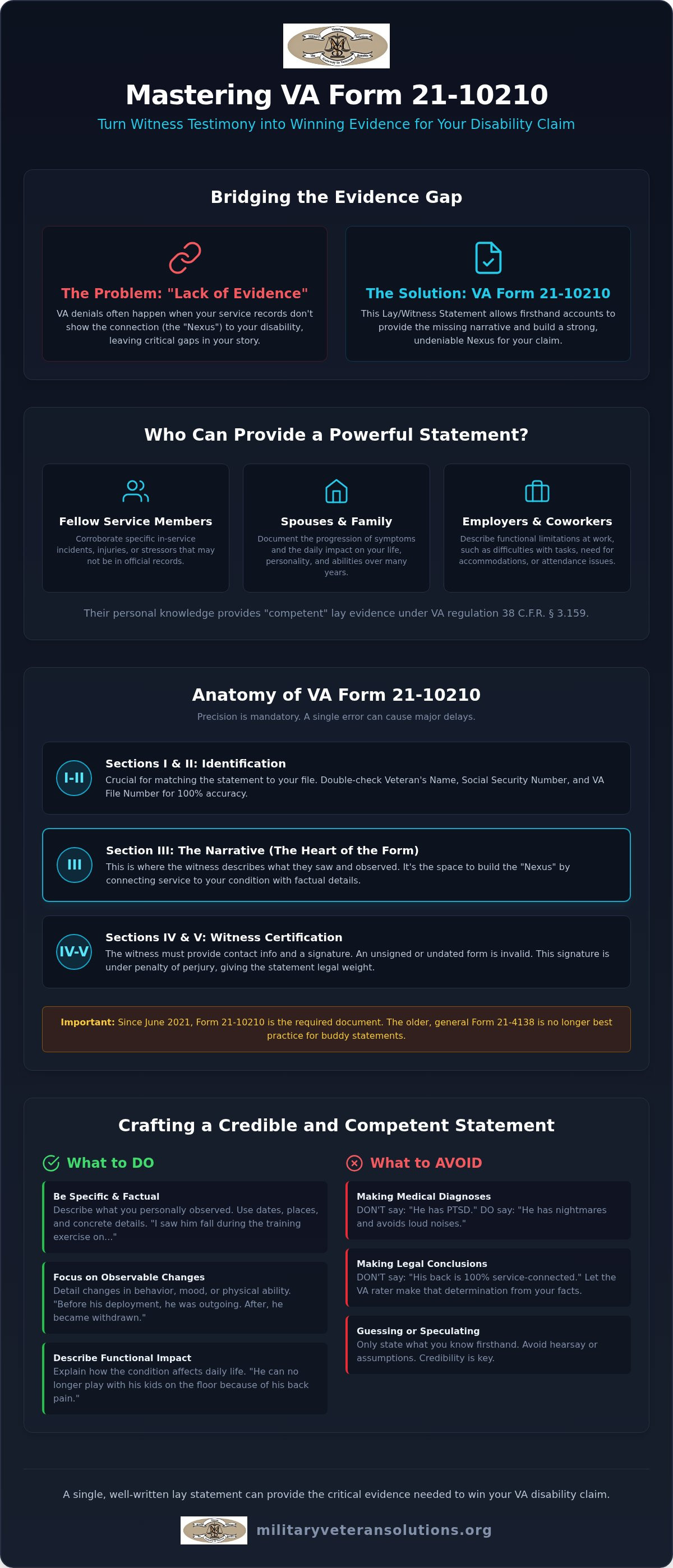
Under VA regulations, specifically 38 C.F.R. § 3.159, lay evidence is considered "competent" if it comes from someone with personal knowledge of the facts. You don't need a medical degree to describe a limp, a panic attack, or a change in personality. These observations are valid evidence. They provide the context needed to overturn denials that rely solely on an absence of service treatment records. It's about showing the VA what they missed in the charts.
Bridging the Gap Between Service and Diagnosis
Many veterans experience "silent years" after discharge where they didn't seek medical help. Perhaps you toughed it out or didn't have healthcare access. A buddy statement can "place" you at a specific event, like a fall during a jump or exposure to a specific toxin, even if it wasn't logged in your file. This is especially critical for mental health claims. While a doctor sees you for thirty minutes, a spouse or close friend sees the sleepless nights and social withdrawal every day. These non-medical observations fill the gaps that a diagnosis alone cannot bridge.
Who Can Provide a Lay Statement?
Choosing the right witness is a strategic decision. You want someone who has firsthand knowledge of your condition's impact. Different witnesses provide different types of value to your claim:
- Fellow service members: These individuals can corroborate specific incidents, stressors, or injuries that occurred during your time in uniform.
- Spouses and family members: They are often the best witnesses for documenting how your symptoms have progressed or interfered with your life over decades.
- Former employers or coworkers: These witnesses can describe functional limitations, such as why you struggled to stay on task or why you needed frequent breaks due to physical pain.
Using va form 21-10210 ensures these voices are heard in a format the VA recognizes. It transforms personal stories into actionable evidence that supports your right to benefits.
What is VA Form 21-10210? Definition and Requirements
The official VA Form 21-10210, titled "Lay/Witness Statement," serves as the formal vehicle for third-party evidence. It's no longer best practice to use the old, general 21-4138 for buddy statements. The VA transitioned to this specialized document in June 2021 to ensure that witness testimony is standardized and easily processed by their automated systems. This shift means your evidence gets in front of a rater faster, provided the form is completed accurately. It's a tool designed to turn personal observations into a permanent part of your claims file.
When a witness signs this form, they're doing more than just sharing a story. They're signing under penalty of perjury. This legal certification gives the statement the weight of a sworn affidavit. It tells the VA that the witness is willing to stand behind their observations, which is why raters take these documents seriously. If you're unsure if your witness's statement is strong enough to meet this standard, a professional military record review can help identify where their testimony will have the most impact.
Section-by-Section Breakdown
Precision is mandatory. If the VA can't match the form to your file, the evidence effectively doesn't exist. You don't want your claim stalled because of a simple clerical error.
- Section I & II: These areas identify the veteran and the claimant. Ensure Social Security numbers and VA file numbers are double-checked. Even a small typo can lead to months of administrative delays.
- Section III: This is the narrative section. It's the heart of the form where the witness describes what they saw and heard. It's the space where the "Nexus" is built.
- Section IV & V: These sections require the witness's contact information and signature. A missing date or an unsigned form is a common reason for immediate rejection by the evidence intake systems.
Online vs. Paper Submission
Speed matters in the appeals process. Submitting your va form 21-10210 through the VA.gov online portal is the most efficient route. It provides an immediate digital receipt and bypasses the manual scanning process at the Evidence Intake Center. If you prefer paper, you must mail it to the Evidence Intake Center in Janesville, Wisconsin. Always number your pages and include your name and file number on every additional sheet. This prevents your evidence from being separated or lost during high-volume processing periods.
VA Form 21-10210 vs. VA Form 21-4138: Which Should You Use?
Choosing between these two forms isn't just a matter of preference. It's a strategic decision that affects how a rater views your evidence. While both documents serve to provide testimony, they're designed for different voices in the claims process. VA Form 21-4138 remains the standard for the veteran's own personal statement. In contrast, va form 21-10210 is the required tool for anyone else who wants to support your claim. Using the wrong form for a witness can lead to your evidence being overlooked or categorized as "non-standard," which often results in unnecessary delays.
We've seen many veterans struggle when their buddy statements are rejected simply because they were submitted on the wrong piece of paper. The VA is increasingly reliant on automated systems that look for specific form numbers to sort evidence. When you provide a third-party statement on the correct va form 21-10210, you're ensuring that the system recognizes it as competent lay evidence immediately. This reduces the risk of your evidence sitting in a digital pile while a rater tries to figure out where it belongs.
When the Veteran Should Use 21-4138
This form is your platform to speak directly to the VA. Use it to detail the nuances of your daily life that a medical chart might overlook. If your disability has caused a significant financial impact or if you need to clarify an administrative error in your service records, this is the place to do it. It's also an excellent tool for addressing specific findings from a C&P exam that you feel were inaccurate or incomplete. Your voice matters, and this form ensures it stays central to your claim. Don't use it for your spouse or your old sergeant; use it for yourself.
When the Witness Must Use 21-10210
If a spouse, former supervisor, or fellow soldier is writing on your behalf, they must use the 21-10210. This form is specifically built to formalize third-party observations. It's particularly effective for establishing "Social and Industrial" impairment in mental health claims. A witness can describe how your PTSD symptoms affect your ability to hold a job or maintain relationships in ways that you might struggle to articulate yourself. It's also the correct choice for corroborating a specific injury or stressor event that lacks official documentation. By having a witness use this specific form, you're providing the VA with evidence that's already formatted for their modern review systems.
Don't let a simple clerical error sink your appeal. Asking a witness to fill out a 21-4138 is a common mistake because it's the form many veterans are most familiar with. However, the VA's 2021 update made it clear that third-party statements belong on the 21-10210. Mixing these up can make your evidence package look disorganized. It may even cause a rater to question the validity of the statement. Stick to the designated roles for each form to ensure your evidence is given the weight it deserves.
How to Write a Winning Buddy Statement: Narrative Template
A blank page in Section III of va form 21-10210 is where many claims stall. Don't let your witness get overwhelmed by the empty space. Success depends on a "Before, During, and After" narrative that focuses on what was seen, not what was diagnosed. The VA doesn't care if your buddy thinks you have "chronic back instability." They care that your buddy saw you unable to lift a rucksack during a 2004 training exercise. Keep the content grounded in firsthand knowledge. Hearsay, or what someone told the witness, carries almost no weight in a professional evaluation.
Quantifying the impact of a disability is the difference between a grant and a denial. Witnesses should use specific metrics like frequency, duration, and severity whenever possible. Instead of saying you "struggle to walk," they should describe how often you need to stop and rest. This turns a subjective opinion into an objective observation that a rater can use to assign a disability percentage.
Step 1: Establishing the Relationship
The witness must first prove they're a credible source. They should state exactly how they know you and for how long. For example: "I served as the squad leader for John Doe in the 1st Infantry Division from 2005 to 2009." This single sentence establishes their role and authority to speak on your behalf. If they're a spouse, they should note they've lived with you daily since your discharge. This foundation makes the rest of the statement much harder for a rater to dismiss.
Step 2: Describing the In-Service Event or Change
This is where the witness describes the turning point. They need to detail the specific shift in your health or personality during service. If there was a training accident, they should describe the immediate aftermath. "I saw him fall from the vehicle and noticed he limped for the remainder of the deployment." Avoid medical jargon like "patellofemoral syndrome." Stick to plain English. Describe the nightmares, the social withdrawal, or the physical struggle to perform daily duties. These are the observable facts that raters look for when building a Nexus.
Step 3: Detailing Post-Service Symptoms
The narrative must conclude with how the condition impacts your life now. Witnesses should quantify the struggle using frequency, duration, and severity. Instead of saying "he is often in pain," they should write, "he experiences back spasms three times a week that last for several hours, preventing him from standing long enough to cook a meal." This level of specificity turns a vague comment into a powerful piece of evidence. The statement must then close with the formal certification of truthfulness to ensure it's legally binding.
If you're struggling to help your witnesses find the right words, our team can help. We specialize in identifying the evidence gaps that lead to denials. Reach out for a virtual consultation to ensure your va form 21-10210 statements are strong enough to win.
Maximizing Your Appeal: Professional Review of Lay Evidence
Gathering a handful of va form 21-10210 submissions is a strong start, but it isn't a guaranteed victory. A buddy statement is only as powerful as its alignment with your overall claims file. If a witness describes a traumatic back injury in 2006, but your service records show you were on a light-duty desk assignment with no medical complaints that year, you've created "conflicting evidence." Raters often use these small discrepancies to dismiss lay testimony entirely. You need a cohesive narrative across every document you submit to ensure your story holds up under scrutiny.
Professional advocacy firms look for these pitfalls before the VA does. We analyze the consistency between what your friends remember and what the military recorded. This methodical approach identifies "silent gaps" where a statement might actually hurt your case if not phrased carefully. Your goal is to provide a clear, undisputed path to a Nexus. Anything less gives the VA a reason to maintain a denial. Once you've gathered your lay evidence, the next step is a rigorous audit to ensure every word supports your objective.
Identifying Gaps with Decision Letter Analysis
Success in an appeal requires precision. You must match your lay statements to the specific "reasons for denial" listed in your latest notification. If the VA denied you because they didn't see "continuity of symptoms," your witness needs to focus on the years between your discharge and your current diagnosis. We recommend starting with a thorough VA Decision Letter Analysis to pinpoint exactly where your evidence is failing. This prevents you from submitting redundant information that doesn't move the needle. It's about working smarter, not just providing more paperwork.
When to Seek Professional Representation
Military Veteran Solutions, LLC provides the expert audit your claim needs before you hit "submit." We don't just collect forms. We analyze your va form 21-10210 statements against your military medical records to ensure total consistency. Founded by a 10-year disabled Army veteran with over 25 years of experience in the benefits space, our firm understands the high stakes of an appeal. We identify potential red flags that could trigger a second denial and help you refine your strategy.
Our virtual consultations help you select the witnesses who can provide the most "competent" evidence for your specific condition. We bridge the gap between your personal experiences and the VA's technical requirements. Don't leave your benefits to chance when a professional review can solidify your case. Take the final step toward the rating you've earned.
Contact Military Veteran Solutions for an expert record review.
Secure Your Benefits with Strategic Evidence
You now have the framework to turn a history of "lack of evidence" into a successful grant of benefits. Mastering va form 21-10210 is about more than just filling out a document. It's about translating the lived reality of your service into a narrative that the VA respects. By standardizing third-party testimony and using a precise "Before, During, and After" structure, you provide the vital context that medical charts often ignore. You've fought for this country, and it's time to ensure your records reflect the true cost of that service.
Military Veteran Solutions, LLC stands ready to act as your strategic ally. We are a veteran-owned and operated firm with over 25 years of experience navigating the complexities of the benefits system. Our team specializes in identifying hidden evidence within military records and providing national advocacy for complex appeals. Don't let a disorganized statement or a minor clerical error be the reason for another denial. Get a Professional Review of Your VA Claim Evidence today. You've carried the burden long enough. Let us help you carry the claim to the finish line.
Frequently Asked Questions
Can a spouse fill out VA Form 21-10210 for a veteran?
Yes, a spouse is one of the most effective witnesses for a disability claim. They see the daily reality of your symptoms that a doctor might miss during a brief exam. A spouse should use the form to describe observable behaviors, such as your struggle to climb stairs or the frequency of your nightmares. Their firsthand account provides the "Social and Industrial" context the VA needs to understand your functional limitations.
How much weight does the VA give to buddy statements?
The VA is legally required to consider "competent lay evidence" under 38 C.F.R. § 3.159. While a buddy statement doesn't replace a medical diagnosis, it carries significant weight when it corroborates an event that isn't in your service records. If the statement is detailed and consistent with the rest of your file, it can be the deciding factor in establishing a Nexus for your condition.
What happens if a witness lies on VA Form 21-10210?
Lying on this form carries severe legal consequences. Because the witness signs under penalty of perjury, providing false information is a federal offense that can lead to criminal prosecution. Beyond the legal risks, the VA will immediately deny the claim if they detect fraudulent testimony. Honesty is the only way to protect the integrity of your appeal and ensure a favorable outcome.
Do buddy statements need to be notarized in 2026?
No, buddy statements do not require notarization to be valid. The June 2021 revision of va form 21-10210 includes a built-in certification clause. By signing and dating the document, the witness is making a legally binding statement. This streamlined process allows you to gather evidence quickly without the added hurdle of finding a notary public for every witness.
Can I submit multiple buddy statements for the same claim?
Yes, submitting multiple statements is often a smart strategy. You might use one statement from a fellow service member to prove an in-service injury occurred and another from a current coworker to show how that injury affects your work performance today. Each statement should offer a unique perspective. Avoid submitting repetitive accounts that don't add new, observable facts to your claims folder.
What is the difference between a lay statement and a Nexus letter?
A lay statement focuses on observable facts from a non-medical witness, while a Nexus letter is a formal opinion from a medical professional. va form 21-10210 tells the story of what happened and how you've changed. The Nexus letter provides the medical science linking those changes to your military service. You often need both to create an airtight case for service connection.
How do I submit VA Form 21-10210 if I already filed my claim?
You can submit additional evidence at any time while your claim is pending. The fastest method is uploading the digital file directly through the VA.gov portal. You can also mail the form to the Evidence Intake Center in Janesville, Wisconsin, or fax it to 844-531-7818. Always ensure your VA file number is clearly written on every page to prevent administrative delays.
Is there a page limit for the statement section on Form 21-10210?
There is no official page limit, but you should prioritize impact over length. If the witness needs more space than Section III provides, they can attach additional sheets of paper. It's vital that every extra page includes the veteran's full name and Social Security number. Keep the narrative focused on specific incidents and observable symptoms to ensure the rater stays engaged with your evidence.


