
If your medical condition is on the VA’s presumptive list, why did you just receive a denial letter in the mail? It feels like a direct betrayal of the promise made by the PACT Act. You were told these claims were "automatic," yet here you are, facing a wall of legal jargon and the crushing anxiety of financial insecurity. It’s exhausting to feel like your service isn't being recognized because of a bureaucratic technicality. Understanding how to appeal a denied presumptive disability claim begins with one hard truth: presumptive does not mean guaranteed.
The VA can, and often does, use a "rebuttal" clause to deny benefits even when your condition is on the list. You need a clear strategy to fight back. In this guide, we’ll uncover the specific legal reasons the VA uses to reject these claims and how you can protect your benefits from a rebuttal. We will walk you through the three pillars of a successful claim and the exact steps to take in your 2026 appeal to ensure your sacrifices are finally honored.
Key Takeaways
- Understand why a presumptive condition is a legal shortcut rather than a guarantee, and how the VA uses the "rebuttal clause" to challenge your claim.
- Identify the three non-negotiable requirements for success, focusing on how a thorough military record review proves the "Qualifying Service" pillar.
- Discover the specific evidence strategies, including the strategic use of lay statements, to protect your rating from claims of post-service injuries.
- Learn how to appeal a denied presumptive disability claim by selecting the most effective appeal lane when the VA fails to apply the law of presumption.
- Find out how a professional VA decision letter analysis can pinpoint the exact missing links required to overturn a denial and secure your financial security.
Understanding Presumptive Service Connection: Legal Shortcut vs. Guaranteed Benefit
A presumptive service connection isn't a gift; it's a legal bridge. In a standard claim, you must provide a medical nexus letter to prove your military service caused your current condition. For presumptive claims, the law builds that bridge for you. It replaces the need for complex medical theories with a simple legal assumption. However, the "Automatic Approval" myth continues to blindside thousands of veterans. You might assume that having a condition on the list means a guaranteed check. That isn't how the system works. Even with the massive expansions under the PACT Act in 2026, the VA still expects a well-grounded claim that survives their scrutiny.
What Does 'Presumptive' Actually Mean?
This legal framework shifts the burden of proof from your shoulders to the VA. Instead of you proving the service connection, the VA must assume it exists if you meet three specific criteria: time, location, and a diagnosed condition. It sounds straightforward. But you must understand that this is a "rebuttable presumption" rather than a conclusive one. A rebuttable presumption means the VA starts by believing you, but they are actively looking for evidence to prove you wrong. If they find a post-service injury or a different cause in your medical history, they'll use it to deny you. Knowing how to appeal a denied presumptive disability claim is essential because the VA often uses flimsy evidence to rebut your right to benefits.
Common Presumptive Frameworks (Agent Orange, PACT Act, Gulf War)
Most veterans fall into a few major "buckets" of presumption. This began in earnest with the Agent Orange Act of 1991, which set the precedent for toxic exposure claims. Today, the PACT Act has expanded these categories to include dozens of new respiratory conditions and cancers for those who served near burn pits. While these frameworks are broader in 2026, your specific MOS and deployment dates remain critical. The VA won't just take your word for it. They'll cross-reference your records to ensure you were in a qualifying location during the exact windows defined by law. This is where a thorough Military Record Review becomes your strongest defense. If your records are incomplete or your MOS doesn't traditionally align with the exposure, the VA may issue a denial despite the presumptive status. Understanding these nuances is the first step in learning how to appeal a denied presumptive disability claim effectively.
The Three Non-Negotiable Requirements for a Successful Presumptive Claim
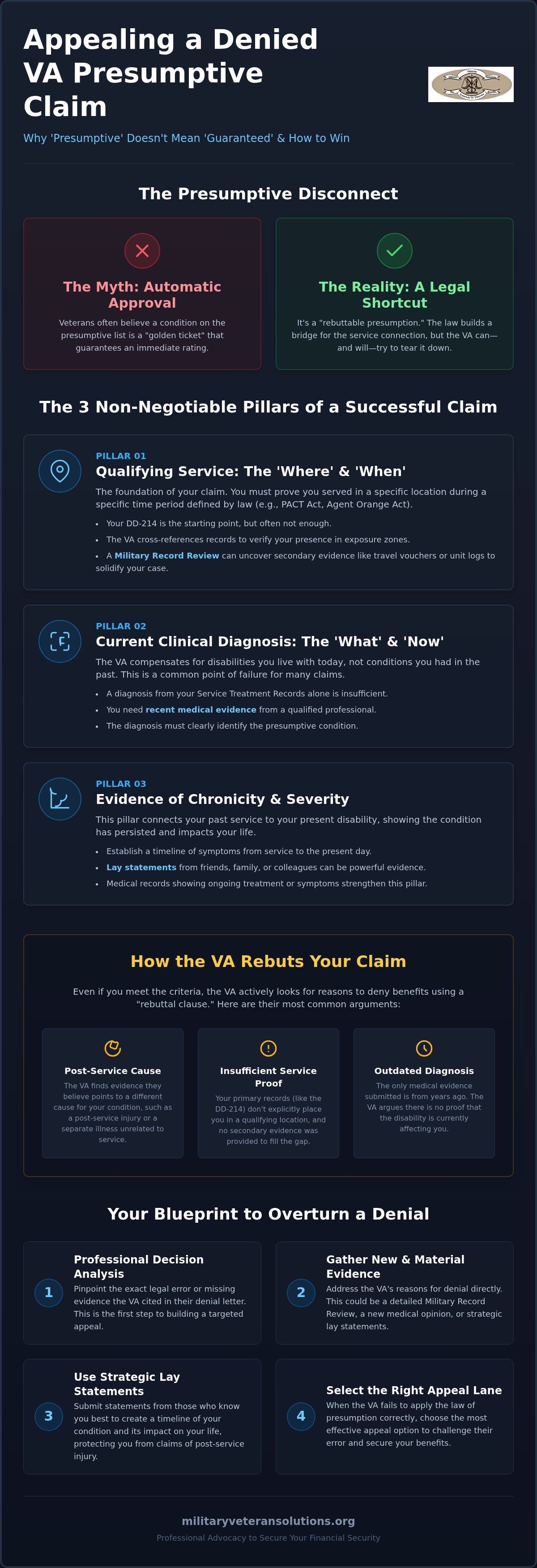
Many veterans believe that having a condition on the presumptive list is a "golden ticket" to an immediate rating. In reality, presumptive status only solves one-third of the service-connection puzzle. It establishes the "nexus," or the link between your service and your condition, but it doesn't prove you actually have the condition or that you served in the specific required locations. To secure your benefits, your claim must stand on three non-negotiable pillars: qualifying service, a current clinical diagnosis, and evidence of chronicity and severity. If any of these pillars are weak, the VA will issue a denial regardless of how "automatic" the claim is supposed to be.
Proving Qualifying Service (The 'Where' and 'When')
The VA's presumption is based entirely on where you served and when you were there. Proving this usually starts with your DD-214, but personnel records don't always tell the full story. For those who served in toxic zones or participated in specific operations that weren't properly recorded, this step becomes a major hurdle. If your records don't explicitly show boots on the ground in a qualifying PACT Act territory, the VA will likely reject the presumption. This is why a professional Military Record Review is vital. It uncovers the secondary evidence, such as travel vouchers or unit logs, that places you in the exposure zone when your primary records fall short.
The Necessity of a Current, Clinical Diagnosis
The VA does not pay for illnesses you had twenty years ago; they compensate you for the disability you live with today. A common reason veterans need to learn how to appeal a denied presumptive disability claim is the lack of a "current" diagnosis. If your only medical evidence is an old entry in your service treatment records, the VA will deny the claim because there is no proof of an active condition. You must have a diagnosis from 2026 or the very recent past to satisfy this requirement.
Your medical records must also use precise diagnostic terminology. If your doctor describes "breathing issues" instead of "chronic rhinitis" or "asthma," the VA adjudicator may not recognize it as a presumptive condition. If your denial was based on a missing or vague diagnosis, you can often file a Supplemental Claim once you've secured a clear, clinical diagnosis from your physician. This new evidence directly addresses the VA's reason for denial and keeps your original effective date alive. Beyond the diagnosis, you must also prove chronicity. The condition can't be a one-time occurrence; it must be a persistent, ongoing disability that meets the specific severity levels outlined in the VA’s rating schedule. Understanding how to appeal a denied presumptive disability claim requires looking past the list of conditions and focusing on the clinical data that defines your daily struggle.
Common Reasons for Denial: How the VA Rebuts Presumptive Evidence
The VA has a legal backdoor. It’s called the "Rebuttal Clause," found in 38 CFR § 3.307(d). This regulation allows the VA to deny your claim if they can "clearly show" your condition resulted from something other than your service. It feels like a bait-and-switch. You meet the VA health care eligibility requirements and have a condition on the PACT Act list, yet you still get a denial. The VA often looks for an "intercurrent injury," which is a medical event that happened after you took off the uniform. If you had a civilian job in a chemical plant or a long history of smoking, the VA will use those facts to argue that your condition isn't service-connected. They might also cite "manifestation periods." Some chronic diseases must appear within a specific timeframe after discharge to qualify for the presumption. If your symptoms didn't meet that window, the VA will rebut the connection.
The 'Clearly Shown' Standard for Rebuttal
The VA cannot simply guess why you are sick. They must have affirmative evidence to overcome the legal presumption of service connection. This means they need a medical opinion or scientific literature that proves another cause is "clearly shown" to be the culprit. They might point to genetic markers or pre-existing conditions that weren't aggravated by your time in the military. Understanding these legal hurdles is the first step in learning how to appeal a denied presumptive disability claim. If the VA’s evidence is weak or speculative, your appeal can challenge the validity of their rebuttal. You don't have to accept their theory as fact.
When the C&P Examiner Disagrees with the Law
Compensation and Pension (C&P) examiners are often the weakest link in a presumptive claim. Many examiners don't fully understand the law. They might apply traditional "nexus" standards, looking for a direct link in your service records when the law says that link is already presumed. If an examiner writes a negative opinion stating your condition is "less likely than not" related to service, the VA will use that to deny you. This is a direct violation of the presumptive framework. Reviewing these errors through a professional VA Decision Letter Analysis is critical. It allows you to spot exactly where the examiner went wrong. Knowing how to appeal a denied presumptive disability claim often comes down to proving that the examiner ignored the law of presumption in favor of their own flawed medical theory.
Evidence Strategies: Beyond the Diagnosis to Secure Your Rating
Winning an appeal requires more than just repeating your diagnosis. If the VA has already rebutted your claim using the "clearly shown" standard, you must provide evidence that is equally definitive. You need to bulletproof your file against their theories of non-service-related causes. This involves shifting the focus from the condition itself to the timeline of your life. If you are researching how to appeal a denied presumptive disability claim, your best tools are often found outside of official medical records. Lay Statements (VA Form 21-10210) allow you to describe the progression of your illness in your own words. These statements bridge the gap between your service and your first official diagnosis, especially when years have passed since discharge.
Buddy letters from fellow service members are equally powerful. While the VA might question your memory of a specific burn pit or chemical spill, a corroborating statement from someone who was there adds immense weight to your claim. If the VA successfully rebuts the primary presumption by blaming a post-service event, you may need to pivot to a "Secondary Nexus." This strategy involves proving that while a post-service event may have contributed, your military exposure was still a significant factor or that your presumptive condition was aggravated by service. Our team provides a detailed VA Decision Letter Analysis to uncover these hidden legal openings and build a stronger case for your appeal.
Building a Timeline of Symptoms
The VA often denies claims because they don't see a "continuity of treatment." They see a veteran who served in 2005 and a diagnosis from 2024 with nothing in between. You must fill that silence. Documenting the manifestation of your condition means auditing your own history for "silent" symptoms. Maybe you didn't see a doctor for your respiratory issues in 2012, but you missed work or bought over-the-counter medication constantly. These details matter. Proving that your symptoms were persistent, even if undiagnosed, prevents the VA from claiming your condition is a "new" civilian injury.
Leveraging Expert Representation and Analysis
A professional eye can see what an adjudicator misses. A thorough Military Record Review often finds proof of exposure that isn't on your DD-214, such as specific mission logs or unit citations. These documents can solidify the "Qualifying Service" pillar discussed earlier. When you combine this with a virtual consultation to prepare for your next C&P exam, you're no longer walking into the process blind. You'll know exactly which symptoms to emphasize and how to counter an examiner's attempt to ignore the law. Knowing how to appeal a denied presumptive disability claim is about controlling the narrative with facts the VA cannot ignore.
Overturning a Denial: Professional Advocacy and the VA Appeals Process
Receiving a denial letter is gut-wrenching. It feels like the system is ignoring your sacrifice, but you must remember that a denial isn't the end of the road. It's a signal to shift your strategy from filing to advocacy. In 2026, the appeals process is more streamlined than ever, yet it requires a high level of precision. You have exactly one year from the date on your decision letter to act. If you miss this window, you lose your original effective date and the potential back pay that comes with it. Understanding how to appeal a denied presumptive disability claim is about choosing the right lane to force the VA to follow the law.
Higher-Level Review vs. Supplemental Claims for Presumptives
If the VA adjudicator simply ignored the law of presumption despite your qualifying service, a Higher-Level Review (HLR) is your best option. This lane is designed for cases where the evidence was already there, but the VA made a clear and unmistakable error. You cannot submit new evidence in an HLR. Instead, a senior reviewer looks at the existing record to see if the law was applied correctly. This is often the fastest way to resolve a denial when the facts were already in your favor.
If you are unsure how to appeal a denied presumptive disability claim after the VA used a rebuttal clause to blame your condition on a non-service cause, you should choose the Supplemental Claim lane. This allows you to introduce new and relevant evidence, such as a private medical opinion or a more detailed timeline of symptoms, to counter the VA's theory. As of June 2026, Supplemental Claims are being decided in an average of 58.5 days. This makes it a fast and effective way to correct a wrongful denial by providing the missing clinical links the VA claims are absent. Virtual advocacy can further speed up this process by ensuring your evidence is organized and submitted correctly the first time.
The Role of Military Veteran Solutions, LLC in Your Appeal
Navigating these legal hurdles alone is overwhelming. Our team provides a steady, calm presence in the face of complex administrative chaos. Military Veteran Solutions, LLC specializes in VA Decision Letter Analysis to pinpoint the exact reason for your denial. We don't just look at the result. We analyze the "Reasons for Decision" to see if the examiner ignored the PACT Act frameworks or misapplied the rebuttal standard found in 38 CFR § 3.307(d).
We also perform exhaustive Military Record Reviews to find the missing links that prove your qualifying service. Often, the proof of exposure is buried in daily logs or mission reports that the VA didn't bother to check. Whether you need Veteran Claims Representation or a virtual consultation to prepare for your next step, Military Veteran Solutions, LLC is here as your grassroots ally. You've served your country; now let us serve you by ensuring the system recognizes your sacrifice and provides the security you earned.
Get a professional analysis of your VA decision letter today.
Secure the Benefits You Earned Through Service
Don't let a denial letter be the final word on your health and financial security. While the VA’s rebuttal clause can feel like an insurmountable hurdle, you now have the strategy to fight back. Remember that presumptive status is a legal starting point, not a guaranteed finish line. You must still verify your qualifying service and maintain a current, chronic diagnosis to satisfy the VA’s strict 2026 standards. If you are struggling with how to appeal a denied presumptive disability claim, a strategic shift toward expert evidence and professional analysis is the only path forward.
Military Veteran Solutions, LLC was founded by a 10-year Army veteran and disabled veteran who understands the weight of this system intimately. With over 25 years of combined advocacy experience, our team provides the expert analysis of VA decision letters you need to find the missing links in your case. We are dedicated to protecting your interests and ensuring your service is finally recognized. Schedule your virtual consultation with a veteran advocate today. You don't have to navigate this daunting environment alone; your sacrifice deserves a powerful ally.
Frequently Asked Questions
Is a presumptive condition guaranteed to be approved by the VA?
No, a presumptive condition isn't a guaranteed approval. The VA uses a "rebuttable presumption," which means they start by assuming service connection but can still deny the claim if they find evidence of another cause. You must still prove you served in a qualifying location and have a current, clinical diagnosis. If the VA finds a post-service injury or a different medical explanation, they'll issue a denial despite the condition's status.
What is the PACT Act rebuttal and how does it affect my claim?
The rebuttal clause, found in 38 CFR § 3.307(d), allows the VA to challenge the presumption of service connection. If the VA has "affirmative evidence" that your condition resulted from a non-service cause, such as genetics or civilian toxic exposure, they can legally deny your claim. This rebuttal often catches veterans off guard. It requires a strategic response to prove the VA's evidence is speculative or incomplete to protect your benefits.
Can the VA deny my claim if I have a presumptive condition but no medical records from service?
Yes, the VA can deny your claim if you lack a current diagnosis, but you don't necessarily need medical records from your time in service. The presumptive framework is specifically designed to bridge the gap for conditions that manifest years later. However, you must provide proof of qualifying service in a toxic zone and a current, active diagnosis from a medical professional to satisfy the VA's requirements for a well-grounded claim.
What happens if the VA says my condition was caused by something other than my service?
When the VA blames your condition on a non-service cause, they're exercising their right to rebut the presumption. To fight this, you must show that your military exposure was still a significant factor. Learning how to appeal a denied presumptive disability claim in this scenario often involves submitting a Supplemental Claim with a private medical opinion that directly challenges the VA's theory and reinforces the service connection through clinical data.
Do I need a nexus letter for a PACT Act presumptive condition?
Legally, you don't need a nexus letter because the law creates the link for you. The PACT Act assumes your condition was caused by your service if you were in a qualifying location. However, if the VA issues a denial based on a rebuttal, a medical opinion can be vital. It serves as a "secondary nexus" to protect your rating and prove that the VA's alternative theory is medically unsound or scientifically weak.
Can the VA take away a presumptive disability rating once it's granted?
Yes, the VA can re-evaluate and potentially reduce a presumptive rating if they find evidence that your condition has significantly improved. Ratings aren't permanent unless they meet specific protection rules, such as the 20-year rule. If you receive a notice of a proposed reduction, you have the right to a hearing. You should gather current medical evidence to prove your condition remains chronic and severe despite any temporary improvements.
How long do I have to appeal a denied presumptive disability claim?
You have exactly one year from the date printed on your VA decision letter to file an appeal. Missing this deadline means you lose the ability to maintain your original effective date for back pay. If you're past the one-year mark, you can still file a new claim, but your benefits won't be retroactive to your original filing. Knowing how to appeal a denied presumptive disability claim quickly is essential for your long-term financial security.
What should I do if my C&P examiner says my condition isn't service-connected?
If a C&P examiner claims your condition isn't service-connected, they may be ignoring the law of presumption. Examiners often mistakenly apply standard "nexus" requirements to presumptive cases. You should request a copy of the exam and identify these legal errors. You can then use a Higher-Level Review to point out that the examiner’s negative opinion contradicts the statutory presumption granted by the PACT Act or other legal frameworks.


