
A VA denial is rarely a final judgment on your service. It is often just a sign that the winning evidence is buried in a folder where the rater didn't bother to look. When you receive that decision letter, it is easy to feel ignored or believe your records are simply incomplete. However, finding new evidence for va appeal isn't about inventing facts; it's about uncovering the clinical breadcrumbs already hidden within your military medical history.
We understand the anxiety of watching the one-year appeal deadline approach while you struggle to decode the VA's "new and relevant" evidence standard. You deserve a partner who knows how to navigate these institutional hurdles. In this guide, we'll explain how the evidence landscape has shifted for 2026 and provide a methodical approach to conducting your own military medical record review. You'll learn exactly what qualifies as a game-changer for your claim so you can submit a Supplemental Claim that the VA cannot ignore.
Key Takeaways
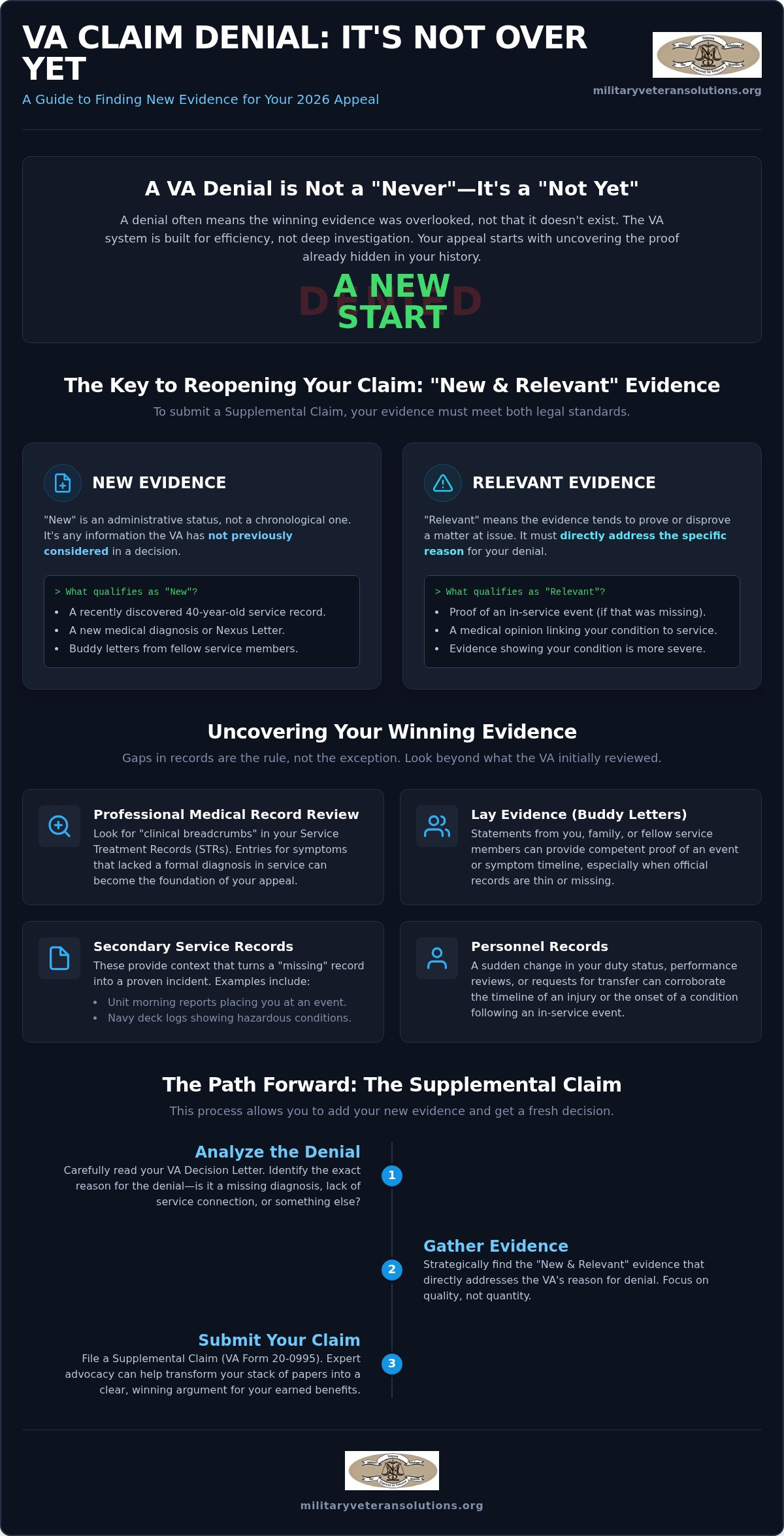
- Understand why a VA denial is often a "not yet" rather than a "never." Your records likely contain hidden proof that the rater overlooked during the initial review.
- Learn how to meet the 2026 "new and relevant" standard. This legal threshold is the key to reopening your claim with information the VA hasn't considered before.
- Discover how a professional military medical record review uncovers clinical clues. Entries for symptoms that lacked a formal diagnosis in service can become the foundation of your appeal.
- Explore strategies for finding new evidence for va appeal outside of official files. Lay evidence like buddy letters can provide the competent proof needed when records are thin or incomplete.
- See how a Supplemental Claim can fast-track your 2026 decision. Expert advocacy helps transform a stack of papers into a clear, winning argument for your earned benefits.
The VA Denial Myth: Why 'No Evidence' Isn't the End of Your Claim
You opened the envelope and saw the word "Denied." It feels like a door slamming shut on the benefits you earned through years of sacrifice. It is easy to feel ignored when the VA claims there is "no evidence" for a condition you live with every single day. However, you must realize that a denial letter is often just a "not yet," not a final "never." The VA's search for evidence is rarely exhaustive or personalized. They process a staggering volume of claims, and raters often miss critical details buried deep within hundreds of pages of records.
Finding new evidence for va appeal starts with understanding that the system is built for administrative efficiency, not for the deep investigative work your specific case requires. The 2026 landscape under the Appeals Modernization Act (AMA) actually favors veterans who take a proactive stance. Instead of waiting years for a board hearing, you can use the Supplemental Claim lane to submit fresh information that directly addresses the VA's concerns. The most common reason for a denial is a "lack of service connection," which is also the most reversible. It simply means the link between your current diagnosis and your service hasn't been clearly established yet.
Myth: If it's not in your STRs, it didn't happen
Many veterans believe that if an injury wasn't documented by a medic in the field, it doesn't exist in the eyes of the law. This is a dangerous myth. Combat zones are chaotic environments where survival takes priority over paperwork. Decentralized filing and the sheer pace of operations often mean that "silent" injuries, such as a back strain or a concussive blast, never made it into your Service Treatment Records (STRs). Your personal memory of these events is a valid starting point for discovery. We look for the clinical breadcrumbs that point to an event, even if a formal medical entry is missing from your file.
The reality of incomplete military medical records
Gaps in your records are the rule, not the exception. Records get lost during base transfers, destroyed in accidents, or simply never filed correctly by overworked clerks. If your file seems thin, don't lose hope. We can often reconstruct your history using secondary sources that the VA rater likely ignored. Finding new evidence for va appeal often involves looking at the bigger picture of your service history, including:
- Unit morning reports that place you at the scene of a specific incident or engagement.
- Navy deck logs showing ship movements and hazardous conditions during your tour.
- Personnel records that indicate a sudden change in duty status or performance following an injury.
These documents provide the vital context that turns a "missing" record into a proven service incident. Your story is there; it just needs to be uncovered.
Defining 'New and Relevant' Evidence for Your 2026 VA Appeal
To move forward with a Supplemental Claim in 2026, you must understand the two-pronged legal standard that the VA requires. Your evidence must be both new and relevant. This isn't just a suggestion; it is a strict gatekeeping mechanism. If your submission fails to meet both criteria, the VA will simply refuse to reopen your claim. Finding new evidence for va appeal requires you to look beyond the date on a document and focus instead on its legal weight. You don't need a mountain of paperwork. You need the specific pieces of proof that address the VA's previous objections.
The "Relevant" factor is where many veterans lose their way. You might submit dozens of pages showing your current pain, but if the VA denied you because they couldn't find an in-service event, those pages are legally irrelevant. They don't fix the specific hole in your case. Evidence shifts the needle when it directly provides the "missing link" identified in your denial letter. This could be a new medical diagnosis, a nexus letter from a specialist, or a lay statement that provides a clear timeline of your symptoms. A targeted VA Decision Letter Analysis is the first step in identifying whether your gap is a missing diagnosis, a lack of service connection, or an insufficient disability rating.
What counts as 'New' in the eyes of a Veterans Law Judge?
Many veterans mistakenly believe that "new" means the medical event or evaluation must have happened recently. In the context of an appeal, "new" is an administrative status, not a chronological one. You could discover a 40-year-old record from the National Personnel Records Center (NPRC) that the VA never saw, and it would legally qualify as new. New evidence is information not previously submitted to the record. It can also include recent medical evaluations that use modern diagnostic tools to provide a more accurate picture of a condition that was previously misunderstood or misdiagnosed by a C&P examiner.
Ensuring your evidence is 'Relevant' to the denial
Your decision letter is the blueprint for your victory. It tells you exactly why the rater said no. When finding new evidence for va appeal, you must tailor your search to fill that specific gap. If the rater acknowledged your in-service injury but denied the claim because there is no "nexus," submitting more service records won't help. You need a medical opinion linking your current state to that past event. Avoid the danger of submitting "fluff" evidence. Sending the VA information they already have, or information that doesn't address their specific legal requirements, only serves to delay your decision and increase your frustration. Focus on clarity and directness to ensure your evidence is impossible to ignore.
The Power of a Professional Military Medical Record Review
A stack of medical records is just paper until an expert eye finds the truth hidden in the margins. For many veterans, the "secret weapon" that finally overturns a denial isn't a new injury, but a professional military medical record review of the history they already have. Finding new evidence for va appeal requires more than a quick skim. It demands a forensic audit of every line, note, and scribbled observation from your time in uniform. While the VA uses automated systems and overworked raters to process your file, we apply a "boots on the ground" perspective to identify the clinical clues they consistently ignore.
Military Veteran Solutions, LLC was founded by a 10-year Army veteran. We understand that your records are often a chaotic map of your service. We don't just look for a formal diagnosis; we look for the symptoms that should have been diagnosed. For example, a 20-year-old entry about a severe ankle sprain might seem minor. However, if that injury altered your gait for decades, it could be the direct cause of your current chronic back condition. Our goal is to connect those dots, turning a forgotten clinic visit into the winning foundation of your 2026 appeal.
Identifying 'silent' entries in your service records
Many critical pieces of evidence are "silent." These are "complaint-only" entries where you reported pain or a symptom, but the medic simply gave you ibuprofen and sent you back to your unit. These entries are vital because they establish a chronicity of care. We also analyze prescriptions for "off-label" uses. If you were prescribed a specific medication that is commonly used for sleep or anxiety, even if those words aren't in the chart, it serves as evidence of a struggle you were facing. Even your personnel file can hold markers for trauma. A sudden, unexplained drop in performance or a string of disciplinary issues often points to underlying, undocumented PTSD or TBI.
Connecting service incidents to current diagnoses
The "Nexus" is the bridge between your service in 1995 and your life in 2026. Finding new evidence for va appeal often means identifying secondary conditions that you didn't even know were claimable. If your service-connected knee injury has caused you to develop depression due to chronic pain, that depression is a valid, compensable condition. A professional review identifies evidence that automated VA systems often overlook. We build that bridge by showing a continuous timeline of symptoms and medical logic that the VA's cursory review missed. You aren't just submitting a claim; you are presenting a complete, undeniable history of your health.
Strategies for Finding New Evidence Outside Your Official File
When your Service Treatment Records (STRs) are incomplete or misfiled, the search doesn't end. You must look beyond the official government folder to find the proof the VA claims is missing. Finding new evidence for va appeal often involves gathering "lay evidence" and private medical documentation that bridges the gaps left by military clerks. The VA is legally obligated to consider any evidence that is competent and relevant, regardless of whether it was generated by a military doctor or a fellow service member who was standing next to you in the motor pool.
The PACT Act has also opened new doors for veterans by establishing presumptive conditions based on deployment history. If you served in specific locations, the VA may now concede service connection for certain illnesses without requiring a direct link in your service records. This shift in the 2026 legal landscape means your deployment orders or unit history can serve as powerful new evidence in a Supplemental Claim. It is about leveraging every available tool to prove your case.
Leveraging Lay Statements and Buddy Letters (VA Form 21-10210)
Buddy letters are not just "nice to have" additions; they are competent evidence that can prove an in-service incident when medical records are silent. You should identify fellow veterans who witnessed your injury or noticed a significant change in your behavior following a specific event. A winning lay statement must be specific. It should include approximate dates, locations, and a clear description of the symptoms the witness observed. For mental health or sleep apnea claims, statements from a spouse or family member are particularly critical. They can describe the daily reality of your condition, such as night terrors or gasping for air, which a doctor might only see during a brief appointment.
Obtaining and submitting private medical records
A current diagnosis from a specialist in 2026 is often the "new" evidence required to reopen a previously denied claim. If you've been seeing a civilian doctor, those records are vital for proving your condition has persisted since you left the service. However, simply dumping a box of records on the VA's desk is rarely effective. You must ensure your private doctor's notes use specific language to be useful for an appeal. Phrases like "at least as likely as not" are the legal keys that unlock service connection. We help you consolidate your private treatment history into a cohesive timeline that makes it easy for the rater to see the full picture. If you are ready to turn your outside records into a winning argument, schedule a virtual consultation to start your claim representation.
Navigating the Supplemental Claim Path with Expert Advocacy
The Supplemental Claim lane is the most efficient path to a 2026 decision. It allows you to submit fresh proof without the multi-year wait times often associated with a Board of Veterans' Appeals hearing. However, speed is useless without a strategy. Military Veteran Solutions, LLC takes your "stack of papers" and transforms it into a cohesive, evidence-backed argument. We don't just file forms; we build cases. Our process begins with a thorough VA Decision Letter Analysis. We must understand exactly why the VA said no before we can prove why they should have said yes. This deep dive identifies the specific legal and medical gaps that your appeal must bridge.
Finding new evidence for va appeal is a high-stakes task. You shouldn't have to navigate it alone. Through our virtual consultations, we provide national-level advocacy to veterans regardless of where they live. This accessibility ensures that every veteran has the opportunity to work with experts who have over 25 years of experience in the field. We use that expertise to ensure your claim is handled with the precision and urgency it deserves.
How professional representation changes the game
There is a massive difference between "filing" a claim and "advocating" for one. When you file alone, you are often just checking boxes. When we represent you, we are fighting a battle of information. We identify the highest-value evidence, such as a specific clinical note or a buddy statement, and lead your appeal package with it. This methodical approach reduces the stress of the appeals process. You can feel secure knowing that your file has undergone a detail-oriented analysis designed to pre-empt VA objections before they are even raised.
Next Steps: Securing your earned entitlements
Don't let the clock run out on your benefits. You have a one-year window from the date of your denial to protect your effective date and secure your back pay. Finding new evidence for va appeal takes time and careful research, so you cannot afford to wait until the last minute. The sooner we begin your military record review, the sooner we can uncover the evidence that has been sitting in your file all along. You earned these benefits through your service; now it's time to secure them. Schedule your virtual consultation with Military Veteran Solutions, LLC today to start your journey toward a successful appeal.
Take Control of Your VA Appeal
Your military service left a lasting mark on your life. Your medical records must reflect that truth. A VA denial isn't a final verdict; it is simply a signal that your evidence needs to be more precise and targeted. By mastering the "new and relevant" standard and looking beyond basic treatment records for buddy letters and specialist nexus opinions, you can build an undeniable case. Finding new evidence for va appeal is a methodical process that requires an expert eye and a persistent spirit.
We are a veteran-owned firm with over 25 years of experience in identifying the hidden service connections that turn denials into approvals. We provide nationwide virtual consultations to ensure you have elite advocacy, regardless of your location. You earned these benefits through your sacrifice. We are here to help you secure them through exhaustive, detail-oriented analysis.
Start your VA appeal with a professional record review from Military Veteran Solutions
The path to your benefits is open. Take the first step today and let us help you uncover the evidence that secures your future.
Frequently Asked Questions
What counts as 'new and relevant' evidence for a VA appeal in 2026?
New evidence is information the VA has not previously reviewed, while relevant evidence is any documentation that tends to prove or disprove a specific matter in your claim. This standard doesn't require "smoking gun" proof; it simply requires information that has a bearing on your case. Examples include a fresh medical diagnosis, a newly discovered service record, or a buddy statement that provides a missing timeline of symptoms.
Can I submit new evidence if I chose a Higher-Level Review (HLR)?
You cannot submit new evidence during a Higher-Level Review. This lane is a "closed record" review, meaning a senior rater only looks at the evidence that was present when the original decision was made. If you have succeeded in finding new evidence for va appeal, you must file a Supplemental Claim rather than an HLR to get that information into your file.
How do I get a copy of my military medical records if they are missing?
You should start by submitting Standard Form 180 to the National Personnel Records Center (NPRC) or using the eVetRecs online system. If the NPRC reports that your records are missing or were destroyed, we often use secondary evidence to reconstruct your history. This includes unit morning reports, deck logs, and personnel records that can place you at the scene of an injury or event.
Is a 'buddy letter' really considered strong evidence by the VA?
A buddy letter is competent lay evidence that the VA is legally required to consider alongside your medical records. These statements are incredibly powerful for proving in-service stressors or injuries that weren't documented at the time. When a fellow service member provides specific details about an event they witnessed, it can bridge a gap that medical paperwork alone cannot fill.
What is a Nexus letter and do I need one for my appeal?
A Nexus letter is a formal medical opinion that links your current disability to an event, injury, or illness during your military service. You likely need one if the VA denied your claim because they didn't see a "service connection." This letter provides the clinical logic and the "at least as likely as not" statement that raters look for when approving an appeal.
How long do I have to find new evidence after a VA claim denial?
You have one year from the date on your decision letter to submit a Supplemental Claim with new evidence. Filing within this window is critical because it preserves your original effective date. If you miss this deadline, you can still submit finding new evidence for va appeal later, but you will lose out on the potential for back pay dating to your initial filing.
Can I file a Supplemental Claim more than once for the same condition?
You can file a Supplemental Claim as many times as you like, provided you have new and relevant evidence for each submission. There is no limit to how many times you can try to reopen a claim. As long as you are providing information the VA hasn't considered before, they must review the claim again and issue a new decision.
Why should I use a professional service for my military record review?
Professional reviews identify the clinical breadcrumbs and service-connection markers that automated VA systems and busy raters often overlook. An expert eye can spot a "complaint-only" entry from twenty years ago and link it to your current diagnosis. This level of detail-oriented analysis transforms a disorganized stack of papers into a strategic, winning argument for your benefits.


