
What if your recent VA denial letter was actually the most valuable piece of evidence you currently own? While it feels like a door slamming shut, that letter is actually a roadmap that tells you exactly which medical bridge you failed to build. If you are currently facing a VA appeal for secondary condition denied, you likely feel overwhelmed by complex legal jargon and the lack of a clear path forward. It's frustrating to feel like the system is ignoring your reality, and it's natural to fear that pushing back might put your existing benefits at risk.
You don't have to navigate this complex maze alone. We'll show you how to deconstruct the VA's logic and build a bulletproof evidence package that proves the link between your conditions. This guide provides a clear roadmap for the 2026 appeal process, explaining which lane is fastest and how to secure the medical expertise you need to finally reach your deserved rating. By the time you finish reading, you'll have the tools to turn a rejection into a successful service connection.
Key Takeaways
- Deconstruct your VA denial letter to pinpoint the specific "missing link" that caused the initial rejection.
- Navigate a VA appeal for secondary condition denied by mastering the "nexus" evidence required to bridge your primary and secondary disabilities.
- Identify whether the Higher-Level Review or Supplemental Claim lane offers the fastest and most effective path to your desired rating.
- Build a bulletproof evidence package through strategic military record reviews that uncover supportive documentation buried in your service history.
- Understand how professional advocacy and C-File analysis provide the technical edge needed to win complex service connection appeals.
Decoding Your Denial: Why the VA Rejects Secondary Conditions
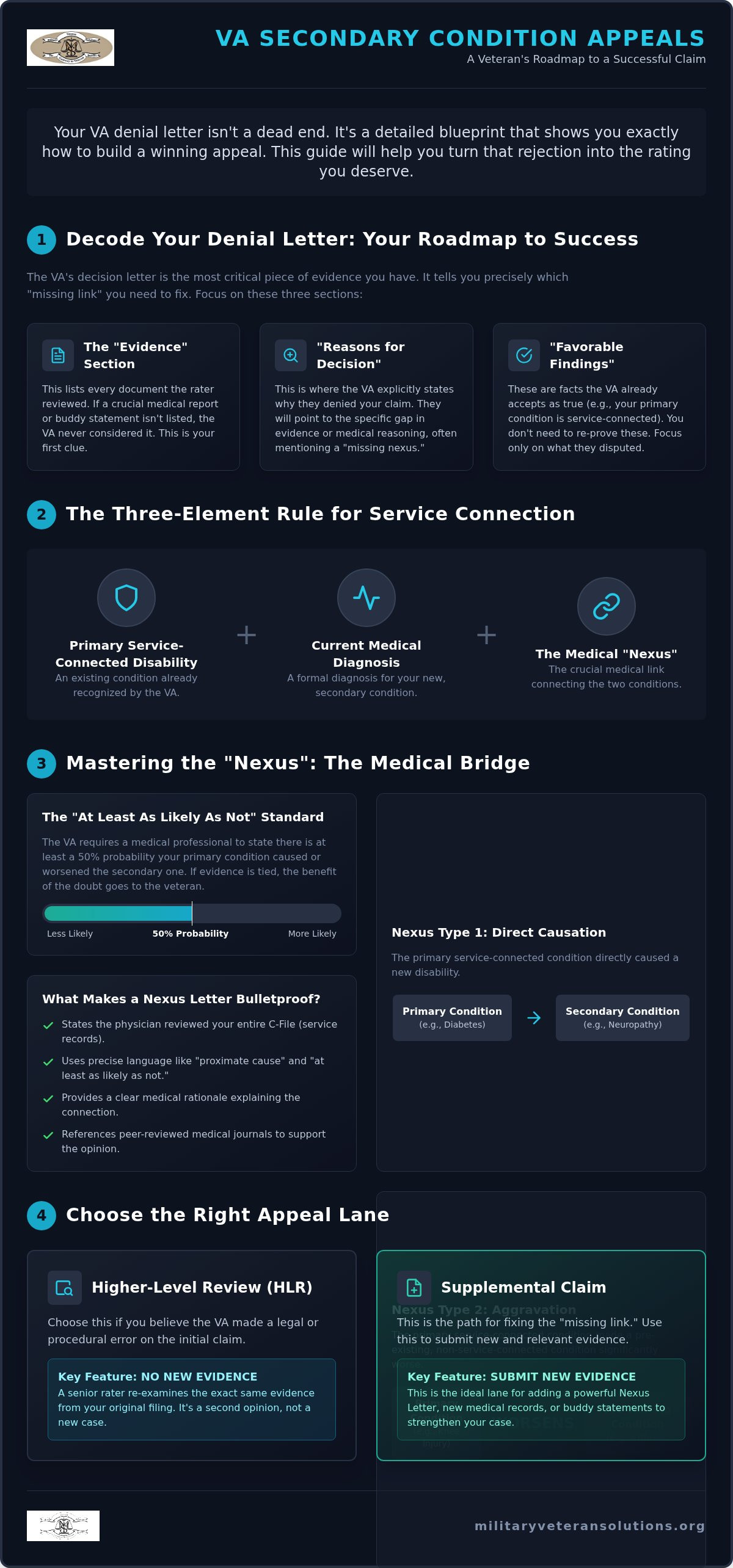
A secondary service connection is a claim where a new disability is caused or made worse by an existing, service-connected condition. While this sounds straightforward, the VA applies a much higher level of scrutiny to these claims than to primary ones. They aren't just looking at your symptoms; they're looking for a specific, scientifically backed chain of events. If you're currently facing a VA appeal for secondary condition denied, you've likely encountered technical phrases like "not well-grounded" or "no medical nexus." These terms are legal conclusions based on the Three-Element Rule. To win, you must establish three things: a primary service-connected disability, a current medical diagnosis for your secondary condition, and a clear medical link connecting the two.
Your VA Decision Letter is the most important document in your strategy. It isn't just a rejection; it's a blueprint. It tells you exactly where the rater felt your evidence fell short. If you eventually need to take your case to the Board of Veterans' Appeals (BVA), your success will depend on how well you addressed the specific gaps identified in this initial letter. We treat this document as a roadmap that reveals the "missing link" in your medical history.
How to Read Your VA Decision Letter Like an Advocate
Start by identifying the "Evidence" section. This list shows every record the rater actually reviewed. If a crucial private medical report or a buddy statement isn't listed, the VA didn't consider it. Next, look at the "Reasons for Decision" section. This is where the VA explains the specific gap in your medical link. Finally, pay close attention to "Favorable Findings." These are facts the VA already accepts as true, such as the existence of your primary condition. You don't need to re-prove these; you only need to fix the parts they disputed.
Common Pitfalls in Initial Secondary Condition Filings
Many veterans rely on "common sense" links that the VA simply won't accept. For example, you might know your back hurts because of an altered gait caused by a service-connected knee injury, but without specific medical literature or a nexus letter, the VA will deny the claim. Another common error is failing to distinguish between "aggravation" and "causation." If your primary condition made a pre-existing issue worse, that's aggravation. If the primary condition created the new issue, that's causation. Mixing these up can lead to a swift denial. Lastly, you must have a current, formal diagnosis. Complaining of pain isn't enough; you need a clinical name for the condition to move forward with a VA appeal for secondary condition denied.
The Essential 'Nexus': Proving the Medical Bridge
A nexus is the indispensable medical rationale that links a secondary condition to a primary disability. Without this logical connection, your claim is merely a list of symptoms without a legal anchor. When you're managing a VA appeal for secondary condition denied, you're essentially fighting a gap in medical reasoning. The VA requires evidence showing either direct causation or aggravation. Direct causation occurs when your primary service-connected disability, such as Diabetes, leads to a secondary issue like Neuropathy. Aggravation happens when your service-connected condition makes an unrelated, pre-existing problem significantly worse. Both pathways are valid, but they require different types of medical evidence to succeed.
The VA operates on a specific burden of proof called the "at least as likely as not" standard. This means a medical professional must conclude there's at least a 50% probability your secondary condition was caused or worsened by your primary one. If the evidence is perfectly balanced, the law requires the VA to give the benefit of the doubt to the veteran. Proving this standard often requires filing a Supplemental Claim with a strong nexus letter to tip the scales in your favor. If your initial claim lacked this bridge, the VA had no choice but to issue a denial.
What Makes a Nexus Letter Bulletproof?
A generic note from your family doctor rarely suffices. A powerful nexus letter must explicitly state that the physician reviewed your entire C-File, providing a comprehensive analysis of your military and medical history. It needs to utilize precise legal language like "proximate cause" and "within the realm of medical probability." When a doctor references peer-reviewed medical journals to back their opinion, it transforms a simple statement into an authoritative piece of evidence that is difficult for a rater to ignore. This technical depth is what separates a successful appeal from a repeated rejection.
Military Record Reviews: Finding the Hidden Evidence
Sometimes the proof you need is buried in decades-old files that the initial rater overlooked. A professional Military Record Review can identify early symptoms or complaints that link your current secondary condition to your service history. These findings are often strengthened by lay statements on VA Form 21-10210. These personal accounts from family or fellow service members bridge the chronological gap between medical appointments. They show the daily impact and progression of your symptoms, providing the human context that medical codes often miss.
HLR vs. Supplemental Claim: Choosing the Right Appeal Lane
You have exactly 365 calendar days from the date on your decision letter to act. If you miss this window, you risk losing your original effective date and the back pay that comes with it. Choosing the Right Appeal Lane is the most strategic decision you'll make in this process. For most veterans facing a VA appeal for secondary condition denied, the choice comes down to the Higher-Level Review (HLR) or a Supplemental Claim. While the Board of Veterans' Appeals (BVA) is an option, it often takes 12 months for a direct review and up to 24 months for a hearing; it's the "long road" reserved for complex legal disputes.
The lane you select determines whether you can add more proof to your file. If your denial was based on a lack of medical evidence, choosing the wrong lane will lead to another rejection. In 2026, the VA's goal is to issue decisions within 125 days for both HLRs and Supplemental Claims, but current data shows actual processing times vary between four and seven months. We help you evaluate which path offers the highest probability of success based on the specific reasons listed in your denial letter.
When to Choose a Higher-Level Review
Select a Higher-Level Review (VA Form 20-0996) if you believe the rater had all the evidence but simply made a mistake. This lane is a "closed record" review. You cannot submit new evidence here. It's most effective if the VA failed its "Duty to Assist" during a C&P exam or ignored a medical link already in your file. Request an "Informal Conference" to speak directly with a senior rater. This is your chance to point out exactly where the previous rater missed the mark. In 2026, HLR decisions typically take between 4 and 7 months. It's a steady, methodical process designed to catch administrative or legal errors.
When a Supplemental Claim is the Only Path to Victory
If your denial letter states "no medical nexus," you must choose the Supplemental Claim lane (VA Form 20-0995). Approximately 90% of secondary condition appeals require this path because you need to introduce "new and relevant" evidence to bridge the gap. This usually means submitting a professional nexus letter or a new medical opinion that wasn't previously considered. Evidence is "relevant" if it helps prove a matter at issue in the claim. Including a "Statement in Support of Claim" on VA Form 21-4138 allows you to explain how this new evidence directly addresses the VA's reasons for denial. Supplemental claims are currently processing in about 4 to 6 months. Filing this claim within the one-year deadline preserves your effective date, ensuring you receive every dollar of back pay you've earned.
Step-by-Step: How to Build Your Secondary Appeal Package
Building a successful case after a VA appeal for secondary condition denied requires a methodical approach. You aren't just refiling the same claim; you're constructing a new argument designed to survive the VA's high bar for secondary service connection. This process begins with the very letter that rejected you. By deconstructing the VA's logic, you can systematically address every deficiency until your evidence package is undeniable. Follow these five steps to secure the rating you've earned.
- Step 1: Deconstruct the Decision Letter. Identify the specific reason for denial. If the VA conceded your primary condition but rejected the link, your strategy must focus exclusively on the nexus.
- Step 2: Review Your Military Records. Conduct a professional search for any mention of symptoms or complaints that occurred during your service. These hidden details often provide the historical context needed to support a secondary link.
- Step 3: Secure a High-Quality Nexus Letter. This is the medical-legal bridge. Your provider must link your conditions using the "at least as likely as not" standard, supported by clinical evidence and medical literature.
- Step 4: Draft Lay Statements. Use VA Form 21-10210 to gather statements from family or peers. These documents prove the severity and progression of your symptoms in your daily life.
- Step 5: File VA Form 20-0995. Submit your Supplemental Claim with all new evidence within the one-year deadline to preserve your effective date.
If you're unsure how to find the "missing link" in your records, our team provides the expert analysis needed to win. Schedule a virtual consultation today to get professional eyes on your C-File.
Gathering 'New and Relevant' Evidence
The VA defines "new" evidence as information they've never seen before. "Relevant" evidence is information that addresses the specific issue that caused your denial. A new nexus letter is the gold standard, but "Buddy Statements" are equally powerful for conditions like sleep apnea or mental health. These statements from people who live with you or served with you provide a chronological bridge between your military service and your current diagnosis. Combining private medical records with your VA records creates a comprehensive picture that a rater cannot easily dismiss.
Preparing for the C&P Exam (Round Two)
Expect a second Compensation and Pension (C&P) exam. This is your opportunity to correct the record. When describing your symptoms, always follow the "Worst Day" rule. Don't tell the examiner how you feel on a good day; describe your symptoms at their absolute worst. This ensures your rating accurately reflects the level of your disability. Bring a physical copy of your nexus letter to the exam. Ask the examiner to review it. This forces them to acknowledge the professional medical opinion you've already secured and helps prevent a VA appeal for secondary condition denied from happening again.
Professional Advocacy: Why Representation Wins Appeals
Many veterans believe filing an appeal is simply about resubmitting the same paperwork and hoping for a different result. It isn't. There's a massive difference between a "claims filer" and a "claims representative." A filer just checks boxes and submits forms. A representative deconstructs the legal and medical barriers that led to your VA appeal for secondary condition denied. We don't just submit documents; we build persuasive arguments based on the technicalities of VA law and the specific gaps identified in your denial letter.
Our process centers on an exhaustive audit of your Claims File, or C-File. This document often contains thousands of pages of history. VA raters, working under high quotas, often miss specific medical entries or service records that prove a secondary link. We find those needles in the haystack. By conducting a thorough Military Record Review and VA Decision Letter Analysis, we identify the evidence raters miss. This ensures your appeal package is bulletproof before it ever reaches a senior rater's desk.
Distance shouldn't be a barrier to expert advocacy. Through our virtual consultations, we provide veterans across the country with high-level record audits and strategic planning. We've spent over 25 years turning "no" into "yes" by focusing on evidence-based persistence. If the VA denied your claim because they didn't see the link, our job is to make that link impossible to ignore.
The Military Veteran Solutions, LLC Advantage
Military Veteran Solutions, LLC was founded by a 10-year Army veteran. We've lived the system we now navigate, and we understand the frustration of a VA appeal for secondary condition denied. With over 25 years of experience in advocacy, we know exactly what "nexus" evidence is required to tip the scales. We focus on a "100 Percent" strategy. Our goal is to maximize your earned benefits, ensuring you receive the full rating your service-connected disabilities warrant.
Next Steps: Starting Your Appeal Today
Time is your most critical resource. The one-year window to appeal is strict; if you miss it, you lose your original effective date and years of potential back pay. Don't let a single rejection letter discourage you. Many of the most successful claims were initially rejected before being won through a strategic appeal. Persistence, backed by the right evidence, is the key to victory. Schedule your virtual consultation with Military Veteran Solutions, LLC today to begin deconstructing your denial and building a roadmap to a successful rating.
Take Control of Your Service-Connected Rating
A rejection letter isn't the final word on your health; it's a technical obstacle that can be overcome with the right medical-legal bridge. By addressing the specific deficiencies identified in your decision letter and selecting the most effective appeal lane, you can successfully navigate a VA appeal for secondary condition denied. Whether you're introducing new nexus evidence or correcting an administrative error, the path to a higher rating requires precision, persistence, and a deep understanding of the VA's 2026 standards.
You don't have to face this complex administrative system alone. Military Veteran Solutions, LLC is veteran-owned and has been operated for over 20 years, focusing on the exhaustive record audits that win difficult cases. Our expert military record review specialists identify the hidden evidence that raters often miss, while our nationwide virtual consultations ensure every veteran has access to elite advocacy. We're committed to protecting your interests and securing the benefits you've earned through your service.
Get a Professional VA Decision Letter Analysis Today and let us help you build a roadmap to victory. Your service was honorable, and your disability rating should reflect that reality. We're ready to stand with you until your case is won.
Frequently Asked Questions
Can the VA deny a secondary condition if I already have a 70% rating?
Yes, the VA can deny a secondary claim regardless of your current primary rating percentage. A high rating for a primary disability doesn't automatically prove that a new condition is related to it. Each secondary claim must stand on its own medical evidence. You must still provide a formal diagnosis and a clear medical link to succeed.
What is the most common reason a VA secondary claim is denied?
The most common reason for denial is the lack of a medical nexus. This means the rater didn't find enough evidence to prove your secondary condition was caused or aggravated by your primary service-connected disability. Many veterans fail to include professional nexus letters or peer-reviewed medical literature to support the biological link between their two conditions.
How long do I have to appeal a denied secondary condition claim?
You have exactly 365 calendar days from the date stamped on your VA decision letter to file an appeal. This one-year window is critical for preserving your original effective date. If you miss this deadline, you lose the ability to collect retroactive back pay from your initial filing date and must start the process over.
Do I need a new nexus letter for every secondary condition I file?
Yes, each secondary condition requires a specific medical rationale tailored to that unique diagnosis. A nexus letter explaining how your back pain caused a knee issue won't help you with a claim for depression linked to that same back pain. Every claim needs its own clinical reasoning to show the VA exactly how the conditions are connected.
Can a Supplemental Claim result in my original rating being decreased?
Yes, it's possible for an original rating to be decreased, though it's rare. When you pursue a VA appeal for secondary condition denied, you essentially invite the VA to look at your medical history again. If their review shows your primary condition has significantly improved, they may propose a reduction. This is why a professional record audit is vital before filing.
What are the most common secondary conditions for PTSD?
Common secondary conditions linked to PTSD include sleep apnea, hypertension, and gastroesophageal reflux disease (GERD). Many veterans also experience secondary chronic pain syndromes or migraines. Proving these links usually requires a detailed nexus statement. This statement must show how PTSD symptoms, or the medications used to treat them, led directly to the development of the new condition.
How much does it cost to have a professional analyze my VA decision letter?
Professional analysis fees vary based on the depth of the audit and the size of your military medical record. It's important to consult with a claims representative to discuss their specific service models. Many veterans find that the initial investment in a thorough record review saves time and prevents the frustration of repeated denials through the years.
Can I file a secondary claim for a condition that appeared years after service?
Yes, you can file a secondary claim regardless of how much time has passed since your discharge. The VA doesn't require the condition to manifest during your time in uniform. It only requires a medical link to an existing service-connected disability. If your VA appeal for secondary condition denied was based on timing, you likely need a stronger nexus statement to prove the delayed onset.


