
A VA denial letter isn't a final "no"; it's actually a roadmap that tells you exactly what evidence is missing to win your benefits. It feels like a betrayal to see your agent orange claim denied, particularly since the PACT Act was supposed to make this process easier for veterans like you. You might feel ignored or worried about losing years of back pay while navigating a complex bureaucracy. We understand that frustration because we've seen how the system works from the inside.
You deserve a clear path forward that doesn't leave you guessing. In this article, you'll discover why the VA still denies claims for presumptive conditions and how to audit your military records to find the missing links. We'll explain how to choose the most effective appeal lane for your specific situation. By the end, you'll have a strategy to successfully link your health condition to your service and secure the 2026 disability rates you've earned.
Key Takeaways
- Master the three critical pillars—diagnosis, exposure, and nexus—that form the foundation of every successful 2026 Agent Orange claim.
- Learn to decode your VA decision letter by identifying "Favorable Findings" that reveal exactly why your agent orange claim denied status occurred.
- Review the updated 2026 master list of presumptive conditions to ensure your diagnosis qualifies under the latest PACT Act expansions.
- Evaluate the strategic differences between filing a Supplemental Claim for new evidence versus requesting a Higher-Level Review to correct VA errors.
- Gain insight into how a detailed military record review can bridge the gap between your service history and your current medical diagnosis.
Understanding Your Agent Orange Claim Denial and the Presumptive Framework
Receiving an agent orange claim denied letter is a gut-wrenching experience. You served, you were exposed, and now you're sick. It feels like the system is rigged against you. However, the "presumptive" framework is designed to help, not hinder. In 2026, a presumptive service connection means the VA concedes that your illness was caused by toxic exposure without requiring you to prove a direct medical link. This is a powerful legal shortcut, but it isn't a guarantee of success.
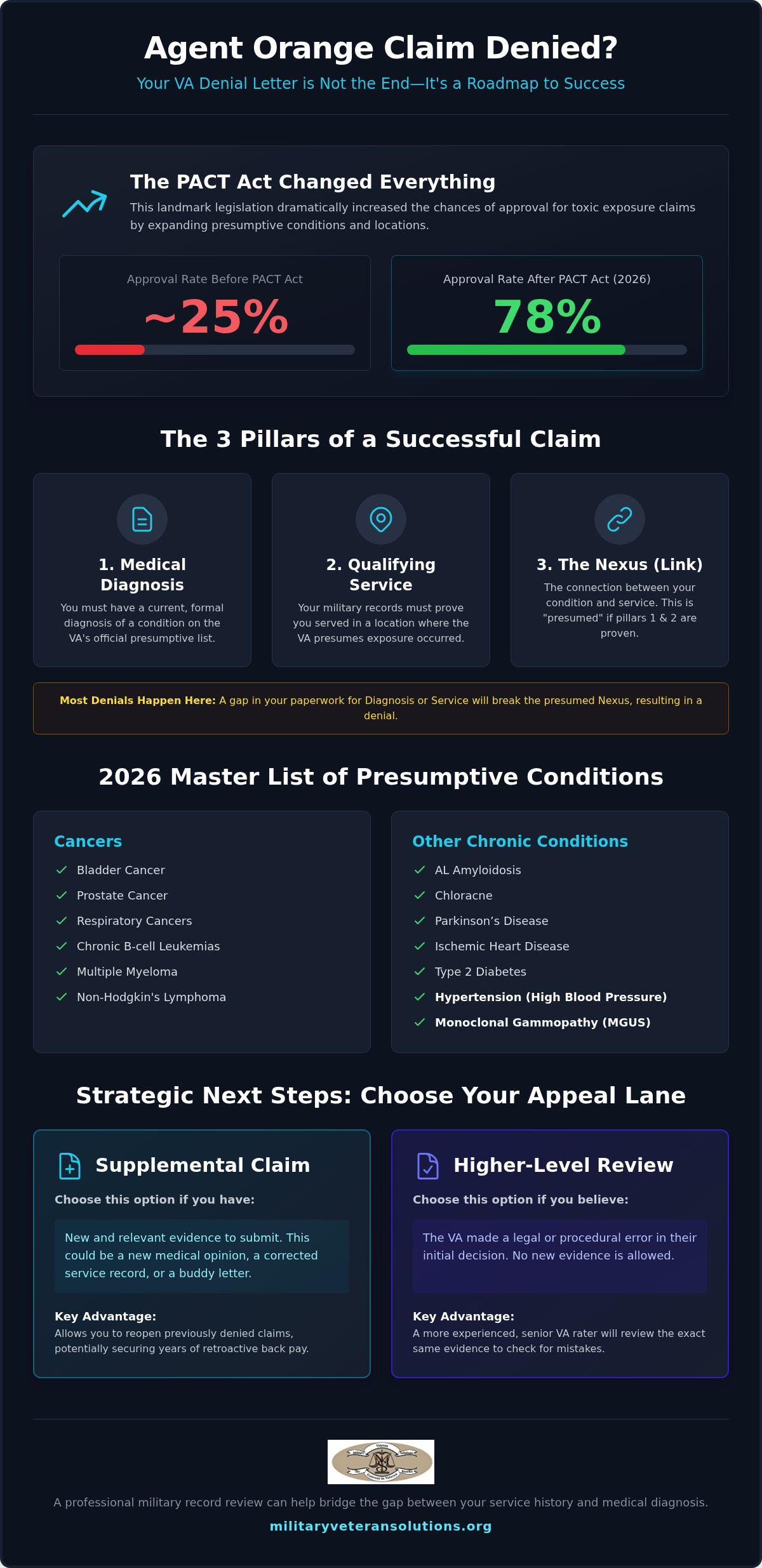
To win, your claim must stand on three pillars. First, you need a current medical diagnosis of a condition on the VA's master list. Second, you must provide evidence of qualifying service in a location where the VA acknowledges exposure. Third, you need a nexus. While the nexus is "presumed" for list-eligible conditions, any gap in the first two pillars will result in a denial. Understanding the History of Agent Orange helps clarify why these specific locations and conditions were chosen, but the VA's application of these rules is often strictly administrative. They look for specific keywords and dates. If those aren't present, the claim fails.
The Myth of the 'Automatic' Grant
Many veterans believe that having a condition like Type 2 Diabetes or Prostate Cancer leads to an automatic check in the mail. This is a dangerous misconception. The VA still requires "competent and credible" medical evidence. If your doctor's notes are vague or your service records don't explicitly place you in a qualifying zone during the right years, the VA will reject the application. They aren't necessarily questioning your illness; they're questioning your paperwork. You must prove you were there and that you are sick now.
How the PACT Act Changed the Denial Landscape
The 2022 PACT Act fundamentally shifted the odds for veterans. Before this legislation, toxic exposure approval rates hovered around 25%. Today, that number has climbed to 78% as of early 2026. This law expanded the list of locations to include places like Thailand, Laos, and Guam. It also established a "Duty to Assist," meaning the VA is legally obligated to help you gather evidence. If you faced an agent orange claim denied decision years ago, these updates allow you to reopen your case as a Supplemental Claim. This could potentially secure years of retroactive back pay that you previously thought was lost forever.
Agent Orange Presumptive Conditions: The 2026 Master List
Knowing the current list of recognized illnesses is the first step to reversing an agent orange claim denied decision. The VA's 2026 master list is more extensive than many veterans realize. It includes a wide range of cancers such as bladder cancer, prostate cancer, and respiratory cancers. It also covers chronic B-cell leukemias, multiple myeloma, and non-Hodgkin's lymphoma. Beyond cancers, the list includes AL amyloidosis, chloracne, and Parkinson’s disease. Even if your condition is on this list, you must still meet specific VA eligibility for Agent Orange claims to secure your benefits. Many veterans struggle with the nuances of Ischemic Heart Disease and Type 2 Diabetes. These conditions require specific medical evidence to prove they meet the VA's threshold for disability compensation.
If you're unsure if your specific diagnosis qualifies under these rules, a professional military record review can provide the clarity you need to move forward with confidence.
Newer Additions and Evolving Medical Standards
Hypertension was the most denied claim for decades; however, the PACT Act finally recognized it as a presumptive condition. This is a game-changer for thousands of Vietnam-era veterans. Another critical addition is Monoclonal Gammopathy of Undetermined Significance (MGUS). While these are now presumptive, the VA still evaluates the severity of your condition to determine your rating percentage. A diagnosis alone isn't enough to secure a high rating. You must show how the condition impacts your daily life and whether it requires constant medication or results in secondary complications like kidney issues or heart failure.
Location-Based Presumptions: Where You Served Matters
Where you served is just as important as your medical diagnosis. The Blue Water Navy Vietnam Veterans Act expanded coverage to those who served offshore in the territorial seas. As of 2026, the list of qualifying locations has grown significantly. It now includes Thailand, Laos, Cambodia, Guam, American Samoa, and Johnston Atoll during specific periods. Proving your presence in these areas is often the missing piece in a successful appeal. The VA distinguishes between "boots on the ground" service and service in inland waterways. If your agent orange claim denied letter cited a lack of service connection, your records may simply need a more thorough audit to prove you were in a recognized exposure zone.
Analyzing the VA Decision Letter: Identifying Why Your Claim Was Rejected
The letter you received isn't just a rejection. It's a blueprint for your next victory. When your agent orange claim denied notification arrives, the first thing you should do is look for the "Favorable Findings" section. This is where the VA admits what you've already proven. They might concede that you served in Vietnam or that you have a current diagnosis of Type 2 Diabetes. By identifying what they already believe, you can stop wasting time on those elements and focus entirely on the missing pieces. This targeted approach turns a confusing document into a strategic tool for your appeal.
Many veterans fall into the C&P exam trap. You might have a condition clearly listed on the Agent Orange presumptive conditions list, but a VA examiner writes a "negative medical opinion." They might claim your heart disease is due to age or lifestyle rather than toxic exposure. This contradicts the presumptive rule. Spotting this error is vital. It allows you to challenge the examiner's expertise or the logic of their conclusion. If the VA ignored its own rules, your path to overturning the decision becomes much clearer.
The 'Big Three' Denial Reasons
Denials usually boil down to three specific failures. First is a "Lack of Diagnosis." The VA often ignores private doctor notes if they don't use specific diagnostic codes or if the diagnosis isn't considered "current" at the time of the exam. Second is "Exposure." The VA might claim your service dates or location don't align with their recognized zones, even if you were just a few miles away. Third is the "Nexus." Even with presumptive rules, the VA sometimes uses a "Negative Medical Opinion" to argue that a specific risk factor, like smoking or family history, outweighs the presumption of Agent Orange exposure.
Auditing Your Service Treatment Records (STRs)
Your records are the key to unlocking your benefits. You should flag every entry that proves your presence in a presumptive zone, such as specific unit assignments, temporary duty orders, or ship logs. If your agent orange claim denied letter mentions a lack of service connection, your records may simply need a more thorough audit to find these hidden details. When records are incomplete, you can use Lay Statements (VA Form 21-10210) to provide "buddy letters" or personal accounts that fill the gaps. Our expert VA Decision Letter Analysis helps you pinpoint exactly where the VA went wrong so you can file a targeted, effective appeal.
Strategic Next Steps: How to Overturn a Denied Agent Orange Claim
Receiving an agent orange claim denied letter feels like a setback, but it's actually the start of a more focused fight. In 2026, the VA's appeal system allows you to correct errors or provide better evidence without losing your place in line. Choosing the right lane depends entirely on why you were denied. A denial isn't a final "no"; it's a guide that tells you exactly which evidence the VA is missing to grant your benefits. If you're ready to push back, you need to understand the three distinct paths available to you.
Choosing the Right Appeal Lane
If your denial was based on a lack of medical evidence, the Supplemental Claim is your most effective tool. This lane allows you to submit "new and relevant" evidence that the VA hasn't seen before. This might include a more detailed medical nexus letter from a specialist or a secondary diagnosis that links your current illness to your service. However, if you believe the VA simply ignored evidence already in your file, such as records proving you served in Thailand or Guam, a Higher-Level Review (HLR) is the better choice. In an HLR, a senior rater reviews your existing file for errors. You cannot add new evidence in this lane, which makes your initial record audit critical. If the evidence isn't already in the file, the HLR won't be able to change the outcome.
For more complex cases where legal interpretations are at odds, you can take the fight to the Board of Veterans' Appeals (BVA). While this process takes longer, 2020 data shows that roughly 65% of veterans who appeal to the BVA see a positive outcome, either through an outright grant of benefits or a remand for further development. This high success rate proves that persistence often pays off when you have the right representation.
The Importance of Effective Date Preservation
Time is your most valuable asset when protecting your back pay. You have exactly one year from the date on your denial letter to file an appeal and keep your original effective date alive. If you miss this window, you may have to file a new claim, which could cost you thousands of dollars in retroactive benefits. This is especially critical in 2026, as the 2.8% Cost-of-Living Adjustment (COLA) has increased the monthly value of your potential award. To lock in your place while you gather evidence, you should submit an "Intent to File" (VA Form 21-0966). This simple step gives you up to one year to complete your appeal while securing your benefits back to the day you notified the VA of your intent.
If you're overwhelmed by these choices, our team can help you file your VA appeal with a strategy tailored to your specific service history and medical needs.
Professional Advocacy: Winning Your Agent Orange Appeal
Winning an appeal requires more than just filling out forms. It requires a strategic deep dive into your history to find what the VA missed. A professional Military Record Review is often the "X-factor" that turns a rejection into an approval. While many organizations offer basic assistance, they often lack the capacity to conduct an exhaustive analysis of decades-old service records. We look for the subtle details, like temporary duty assignments or specific unit locations, that prove exposure and solidify your claim. Our virtual consultations make this expert level of advocacy accessible to veterans nationwide, ensuring you have a powerful ally regardless of your location.
Your agent orange claim denied letter is just one person's opinion at one point in time. It's not the final word. By conducting a detailed VA Decision Letter Analysis, we can pinpoint the exact administrative or medical gap that caused the denial. This methodical approach removes the guesswork. It allows us to build a case file that is so thorough it becomes difficult for the VA to ignore. We act as a bridge between your lived experience and the complex bureaucracy of the VA system. You don't have to navigate this alone.
Why Experience in the Trenches Matters
There's no substitute for experience gained on the front lines. Military Veteran Solutions was founded by a 10-year Army veteran with over 25 years of experience in advocacy. We aren't just representatives; we're peers who have navigated these same difficult paths. This perspective allows us to move beyond simple paperwork. We focus on building a winning case file by identifying secondary conditions you might have missed. For instance, many veterans don't realize that peripheral neuropathy or renal issues can be linked back to their service-connected diabetes. We ensure every possible avenue for compensation is explored and documented.
Take Action on Your Denied Claim
Don't let the VA's first "no" define your future. The process of overturning an agent orange claim denied decision is rigorous, but it's a path we've walked many times. From the initial record audit to the final successful appeal, we stand by you with a no-nonsense approach to institutional hurdles. Your service earned these benefits, and your health demands them. It's time to secure the relief and security you deserve. We'll help you organize the evidence and choose the right appeal lane to maximize your chances of success. Get your professional VA Decision Letter Analysis from Military Veteran Solutions today and start the journey toward the benefits you've earned.
Secure the Benefits Your Service Earned
Seeing your agent orange claim denied can feel like the end of the road, but it's actually the beginning of a more targeted strategy. You now know how to audit your decision letter for errors and which appeal lane best fits your specific medical evidence. By focusing on the "Favorable Findings" and addressing the specific gaps the VA identified, you can turn a rejection into a successful award. Whether you're navigating the expanded PACT Act locations or proving a nexus for hypertension, precision is your greatest ally.
You don't have to face this complex bureaucracy alone. Military Veteran Solutions was founded by a disabled veteran with over 25 years of advocacy experience. We provide nationwide support through meticulous military record reviews and decision letter analysis to ensure no detail is overlooked. It's time to stop guessing and start winning. Schedule your virtual VA claim consultation with Military Veteran Solutions today. Your health is a priority, and we're here to help you secure the relief and security you deserve.
Frequently Asked Questions
Can I appeal an Agent Orange denial from 10 or 20 years ago?
You can absolutely reopen a claim denied decades ago by filing a Supplemental Claim with "new and relevant evidence." The PACT Act of 2022 created new legal pathways for conditions and locations that weren't previously recognized by the VA. This allows you to have your case re-evaluated under the current, more inclusive 2026 standards, potentially securing benefits that were once out of reach.
What is the most common reason the VA denies an Agent Orange claim?
The most frequent cause for an agent orange claim denied status is a lack of a current, formal medical diagnosis or insufficient proof of service in a qualifying location. Even with presumptive rules, the VA requires "competent and credible" evidence that you actually have the condition and were physically present in an exposure zone during the recognized dates. Administrative errors in service records are often the hidden culprit behind these rejections.
Do I need a Nexus Letter for an Agent Orange presumptive condition?
You don't legally need a Nexus Letter for a condition on the presumptive list because the service connection is assumed by law. However, if a C&P examiner provides a negative opinion or attributes your illness to other risk factors like age or lifestyle, a private medical nexus letter becomes a vital tool. It provides the medical authority needed to counter the VA's arguments and protect your right to compensation.
How does the PACT Act affect my previously denied Agent Orange claim?
The PACT Act significantly expanded the list of presumptive conditions and locations, which helped increase the toxic exposure approval rate from 25% to 78% as of 2026. If you were denied before the law changed, you can now submit a Supplemental Claim to have your evidence reviewed under these broader guidelines. This law fundamentally shifted the burden of proof in favor of the veteran.
Is Hypertension really a presumptive condition for Agent Orange now?
Yes, hypertension is officially a presumptive condition for Agent Orange exposure as of the PACT Act's implementation. This change finally resolved decades of denials for Vietnam-era veterans who struggled to link high blood pressure to their service. While it's now presumptive, the VA still evaluates the severity of your condition to determine your specific disability rating percentage and monthly pay rate.
What should I do if my C&P examiner says my condition isn't related to Agent Orange?
If an examiner contradicts the presumptive rule, you must challenge that finding through a Higher-Level Review or a Supplemental Claim. You can use your own medical records or a private specialist's opinion to prove the examiner's logic is flawed or ignored the law. Don't accept a negative C&P opinion as the final word on your health; it's often an error that can be overturned.
How much back pay can I get if my denied Agent Orange claim is overturned?
Back pay is calculated from your "effective date" to the present using the historical VA disability rates for each year. For a successful 2026 appeal, your monthly payments will include the recent 2.8% COLA adjustment. If you've kept your agent orange claim denied status in an active appeal status, back pay can result in a substantial lump-sum payment covering several years of missed benefits.
Can my spouse receive benefits if I was denied an Agent Orange claim before passing?
Surviving spouses can often file for Dependency and Indemnity Compensation (DIC) even if the veteran's claim was never overturned during their lifetime. If the cause of death is now listed as a presumptive condition, the VA may grant benefits to the survivor. This process is a critical way to ensure that families receive the support the veteran was entitled to all along.


