
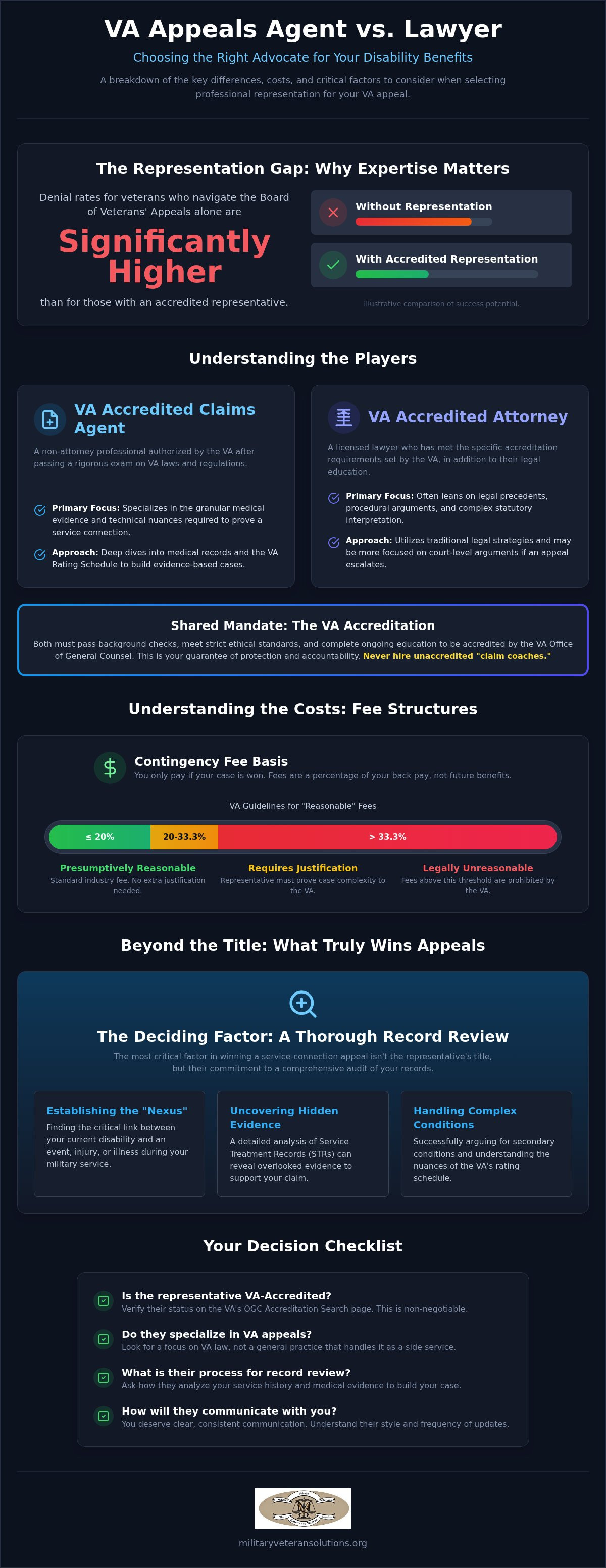
Veterans who navigate the Board of Veterans' Appeals without professional representation face a denial rate significantly higher than those with an expert in their corner. When you are stuck in the "hamster wheel" of denials, the debate of a VA appeals agent vs lawyer isn't just about a professional title. It's about who will actually dig into your medical records to find the evidence needed for a win. You have served your country, yet you are now fighting a bureaucratic war for the 2026 disability rates you deserve, such as the $3,927 monthly benefit for a 100% rating.
It's exhausting to decipher VA jargon while watching the 365-day clock tick down on your appeal deadline. You deserve clear communication and a representative who understands the weight of your service. This guide will help you navigate the complex choice between VA accredited claims agents and attorneys so you can secure the maximum disability benefits you earned. We will break down the latest fee transparency rules, success statistics, and why a thorough audit of your service history is the most powerful tool in your arsenal.
Key Takeaways
- Identify the core differences between accredited claims agents and attorneys to determine which professional expertise aligns with your specific disability claim.
- Understand the 20% contingency fee threshold and how standard payment structures protect your back pay during the VA appeals agent vs lawyer selection process.
- Learn why a comprehensive military record review is the most critical factor in establishing the "nexus" required to win a service-connection appeal.
- Utilize a specialized decision checklist to evaluate a representative’s communication style and their ability to handle complex secondary conditions.
- Discover how a veteran-to-veteran advocacy approach leverages 25 years of experience to uncover hidden evidence within your service treatment records.
Understanding the Players: VA Accredited Claims Agents vs. Attorneys
Choosing the right advocate is the most consequential decision you will make in your journey toward a fair disability rating. Deciding between a VA appeals agent vs lawyer often feels like choosing between two specialized tools for a high-stakes mission. A VA Accredited Claims Agent is a non-attorney professional who has been authorized by the Department of Veterans Affairs to represent veterans. These individuals must pass a rigorous, comprehensive examination that tests their knowledge of VA laws and regulations. They are specialists in the administrative system, often possessing a deep understanding of the technicalities within the VA Rating Schedule.
A VA Accredited Attorney is a licensed lawyer who has met the specific accreditation requirements set by the VA. While they bring a traditional legal education to the table, they must also stay current on veteran-specific statutes. Both types of representatives must pass background checks and maintain their standing through the VA Office of General Counsel. The primary difference usually lies in their approach. Attorneys often lean on legal precedents and procedural arguments. Agents, conversely, frequently specialize in the granular medical evidence and technical nuances required to prove a service connection. Both are powerful allies, but their methods of attack differ based on their professional training.
What Does VA Accreditation Actually Mean?
Accreditation is not just a title; it is a vital consumer protection. The VA Office of General Counsel (OGC) vets every representative to ensure they possess the moral and ethical character necessary to handle your sensitive information. In 2026, the requirements for continuing education have become even more stringent. Both agents and lawyers must complete regular training to stay ahead of shifting policies and new medical nexus requirements.
You should never hire a "claim coach" or any individual who lacks formal accreditation. These unaccredited actors often operate in a legal gray area, charging fees that the VA does not authorize and offering no recourse if they miss a critical deadline. An accredited representative is accountable to the federal government. They provide a level of security and professional standards that unaccredited coaches simply cannot match. Trusting your benefits to anyone else is a risk you don't need to take.
The Shared Goal: Navigating the AMA Appeals Modernization Act
Whether you choose a VA appeals agent vs lawyer, both have the authority to guide you through the three lanes of the Appeals Modernization Act. They can file Supplemental Claims when new evidence is found or request a Higher-Level Review when the VA makes a clear procedural error. Both are fully authorized to represent you before the Board of Veterans' Appeals, where a Veterans Law Judge will hear your case.
The modern appeal process thrives on a nationwide model. Virtual consultations and digital record reviews allow experts to provide high-caliber advocacy regardless of where you live. This accessibility ensures that every veteran has the chance to work with a dedicated team that understands the weight of their service. By focusing on Military Record Reviews and VA Decision Letter Analysis, these representatives build a foundation for success that a veteran working alone would struggle to replicate.
Comparing Costs: Fee Structures for VA Appeal Help Nationwide
The financial aspect of an appeal often creates more anxiety than the paperwork itself. You've already sacrificed enough; the thought of high legal fees eating into your hard-earned benefits is a legitimate concern. When comparing a VA appeals agent vs lawyer, you'll find that both typically operate on a contingency fee basis. This means you don't pay for their representation unless they successfully win your case. This model aligns your representative’s interests with your own, ensuring they're as motivated as you are to secure a favorable decision.
VA regulations are designed to protect veterans from predatory pricing. The Department of Veterans Affairs generally considers fees up to 20% of past-due benefits to be "presumptively reasonable." If a representative charges between 20% and 33.33%, they may have to justify the higher cost based on the complexity of the case. Anything exceeding 33.33% is legally considered unreasonable. You can verify any representative's status through the VA's directory of accredited representatives before signing any agreement. If you're unsure about the language in your current decision letter, a thorough VA decision letter analysis can clarify your path forward without upfront risk.
Standard Fee Ranges in 2026
In 2026, the VA increased transparency by publishing the amounts disbursed directly to agents and attorneys. Most representatives choose "direct payment," where the VA withholds the agreed-upon percentage from your back pay and sends it to the advocate. Back pay is the retroactive amount of disability compensation owed to a veteran from the effective date of their claim until the date the VA finally grants the benefit. This system ensures the veteran never has to find thousands of dollars out-of-pocket to pay for professional help after a victory.
Hidden Costs to Watch For
While contingency fees cover the representation, some appeals require additional investments to win. The most common "hidden" costs involve medical nexus letters and independent medical opinions (IMOs). These are professional evaluations from doctors that prove your condition is service-connected. While your representative handles the strategy, you may be responsible for the cost of these expert reports.
Transparency is the number one trust factor. A reputable advocate will be upfront about administrative costs like record retrieval or postage. At Military Veteran Solutions, LLC, we structure our advocacy to remain accessible by focusing on exhaustive military record reviews to find existing evidence, often reducing the need for expensive outside experts. We believe every veteran deserves elite representation regardless of their current financial situation.
Beyond the Title: Why Evidence and Record Reviews Matter Most
The debate over a VA appeals agent vs lawyer often focuses on legal degrees, but the VA doesn't grant benefits based on a representative's title. They grant them based on evidence. Specifically, they require a "nexus," which is a proven medical link between your current disability and an event, injury, or illness during your military service. If this link is missing or weak, no amount of legal maneuvering will save the claim. This is why the foundation of a successful appeal isn't just a filing; it's a deep-dive audit of your history.
A title won't win an appeal. Evidence does. While many law firms frame the attorney as the only path to victory, the reality is that the VA's administrative system rewards those who can most effectively document the veteran's service-connected truth. This requires more than just filling out forms. It requires a forensic look at every page of your file to find what the VA rater missed.
The Power of a Professional Military Record Review
A thorough Military Record Review is the most effective weapon in an advocate's arsenal. Many veterans believe their records contain nothing useful because they didn't go to sick call every day. However, a seasoned advocate looks for "silent" entries. These are brief mentions of symptoms, one-time prescriptions, or duty excuses that the VA rater often ignores. For PTSD claims, we audit personnel records for "markers" or stressors that confirm your story, even if the incident wasn't recorded in a medical file.
Having a representative who speaks the military's language is a massive advantage. We understand what "profile" changes mean and how MOS-specific duties impact long-term health. According to the official VA guidance on representatives, both agents and attorneys can provide this level of scrutiny. However, veteran-led firms often bring a "boots on the ground" perspective that law-only firms might overlook. We've lived the lifestyle. We know where the evidence hides.
Analyzing the VA Decision Letter
Every denial comes with a roadmap. The "Reasons for Decision" section in your VA letter tells us exactly why they said no. We use this as a blueprint to rebuild your case. By decoding the VA’s logic, we can identify where they misapplied 38 CFR Part 4, which is the Rating Schedule used to determine your percentage. This level of VA appeals agent vs lawyer analysis ensures you aren't just spinning your wheels.
If the VA made a clear legal error, we might suggest a Higher-Level Review. If the issue is a lack of evidence, a Supplemental Claim is the better path. You need an advocate who treats your decision letter like a tactical map, identifying the weak points in the VA's defense to secure the benefits you earned. With over 25 years of experience, we know how to turn a denial into a path for victory.
Choosing Your Representative: A Decision Checklist for Veterans
Deciding on a representative is a tactical choice. The right partner for your appeal depends on the specific hurdles of your case. While some veterans prefer the perceived prestige of a law firm, others find that the technical precision of an accredited agent is more effective for navigating the Department of Veterans Affairs. When weighing a VA appeals agent vs lawyer, you must evaluate who will prioritize your record over their caseload volume.
Case complexity is a major factor. A simple rating increase might require a straightforward review of recent medical records. Conversely, complex secondary conditions require a representative who can build a medical bridge between two seemingly unrelated diagnoses. You need to decide if you want to be one of thousands of clients at a massive firm or a priority for a dedicated advocacy team. If you are ready to start with a professional evaluation of your case, you can schedule virtual consultations to discuss your unique service history.
Questions to Ask Any Potential Representative
Before signing a fee agreement, interview your potential advocate. Use these questions to gauge their transparency and expertise:
- Are you VA accredited and can I see your OGC listing? Never skip this. If they aren't on the official list, they aren't authorized to represent you.
- What is your specific process for reviewing my military service records? You want to hear about a forensic audit, not just a quick glance at your latest C&P exam.
- How do you handle virtual consultations for veterans outside your home state? Nationwide VA appeal representation is standard in 2026. Ensure they have the digital infrastructure to handle your case securely from any distance.
When an Accredited Agent is the Right Choice
While attorneys are often associated with the courtroom, accredited claims agents are the masters of the VA Rating Schedule. An agent is often the superior choice for appeals involving complex interpretations of 38 CFR Part 4. These cases require a deep understanding of how the VA evaluates specific symptoms rather than broad legal arguments. Choose an agent when you want:
- A personalized, advocacy-focused relationship where you aren't just a file number.
- A specialist who focuses on medical evidence and finding the "nexus" within your service treatment records.
- Representation that has spent decades, such as the 25-year advantage we offer, navigating the specific shifts in VA policy and the PACT Act.
The best VA appeals agent vs lawyer choice is the one that makes you feel secure. You have already fought for your country. Now, you need an ally who will fight for the benefits you were promised with the same level of dedication.
Nationwide VA Appeal Advocacy with Military Veteran Solutions, LLC
Choosing a representative is a choice about who will carry your burden through the finish line. While the debate of a VA appeals agent vs lawyer often focuses on credentials, the real differentiator is the depth of the investigation. Military Veteran Solutions, LLC is a veteran-owned and operated firm that understands the nuances of military life because we lived it. Founded by a 10-year Army veteran, our firm brings a "boots on the ground" perspective to an administrative process that can often feel cold and impersonal.
With over 25 years of experience, we have navigated every major policy shift, from the implementation of the AMA to the expansive changes brought by the PACT Act. This historical perspective allows us to anticipate VA roadblocks before they occur. We specialize in nationwide virtual representation, ensuring that veterans from every corner of the United States can access elite advocacy without leaving their homes. Our process is methodical; it begins with a comprehensive VA Decision Letter Analysis to identify the specific reasons for your denial and ends with a strategy designed to win.
The Military Veteran Solutions, LLC Difference
We focus on the details that larger, volume-based law firms often miss. The choice between a VA appeals agent vs lawyer often comes down to the level of individual care your case receives. Our primary mission is the thorough audit of your service history through exhaustive Military Record Reviews. We look for the "missing link" or the silent evidence that proves your condition started or was aggravated by your service. This isn't just about filing an appeal; it's about building an undeniable case for the benefits you rightfully earned.
You aren't just another file number to us. We provide the personalized attention and clear communication that veterans deserve throughout a multi-year appeal process. We understand that behind every claim is a person whose life has been impacted by their service. We are committed to securing the maximum disability rating you are entitled to under the law, ensuring you receive every dollar of the 2026 compensation rates you deserve.
Start Your Appeal Journey Today
Ready to stop spinning your wheels in the VA system? The path to a successful appeal starts with a clear understanding of your current situation. To begin, you can schedule one of our virtual consultations to discuss your case in detail. Our experts will help you navigate the complex deadlines and evidence requirements that stand between you and your award.
When you prepare for your initial record review, have your most recent VA decision letter and your DD-214 ready. These documents provide the starting point for our deep-dive analysis. Don't let another deadline pass or another year of back pay slip away. Take the first step toward the rating you deserve and Get your professional VA decision letter analysis from Military Veteran Solutions, LLC.
Secure Your Benefits and Your Future
You have already done the hard work by serving your country. Now, it's time to let a professional advocate handle the heavy lifting of navigating the VA administrative maze. Choosing between a VA appeals agent vs lawyer is a strategic decision that should prioritize thorough record analysis over mere legal titles. Whether you need to establish a complex medical nexus or decode a confusing denial letter, the right representative ensures no piece of evidence is left behind. Your success depends on a forensic audit of your history, not just a signature on a form.
At Military Veteran Solutions, LLC, we combine a veteran-to-veteran connection with over 25 years of specialized VA advocacy experience. Founded by a 10-year Army veteran, our firm provides nationwide virtual representation across all 50 states to ensure every veteran gets the support they deserve. We understand the system because we've lived it. You don't have to face the weight of the appeals process alone. Take control of your claim and schedule your virtual VA claim consultation with Military Veteran Solutions, LLC today. Your service matters, and we are here to help you secure the maximum disability rating you rightfully earned.
Frequently Asked Questions
Can a VA accredited claims agent do everything a lawyer can?
In the administrative system, a VA accredited claims agent can perform the same functions as an attorney. Both are authorized to file appeals, review your C-File, and represent you during hearings before a Veterans Law Judge. The choice between a VA appeals agent vs lawyer usually comes down to their specific expertise in rating schedules versus legal theory. Only if your case moves to the Court of Appeals for Veterans Claims is a licensed attorney required.
Is it more expensive to hire a lawyer than a claims agent for a VA appeal?
Cost is typically consistent across both types of representatives because they both operate on contingency fee models. Most accredited professionals charge between 20% and 33.33% of your past-due benefits. The VA considers a 20% fee presumptively reasonable regardless of whether you hire an agent or an attorney. You don't pay for the representation unless you win your appeal and receive back pay from the VA.
How do I verify if a representative is actually VA accredited in 2026?
You can verify any individual’s credentials through the VA Office of General Counsel accreditation search tool. This public database is the only way to ensure a representative is legally authorized to handle your claim in 2026. Avoid anyone who refers to themselves as a "claim coach" or "consultant" but does not appear in this directory. Working with unaccredited individuals puts your benefits and your personal data at significant risk.
Do I need to hire someone in my home state for a VA appeal?
No, you don't need to hire a representative in your home state. VA disability law is federal, which means an advocate in one state can represent a veteran in any other state or U.S. territory. In 2026, virtual consultations and digital record access have made nationwide representation the gold standard. This allows you to choose an expert based on their track record and specialization rather than their physical proximity to your home.
What happens if my VA appeal is denied even with professional representation?
A denial isn't the end of the road. If your appeal is unsuccessful, your representative will analyze the new decision letter to determine the next tactical move. This might involve filing a Supplemental Claim with "new and relevant" evidence or moving the case to the Board of Veterans' Appeals. Having an expert ensures you don't miss the one-year deadline to keep your original effective date and preserve years of back pay.
Can I switch from an agent to a lawyer (or vice versa) in the middle of an appeal?
Yes, you have the right to change your representative at any time during the process. You must submit a new Power of Attorney to the VA, which automatically revokes the previous appointment. However, be aware that the original representative may still be entitled to a portion of the fee if they performed significant work on the case. Always review your original fee agreement before making the switch.
How long does the average VA appeal take when using a professional representative?
Timelines depend on which lane of the Appeals Modernization Act you enter. As of early 2026, a Supplemental Claim typically takes 3 to 6 months. A Higher-Level Review averages 4 to 8 months. If you choose a Board Appeal with Direct Review, expect a wait of approximately 1.4 years. Hearing-based appeals at the Board remain the slowest option, often taking 2 to 5 years or more to reach a final decision.
Will hiring a representative speed up my VA disability claim?
Representation doesn't move your file to the front of the VA's queue. However, it often results in a faster overall resolution by preventing common mistakes that lead to multiple denials. An expert ensures your evidence is "new and relevant" from the start. When comparing a VA appeals agent vs lawyer, choose the one who will correctly file your paperwork the first time to avoid years of unnecessary delays.


