
In the world of veterans benefits, 70 plus 20 rarely equals 90, and reaching that final 100% often feels like trying to solve a puzzle with missing pieces. You've likely stared at your decision letter wondering exactly how does the va combine disability ratings when the math doesn't align with a standard calculator. It's exhausting to feel stuck at the "90% plateau" while the physical and mental toll of your service remains uncompensated. You deserve a system that recognizes your full sacrifice, not one that leaves you feeling sidelined by complex administrative hurdles.
We understand the anxiety that comes with tracking multiple conditions and worrying about future benefit amounts. This guide will help you master the complexities of the VA's "whole person" calculation and show you how to navigate the combined rating table for 2026. You'll gain a clear understanding of your current rating, including how the 2.8% COLA adjustment brings a 100% rating to $3,930.96 per month for a veteran alone. We'll preview the specific steps needed to reach 100% P&T and give you the confidence to challenge any decision that falls short of your entitlement.
Key Takeaways
- Learn how the VA views you as a "whole person" and see exactly how does the va combine disability ratings using a descending order of severity.
- Discover the step-by-step process for navigating the official VA combined rating table to predict your total compensation with professional accuracy.
- Understand how the bilateral factor provides a mandatory 10% "bonus" for disabilities affecting both sides of your body before they are combined with other ratings.
- Identify how secondary conditions and nexus links can help you overcome the "90% plateau" to reach the 100% P&T status you have earned.
- Find out why a "math error" in your decision letter is a valid reason for an appeal and how expert analysis can uncover missed service connections.
What is VA Math? The 'Whole Person' Concept Explained
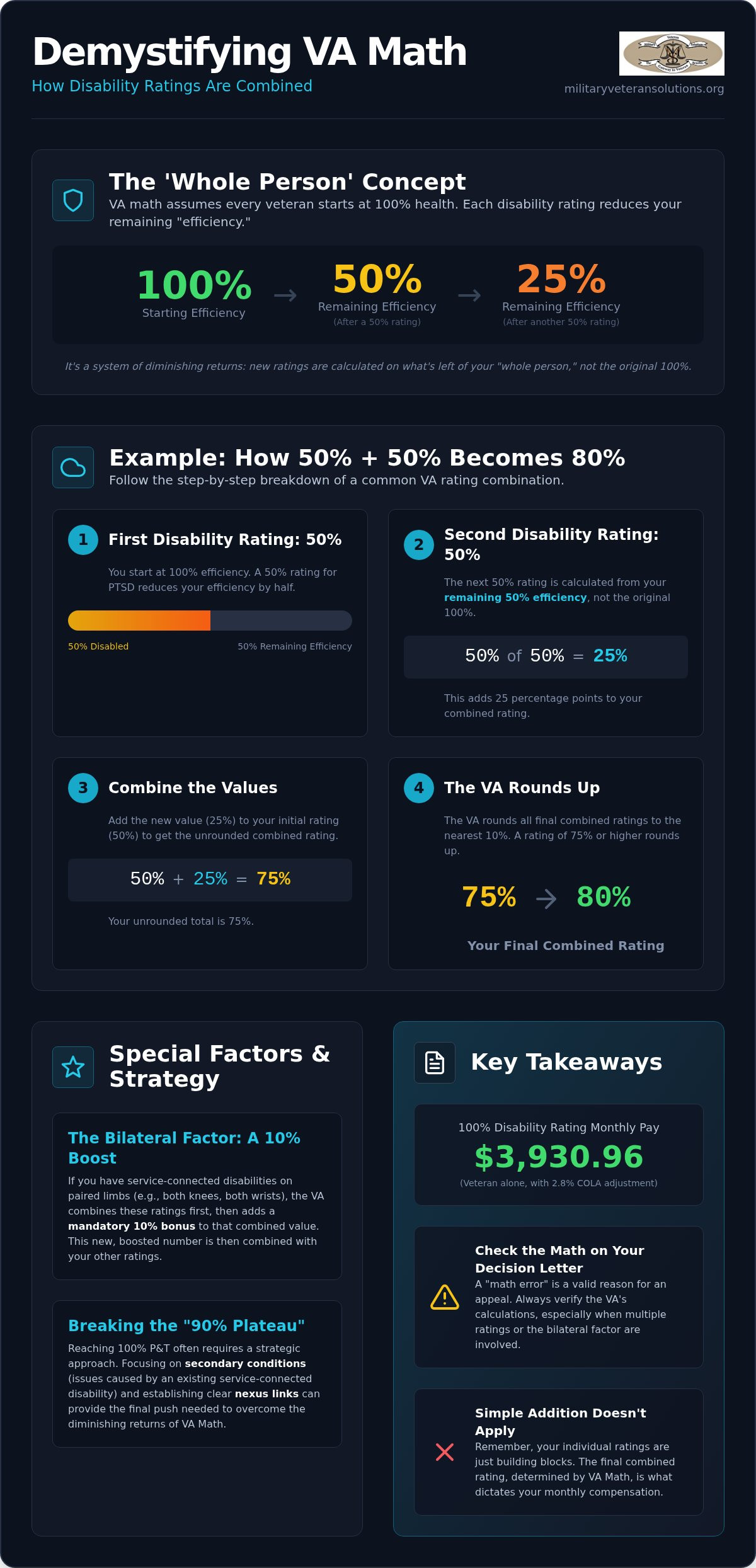
VA Math is the specific calculation method the Department of Veterans Affairs uses to determine your total disability percentage when you have more than one service connected condition. It's not a standard addition process. Instead, the VA operates under the "Whole Person" theory. This philosophy assumes that every veteran starts at 100% efficiency. When you receive a disability rating, that percentage represents how much of your "whole person" efficiency has been lost. The VA then calculates any additional disabilities based only on the efficiency you have left.
To understand how does the va combine disability ratings, you have to stop thinking in terms of sums and start thinking in terms of remaining capacity. For example, if you have a 50% rating for a respiratory condition, you are considered 50% disabled and 50% efficient. If you are then granted another 50% rating for a separate condition, the VA doesn't add 50 to 50 to reach 100. They take 50% of your remaining 50% efficiency, which is 25%. When you add that 25% to your initial 50%, you reach a combined 75%. Because the VA rounds to the nearest 10%, your final check would reflect an 80% disability rating.
Why the VA Doesn't Use Simple Addition
The logic behind this system is that a person cannot be more than 100% disabled. If the VA used simple addition, many veterans would quickly exceed 100% on paper. This would create a mathematical impossibility in their eyes. This system often leads to a feeling of diminishing returns as your ratings get higher. It's common to feel a deep sense of frustration when a hard won 10% rating for a new condition doesn't move your total combined percentage at all. As you get closer to 100%, each new rating provides a smaller boost because there's less "efficiency" left to take from. This is a primary reason why how does the va combine disability ratings remains one of the most confusing aspects of the claims process.
The Difference Between Combined and Individual Ratings
Your individual ratings are the specific percentages assigned to each single diagnostic code based on the criteria found in 38 CFR Part 4. These numbers reflect the severity of one specific condition, such as a knee injury or a mental health diagnosis. However, your monthly compensation is never based on these individual numbers alone. It's based entirely on the final combined number after the VA Math has been applied. We often see veterans who have five or six individual 10% ratings but find themselves stuck at a 50% combined rating. Understanding the difference is vital for your financial security. Your individual ratings are just the building blocks; the combined rating is what determines the actual support you receive to provide for your family.
How to Use the VA Combined Rating Table
While many veterans rely on automated calculators, understanding the manual process ensures you can spot errors in your decision letter. To see how does the va combine disability ratings accurately, you must use the Combined Rating Table found in 38 C.F.R. § 4.25. This grid is the final authority on your benefits. It requires a methodical approach to ensure every service connected condition is accounted for before the VA rounds your final percentage. You can find more detail on the VA's official explanation of disability ratings to see the regulatory framework behind this grid.
Step 1: Ranking Your Disabilities
The first rule of VA Math is that you never combine ratings in a random order. You must list all your service connected conditions from the highest percentage down to the lowest. This order is mathematically critical. If you have a 70% rating for PTSD and two 10% ratings for tinnitus and back pain, you must start with the 70% mark. Starting with the largest percentage ensures the "whole person" calculation begins with the most significant impact on your efficiency. If you have two ratings of the same value, such as two 30% ratings, the order between those two specifically doesn't matter, but they must still follow any higher ratings you have already listed.
Step 2: Intersecting Values on the Table
Once your list is ordered, take the highest rating and find it in the left hand column of the table. Take your second highest rating and find it in the row across the top. Follow the column and row until they intersect. This resulting number is your new "running total." If you have a third disability, you find your current running total in the left column again and your next rating in the top row. You continue this chain until every condition has been processed. Keeping a written log of these intermediate numbers is vital. If your final result feels lower than expected, a professional VA decision letter analysis can help determine if the rater skipped a step or ignored a secondary condition.
The final step in this process is the rounding rule. The VA does not pay at "in between" percentages like 64% or 85%. Any combined rating must end in a zero. If your final running total ends in a 5 or higher, the VA rounds up to the next 10% increment. If it ends in a 4 or lower, they round down. For example, a 74% combined rating rounds down to 70%, while a 75% rating rounds up to 80%. Rounding is the VA's final step in determining your pay grade. This small distinction can result in a difference of hundreds of dollars in your monthly 2026 compensation check.
The Bilateral Factor: A 10% Boost for Extremities
The VA recognizes that a disability affecting both sides of your body is significantly more limiting than a single sided injury. This is where the bilateral factor comes into play. It's a specific rule used when determining how does the va combine disability ratings for veterans with injuries to both arms, both legs, or paired muscle groups. Unlike standard ratings that are combined in descending order across the entire list, bilateral conditions are grouped and boosted before they are merged with non extremity ratings. This factor can often be the difference between an 80% and 90% total rating, providing the financial lift you actually deserve.
Which Conditions Qualify for the Bilateral Factor?
To trigger this boost, you must have service connected conditions affecting both "upper extremities" or both "lower extremities." This includes your arms, hands, shoulders, legs, feet, and hips. It also applies to paired skeletal muscle groups. Crucially, the conditions do not need to be identical. A right hip strain and a left ankle injury qualify just as much as two injured knees. However, sensory organs like eyes or ears do not typically trigger this specific factor. They are evaluated under different criteria within the About VA Disability Ratings guidelines. This boost is strictly reserved for the musculoskeletal system and your limbs.
Calculating the Bilateral Bonus
The math here is frequently misunderstood because it is a 10% bonus of the combined value, not 10 additional percentage points. The VA calculates this by combining the bilateral ratings first using standard VA Math. Once they have that sub total, they add an additional 10% of that number as a "bonus." This happens before the bilateral group is combined with anything else, like PTSD or a respiratory condition. We see many veterans miss out on higher ratings because this calculation was applied incorrectly or omitted entirely during the initial review of their claim.
Let's look at a concrete example involving two 10% leg ratings. First, the VA combines them: 10% of 100 is 10, leaving 90% efficiency. Then, 10% of 90 is 9. Added together, the combined value is 19%. The VA then takes 10% of that 19%, which is 1.9%. They add 1.9% to the 19% for a bilateral sub total of 20.9%. This 20.9% then enters the main "VA Math" calculation as a single, more powerful rating. While 1.9% sounds small, it is often the exact amount needed to push a 74% rating (which rounds down to 70%) up to a 75% rating (which rounds up to 80%).
Strategic Ratings: Secondary Conditions and the 100% Goal
Reaching a 90% rating is a significant milestone, but many veterans find themselves stuck at this level for years. This is widely known as the "90% plateau." Because of how does the va combine disability ratings, the jump from 90% to 100% is the steepest climb in the entire system. At a 90% rating, the VA considers you only 10% efficient. To reach the 95% threshold required to round up to 100%, you must find another 5% of total disability. Mathematically, this means you need a new, standalone 50% rating just to move the needle those final 5 points. This is why a strategic approach focusing on secondary conditions is often the only way to secure your maximum entitled benefits.
A secondary service connection is a disability caused or aggravated by an existing service connected condition. These conditions are not "lesser" in the eyes of the VA; they carry the same weight as primary conditions in your combined total. However, the VA will not automatically grant these ratings. You must provide clear medical evidence, typically in the form of a Nexus letter, to prove the link. This evidence acts as the bridge between your primary diagnosis and the new complication, ensuring the rater understands the full scope of your service connected health issues.
Identifying Missed Secondary Connections
Many veterans overlook the ripple effects of their primary injuries. For instance, chronic back pain frequently leads to radiculopathy (nerve damage) in the legs, while the constant mental toll of a physical limitation can result in secondary depression or anxiety. Even the side effects of VA prescribed medications can be rated as secondary conditions if they cause new issues like gastrointestinal distress or hypertension. A professional military record review can uncover these often missed links. Understanding how does the va combine disability ratings is essential when building a strategy around secondary conditions, as these new percentages are applied to your remaining efficiency to help you overcome the 90% plateau.
Total Disability Based on Individual Unemployability (TDIU)
If the math simply won't reach 100% despite your best efforts, TDIU offers a vital alternative. This program pays you at the 100% rate even if your combined rating is lower, provided your service connected disabilities prevent you from maintaining "substantially gainful" employment. To qualify, you generally need one individual rating at 60% or a combined rating of 70% with at least one condition rated at 40%. It's a powerful tool for veterans who are struggling to stay in the workforce but find themselves blocked by the diminishing returns of VA Math. We recommend exploring this route if your health makes traditional employment impossible, as it provides the financial security of a 100% rating without requiring a perfect mathematical score.
Professional Decision Letter Analysis: When the Math Feels Wrong
Receiving your VA decision letter should be a moment of relief, yet for many, it's the start of a new frustration. The complex nature of how does the va combine disability ratings means that even a small data entry error can result in a significant loss of monthly compensation. If your final percentage doesn't seem to match the severity of your daily symptoms, it's possible the rater misapplied a regulation or overlooked a critical piece of evidence. Military Veteran Solutions, LLC serves as a dedicated advocate to bridge the gap between a confusing letter and the benefits you actually deserve.
Common Errors in VA Rating Decisions
Calculations are only as good as the data entered into them. We often see raters fail to apply the bilateral factor correctly, which we previously identified as a mandatory boost for paired extremities. If this 10% bonus is omitted, your total rating can easily fall short by a full pay grade. Another frequent oversight involves Range of Motion (ROM) testing. If your examiner failed to document flare ups or pain on motion, you might be "low balled" with a 10% rating when your symptoms qualify for 30% or 40%. We also look for instances where the VA ignored secondary conditions that were clearly documented in your medical history but never formally addressed in the final decision.
How Virtual Consultations Help You Win
A virtual consultation provides a nationwide perspective on your specific claim without you ever having to leave your home. Military Veteran Solutions, LLC performs an exhaustive military record review to spot these inconsistencies and identify the "nexus" links required for a successful appeal. We help you organize your documentation for a professional audit, turning a disorganized pile of medical records into a clear roadmap for the VA to follow. This detailed analysis ensures that your next move is strategic and backed by facts. Don't let a mathematical error or a missed connection keep you from providing for your family. Schedule your VA Decision Letter Analysis today.
Take Control of Your Disability Rating Strategy
Mastering the logic of how does the va combine disability ratings is the first step toward securing the financial future you've earned. By moving beyond simple addition and focusing on the strategic value of the bilateral factor and secondary conditions, you can finally navigate the system with confidence. You've already done the hard work of serving. You shouldn't have to fight a complex administrative puzzle alone to receive your maximum entitlement.
Military Veteran Solutions, LLC is a veteran owned advocacy firm with over 25 years of experience in VA claims. We provide national virtual consultations to audit your records and identify the math errors or missed service connections that often lead to low balled ratings. Our team offers the professional authority and deep empathy needed to challenge an unfair decision and find the "nexus" for your claims. Don't let a confusing letter be the final word on your health and security.
Secure the Benefits You Earned with a Professional Claims Review
Your path to a 100% rating is clearer when you have an expert guide by your side. We're here to help you secure the relief and security you deserve.
Frequently Asked Questions
Is 50% and 50% always 80% in VA math?
Yes, if these are your only two service connected disabilities. The first 50% rating leaves you with 50% efficiency. The second 50% rating takes half of that remaining efficiency, which is 25%. When you combine 50 and 25, you get 75%, which the VA rounds up to 80% for compensation purposes. This is the standard outcome when no other ratings or bilateral factors are involved.
What happens if my combined VA rating is 94%?
A combined rating of 94% rounds down to 90% for your monthly payment. This is a common source of frustration for veterans near the 100% mark, often called the 90% plateau. To receive the full 100% pay rate, your raw mathematical score must reach at least 95% to trigger the upward rounding rule. Small errors in your record can often be the difference between these two pay grades.
How does the VA round a 65% combined rating?
The VA rounds a 65% rating up to 70%. Their policy is to round to the nearest 10% increment. If your combined value ends in 5, 6, 7, 8, or 9, it moves to the higher number. If it ends in 1, 2, 3, or 4, it rounds down to the lower 10% mark. This rounding is the final step after all your individual conditions have been combined.
Can the VA lower my rating if I ask for an increase?
Yes, requesting an increase technically opens your entire disability file for review. If a Compensation and Pension (C&P) examiner finds that a condition has significantly improved, the VA can propose a reduction. You should always ensure your medical evidence strongly supports an increase before you submit a new claim to avoid unexpected setbacks. We recommend a professional record review to identify any potential vulnerabilities in your current ratings.
Does the bilateral factor apply to mental health conditions?
No, the bilateral factor is strictly reserved for disabilities affecting your limbs or paired muscle groups. Mental health conditions like PTSD or depression are rated using a different set of criteria based on social and occupational impairment. When understanding how does the va combine disability ratings, remember that the bilateral boost only applies to your musculoskeletal system before other ratings are added to the total.
How many 10% ratings does it take to get to 100%?
It takes 27 individual 10% ratings to reach a 95% score that rounds to 100%. This illustrates why relying on small ratings is an exhausting uphill battle. Each new 10% rating takes a smaller piece of your remaining efficiency. A more effective strategy often involves identifying secondary conditions or seeking higher ratings for primary conditions that carry higher individual percentages.
What is the difference between 100% and TDIU?
A 100% schedular rating means your combined disabilities mathematically reach the 95% threshold. TDIU, or Total Disability Based on Individual Unemployability, pays you at the 100% rate because your service connected conditions prevent you from working, even if your combined math is only at 70% or 80%. Both paths provide the same monthly compensation amount and access to 100% level benefits.
Can I have two separate ratings for the same body part?
Generally, you cannot receive two ratings for the same symptom due to pyramiding rules. However, you can have multiple ratings for the same joint if they cover different types of impairment, such as limited flexion and limited extension. It's vital to know how does the va combine disability ratings for these specific joints to ensure you aren't being undercompensated for complex injuries that affect your mobility in multiple ways.


