
What if the evidence needed to win your VA claim isn't missing, but simply buried under a mountain of military jargon you were never trained to decode? It's exhausting to feel like just another number in a faceless bureaucracy, especially when you're staring at hundreds of pages of service records that seem to lead nowhere. You know your injury happened during your service, yet the VA keeps coming back with denials that ignore your reality. Utilizing a professional military record review service ensures your history is viewed through the lens of an advocate who knows exactly what the raters are looking for.
This strategic audit does more than just organize your files; it uncovers the "smoking gun" evidence that establishes a clear medical nexus. By transforming overlooked documentation into winning evidence, you can move past the anxiety of missed deadlines and confusing paperwork. We'll explore how a thorough analysis of your service history identifies hidden secondary conditions and corrects documentation gaps to finally secure the fair disability rating and back pay you've earned.
Key Takeaways
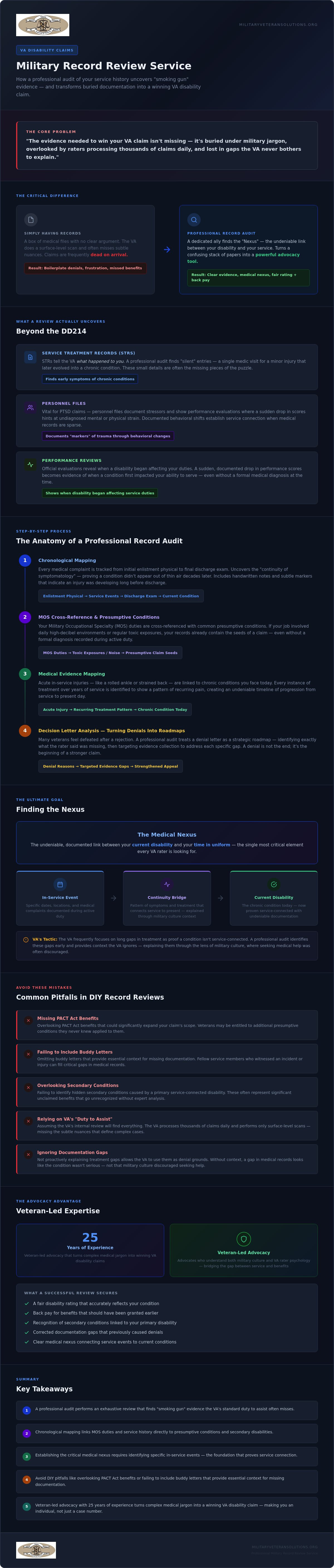
- Discover how a professional military record review service performs an exhaustive audit to find "smoking gun" evidence that the VA's standard duty to assist often misses.
- Learn the process of chronological mapping to link your MOS duties and service history directly to presumptive conditions and secondary disabilities.
- Understand how to establish the critical medical nexus by identifying specific in-service events that prove your current condition is service-connected.
- Avoid common DIY pitfalls like overlooking PACT Act benefits or failing to include buddy letters that provide essential context for missing documentation.
- Recognize the advantage of veteran-led advocacy that uses 25 years of experience to turn complex medical jargon into a winning VA disability claim.
Why a Professional Military Record Review Service is Essential
A military record review service isn't just a filing system; it's a strategic audit of your entire service history. Many veterans assume that because they have their records in hand, the VA will naturally find the proof. This isn't always the case. There's a massive difference between simply possessing records and presenting admissible evidence that forces a rater to take notice. A professional review sifts through hundreds of pages to find the "Nexus," which is the undeniable link between your current disability and your time in uniform.
Possessing a box of medical files doesn't guarantee a successful claim. Without a clear connection, your claim is often dead on arrival. By identifying the specific dates, locations, and medical complaints that bridge the gap between your discharge and your current symptoms, we build a coherent argument for the benefits you earned. It's about turning a confusing stack of papers into a powerful tool for your advocacy.
The 'Duty to Assist' vs. Independent Advocacy
The Veterans Benefits Administration has a legal obligation to help you gather evidence, but their internal review is often a surface-level scan. They are processing thousands of claims daily. They often miss the subtle nuances that define a complex case. When you utilize a professional military record review service, you get a dedicated ally who doesn't just look for a diagnosis; they look for the story. This thoroughness prevents the boilerplate denials that leave so many veterans feeling ignored and frustrated by the system.
Beyond the DD214: What a Review Actually Uncovers
Your DD214 tells the VA where you were, but your Service Treatment Records (STRs) tell them what happened to you. We look for "silent" entries, such as a single visit to a medic for a minor injury that later evolved into a chronic condition. These small details are often the missing pieces of the puzzle. Personnel records are equally vital for your claim. They provide proof of stressors for PTSD claims or show performance evaluations where a sudden drop in scores hints at undiagnosed mental or physical strain. These documented shifts in behavior or physical ability are essential for establishing service connection when direct medical records are sparse.
- STR Analysis: Finding the early symptoms of chronic conditions.
- Personnel Files: Documenting the "markers" of trauma or injury through behavioral changes.
- Performance Reviews: Using official evaluations to show when a disability began affecting your duties.
The Anatomy of a Professional Record Audit
A professional military record review service doesn't just look at what's in your file; it looks at what's missing and why. We begin with chronological mapping. This involves tracking every medical complaint from your initial enlistment physical to your final discharge exam. It's a meticulous process that uncovers the "continuity of symptomatology" needed to prove a condition hasn't just appeared out of thin air decades later. We don't just read the summary; we analyze the handwritten notes and the subtle markers that indicate an injury was brewing long before you hung up the uniform.
When you prepare to file a VA disability claim, the VA often looks for reasons to deny. They frequently focus on long gaps in treatment as proof that a condition isn't service-connected. Our audit identifies these gaps early. We provide the context the VA ignores, explaining them through the lens of military culture where seeking medical help was often discouraged. We also cross-reference your Military Occupational Specialty (MOS) duties with common presumptive conditions. If your job involved daily high-decibel environments or regular toxic exposures, your records already contain the seeds of a claim, even if a specific diagnosis was never officially recorded during active duty.
Medical Evidence Mapping
We link acute in-service injuries, like a rolled ankle or a strained back, to the chronic conditions you face today. This requires identifying every instance of treatment over years of service to show a pattern of recurring pain. Medical evidence mapping bridges the gap between your service-connected injuries and the chronic conditions you live with today by creating an undeniable timeline of progression.
Decision Letter Analysis: Learning from Denials
Many veterans feel defeated after a rejection, but a denial letter is actually a strategic roadmap. By using a VA decision letter review service, we can pinpoint the exact reason the VA said "no." It might be a lack of service connection, a "missing nexus," or a claim that the condition isn't "at least as likely as not" related to your time in uniform. We take that specific language and hunt through your records for the exact evidence that refutes their conclusion.
We use these rejections to find contradictions in your records that the C&P examiner may have overlooked or ignored. If an examiner's report states your back pain is purely age-related, but we find a heavy-lifting injury report from a deployment, we have the factual evidence to challenge their finding. This level of granular detail is what turns a losing appeal into a winning case. If you're tired of the guesswork and want a clear path forward, a virtual consultation can help you understand exactly where your evidence stands.
Finding the Nexus: The Goal of Every Record Review
Every successful VA disability claim rests on three non-negotiable pillars: a current medical diagnosis, a specific in-service event or injury, and the medical nexus that links them. While a doctor can provide the diagnosis, proving the in-service event often requires a deep dive into military service records to find the exact moment the damage occurred. A military record review service focuses on solidifying that second pillar. It isn't enough to say you were injured; you must prove it with documentation that the VA cannot dispute. This process uncovers the evidence that forms the foundation of your entire case.
A record audit often reveals secondary conditions that a veteran may not even realize are linkable to their service. For instance, chronic sleep apnea might be secondary to service-connected PTSD, or a hip issue could stem from an old foot injury. When the paper trail has gaps, we use lay statements to bridge the distance. These statements provide the human context that data alone sometimes misses, describing how your symptoms have progressed from your time in uniform to the present day. This combination of hard data and personal testimony creates a comprehensive picture of your health that the VA's surface-level reviews often overlook.
Primary vs. Secondary Service Connection
Proving a secondary connection requires a strategic understanding of medical causality. A knee injury sustained in 1995 can easily lead to a back claim in 2026 due to altered gait and overcompensation. Our record reviews specialize in proving "aggravation," showing how a primary service-connected disability has directly caused or worsened a new condition. If your initial claim was denied because the VA didn't see a direct link, you can use filing VA appeals help to restructure your argument. This strategy focuses on the ripple effect of your injuries, which is often the key to securing a higher disability rating.
The Power of the Nexus Letter
A nexus letter is your most powerful tool, but only if it's built on a foundation of specific record citations. The VA routinely dismisses generic letters that use "boilerplate" language. To meet the "at least as likely as not" legal standard, a medical professional must cite specific events found during your record review. By providing your doctor with an audited summary of your service history, you enable them to write a stronger, more authoritative letter. This ensures the VA sees a clear, evidence-based connection rather than a simple medical opinion, making it much harder for them to deny your claim.
Common Pitfalls in DIY Record Reviews
Attempting a DIY review is a common mistake that often leads to avoidable denials. Most veterans assume the VA has retrieved every relevant document from every branch of service. They haven't. A standard search might miss records from a short detachment, a specialized training assignment, or a temporary duty station. Without a professional military record review service, you risk basing your claim on an incomplete picture. You might spend weeks staring at a 500-page file and still miss the single, handwritten entry that proves your injury occurred in the line of duty.
Many veterans also ignore the power of "Buddy Letters." They assume that if an event isn't in an official medical file, it simply doesn't exist. This is a critical error. Statements from those who served alongside you can validate missing record entries, providing the "markers" of an event that was never officially logged. We treat these documents as essential evidence, not optional extras. Ignoring these personal accounts often means leaving a significant portion of your proof on the table.
The PACT Act and Presumptive Conditions
The PACT Act changed the rules for millions, yet many DIY filers still struggle to link their conditions to toxic exposure. In a professional review, we don't just look for a diagnosis in your service treatment records. We look for proof of location. If you served in a toxic exposure zone, your medical records don't need to show an immediate injury. Proving your physical presence in that area triggers presumptive protections. We review deployment orders and travel vouchers to ensure your service is correctly categorized under these laws. Even if your medical file is "negative" for exposure symptoms during service, your location is the key that unlocks these benefits.
Missing Records: What to Do When the File is Empty
If your file is thin or missing, don't lose hope. We reconstruct service histories through secondary sources like deck logs, morning reports, and unit histories. These documents can prove stressors and events even when your personal records are silent. You shouldn't be penalized for the government's record-keeping failures. If your STRs were lost or destroyed, va claim assistance provides the strategies needed to find alternative proof through unit-level documentation. If you're overwhelmed by the gaps in your history, a virtual consultation can help you identify exactly what's missing from your file and how to find it.
Securing Your Benefits with Military Veteran Solutions, LLC
At Military Veteran Solutions, LLC, we don't just see a file; we see a life dedicated to service. Our firm is veteran-owned and operated by a 10-year Army veteran with over 25 years of experience in the specialized field of veteran advocacy. This background provides a unique peer-to-peer connection that high-volume firms often lack. We know the administrative hurdles you face because we've navigated them ourselves. This seasoned perspective allows us to act as a powerful ally, turning a daunting process into a clear, manageable path toward the benefits you earned.
Our commitment is simple: we identify every possible entitlement, whether you're fighting for an initial 10% rating or seeking a 100% total disability rating. We leave no stone unturned. By conducting a thorough, expert-led evidence audit, we provide the relief and security that comes from knowing your claim is built on a solid foundation. You don't have to face the VA bureaucracy alone when you have an authoritative expert who is also a dedicated grassroots ally in your corner.
Our Exhaustive Review Process
We follow a methodical and direct approach to every case. First, we perform a deep-dive analysis of your military and medical history to identify the "markers" of service connection that others miss. We then translate these complex records into a strategic filing plan designed to withstand VA scrutiny. This isn't a one-sided process. We maintain a collaborative relationship with you, ensuring your personal experiences are integrated into the technical evidence. Our goal is to transform your service documentation into a compelling narrative that demands a fair evaluation.
- Comprehensive Analysis: We cross-reference medical complaints with personnel files to find hidden links.
- Strategic Planning: Every piece of evidence is mapped to a specific VA requirement or presumptive condition.
- Direct Collaboration: We ensure your lay statements and buddy letters align perfectly with the clinical data.
Start Your Journey to a Fair Rating Today
Waiting to review your records is a decision that can cost you thousands in lost back pay. The VA's systems are complex, and deadlines are unforgiving. By engaging our military record review service now, you protect your effective date and ensure your appeal is filed with the strongest possible evidence. Preparing for your initial virtual consultation is straightforward. Simply bring your current decision letters and any service records you have on hand. We'll handle the heavy lifting of the analysis. Don't let your history remain hidden in a box. Schedule your professional military record review with Military Veteran Solutions, LLC today and take the first step toward the compensation you deserve.
Take Command of Your VA Claim Evidence
Your service history holds the key to the benefits you've earned, but those records are only as strong as the analysis behind them. A professional military record review service transforms a chaotic stack of paperwork into a precise roadmap for a successful appeal. By identifying the critical medical nexus and uncovering secondary conditions you may have overlooked, this exhaustive audit bridges the gap between your time in uniform and your current health. You don't have to settle for a denial when the proof is already in your hands.
Don't let a surface-level VA review or a simple administrative error stand between you and your fair rating. Military Veteran Solutions offers a veteran-founded perspective backed by 25 years of advocacy experience. Whether you're navigating PACT Act complexities or reconstructing a history from missing service treatment records, our nationwide virtual support ensures you have a powerful ally in your corner. You served your country with honor; it's time to ensure your records reflect the full extent of your sacrifice.
Secure your earned benefits with a professional record review from Military Veteran Solutions.
Frequently Asked Questions
What exactly is a military record review service?
A military record review service is a comprehensive audit of your Service Treatment Records and personnel files designed to identify evidence for disability compensation. We look beyond surface-level entries to find the specific markers that establish a medical nexus. This process is the foundational step for any successful appeal. It ensures that every injury, exposure, and stressor is documented and presented in a way the VA can't ignore.
Can I review my own military medical records for a VA claim?
You certainly can review your own files, but most veterans find the hundreds of pages of medical jargon and handwritten notes overwhelming. It's easy to miss a single, critical entry that could be the "smoking gun" for your claim. A professional review provides the objective expertise needed to decode complex administrative systems. We find the secondary conditions and presumptive links that untrained eyes often overlook during a DIY search.
How long does a professional record review take?
The timeline for a professional military record review service varies based on the volume of your documentation and the complexity of your service history. While we handle every file with promptness, our analysis is exhaustive and detail-oriented to ensure no evidence is missed. We prioritize thoroughness because a rushed review often leads to boilerplate denials. Our goal is to build a strategic filing plan that stands up to scrutiny.
What if some of my military records are missing or were destroyed?
Missing or destroyed records don't have to be the end of your claim. We specialize in reconstructing your service history through secondary sources like unit morning reports, deck logs, and unit histories. These official documents can prove your presence in toxic exposure zones or validate stressors for PTSD claims. We also use buddy letters to fill gaps, ensuring you aren't penalized for the government's record-keeping failures or historical fires.
How does a record review help with a VA claim appeal?
A record review helps an appeal by pinpointing exactly where the VA's previous decision was flawed. We analyze your denial letter and cross-reference it with your files to find the evidence that contradicts the VA's findings. This allows us to restructure your claim with new, relevant evidence that addresses the specific reasons for your rejection. It turns a "lack of service connection" into a roadmap for a successful and fair outcome.
Will a record review help me get a 100% disability rating?
While no service can guarantee a specific percentage, a thorough review ensures you are seeking every entitlement you've earned, from 10% to 100%. We identify primary injuries and the secondary conditions they cause, which often leads to a higher combined rating. By auditing your evidence before you file, we make sure you aren't leaving money on the table due to overlooked documentation or missing medical links in your history.
What is the difference between a medical record and a service personnel record?
Medical records document your specific injuries and treatments, while service personnel records detail your duties, locations, and performance evaluations. Both are essential for a winning claim. Personnel records often provide the "markers" of trauma or physical strain, such as a sudden drop in performance or a change in MOS. We analyze both sets of documents to create a complete picture of how your service impacted your long-term physical and mental health.
Do I need a record review if my condition is already service-connected?
Yes, a review is still highly beneficial even if you already have service connection for one condition. We use your records to identify secondary disabilities that stem from your primary injury, such as back issues caused by a service-connected knee problem. This proactive approach helps you secure a fair disability rating that reflects the full scope of your health challenges, ensuring your benefits keep pace with your actual medical needs.


