
Why should you be stuck with a 10% rating when the constant ringing in your ears triggers debilitating, prostrating head pain? If you're living with service-connected tinnitus, you already know it's more than an annoyance. It's a catalyst for migraines that derail your work and family life. Many veterans feel stranded when the VA ignores the link between auditory trauma and neurological symptoms. You understand that the frustration of a low rating is only matched by the confusion of proving a "nexus" to a rater. Securing a service connection for migraines secondary to tinnitus is the strategic bridge you need to obtain a higher combined disability rating and the compensation you've earned.
This 2026 guide provides the roadmap to move your claim forward. You'll learn how to navigate the medical-legal requirements and what evidence is necessary to prove the connection. We will analyze the current rating schedule under 38 CFR § 4.124a and show how a thorough military record review can uncover the evidence you've been missing. It's time to stop settling for a rating that doesn't account for your actual impairment and start building a case that demands results. We've navigated these difficult paths before and are committed to helping you do the same.
Key Takeaways
- Understand the fundamental link between your auditory trauma and neurological symptoms to bridge the gap between a 10% tinnitus rating and higher compensation.
- Navigate the 2026 VA rating criteria under Diagnostic Code 8100 to ensure your prostrating attacks are documented for the maximum entitlement you deserve.
- Learn the exact medical-legal evidence required to establish a service connection for migraines secondary to tinnitus through a thorough military record review.
- Discover the critical roles that a formal diagnosis and a strong medical nexus letter play in securing a successful outcome for your secondary claim.
- Master the strategies for overcoming common VA denials by utilizing supplemental claims and professional advocacy to address a perceived lack of nexus.
What is Secondary Service Connection for Migraines?
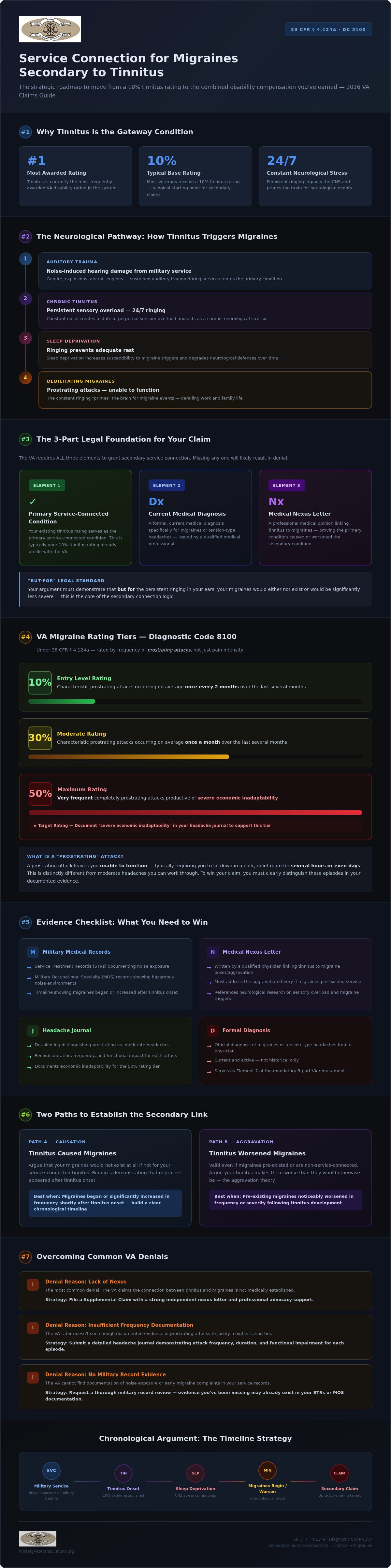
A secondary service connection occurs when a disability you already have from your military service causes or aggravates a new, separate medical condition. It's a common path for veterans who find that their primary ratings don't tell the whole story of their daily struggle. To establish a service connection for migraines secondary to tinnitus, you must demonstrate "but-for" logic. Essentially, you're arguing that but for the persistent ringing in your ears, your migraines would either not exist or would be significantly less severe.
The VA requires three specific elements to grant this connection. First, you need a primary service-connected condition, which in this case is your tinnitus rating. Second, you must have a current medical diagnosis for the secondary condition, specifically migraines or tension-type headaches. Finally, you need a medical nexus. This is the professional link that proves the first condition caused or worsened the second. Without this three-part foundation, your claim will likely face a denial.
The Medical Nexus: Connecting Tinnitus and Migraines
The link between these two conditions is often found in the way the brain processes constant sound. Research into tinnitus and its neurological effects suggests that chronic ringing creates a state of perpetual sensory overload. This constant noise acts as a neurological stressor that can trigger the onset of intense head pain. Sleep deprivation is another critical factor; when the ringing prevents you from resting, your brain becomes more susceptible to migraine triggers. Under the aggravation theory, a secondary claim is valid if your service-connected tinnitus makes your pre-existing or non-service-connected migraines worse than they would have been otherwise.
Why Tinnitus is a Strong Primary Condition
Tinnitus is currently the most frequently awarded VA disability rating. Because so many veterans have this 10% rating, it serves as a logical starting point for secondary claims. The psychological toll of hearing high-pitched ringing 24/7 impacts the central nervous system, making it a powerful gateway condition for neurological issues. When building your case, look for a clear timeline. If your migraines began or significantly increased in frequency shortly after your tinnitus onset, you have a strong chronological argument to present to the VA. Proving a service connection for migraines secondary to tinnitus requires this level of detail to ensure your rating reflects the true impact on your life.
VA Rating Criteria for Migraines and the Tinnitus Link
The VA evaluates migraines under 38 CFR § 4.124a, Diagnostic Code 8100. This schedule doesn't just look at the intensity of your pain; it focuses on how often your attacks are "prostrating." When you pursue a service connection for migraines secondary to tinnitus, the goal is to align your medical evidence with these specific legal definitions. The system is designed to compensate you for the functional loss caused by your symptoms, not just the diagnosis itself. You must prove that the tinnitus is the catalyst for these neurological events.
The rating tiers are clear but strict:
- 10% Rating: Characteristic prostrating attacks occurring on average once every 2 months over the last several months.
- 30% Rating: Characteristic prostrating attacks occurring on average once a month over the last several months.
- 50% Rating: Very frequent completely prostrating attacks productive of severe economic inadaptability.
Tinnitus acts as a constant neurological trigger. The persistent ringing associated with noise-induced hearing damage and tinnitus creates a state of chronic sensory overload. This constant stress wears down your neurological defenses, making you more susceptible to frequent, debilitating migraines. It's not just a coincidence that these conditions coexist; the ringing effectively "primes" your brain for a migraine event. This physiological pathway is often the missing piece in a successful secondary claim.
Defining "Prostrating" Attacks
A prostrating attack is more than a severe headache. The VA defines it as an episode that leaves you unable to function, typically requiring you to lie down in a dark, quiet room for several hours or even days. To win your claim, you must distinguish these episodes from moderate headaches that you can work through. We recommend maintaining a detailed headache journal. Documenting the date, duration, and specific symptoms of every prostrating event creates the evidence trail a rater needs to justify a higher percentage. Without this documentation, the VA may default to the lowest possible rating despite the severity of your pain.
The Role of Economic Inadaptability
To reach the 50% rating, you must demonstrate that your migraines cause "severe economic inadaptability." This means the attacks are so frequent or intense that they jeopardize your ability to maintain "substantially gainful" employment. Evidence such as sick leave records, FMLA documentation, or detailed statements from your employer can prove this impact. When migraines are this severe, they often serve as a foundation for Total Disability based on Individual Unemployability (TDIU). If you feel your current rating doesn't reflect your struggle, a virtual consultation can help you determine the best path forward for your specific case.
Identifying Evidence in Your Military Medical Records
Your service treatment records (STRs) are often the missing link in your claim. While you might think your records are empty, a professional military record review service can uncover evidence you overlooked. We look for specific markers like "complaints of headache" or "blurred vision" that were documented during your time in uniform. Often, these symptoms weren't given a formal diagnosis at the time, but they establish the early onset of your neurological condition. By linking acoustic trauma events to the development of your tinnitus, we can show a parallel progression toward migraines. This continuity is vital for establishing a service connection for migraines secondary to tinnitus.
Auditing for "Hidden" Evidence
Don't ignore the pharmacy logs. If you were frequently prescribed high-dose Ibuprofen or Excedrin, that's objective evidence of a recurring issue. Many veterans visited sick call for what was labeled a "tension headache," only for those symptoms to evolve into chronic migraines later in life. If the VA has already denied your claim, a VA decision letter review service is essential. It helps identify exactly where the rater missed these critical "hidden" details in your STRs. We find that small notations in a pharmacy log can be the difference between a denial and a successful appeal.
Gathering Post-Service Medical Documentation
Winning your claim requires a current diagnosis from a neurologist or primary care physician. It's not enough to say your head hurts; you need a formal diagnosis of migraines under Diagnostic Code 8100. You should ensure your doctor uses "VA-ready" terminology that describes the frequency and prostrating nature of your attacks. You must demonstrate a clear "continuity of symptomatology" from your time in service to the present day to prove your condition never truly went away. This documentation bridges the gap between your military history and your current impairment, ensuring the VA sees the full picture of your disability.
How to Build a Winning Secondary Condition Claim
Transitioning from understanding the law to filing your claim requires a disciplined strategy. You've identified the evidence in your records; now you must present it in a way the VA cannot ignore. Establishing a service connection for migraines secondary to tinnitus depends on a four-step evidentiary framework. First, confirm your diagnosis under Diagnostic Code 8100. Second, secure a nexus letter where a medical professional explicitly states your migraines are "at least as likely as not" caused or aggravated by your tinnitus. The final two steps involve personal and witness testimony to humanize the data in your medical file.
The administrative side of your claim is just as important as the medical side. You're building a bridge between your symptoms and the legal requirements for compensation. This process involves translating your daily pain into the specific language the VA rater is trained to recognize. Every form you submit should reinforce the "but-for" logic we discussed earlier. If you're feeling overwhelmed by the paperwork, our veteran claims representation services can help you organize your evidence for maximum impact.
Writing the Statement in Support of Claim
VA Form 21-4138 is your opportunity to speak directly to the rater. Don't just list your symptoms. Describe the specific frequency, duration, and severity of your attacks. You must explicitly explain how your tinnitus serves as the primary trigger. Describe the sensation of the ringing increasing in volume or pitch just before the head pain becomes unbearable. Detail the reality of your "prostrating" episodes, such as the times you missed your child's birthday or had to leave work early to sit in a dark room. This narrative provides the context that clinical records often lack.
The Power of Buddy Statements
While your own statement is vital, the VA often places significant weight on third-party observations. Use VA Form 21-10210 to collect "buddy statements" from your spouse, close friends, or supervisors. These witnesses can testify to your "economic inadaptability" by describing the days you were too ill to function. They should focus on observable symptoms like vomiting, visible light sensitivity, or the need for total silence. Because these statements are signed under penalty of perjury, they carry substantial legal weight during the evaluation process. A supervisor's statement regarding your missed shifts or decreased productivity is particularly powerful for those seeking a 50% rating.
Professional Advocacy: Overcoming Denials for Secondary Migraines
A denial letter isn't the end of your journey. It's often just the first step in a more focused legal argument. The VA frequently denies a service connection for migraines secondary to tinnitus by claiming a "lack of nexus," effectively stating they don't see the medical link between your ringing ears and your head pain. This occurs even when you've provided a formal diagnosis. Understanding how filing VA appeals help can transform that initial rejection into a successful award is critical for your long-term financial security. You've already done the hard work of serving; now you must do the strategic work of appealing.
You have two primary paths after a denial. If you've gathered new evidence, such as the headache logs or refined nexus letters we discussed in previous sections, a Supplemental Claim is your best tool. This allows the VA to review the fresh data you've compiled. However, if you believe the rater simply overlooked evidence already in your file, a Higher-Level Review (HLR) is more appropriate. In an HLR, a more experienced rater reviews the same evidence without considering new information. This "closed record" review is perfect for correcting clear administrative errors. Choosing the wrong path can waste months of time, so a strategic approach is essential.
Analyzing the VA Denial Letter
Your denial letter contains a roadmap for your appeal. Look closely at the "favorable findings" section. This part tells you what the VA actually believes, such as acknowledging your tinnitus is service-connected or confirming you have a migraine diagnosis. By identifying exactly what's missing, you can use veteran advocacy services to bridge the specific evidentiary gap the rater identified. We focus on the "why" behind the denial to ensure your next submission is bulletproof and addresses every concern raised by the VA. Don't let a single rejection stop you from obtaining your earned entitlements.
The Path to a 100% Rating
Securing a service connection for migraines secondary to tinnitus can be the deciding factor in reaching a 100% total rating. Because of "VA Math," adding a 30% or 50% migraine rating to your existing conditions doesn't always result in a simple addition. It's a complex calculation of your remaining "whole person" percentage. A successful secondary claim can push a veteran from a stagnant 70% or 90% rating into the 100% bracket, unlocking significant monthly compensation and additional health benefits. This jump in rating represents a life-changing shift in financial stability. Ready to secure your benefits? Schedule a virtual consultation with Military Veteran Solutions, LLC today to begin your expert record review.
Take Command of Your VA Disability Claim
You don't have to settle for a rating that fails to account for the true severity of your symptoms. Establishing a service connection for migraines secondary to tinnitus is a precise medical-legal process that requires more than just a diagnosis. It demands a clear nexus and a meticulous audit of your military history to find the evidence the VA rater may have overlooked. By documenting your prostrating attacks and utilizing witness testimony, you build a case that the system can't easily dismiss.
Military Veteran Solutions, LLC was founded by a 10-year Army veteran who understands these hurdles from the inside. With over 25 years of experience, we specialize in comprehensive military record and decision letter analysis to identify the evidence needed to win. You've served your country; now it's time to secure the monthly compensation that reflects your actual impairment. Get Expert Help with Your VA Appeal Today. We're here to stand as your ally and guide you toward a successful outcome.
Frequently Asked Questions
Can I get VA disability for migraines if I already have a tinnitus rating?
You can certainly receive disability compensation for migraines even if you're already rated for tinnitus. This is achieved through a secondary service connection. If your service-connected tinnitus causes or worsens your migraine headaches, the VA recognizes this as a valid secondary disability. You must provide a current medical diagnosis and evidence that links the two conditions together. This allows you to increase your combined rating beyond the standard 10% for tinnitus.
What is a nexus letter, and do I need one for secondary migraines?
A nexus letter is a formal document from a medical professional that links your secondary condition to your primary service-connected disability. For a successful service connection for migraines secondary to tinnitus, a nexus letter is almost always essential. It provides the "at least as likely as not" medical opinion that VA raters require to bridge the evidentiary gap. This professional link is the foundation of any secondary claim strategy.
How much is a 50% migraine rating worth in 2026?
While the exact dollar amount depends on your total combined rating and dependents, a 50% rating significantly increases your monthly compensation. It represents the highest possible rating for migraines under Diagnostic Code 8100. This level of disability is often a critical component for veterans aiming to reach a 100% total rating. It can also be the deciding factor when qualifying for Total Disability based on Individual Unemployability (TDIU) if you cannot work.
Can the VA deny my migraine claim if I did not report them in service?
The VA can deny the claim, but not reporting migraines during your service isn't an automatic disqualifier. Since you're filing for a secondary connection, you only need to prove the migraines are caused by your service-connected tinnitus. However, a professional military record review can often find "hidden" evidence of early symptoms like light sensitivity or sick call visits for "tension" headaches. These entries establish a history of symptoms that support your current claim.
What happens if the VA says my migraines are caused by stress, not tinnitus?
This is a common denial tactic used to avoid granting a service connection for migraines secondary to tinnitus. If the VA attributes your headaches to an unrated condition like stress, you should file a Supplemental Claim with a stronger nexus letter. This new evidence should specifically explain how your tinnitus creates neurological stress or sleep deprivation that triggers your migraine attacks. It's about correcting the VA's narrative with medical facts and expert analysis.
How do I prove "economic inadaptability" for a higher migraine rating?
Proving economic inadaptability requires evidence that your migraines interfere with your ability to maintain work. You should submit sick leave records, FMLA paperwork, or buddy statements from a supervisor. These documents should describe how your frequent, prostrating attacks force you to miss shifts or reduce your productivity. This objective evidence is what separates a 30% rating from a 50% rating. It demonstrates that your impairment has a real-world impact on your livelihood.
Is it better to file a Supplemental Claim or a Higher-Level Review for migraines?
The choice depends on why the VA denied your initial claim. If you have new medical evidence or a more detailed nexus letter, a Supplemental Claim is the correct path. If you believe the VA rater simply ignored evidence that was already in your file, a Higher-Level Review allows a senior rater to take a fresh look. Choosing the right strategy is vital for a successful appeal and prevents years of unnecessary waiting.
How long does it take to get a decision on a secondary service connection claim?
Processing times vary based on the VA's current backlog and the complexity of your medical file. Generally, a standard claim or Supplemental Claim can take several months to complete. While the wait is frustrating, ensure your initial submission is complete and well-organized. A thorough record review before filing can prevent unnecessary delays caused by VA requests for additional information. Our goal is to help you submit a bulletproof claim the first time.


