
The VA doesn't deny tinnitus claims because they don't believe your ears are ringing; they deny them because you haven't told the right story about your service. It's a common misconception that a clean audiology report means your claim is dead on arrival. In reality, your clinical hearing levels often have very little to do with securing a service connection for that persistent buzzing or whistling in your ears.
You've likely felt the sting of a denial letter claiming there's no "service connection," or perhaps you're dreading a C&P exam where a doctor might dismiss your symptoms as subjective. It's frustrating to feel like your MOS history is being ignored. We understand that struggle because we've navigated those same administrative hurdles ourselves. This guide will teach you exactly how to win a tinnitus VA claim by mastering the "Noise Exposure Narrative" and the specific evidence strategies required for a 2026 filing.
We'll show you how to leverage the Duty MOS Noise Exposure list to your advantage, ensuring your specific job risks are front and center. You'll learn how to audit your military records for "nexus" evidence and write a Statement in Support of Claim that the VA can't simply overlook. By the end of this article, you'll have a clear, record-driven path to securing that 10% disability rating you've earned.
Key Takeaways
- Understand that tinnitus is a subjective condition capped at a 10% rating, regardless of whether it affects one ear or both.
- Learn how to use the Duty MOS Noise Exposure list to prove your service connection based on your specific military job risks.
- Discover the essential steps on how to win a tinnitus VA claim by linking your current diagnosis to documented in-service noise exposure.
- Prepare for your C&P exam by treating it as a strategic interview rather than a clinical hearing test.
- Identify how a detailed audit of your C-File can reveal the specific evidence needed to overturn a previous VA denial.
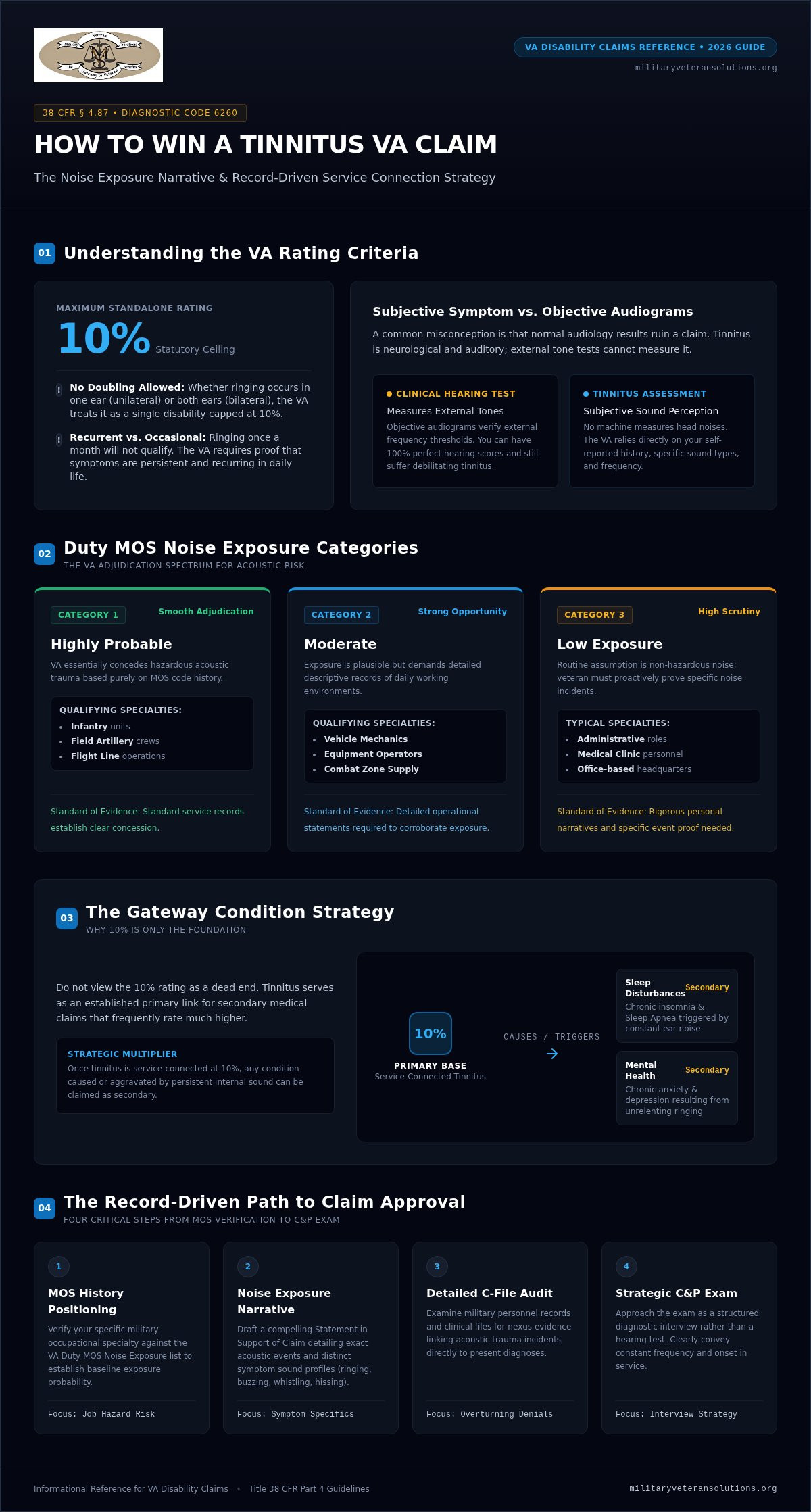
Understanding the Tinnitus VA Rating Criteria
Winning a claim starts with understanding the rules of the game. Tinnitus is a subjective perception of sound without an external source. For many veterans, this sounds like a constant high-pitched whistle, a low hum, or a rhythmic buzzing that never truly goes away. Because there's no machine that can measure the sound in your head, the VA relies heavily on your description of the symptoms and their frequency.
Knowing how to win a tinnitus VA claim requires recognizing that the VA prioritizes "recurrent" symptoms. Occasional ringing that happens once a month likely won't qualify. You need to demonstrate that the noise is a persistent part of your daily life, even if it varies in intensity. Your ability to describe the specific sound, whether it's ringing, buzzing, or hissing, forms the foundation of your medical evidence.
To better understand these strategies and how they apply to your specific situation, watch this helpful video:
The 10% Standalone Rating Limit
The current VA rating schedule is very specific: tinnitus is rated at 10%, and that's the ceiling. It doesn't matter if the ringing is only in your left ear, your right ear, or both; the maximum standalone rating remains 10%. Many veterans feel this is unfair, especially when the condition is debilitating, but it's the reality of the 2026 rating schedule. There's a common misconception that you can "double" the rating for both ears, but the VA treats bilateral and unilateral tinnitus as a single disability.
Don't view that 10% as a dead end. Tinnitus often acts as a gateway to more significant ratings. If your ear ringing causes chronic sleep disturbances leading to sleep apnea, or if the constant noise triggers anxiety or depression, those can be filed as secondary conditions. These secondary claims often carry much higher percentages, making the initial 10% a vital foundation for your overall disability compensation.
Subjective vs. Objective Evidence
You might worry that a perfect score on a hearing test will hurt your case. It won't. Audiograms measure your ability to hear external tones, but they don't capture the internal noise of tinnitus. A clinical understanding of tinnitus confirms that it's a neurological and auditory phenomenon that often exists independently of hearing loss. You can have perfect hearing and still suffer from severe, service-connected tinnitus.
Since there's no objective test, the VA uses your self-reported history as the primary diagnostic tool. This is why your statement in support of the claim is so critical. You aren't just reporting a symptom; you're providing the evidence the examiner can't find on a chart. We help veterans analyze their records to ensure their subjective reports align with their service history, leaving no room for the VA to claim the condition isn't service-connected.
Proving Noise Exposure via Duty MOS and Service Records
The VA uses a specific tool called the "Duty MOS Noise Exposure Listing" to determine if your military job likely caused your ear ringing. This list is a breakdown of every Military Occupational Specialty across all branches, categorized by their probability of hazardous noise exposure. If you want to know how to win a tinnitus VA claim, you must first identify where your MOS sits on this spectrum. The VA follows 38 CFR § 4.87 Diagnostic Code 6260 to evaluate these claims, but the MOS list often dictates how hard you'll have to fight for that 10% rating.
The Duty MOS Noise Exposure Categories
The VA classifies jobs into three main buckets: Highly Probable, Moderate, and Low. Veterans in "Highly Probable" roles, such as Infantry, Field Artillery, or Flight Line operations, have a much smoother path. For these MOS codes, the VA essentially concedes that you were exposed to acoustic trauma. "Moderate" codes, like mechanics or supply personnel in combat zones, still have a strong chance but may require more descriptive evidence of their daily environment.
If your MOS is listed as "Low" exposure, such as administrative or medical roles, the burden of proof shifts heavily to you. You aren't automatically disqualified, but the VA assumes your environment was quiet. To overcome this, you must provide specific evidence of noise events that occurred outside your standard duties. If you aren't sure where your job falls, a virtual consultation can help clarify your standing before you file.
Auditing Your Service Records for Noise Events
Your personnel records are a goldmine of evidence if you know where to look. We search for specific entries that prove exposure, such as range qualifications, combat deployments, or training exercises involving heavy machinery and explosives. Even if your medical file is silent on ear ringing, your personnel file can prove the "in-service event" required for a successful claim.
Finding these details isn't always easy. Utilizing a professional military record review service can uncover "lost" evidence that the VA often overlooks during their standard processing. If you suffered acoustic trauma, like a nearby IED blast or a machinery malfunction, that wasn't recorded in a clinic, we help you document these events through credible statements and record audits. Mastering these record-driven strategies is the most effective way to understand how to win a tinnitus VA claim when the initial evidence seems thin.
Establishing the Nexus: Linking Tinnitus to Military Service
Every successful claim rests on three pillars: a current medical diagnosis, a specific in-service event, and the "nexus" link that connects them. In the world of VA disability, the nexus is the bridge. It's the evidence that proves your ear ringing started because of your time in uniform rather than a loud concert you attended years after discharge. Understanding how to win a tinnitus VA claim requires focusing on this link, especially since the VA's own VA military noise exposure guidance acknowledges that combat, weapons fire, and aircraft noise are primary drivers of acoustic trauma.
You don't always need a formal Nexus Letter from a private doctor to win. While a medical opinion is powerful, tinnitus is unique because it's a subjective condition. The VA often accepts lay evidence as a substitute for clinical records that might be missing from your time in service. The goal is to meet the "at least as likely as not" standard of proof. This means you only need to show there's a 50% or greater probability that your service caused the condition. If the evidence is a tie, the law requires the VA to give the benefit of the doubt to the veteran.
Crafting a Powerful Personal Statement
Your "noise story" is the most important piece of evidence you can provide. Use VA Form 21-4138 to detail exactly when the ringing began. Don't just say it started "in the Army." Instead, be specific about the frequency and duration of the symptoms. Describe the sound; is it a high-pitched whistle or a low-frequency hum? Connect these symptoms to specific dates and locations, such as a particular deployment or a high-intensity training cycle. This narrative fills the gaps that your medical records might have left behind, making it much harder for the VA to issue a denial based on a lack of evidence.
The Role of Buddy Letters (VA Form 21-10210)
Lay evidence from those who knew you during or immediately after your service can be a game-changer. Buddy letters, submitted on VA Form 21-10210, provide a third-party perspective on your symptoms. These statements can come from several sources:
- Fellow Service Members: They can testify to specific noise events, like a heavy artillery barrage or a machinery failure you shared.
- Spouses or Partners: They can describe how you struggled to hear conversations or complained about the "noise in your head" during your first few months home.
- Roommates: They often remember small details, like you needing the TV volume higher than everyone else or having trouble sleeping due to the ringing.
A strong buddy letter doesn't need to be long; it just needs to be honest. If a fellow vet writes, "I remember he always complained about his ears ringing for hours after we left the range," that provides the "in-service onset" evidence the VA looks for. This type of lay evidence is often the key to how to win a tinnitus VA claim when your service medical records are incomplete or silent.
Navigating the C&P Exam for Tinnitus
The Compensation and Pension (C&P) exam for tinnitus is often the shortest medical appointment you'll ever have, but it's also the most critical. Unlike other disability claims that involve physical range-of-motion tests or blood work, this exam is primarily an interview. The examiner's goal is to determine if your condition is "at least as likely as not" related to your military service. If you want to know how to win a tinnitus VA claim, you must walk into that room prepared to deliver a consistent, record-backed narrative of your noise exposure.
One of the most dangerous questions an examiner will ask is, "When did the ringing start?" If you answer that it began several years after you left the military, your claim will likely be denied on the spot. You must be clear that the onset occurred during your service, even if the symptoms have become more frequent or intense over time. Prepare your "Noise Exposure Narrative" before you arrive. Write down specific dates, training exercises, and the types of equipment you worked around so you don't have to rely on memory while you're nervous.
A common mistake veterans make is trying to be "tough" or reporting how they feel at that exact moment. If you're having a "good day" where the ringing is faint, don't tell the examiner you're fine. You are there to describe your condition at its worst. Tinnitus is often intermittent but recurrent; you must explain how the noise disrupts your sleep, your focus, and your daily life during its peak intensity.
Common Questions and How to Answer Them
Examiners frequently look for "intervening causes," such as post-service loud hobbies or civilian jobs. If they ask if you go to concerts or use power tools at home, be honest but maintain the focus on the primary source of the trauma: your military service. Explain that while you may have hobbies now, the persistent ringing only began after specific service-related events. If the audiologist tries to suggest the ringing is solely due to age-related hearing loss, remind them of the specific acoustic trauma events you documented in your personal statement.
What to Do If the C&P Examiner is Dismissive
Not every examiner is thorough. Some may rush you through the process or ignore your descriptions of service events. If you feel your exam was inadequate, document everything immediately after you leave the building. Note the examiner’s name, the length of the appointment, and the specific symptoms they failed to record. You have the right to file a memorandum of record or request a new exam if the first one was flawed. Utilizing a VA decision letter analysis can help you identify exactly where an examiner’s errors led to a denial, allowing you to build a stronger appeal. If you're unsure how to handle a negative exam result, a virtual consultation can provide the clarity you need to move forward.
Understanding how to win a tinnitus VA claim means being your own best advocate during the C&P process. By providing a clear, service-connected timeline and refusing to downplay your symptoms, you create the medical evidence necessary for a successful 10% rating.
Overcoming Denials with Professional Record Analysis
Receiving a denial letter feels like a gut punch, but it isn't the end of the road. Most tinnitus denials boil down to two specific phrases: "no in-service event" or "no medical nexus." These are often administrative hurdles rather than medical realities. The VA rater might have overlooked a specific deployment in your personnel file or failed to cross-reference your MOS with the noise exposure listing. Determining how to win a tinnitus VA claim often comes down to the appeal path you choose after an initial denial.
Your C-File is the most powerful tool in your arsenal. It contains every medical record, personnel file, and previous rating decision the VA has on record. A thorough audit of this file often uncovers "lost" evidence, such as range qualifications or acoustic trauma incidents, that can overturn a denial. We specialize in these deep-dive audits because we know that the evidence needed to win is usually already there; it just hasn't been presented in a way that matches VA regulations.
Higher-Level Review vs. Supplemental Claims
The 2026 VA appeals landscape offers two primary paths for tinnitus: the Higher-Level Review (HLR) and the Supplemental Claim. Choosing the wrong one can cost you months of waiting. An HLR is a "de novo" review by a senior rater. This is the best strategy if the evidence was already in your file, such as a "Highly Probable" MOS, but the original rater made a clear error. You cannot add new evidence in an HLR, so the existing record must be strong enough to stand on its own.
If your denial was based on a lack of medical evidence, a Supplemental Claim is the better choice. This path allows you to submit "new and relevant" evidence, such as a fresh personal statement or buddy letters from fellow service members. Strategically, a Supplemental Claim is often the most effective way to address a "no medical link" denial by providing the lay evidence that fills the gaps in your clinical history. We help you decide which path offers the highest probability of success based on a detailed analysis of your specific denial letter.
The Military Veteran Solutions Approach
Our veteran-led team understands the "Duty MOS" struggle because we've lived it. With over 25 years of experience, we don't just look at your medical records; we audit your entire military history to find the nexus the VA missed. We ensure your "Noise Exposure Narrative" is airtight and aligned with current regulations. This professional advocacy transforms a confusing administrative process into a clear, actionable strategy for your appeal.
Don't let a single denial letter discourage you from seeking the rating you earned. A virtual consultation is a low-friction way to evaluate the strength of your claim and identify the specific records needed to win. We provide the expert advocacy and record reviews required to secure your 10% rating and establish the foundation for any secondary claims. Get a professional analysis of your VA decision letter today.
Take Command of Your Tinnitus Evidence Strategy
Securing a 10% rating for tinnitus isn't just about reporting a symptom; it's about building an undeniable link between your service and your current reality. You've learned how to leverage the Duty MOS Noise Exposure list and why your personal "noise story" is the most powerful evidence you possess. Mastering these record-driven details is the core of how to win a tinnitus VA claim in today's rigorous 2026 environment.
You don't have to navigate this complex system alone. Military Veteran Solutions, LLC was founded by a 10-year Army veteran who understands the specific hurdles of the "Duty MOS" struggle. With over 25 years of advocacy experience, we specialize in identifying the hidden record evidence that the VA frequently overlooks. We're here to help you audit your C-File and transform a previous denial into a successful award.
Take the first step toward the compensation you've earned. Schedule your virtual consultation with Military Veteran Solutions today to ensure your evidence is regulation-ready. Your service is a matter of record; let's make sure it's finally heard.
Frequently Asked Questions
Can I get a VA rating for tinnitus if I have normal hearing?
Yes, you can receive a 10% disability rating for tinnitus even if your hearing test results are completely normal. Tinnitus is a neurological condition that often exists without measurable hearing loss. The VA relies on your subjective report of symptoms and your history of noise exposure rather than just an audiogram. This means a clean hearing test doesn't disqualify you from the benefits you've earned through your service.
What is the VA 'Duty MOS' list for noise exposure?
The Duty MOS Noise Exposure Listing is the official guide the VA uses to determine if your military job likely caused your ear ringing. It categorizes every MOS as having a Highly Probable, Moderate, or Low risk of noise trauma. If your job falls into the Highly Probable category, the VA concedes that you were exposed to hazardous noise, which significantly simplifies the process of establishing a service connection.
How do I prove service connection for tinnitus if I didn't go to medical?
You can establish a service connection without medical records by submitting lay evidence like buddy letters and personal statements. Many veterans didn't seek treatment for ear ringing while active, so the VA accepts credible testimony to prove the onset of symptoms. These statements from spouses or fellow service members can bridge the gap between your service dates and your current diagnosis, providing the evidence the VA needs to grant your claim.
Can tinnitus be rated higher than 10% in 2026?
No, the standalone rating for tinnitus is capped at 10% under the 2026 VA rating schedule. This 10% limit applies regardless of whether you have ringing in one ear or both. While the rating itself is low, it's a vital foundation for secondary claims. Conditions like sleep apnea, anxiety, or depression can be linked to your tinnitus, potentially leading to a much higher overall combined disability rating.
Is a nexus letter required for a tinnitus VA claim?
A formal nexus letter isn't always mandatory, but it can be a decisive piece of evidence if your MOS is in the "Low" exposure category. For many veterans, a strong personal statement combined with a "Highly Probable" MOS is enough to secure a service connection. Learning how to win a tinnitus VA claim involves evaluating your specific records to decide if a private medical opinion is necessary to overcome a previous denial.
What happens if my tinnitus C&P exam is denied?
If your claim is denied, you have the right to file a Supplemental Claim with new evidence or a Higher-Level Review. Most denials occur because the VA didn't find a clear link to your service. We specialize in VA decision letter analysis to uncover why the rater missed the connection. By auditing your C-File, we can often find the specific noise events needed to overturn a negative C&P exam result.
Can I claim tinnitus as a secondary condition to hearing loss?
Initial tinnitus claims in 2026 typically take between 120 and 180 days to process, though this can vary based on the VA's current workload. Appeals, such as Higher-Level Reviews, often follow a similar timeline. You can speed up the process by submitting a fully developed claim that includes your MOS noise exposure details and buddy letters upfront, preventing the VA from having to request additional evidence later.


