
The C&P exam is not a therapy session, and treating it like one is the most common mistake veterans make. It's a high-stakes forensic evaluation where every word you say is measured against a rigid legal framework. When you're wondering about a C&P exam for mental health what to expect, the answer isn't just a conversation; it's a strategic documentation of your worst days. You shouldn't have to feel like you're "faking it" just to get the rating you earned, yet the pressure to prove your trauma to a stranger can feel overwhelming and invasive.
We understand that revisiting your darkest moments is exhausting, especially when you fear the examiner might dismiss your experience. You deserve a process that honors your service and accurately reflects your daily struggles. This guide provides the clear roadmap you need to walk into your appointment with total confidence. We'll break down the 38 C.F.R. § 4.130 rating criteria, explain how the examiner uses the Disability Benefits Questionnaire (DBQ), and show you how to translate your lived experience into the specific language the VA requires for a fair disability rating.
Key Takeaways
- Shift your mindset from therapy to forensics to understand that the examiner's primary goal is documenting evidence for your disability rating.
- Gain a clear roadmap of the C&P exam for mental health what to expect by reviewing the standardized DBQ forms and the social impairment scale.
- Use the "Worst Day" Principle to describe your symptoms accurately and avoid the common mistake of downplaying your struggles during the interview.
- Arm yourself with physical notes and a thorough military record review to ensure every piece of service-connected evidence is presented clearly.
- Learn how to analyze your exam results for inaccuracies and determine if an appeal or a formal VA Decision Letter Analysis is your next best step.
Understanding the Purpose of Your Mental Health C&P Exam
The Compensation and Pension (C&P) exam is a forensic medical review designed to determine service connection and the severity of your disability. It's the "make or break" moment for your claim. Understanding the C&P exam for mental health what to expect starts with recognizing its forensic nature. Unlike a visit to your family doctor, this appointment isn't about healing. It's about evidence.
Many veterans find themselves sitting across from a third-party contractor from companies like VES, QTC, or Optum. These examiners are hired to gather data for the VA rater, not to provide care. This distinction is critical because your behavior and statements will be recorded as forensic data points, not as part of a therapeutic dialogue. The examiner's report will likely be the most influential document in your file, dictating whether you receive the benefits you've earned or face a lengthy appeal process.
Forensic Evaluation vs. Clinical Treatment
Don't expect medical advice or a new prescription during this exam. The examiner is a neutral witness whose report serves as the primary evidence for your disability rating. You must be honest about your symptoms, even when they're uncomfortable to discuss. Masking your pain or using polite language can lead to an inaccurate report that fails to reflect your true level of impairment. This exam is your opportunity to document the reality of your life, not to put on a brave face. If you've already completed a professional military record review, you'll have a stronger foundation to ensure your reported symptoms align with your service history.
Common Mental Health Conditions Evaluated
The VA evaluates a wide range of disorders under a single General Rating Formula. Whether you're seeking compensation for Major Depressive Disorder or Generalized Anxiety Disorder, the focus remains on your occupational and social functioning. Navigating the complex requirements for VA disability benefits for PTSD requires a clear understanding of the examiner's objective. They are specifically looking for stressor verification and symptom frequency. You may also be evaluated for secondary conditions, such as sleep disturbances or somatic symptom disorder, which can significantly impact your overall rating. Knowing the C&P exam for mental health what to expect involves preparing to discuss these conditions with clinical precision, ensuring that no symptom is overlooked or minimized during the brief evaluation window.
The DBQ Framework: What the Examiner Is Actually Looking For
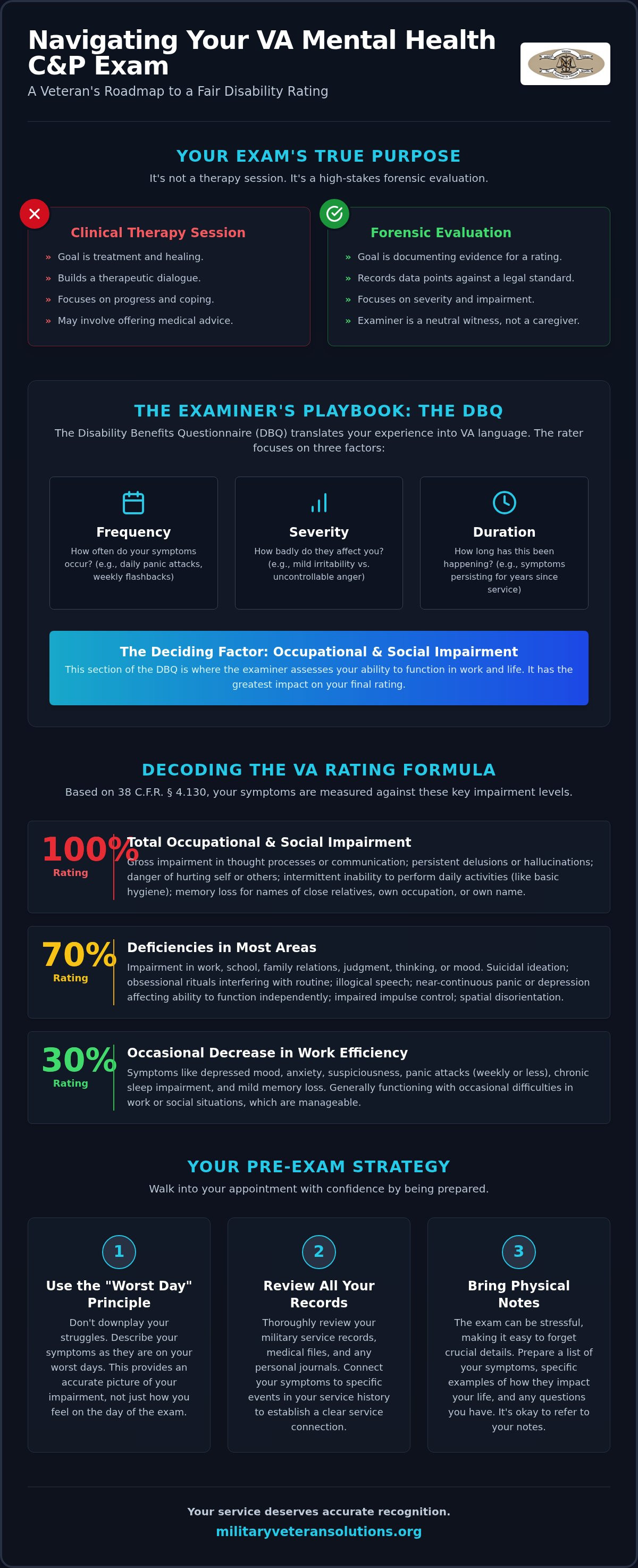
The examiner isn't interested in a general life story; they're looking for checkboxes. During your evaluation, the provider will utilize standardized Disability Benefits Questionnaires (DBQs) to document your symptoms. This form is the primary tool the VA rater uses to assign your disability percentage. It translates your mental health struggles into a legal and clinical language the VA understands. If you want to know about a C&P exam for mental health what to expect, you must focus on the "Occupational and Social Impairment" section of this form. This is where the examiner selects the level of impairment that best describes your daily life.
The VA rater looks for three specific factors: frequency, severity, and duration. It isn't enough to simply have a symptom. You must demonstrate how often it occurs, how badly it affects you, and how long it has persisted. The examiner will evaluate whether your symptoms cause "total occupational impairment" or if you maintain some level of "industrial stability." Your ability to hold a job and maintain family relationships is the yardstick used to measure your rating. If your previous ratings don't match your reality, a VA Decision Letter Analysis can help identify where the examiner's report diverged from your medical evidence.
The General Rating Formula for Mental Disorders
The VA uses a General Rating Formula found in 38 C.F.R. § 4.130 to categorize your impairment. A 30% rating is often assigned when there is "occupational and social impairment with occasional decrease in work efficiency." At this level, you might still function, but your symptoms periodically interfere with your duties. The 70% threshold is much higher. It requires "deficiencies in most areas," such as judgment, thinking, or mood. To reach a 100% rating, the evidence must show "total occupational and social impairment." This usually involves a complete inability to function in a work environment or maintain any social ties due to severe symptoms like persistent delusions or a high risk of self-harm.
Symptoms That Move the Needle
Certain symptoms carry more weight than others in the DBQ framework. Suicidal ideation is a major "needle-mover" that often pushes a claim into the 70% category. Similarly, the frequency of panic attacks is heavily scrutinized. The examiner will look for evidence of "prostrating" attacks that leave you unable to function. Other high-value symptoms include:
- Chronic sleep impairment that affects daytime functioning.
- Memory loss or disorientation regarding time or place.
- Hallucinations or persistent delusions.
- Obsessive rituals which interfere with routine activities.
Overcoming the 'Quiet Veteran' Trap: Reporting Your Symptoms
Most veterans are conditioned to "soldier on" and minimize their pain. In a clinical setting, this stoicism is a sign of strength, but in a forensic evaluation, it's a claim-killer. When considering a C&P exam for mental health what to expect, you must prepare to dismantle the "I'm fine" reflex. If you walk into the room and tell the examiner you're doing well because it's a polite social convention, they will record that as a lack of clinical symptoms. This "Quiet Veteran" trap often leads to ratings that don't reflect the true depth of a veteran's struggle.
To avoid this, you must apply the "Worst Day" Principle. The C&P exam is a brief snapshot, often lasting only 30 to 60 minutes. If you happen to be having a relatively good day, you must still describe your symptoms as they appear on your most difficult days. Masking your anxiety or depression to appear "professional" during the interview will only result in an inadequate report. Use specific examples rather than vague adjectives. Instead of saying you feel "stressed," tell the examiner that you missed four days of work last month because you couldn't face the office. Concrete data is much harder for a rater to ignore than general feelings.
How to Discuss Functional Impairment
The VA rater needs to see how your condition affects your ability to work and maintain a life. You should be prepared to discuss the impact on your marriage and family relationships with brutal honesty. If your irritability leads to frequent arguments or if you've withdrawn from family events, the examiner needs to know. Work-related issues are equally vital. Discuss any conflicts with supervisors, an inability to focus on tasks, or a history of frequent job changes. Social isolation is another key indicator of impairment. Explaining that you no longer go to the grocery store because of crowds is a relevant, high-value symptom that demonstrates functional limitations.
The Role of Buddy Statements and Lay Evidence
Sometimes, those closest to you see the symptoms you've learned to hide. Buddy statements from a spouse, parent, or fellow service member can bridge the gap in your own reporting. These statements provide "lay evidence" that documents your behavior outside the exam room. During your evaluation, mention your VA claim assistance preparation and any evidence not found in your formal medical record. Ensuring the examiner is aware of these external observations can prevent a "denied" status based on a single, short interview. Your goal is to provide a complete picture of your reality, not just a polite summary of your afternoon.
Practical Preparation: Logistics and Conduct During the Exam
Preparation is the antidote to the anxiety that often precedes a forensic evaluation. You shouldn't walk into the room without a clear understanding of your own medical history. By reviewing your records and the findings of a military record review service beforehand, you ensure that your oral testimony remains consistent with documented evidence. Consistency is the hallmark of a credible claim. If you're unsure if your documentation is ready, Schedule a consultation with our experts to review your file before your appointment.
There is a persistent myth that the exam starts in the parking lot with examiners watching from windows. While "undercover" surveillance is rare, continuous observation within the clinic is a reality. The examiner will note your gait in the hallway, your interactions with the receptionist, and how you sit in the waiting room. They are looking for discrepancies between your reported symptoms and your observed behavior. Stay focused. Bring a trusted companion if you need emotional support or help remembering specific details of your symptoms during the C&P exam for mental health what to expect.
Your Pre-Exam Checklist
Arriving prepared means more than just showing up on time. Follow these steps to ensure you're ready for the examiner's questions:
- Re-read your original claim: Ensure the "story" you tell in person matches the paperwork you filed months ago.
- Note specific dates: Be ready to cite the month and year of specific service-connected events or "incidents" that triggered your symptoms.
- List your medications: Write down every prescription you take for mental health and, more importantly, document their side effects, such as lethargy or weight gain.
What to Do During the Exam
The first trap of the day often happens before you even sit down. When the examiner asks, "How are you today?" don't give the polite, reflexive answer of "I'm fine." Instead, respond with a statement that reflects your clinical reality, such as, "I'm struggling with my symptoms today" or "It was very difficult for me to get here." This sets the tone for a forensic evaluation rather than a casual chat.
If the examiner seems cold or dismissive, remain professional but firm. You have a right to ensure they look at the documents or notes you brought with you. If they refuse to review your evidence, simply note that in your own records after the exam. Never lose your temper. An outburst can be used as evidence of "aggressive behavior" rather than a symptom of your condition. Your goal is to be a reliable narrator of your own trauma, providing the clear, objective data the VA rater needs to justify your benefits.
What Happens After the Exam: Analyzing Results and Appeals
The silence after your appointment can be the most stressful part of the process. You've shared your trauma with a stranger, and now you're left waiting for a decision that impacts your future security. Knowing the C&P exam for mental health what to expect after you leave the clinic is just as important as the exam itself. Your first priority is obtaining the examiner's report. If your exam was performed at a VA facility, you can often access the report via the "Blue Button" feature on My HealtheVet within 30 days. However, if a contractor performed the exam, you'll likely need to request your C-File, which can take several months to arrive.
Once you have the report, scrutinize it for inaccuracies. Examiners often misquote veterans or overlook critical evidence found in military records. In 2026, while the VA continues to modernize its digital systems, the average timeline from exam to decision remains approximately 120 to 150 days. If the report contains factual errors or ignores your "worst day" symptoms, you must act quickly. This is the moment to seek filing VA appeals help to ensure a flawed forensic report doesn't result in a permanent denial of benefits.
Challenging a Bad C&P Exam
If you feel the examiner was biased, incompetent, or rushed, document it immediately. Write a "Memorandum of Record" while the details are fresh in your mind. Describe the examiner's conduct, the actual length of the exam, and any specific symptoms they failed to discuss. This document serves as vital evidence if you need to request a new exam or challenge the results. A VA decision letter review service can be instrumental here. We analyze the examiner's findings against your medical history to identify the exact points where the forensic report failed to meet the required legal standards.
The Strategy for Winning an Appeal
An unfavorable exam report isn't the end of your claim. It's simply a pivot point. You have several strategic options for challenging an inaccurate rating:
- Supplemental Claims: Use this path to introduce new medical evidence, such as a private DBQ or a nexus letter from your own treating physician.
- Higher-Level Review (HLR): Choose this if the examiner made a clear legal error or failed to follow the proper rating schedule, but you don't have new evidence to add.
- Professional Representation: Mental health appeals are notoriously complex because they rely heavily on subjective reporting. Having an advocate who understands the nuances of the rating schedule can make the difference between a 30% and a 70% rating.
Take Control of Your Disability Rating
A fair rating requires more than just showing up to an appointment. It demands a forensic mindset and the courage to speak openly about your most difficult days. By understanding the DBQ framework and the "worst day" principle, you've taken the first step toward a successful claim. Your C&P exam for mental health what to expect is just a single data point in a larger system. If the examiner's report fails to capture your reality, you have the right to challenge it with objective evidence and expert advocacy.
You don't have to navigate these daunting administrative hurdles alone. We provide expert reviews of military and medical records alongside specialized advocacy for complex mental health appeals via virtual consultations available nationwide. Get a Professional VA Decision Letter Analysis Today to identify service connections and secure the benefits you've earned. You've fought for your country; now, let us fight for the rating you deserve. You are one step closer to the security and relief you've been seeking.
Frequently Asked Questions
How long does a mental health C&P exam usually last?
Most mental health evaluations last between 30 and 60 minutes, though complex cases involving extensive military records can take longer. It isn't a therapy session; the focus is strictly on forensic evidence. The examiner follows a specific DBQ to document your occupational and social impairment. You should prepare for a focused, high-impact conversation that moves quickly through your symptoms and service history. Don't let the short duration discourage you from being thorough about your daily struggles.
Can my spouse or a friend come into the C&P exam with me?
You have the right to bring a companion for support or to help clarify your symptoms. While the examiner has the final say on whether they stay in the room, having a spouse present can be invaluable for documenting behavioral changes you might "mask" during the interview. They can provide "lay evidence" that often bridges the gap between your self-reporting and your daily reality. Their observations help the examiner see the full scope of your impairment.
What happens if I have a panic attack during the C&P exam?
If you experience a panic attack, the examiner will document it as an objective clinical observation. This is a powerful form of evidence because it demonstrates the severity and frequency of your symptoms in real-time. Don't feel the need to apologize or hide your distress. The forensic nature of the exam means that seeing your symptoms firsthand provides the rater with clear, undeniable proof of your functional impairment. It's an honest reflection of your lived experience.
Should I bring my medical records to the C&P exam?
You should bring a copy of your records, but don't assume the examiner will review them on the spot. They are supposed to review your electronic C-File beforehand. However, having a list of specific dates, symptoms, and medications helps you stay consistent. Knowing the C&P exam for mental health what to expect involves being your own best advocate by having evidence ready if the examiner has questions about your history. It ensures no critical detail is forgotten.
Will the C&P examiner tell me my rating at the end of the appointment?
No, the examiner does not have the authority to assign a disability rating. Their job is solely to gather forensic evidence and complete the DBQ form. Once the report is submitted, a VA rater reviews the entire file to make a final determination. You'll receive the official decision through a letter in the mail. This letter can then be analyzed for potential errors or missed service connections by professional advocates who understand the 2026 rating schedule.
What if the C&P examiner is not a psychiatrist?
It's common for the VA to use psychologists or even nurse practitioners specialized in mental health for these evaluations. As long as they meet the VA's qualification standards, their report is considered valid evidence. If you feel the examiner lacked the expertise to understand your specific condition, this can be a grounds for appeal. We specialize in identifying such procedural errors during a VA decision letter analysis to ensure your case is heard by a qualified professional.
Can a bad C&P exam lead to a reduction in my current rating?
Yes, if the examiner reports that your symptoms have significantly improved, the VA may propose a rating reduction. This is why accurately reporting your "worst days" is so critical. You must ensure the examiner understands that a brief period of stability doesn't mean your condition is healed. If you face a proposed reduction, you have the right to request a hearing and submit new evidence to challenge the report. Protecting your earned benefits is our priority.
How do I get a copy of my C&P exam results?
You can obtain your results by requesting your C-File or using the "Blue Button" report on My HealtheVet if the exam was done at a VA facility. Understanding the C&P exam for mental health what to expect includes knowing how to review these results for misquoted symptoms or missed evidence. If the report is inadequate, it serves as the foundation for a supplemental claim. We help veterans analyze these outcomes to prepare for successful appeals.


