
Why does the VA often treat a constant, piercing ring in your ears like a minor inconvenience instead of the life-altering burden it actually is? You've likely felt the isolation of a crowded room where you can't follow the conversation, or the exhaustion of a 10% cap that doesn't seem to account for your sleepless nights. It's frustrating to feel like your service-connected injuries are being minimized by a complex rating schedule, especially when your military records feel like a black hole of missing information. You aren't alone in this fight, and your symptoms deserve more than a dismissive letter.
This guide will show you how to successfully secure the VA disability for tinnitus and hearing loss you've earned by leveraging 38 CFR regulations and unearthing critical evidence from your old service records. We'll break down the 2026 compensation rates, including the 2.8% COLA increase that brings a 10% rating to $180.42 per month. You'll learn how to navigate the C&P exam with confidence and discover why a previous denial is simply the start of a more targeted advocacy process. We're going to turn your medical history into a powerful tool for the benefits you deserve.
Key Takeaways
- Identify how the 38 CFR rating schedule applies to your specific symptoms, including the 10% maximum for tinnitus and the tiered levels for hearing loss.
- Discover how to leverage the Duty MOS Noise Exposure Listing to build a rock-solid nexus between your military service and your current auditory diagnosis.
- Learn how to navigate the specific requirements of the VA disability for tinnitus and hearing loss claims process, including what to expect during Maryland CNC and Puretone audiometric testing.
- Understand the critical role of medical evidence in overcoming common VA hurdles and why a 0% rating is often a strategic starting point rather than a final answer.
- Gain the confidence to appeal a previous denial by using professional decision letter analysis to pinpoint and resolve the specific reasons the VA rejected your claim.
Understanding VA Disability for Tinnitus and Hearing Loss in 2026
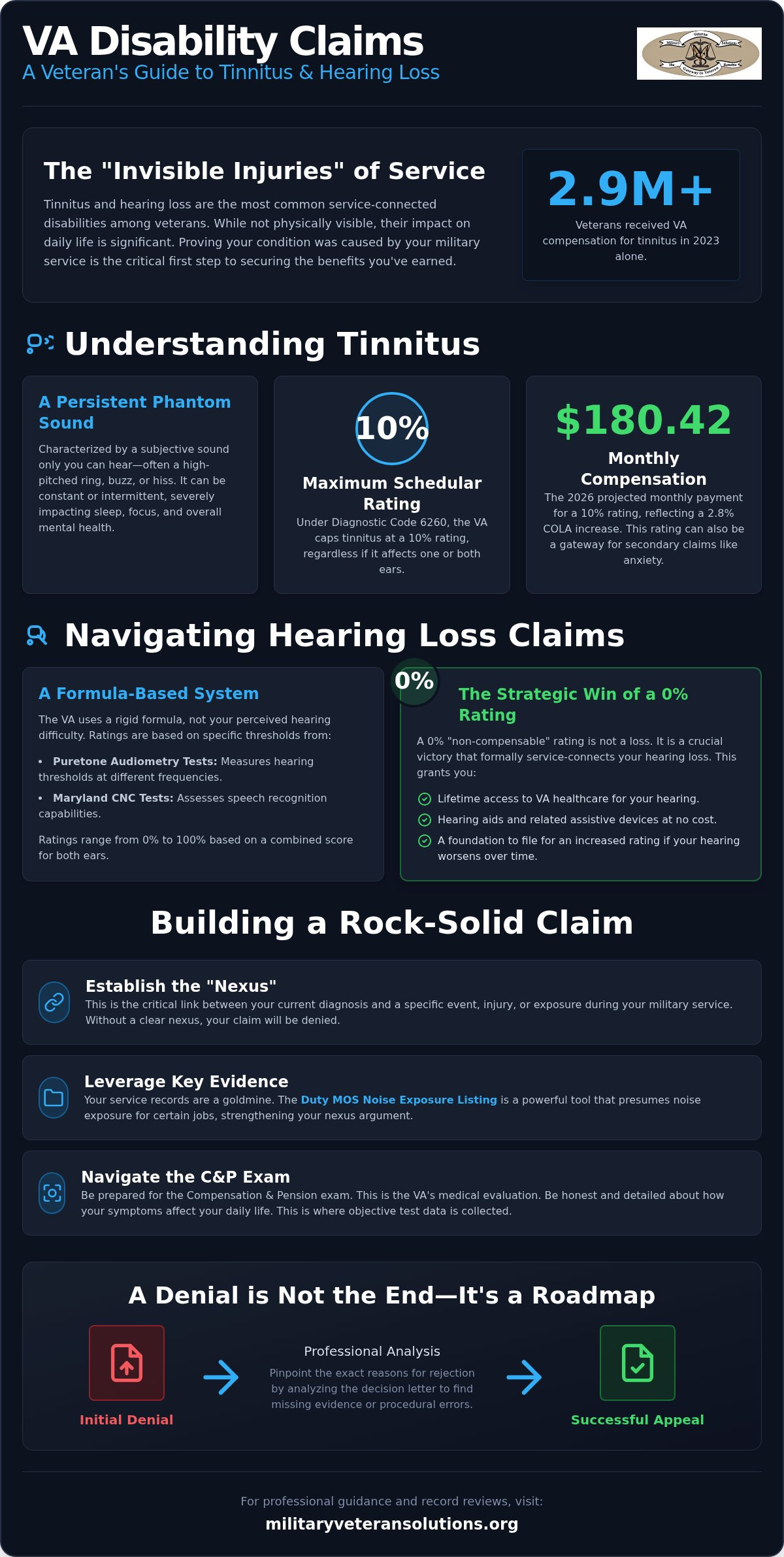
Military service leaves marks that don't always show up on an X-ray. Tinnitus and hearing loss are often called the "invisible injuries" of the veteran community, yet they represent the most common claims filed with the Department of Veterans Affairs. In 2023, over 2.9 million veterans received compensation for tinnitus alone. As we move through 2026, the landscape for VA disability for tinnitus and hearing loss remains a critical gateway to broader benefits. With the 2.8% COLA increase effective this year, a baseline 10% rating provides a steady $180.42 monthly payment. However, the primary hurdle isn't just proving you have the condition. You must prove your time in uniform caused it. Securing a VA disability for tinnitus and hearing loss rating requires more than just showing up to a clinic; it demands a strategic look at your military history.
Tinnitus: The Persistent Ringing
Tinnitus is characterized by a phantom sound that only you can hear. It might manifest as a high-pitched ring, a low buzz, or a rhythmic hissing. Understanding Tinnitus is essential because the VA views this condition as subjective. Since there isn't a blood test for a "ring" in your ears, your personal statement and service records must do the heavy lifting. Whether your symptoms are constant or intermittent, they can disrupt your sleep, focus, and mental health. The VA currently caps this condition at a 10% rating under Diagnostic Code 6260. While this cap feels restrictive, that 10% is often the foundation for secondary claims like anxiety or sleep apnea.
Hearing Loss: More Than Just Volume
The VA doesn't rate hearing loss based on how hard it is for you to hear the television. Instead, they use a rigid formula to determine if your condition is "ratable." Your hearing loss must meet specific thresholds in a puretone audiometry test or show a significant decline in speech recognition. Most veterans suffer from sensorineural hearing loss. This involves damage to the inner ear or auditory nerve due to blast overpressure or long-term noise exposure. Conductive hearing loss, which involves the outer or middle ear, is less common in claims but remains a valid path to compensation. The VA evaluates both ears together to determine a rating that ranges from 0% to 100%. Don't be discouraged by a 0% rating. It's a formal acknowledgment of service connection, which ensures you have access to VA healthcare and hearing aids for life.
The VA Rating Schedule for Auditory Conditions
The VA evaluates your claim using a specific set of rules found in the VA Schedule for Rating Disabilities. This legal framework ensures every veteran is measured against the same criteria, though the results can often feel impersonal and rigid. When you apply for VA disability for tinnitus and hearing loss, you're navigating a system that prioritizes objective test data over your daily lived experience. Understanding how these percentages are assigned is the first step in ensuring your rating reflects the true impact of your service.
Why Tinnitus is Capped at 10 Percent
Under Diagnostic Code 6260, the VA limits tinnitus to a single 10% rating. It doesn't matter if the ringing is in your left ear, your right ear, or both; the maximum schedular rating remains 10%. As of September 2026, the VA has proposed changes to eliminate this standalone rating and fold it into other conditions, but these changes haven't been finalized. This means the 10% flat rate is still the current standard for recurrent tinnitus. If you're struggling to prove the severity of your symptoms, a professional military record review can help identify the evidence needed to secure this baseline.
Hearing loss is significantly more complex than tinnitus. The VA uses a tiered system ranging from 0% to 100%, based on a grid that combines your speech discrimination score and your pure-tone threshold. Many veterans are surprised to receive a 0% rating. This is known as a "non-compensable" rating. While it doesn't result in a monthly check, it's a vital win because it formally service-connects the condition. This 0% rating guarantees you access to VA healthcare and hearing aids, and it serves as a foundation if your hearing worsens over time.
Combining these ratings isn't a matter of simple addition. The VA doesn't just add numbers. If you have 10% for tinnitus and 10% for hearing loss, they use "VA Math" to determine your combined rating. They calculate how much of you is "efficient" and then take a percentage of the remaining "disabled" portion. This often results in a total that is less than the sum of its parts, which can be incredibly frustrating for veterans seeking fair compensation.
Secondary Conditions Linked to Hearing Issues
When building a claim for VA disability for tinnitus and hearing loss, the real path to a higher combined rating often lies in secondary conditions. The constant mental strain of auditory distress frequently leads to service-connected anxiety and depression. Many veterans also suffer from debilitating migraines triggered by the persistent ringing. There's also a growing body of evidence linking severe tinnitus to sleep apnea, as the inability to find silence makes restful sleep nearly impossible. Identifying these links is where dedicated advocacy becomes essential for your claim's success.
Proving the Nexus: Linking Hearing Issues to Your Service
Winning your claim for VA disability for tinnitus and hearing loss requires more than a diagnosis; it requires a nexus. Think of the nexus as a bridge. It connects your current medical condition to a specific event or environment from your time in uniform. Many veterans assume that because they served in a noisy environment, the VA will automatically make the connection. Unfortunately, the burden of proof rests on your shoulders. You must demonstrate that your auditory issues are "at least as likely as not" caused by your service. This is supported by the "Presumption of Soundness," which states that unless noted otherwise on your entrance physical, you're presumed to have entered the military with healthy hearing.
The VA relies heavily on the Duty MOS Noise Exposure Listing. This internal document categorizes every Military Occupational Specialty (MOS) by its probability of noise exposure. If your MOS is listed as "highly probable," the VA should concede that you were exposed to hazardous noise. However, even with a high-risk MOS, your file needs to be airtight. Utilizing a professional military record review service is often the difference between a quick approval and a long appeal. These reviews dig through your personnel files to find specific incidents, such as proximity to blast overpressure or prolonged exposure to turbine engines, that a standard VA reviewer might overlook.
High-Risk MOS and Combat Exposure
Certain roles carry an inherent risk of auditory damage. If you served in the Infantry, Artillery, or Aviation, the VA recognizes your environment was likely hazardous. For those in less obvious roles, like engine room technicians or flight deck personnel, the exposure is just as real but harder to prove. You can strengthen your case by highlighting combat awards or badges, such as the Combat Infantryman Badge (CIB) or Combat Action Ribbon (CAR). These decorations serve as official verification that you were in high-intensity environments where noise levels far exceeded safety standards. You should also refer to the Official VA Schedule of Ratings for Ear Conditions to see how the VA categorizes specific ear pathologies during the rating process.
Gathering Lay Evidence and Buddy Statements
What happens if your medical records are thin? This is where lay evidence becomes your most powerful tool. VA Form 21-10210, the Statement in Support of Claim, allows you to describe the exact onset of your symptoms in your own words. Don't just say your ears ring. Describe the first time you noticed it, perhaps after a specific range day or a deployment. Buddy statements from fellow service members are equally vital. These letters provide eyewitness accounts of the noise exposure you faced together. They fill the gaps that official paperwork often leaves behind, providing a human perspective that the VA's automated systems cannot ignore. You've lived with the noise for years; it's time to make sure the VA hears you.
Navigating the C&P Exam and Evidence Requirements
The Compensation and Pension (C&P) exam is the most pivotal moment in your journey toward securing VA disability for tinnitus and hearing loss. While it feels like a standard doctor's appointment, it's actually a forensic evaluation designed to confirm your diagnosis and determine its severity. The VA examiner isn't there to treat you; they're there to translate your symptoms into the rigid language of the rating schedule. Many veterans walk into these exams unprepared, assuming their service records will speak for themselves. You must be ready to articulate how your auditory issues impact your daily life, from social isolation to safety concerns at work.
During the exam, the audiologist will perform two primary tests: the Puretone Audiometric test and the Maryland CNC test. The Puretone test measures your ability to hear different frequencies, while the Maryland CNC test evaluates your speech discrimination. These results are the "gold standard" for the VA's formula. A common mistake is trying to guess the sounds or "toughing it out" by not mentioning how often the ringing occurs. If you guess, you might inadvertently show better hearing than you actually have, leading to a denial or a 0% non-compensable rating. If you're feeling overwhelmed by the technical requirements, seeking expert claims representation can help you prepare for these high-stakes evaluations.
What to Expect During the Audiology Exam
You'll likely spend time in a soundproof booth with headphones. The examiner will look for physical damage to the eardrum, but the focus remains on your responses to the tones and words. It's vital to be honest about your "worst days." If you're having a clear hearing day during the exam but usually struggle to understand conversations in a crowd, you must tell the examiner. They're looking for a medical opinion on whether your condition is "at least as likely as not" caused by your service. Your honesty about the frequency and intensity of your tinnitus is the only way they can accurately document a subjective condition.
The Importance of a Detailed Medical History
Documentation is the backbone of a successful claim. You should provide a clear timeline of how your hearing has declined since you left the military. Mentioning whether you were issued hearing protection is critical; if you weren't, or if the gear was inadequate for the noise levels of your MOS, the VA needs to know. Private medical evidence, including Disability Benefits Questionnaires (DBQs) from your own doctor, can also serve as powerful counter-evidence if the C&P examiner's report is unfavorable. For help organizing these records, refer to our VA claim assistance guide to ensure no piece of evidence is left behind. Your history is your evidence; don't let it go unrecorded.
Overcoming Denials with Professional Advocacy
Receiving a denial letter feels like a personal rejection of your sacrifice. It's important to understand that the VA's initial decision isn't always the final word. Many claims for VA disability for tinnitus and hearing loss are denied simply because the administrative record was incomplete or a rater misapplied a specific regulation. A denial is an invitation to refine your argument and provide the specific evidence the VA is looking for. You've fought for your country; now it's time to fight for the benefits you've earned.
The first step in a successful appeal is a thorough VA decision letter analysis. This isn't a casual read. It's a technical breakdown of the rater's logic. We look at the "Reasons for Decision" section to see exactly where the link broke down. Did they concede noise exposure but deny a current diagnosis? Or did they ignore a private medical opinion you submitted? Identifying these gaps is how Military Veteran Solutions, LLC provides strategic filing VA appeals help to veterans who feel ignored by the system.
You have two primary paths for an appeal. A Supplemental Claim allows you to submit "new and relevant" evidence, such as a fresh audiogram or a buddy statement. A Higher-Level Review (HLR) asks a more senior rater to look at the same evidence and find an error without adding new information. Choosing the wrong path can waste months of your time. Our firm focuses on identifying the most efficient route to get your VA disability for tinnitus and hearing loss claim approved.
Identifying Errors in VA Decision Letters
VA raters are human, and they often overlook the Duty MOS Noise Exposure Listing. If you were an Infantryman or worked in a noisy engine room, your noise exposure should be conceded, yet it's frequently missed. Technical errors in miscalculating the pure-tone average or speech discrimination scores are also common. For older claims where a mistake was made years ago, the "clear and unmistakable error" (CUE) path offers a way to correct the record and potentially secure significant back pay. Professional advocacy ensures these technical mistakes don't cost you your compensation.
Strategic Steps for a Successful Appeal
Success on appeal requires a deliberate strategy. Sometimes you need to argue the existing record, while other times you need to find that missing piece of "nexus" evidence. A virtual consultation with an expert who understands the system from the inside can help you map out this path without the stress of navigating it alone. Don't just refile the same paperwork and hope for a different result. Use a methodical approach to address the VA's concerns directly. Your service caused your hearing issues. Don't let a technicality stand in the way of the support you deserve. Take the first step toward overturning that denial today.
Securing Your Auditory Benefits in 2026
Navigating the complexities of VA disability for tinnitus and hearing loss requires a strategic blend of medical evidence and thorough record analysis. You now understand that a 0% rating for hearing loss is a vital service connection, while the 10% tinnitus cap is often just the foundation for your broader claim. Success depends on linking your current symptoms to your military service through the Duty MOS Noise Exposure Listing and robust buddy statements. Every piece of evidence counts when you're fighting for the recognition you deserve.
Don't let a confusing decision letter or a flat denial silence your voice. Military Veteran Solutions, LLC is veteran-owned and operated, bringing over 25 years of advocacy experience to your case. We provide virtual consultations nationwide to help you identify the technical errors that frequently lead to rejected claims. Get a Professional VA Decision Letter Analysis from Military Veteran Solutions, LLC to turn your denial into a roadmap for a successful appeal. You've already done the hard work of serving your country. Now, let us help you secure the support you earned. Your hearing is worth the fight.
Frequently Asked Questions
Is tinnitus always rated at 10 percent?
Yes, under current VA regulations, tinnitus is assigned a flat 10% rating under Diagnostic Code 6260. This applies whether the ringing occurs in one ear or both. While the VA has proposed changes to how this condition is evaluated, as of late 2026, the 10% maximum remains the standard. This makes identifying secondary conditions like anxiety or sleep disturbances crucial for increasing your overall combined rating and securing the benefits you deserve.
Can I get VA disability for hearing loss if I have been out of the military for 20 years?
You can absolutely receive benefits regardless of how long you've been out of uniform. There's no expiration date on filing for VA disability for tinnitus and hearing loss. However, the longer you wait, the more difficult it becomes to prove the "nexus" between your service and current symptoms. You'll need strong evidence from your service records and a clear medical history that documents the progression of your auditory issues over the decades.
What is the "Duty MOS Noise Exposure Listing" and how does it help my claim?
The Duty MOS Noise Exposure Listing is an internal VA document that categorizes military jobs by their probability of hazardous noise exposure. If your specific MOS is listed as "highly probable," the VA should concede that you were exposed to noise levels capable of causing damage. This helps your claim by reducing the burden of proving specific noise events, though you still need a current diagnosis and a medical nexus to win your case.
Do I need a formal diagnosis of tinnitus before I file a VA claim?
Yes, you need a formal diagnosis from a qualified medical professional to have a valid claim. The VA requires three pillars for a successful case: a current diagnosis, evidence of an in-service event, and a medical nexus linking the two. While your personal statement describes the ringing, a formal diagnosis provides the objective medical evidence necessary for the VA to assign a rating under the current 38 CFR schedule.
Can I claim hearing loss and tinnitus at the same time?
You can and should claim both conditions simultaneously if they both affect you. While they're often caused by the same noise exposure events, the VA evaluates them under different diagnostic codes. Tinnitus is rated as a standalone 10% condition, while hearing loss is rated on a sliding scale from 0% to 100%. Claiming both ensures that the full impact of your auditory injuries is factored into your final combined disability rating.
What happens if my C&P exam says my hearing loss is due to aging?
This is a frequent reason for denial, often referred to as presbycusis. If the examiner attributes your condition solely to age, you must provide evidence that your service-connected noise exposure either caused the damage or significantly aggravated it. Professional advocacy can help you challenge these findings by identifying evidence in your military records that proves your hearing loss began or was worsened during your time in the military, regardless of your current age.
How does Military Veteran Solutions, LLC help with denied hearing claims?
Military Veteran Solutions, LLC provides a comprehensive VA decision letter analysis to pinpoint exactly why your claim was rejected. We dig into your military service records to find evidence of noise exposure that the VA rater may have overlooked. By offering virtual consultations and expert representation, we help you choose the right appeal path, whether it's a Supplemental Claim with new evidence or a Higher-Level Review to correct technical errors.
Can I receive a 100% rating for hearing loss?
A 100% rating for hearing loss is possible, but it's extremely rare under the VA's rigid testing criteria. It typically requires near-total deafness in both ears, documented through both pure-tone audiometry and speech discrimination tests. Most veterans fall into the 0% to 10% range, with many receiving a 0% non-compensable rating. Even if you don't reach 100%, securing a service connection is vital for obtaining VA-funded hearing aids and future healthcare.


