
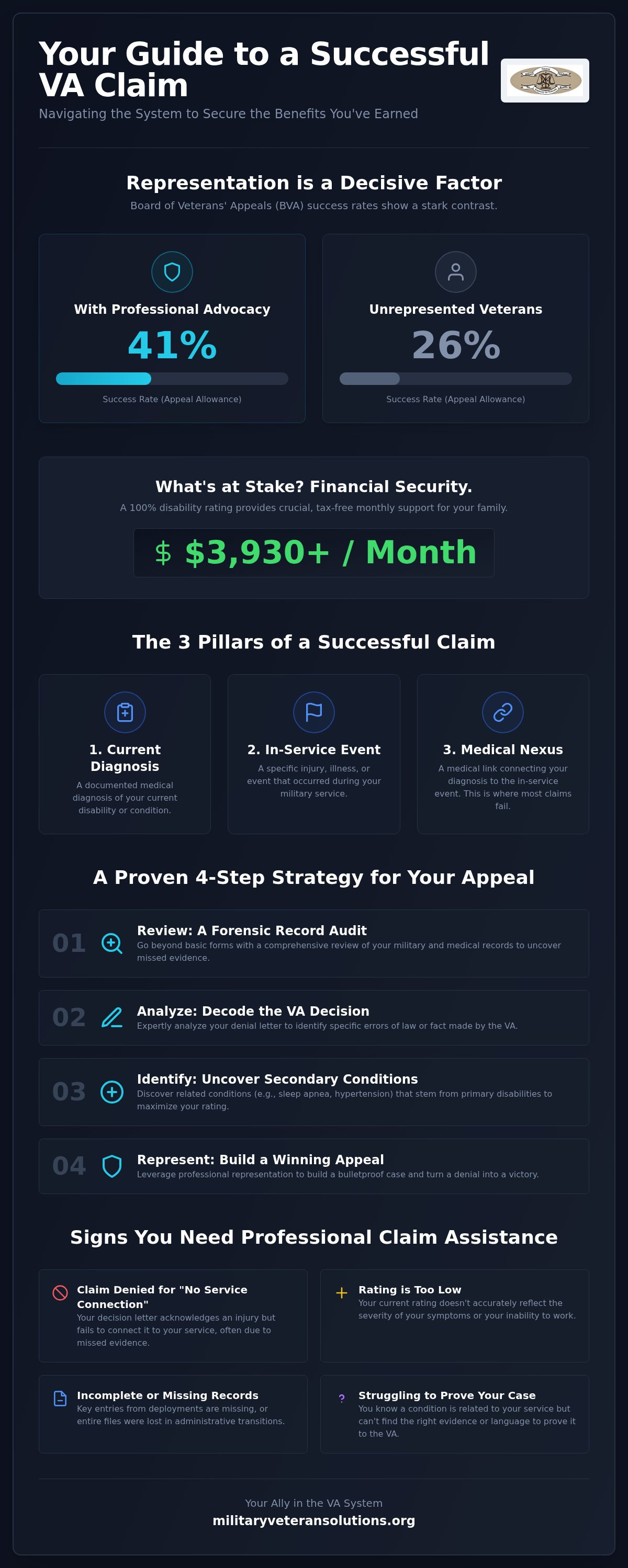
Did you know that as of mid-2026, veterans represented by professional advocates see an appeal success rate of nearly 41 percent, while unrepresented veterans struggle at just 26 percent? It is a staggering gap that proves the system isn't always built for the individual. You've likely felt the weight of this yourself, perhaps feeling like a nameless file while you scramble to understand medical nexus requirements or worry about missing a critical deadline. It's exhausting to fight for the benefits you were promised, especially when a 100 percent rating now represents over 3,930 dollars in monthly support that your family depends on.
You deserve a clear path forward, and this guide provides the expert va claim assistance necessary to secure your earned entitlements. We'll show you how to move beyond basic forms by using deep record reviews and decision letter analysis to uncover the evidence the VA missed. This resource breaks down the 2026 regulatory changes and offers a strategic roadmap for your appeal. You will learn how to identify overlooked secondary conditions and gain the professional representation needed to finally turn a denial into a victory.
Key Takeaways
- Treat the VA disability system as a legal process rather than a simple application to avoid the common pitfalls of filing alone.
- Compare the benefits of dedicated, high-touch advocacy against high-volume VSO models to determine the best path for your specific case.
- Learn why a comprehensive audit of your military records is vital for uncovering the service-connection "nexus" required for a successful rating.
- Utilize expert va claim assistance to decode your VA decision letter and identify the specific errors of law or fact that led to your denial.
- Implement a structured four-step strategy—Review, Analyze, Identify, and Represent—to navigate complex appeals and secure your earned entitlements.
Understanding the Need for Professional VA Claim Assistance
The VA disability system often presents itself as a helpful resource for those who served. In reality, it functions as a complex, adversarial legal process disguised as a benefits application. You aren't just filling out a form; you're building a legal case against a massive bureaucracy. The Veterans Benefits Administration (VBA) operates on strict evidentiary standards that require high-level documentation most veterans don't have readily available. Filing alone leaves you vulnerable to a system that prioritizes speed over individual detail. Current 2026 data shows a stark reality: unrepresented veterans face a board allowance rate of only 26.2 percent, while those with professional advocates see success rates jump to nearly 41 percent.
True va claim assistance goes far beyond checking boxes on Form 21-526EZ. It involves forensic record analysis and a deep understanding of the 2026 regulatory landscape. While the PACT Act expanded presumptions for many, it also flooded the system, leading to an average processing time of over 78 days. This volume often results in rushed decisions. You need more than just a diagnosis; you need a bulletproof strategy that connects your current health to your time in uniform.
The Complexity of Modern VA Claims
Winning a claim requires the "Big Three": a current medical diagnosis, a specific in-service event or injury, and a medical nexus linking the two. That nexus is where most claims fail. The VA has a legal "Duty to Assist," but this often results in a cursory glance at your files rather than a comprehensive audit. They won't hunt for the secondary conditions, such as sleep apnea or hypertension, that frequently stem from primary service-connected disabilities. You must be your own investigator or partner with someone who understands how to bridge these gaps.
Signs You Need Professional Advocacy
Many veterans wait until they've received multiple denials before seeking help. Don't wait for a rejection to take your claim seriously. You should consider professional va claim assistance if any of the following apply to your situation:
- Your decision letter acknowledges your injury but denies a service connection due to a lack of evidence.
- Your current rating doesn't reflect the actual severity of your symptoms or your inability to work.
- Your military medical records are incomplete, missing key entries from deployments, or were lost in administrative transitions.
- You've been denied for a condition you know is related to your service but can't find the right words to prove it.
The system is designed to be exhaustive. If your evidence isn't equally thorough, you're leaving your financial security to chance. Professional representation ensures your voice is heard above the administrative noise.
Types of VA Claim Representation: VSOs vs. Professional Advocates
Choosing your representative is the most critical decision you'll make after leaving the service. Your choice determines whether your file receives a cursory glance or a forensic audit. Current 2026 statistics from the Board of Veterans' Appeals (BVA) show that veterans with professional representation achieve a 40.9 percent allowance rate. Those who proceed without help face a much lower 26.2 percent success rate. Securing the right va claim assistance is the first step toward a successful rating and the long-term security of your family.
The VSO Model: High Volume vs. High Detail
Many veterans start with Veterans Service Organizations (VSOs) like the DAV or American Legion. These organizations provide a vital service, and they're often the first place people look for official VA claim assistance. Because their services are free, VSOs are often overwhelmed. An individual officer might manage hundreds of cases simultaneously. This high volume makes it difficult for them to perform the deep-dive record reviews necessary for complex claims. While they're excellent for straightforward initial filings, they may lack the time to hunt for the secondary conditions that turn a 30 percent rating into a 100 percent rating. A missed detail in your medical history today can cost you years of back pay tomorrow.
Professional Advocacy Firms: The Strategic Advantage
Professional advocacy firms offer a high-touch alternative to the high-volume VSO model when you need specialized va claim assistance. These firms don't just file paperwork; they conduct exhaustive military record reviews to find the evidence the VA overlooked. This level of detail is especially important for veterans in rural areas who can't easily visit a physical office. By utilizing professional representation through virtual consultations, you gain access to expert analysis regardless of your location. Advocates help you choose the right strategic path, such as deciding between a Supplemental Claim with new evidence or a Higher-Level Review to challenge a legal error. They provide a steady, reassuring presence through the anxiety of the appeals process.
Attorneys typically step in when a case reaches the Board of Veterans’ Appeals. They specialize in the legal technicalities of the system and, as noted, have the highest success rates for complex appeals. Whether you choose a VSO, an advocate, or an attorney, ensure your partner has the time to treat your case with the gravity it deserves. You aren't just a number, and your representation should reflect that reality.
The Foundation of Success: Exhaustive Military Record Reviews
Most veterans assume that simply handing over their entire C-File is enough to secure a rating. It isn't. Sending a massive record dump to the VA often leads to a quick denial because the rater lacks the time to search for your specific evidence. If you don't highlight the exact proof, it's as if that evidence doesn't exist. This is why high-touch va claim assistance focuses on the discovery phase rather than just the filing phase. While you can find general guidance through American Legion claims assistance, a forensic audit of your records is what identifies the specific nexus required for a successful rating.
At Military Veteran Solutions, LLC, we distinguish between your personnel records and your Service Treatment Records (STRs). Your personnel file tells the VA where you were, but your STRs tell them what happened to your body. We audit these records to find "silent" entries. These are small notes from a routine physical or a brief clinic visit that never led to a follow-up but prove an injury or exposure occurred during your service. These hidden details are often the only way to establish a service connection decades after you've hung up the uniform.
Identifying Secondary Conditions
A secondary condition is a disability caused or worsened by a primary service-connected rating. Many veterans struggle to reach a 100 percent rating because they only focus on their primary injuries. We look for the medical logic that connects the dots. For example, a chronic orthopedic injury like a service-connected knee condition can lead to a sedentary lifestyle, resulting in weight gain that causes or aggravates sleep apnea. Proving this aggravation requires a sophisticated understanding of VA law and medical evidence. We specialize in identifying these links to ensure your rating reflects the full scope of your health.
Auditing for PACT Act Presumptives
The landscape for toxic exposure claims is still evolving, and while the PACT Act has opened doors, you still have to prove you were in the right place at the right time. We use your personnel records to establish a definitive timeline of your presence in exposure zones. By analyzing the timing of your symptoms relative to your service dates, we build a chronological roadmap for the VA rater. This level of detail prevents the missing evidence denials that plague so many unrepresented veterans. When you have professional va claim assistance, you aren't just guessing; you're providing a verified path to approval.
Navigating Denials: The Power of VA Decision Letter Analysis
Receiving a denial letter from the VA often feels like a dead end. In reality, that confusing document is the most valuable tool in your arsenal. It functions as a roadmap to your eventual approval by outlining exactly what the rater thought was missing from your file. Expert va claim assistance begins with a forensic breakdown of this letter to identify where the VA's logic failed. It isn't just a summary of a decision; it's a direct reveal of where their investigation stopped and where your appeal must begin.
When Military Veteran Solutions, LLC analyzes these letters, we look for two specific types of mistakes. Errors of Fact occur when a rater misses a specific entry in your service treatment records or ignores a provided diagnosis. Errors of Law happen when the VA fails to follow its own regulations, such as neglecting a PACT Act presumption you're entitled to receive. The "Reason for Decision" section is the heart of the document. By using the VA’s own stated logic, we craft a targeted appeal strategy that addresses their specific objections rather than just resubmitting the same information and hoping for a different result.
Common Denial Reasons and How to Counter Them
Most denials boil down to a failure in one of the three pillars of a claim. If you're denied for "No Diagnosis," you need updated medical evidence to satisfy the rater's requirements. A denial for "No Nexus" is the most common hurdle; it means the VA doesn't see the link between your service and your current health. We specialize in identifying the evidence required for professional nexus letters that bridge this gap. If the VA claims there was "No In-Service Event," we help you utilize buddy statements and lay evidence to reconstruct the events that caused your injury, even when official records are thin.
Choosing the Right Appeal Lane
Strategic success depends on picking the right path for your specific situation. You have three primary options under the current system:
- Supplemental Claim: This is the best choice when you have new and relevant evidence, such as a fresh medical opinion or a newly discovered record entry.
- Higher-Level Review (HLR): Choose this lane if you believe the evidence already submitted was sufficient, but the rater made a clear error. No new evidence is allowed in an HLR.
- Board Appeal: This is the final step for complex legal disputes, involving a review by a Veterans Law Judge at the Board of Veterans’ Appeals.
Don't let a denial letter gather dust while your window to appeal closes. Contact Military Veteran Solutions, LLC for a professional VA Decision Letter Analysis to decode your results and build a winning strategy.
Why Military Veteran Solutions, LLC is Your Ally in the VA System
Military Veteran Solutions, LLC isn't just another service provider. We're a veteran-owned firm founded by a 10-year Army veteran who understands the weight of a uniform and the frustration of a denial. With over 25 years of institutional knowledge, we've seen how the system evolves and where it fails the individual. Our team provides specialized va claim assistance that goes beyond the surface level. We don't just fill out forms; we build cases designed to win. Our success is rooted in a comprehensive 4-step process: Review, Analyze, Identify, and Represent. This methodical approach ensures that every military record is audited, every decision letter is decoded, and every secondary condition is identified before we represent your interests. We speak the language of service because we've lived it.
We've spent over two decades perfecting this advocacy model. It's designed to provide relief to veterans who feel like they're shouting into a void. By utilizing virtual consultations, we ensure that expert advocacy is accessible to every veteran in the country, regardless of their proximity to a physical office. You get the high-touch care of a personal mentor combined with the technical expertise of a professional firm. You aren't just another file to us; you're a peer who deserves the full measure of your entitlements.
Dedicated Advocacy for Complex Appeals
We specialize in the hard cases. If you've been turned away by high-volume organizations because your file is too messy or your nexus is too thin, we want to talk to you. Our focus remains fixed on winning the benefits you've earned through your service, not just moving paperwork through a queue. We provide steady support and total transparency throughout the entire process. You'll always know where your claim stands and what the next move is. We don't hide behind administrative jargon; we speak plainly and act decisively. This dedicated va claim assistance model allows us to focus on the details that high-volume VSOs often overlook. We aren't afraid of a fight, and we won't back down from a complex appeal.
Take the Next Step Toward Your Entitlements
Don't let a denial letter be the end of your journey. The VA gives you a specific one-year window to appeal most decisions, and every day you wait is a day of potential back pay lost forever. We're here to help you navigate these hurdles with confidence. Whether you're facing a complex appeal or just trying to understand why your initial claim failed, professional representation makes the difference. Our virtual consultation model ensures you can access our expertise from anywhere in the country. You deserve an ally who is as committed to your case as you were to your service. Schedule your VA Decision Letter Analysis with our experts today. Secure the rating you deserve and the future your family needs.
Secure the Entitlements You Earned in Service
Victory in the VA disability system requires a shift in strategy. You've seen how success depends on moving beyond basic forms to embrace forensic record audits and precise decision letter analysis. The path to a 100 percent rating isn't found in a record dump; it's discovered in the silent entries of your service treatment records and the secondary conditions that others often overlook. You don't have to navigate this adversarial process alone.
Military Veteran Solutions provides the high-touch va claim assistance you need to turn a denial into an approval. As a veteran-owned firm with over 25 years of advocacy experience, we understand the technicalities of the system and the gravity of your situation. We offer virtual consultations nationwide to ensure every veteran has access to dedicated representation. Don't let the complexity of the bureaucracy stand between you and your family's security. Get Expert VA Claim Assistance Now and take the definitive step toward securing your future. You served your country with honor; now it's time to ensure your country serves you.
Frequently Asked Questions
How much does VA claim assistance typically cost?
Costs vary depending on the type of representation you choose. Veterans Service Organizations (VSOs) typically provide their services for free. For-profit advocates or attorneys generally work on a contingency fee basis. This means they only receive payment if they successfully recover past-due benefits for you. The VA generally considers a fee between 20 percent and 33.3 percent of back pay to be reasonable. You should always verify the fee structure before signing any representation agreement.
Can I change my representative if I am unhappy with my current VSO?
You have the right to change your representative at any time if your current VSO isn't meeting your needs. You can appoint a new advocate by filing VA Form 21-22 or 21-22a. This action automatically revokes the authority of your previous representative. It's a common step for veterans who feel their case requires more detailed va claim assistance or a more aggressive approach to a complex appeal.
How long does the VA appeal process take in 2026?
As of May 2026, the average time to complete a disability decision is approximately 78.6 days. However, the appeal process timeline depends on the specific lane you select. Supplemental claims and Higher-Level Reviews generally move faster than Board Appeals. A Board Appeal involving a Veterans Law Judge can still take significantly longer due to the legal complexities involved. Professional analysis of your record helps ensure your evidence is complete, which can prevent unnecessary delays.
Do I need a lawyer to file a VA disability appeal?
You don't need a lawyer to file an appeal, but the data suggests it significantly improves your chances of success. In 2026, veterans with professional representation see a success rate of 40.9 percent at the board level. Unrepresented veterans succeed only 26.2 percent of the time. While you can navigate the system alone, an expert advocate understands the legal technicalities and medical nexus requirements that often lead to a denial.
What is the difference between a VA accredited agent and a VSO?
VSOs are typically employees of veteran service organizations who provide free, high-volume support. Accredited agents are private individuals recognized by the VA to represent veterans, often providing more intensive, high-touch va claim assistance. While VSOs are excellent for initial filings, accredited agents or professional advocacy firms often have more time to conduct the forensic record reviews necessary for complex secondary conditions or difficult appeals. The choice depends on the complexity of your specific case.
Can Military Veteran Solutions help me if I live outside the United States?
You should have your most recent VA decision letter and your service treatment records (STRs) ready for your consultation. These documents are the foundation of any successful strategy. It's also helpful to have a list of your current diagnoses and any buddy statements from individuals who witnessed your in-service events. Having these files organized allows us to quickly identify the gaps in your previous claim and build a stronger path toward your entitlements.
Will the PACT Act help me reopen a previously denied claim?
The PACT Act allows many veterans to reopen previously denied claims if their condition is now considered presumptive. This law expanded the list of health issues linked to toxic exposure during service. You can file a supplemental claim to provide the VA with the new evidence required under these updated regulations. We specialize in auditing personnel records to establish the boots-on-the-ground presence necessary to qualify for these specific 2026 benefits.


