
What if that persistent ringing in your ears isn't just a 10% annoyance, but the strategic foundation for the disability rating you actually deserve? You've likely felt the sting of being told your VA rating for tinnitus is capped at a mere ten percent, regardless of how much it disrupts your concentration or steals your sleep. It's exhausting to battle a subjective symptom that the system seems designed to downplay. We understand that frustration because we've seen how the VA's complex math and rigid caps can leave dedicated veterans feeling overlooked and undervalued.
You don't have to settle for the bare minimum. This 2026 guide is designed to help you master the newest rating rules and calculate your true combined disability potential with precision. We'll show you exactly how to leverage secondary conditions like anxiety, depression, or sleep disturbances to move far beyond that initial 10% ceiling. By the end of this article, you'll know how to identify high-value claims and why a professional Military Record Review is the essential first step to securing the benefits you earned through your service.
Key Takeaways
- Understand the 2026 rules for Diagnostic Code 6260 and why the VA maintains a 10% cap on your VA rating for tinnitus.
- Master the complexities of "VA Math" to accurately estimate how individual ratings impact your overall whole person efficiency.
- Uncover the strategic advantage of filing for secondary conditions, such as mental health disorders, to bypass the tinnitus rating limit.
- Learn how to use your MOS and the Noise Exposure Listing to prove service connection even when medical records are silent.
- Discover why professional advocacy and a thorough Military Record Review are the keys to overturning a denied claim or a static rating.
What is the VA Rating for Tinnitus in 2026?
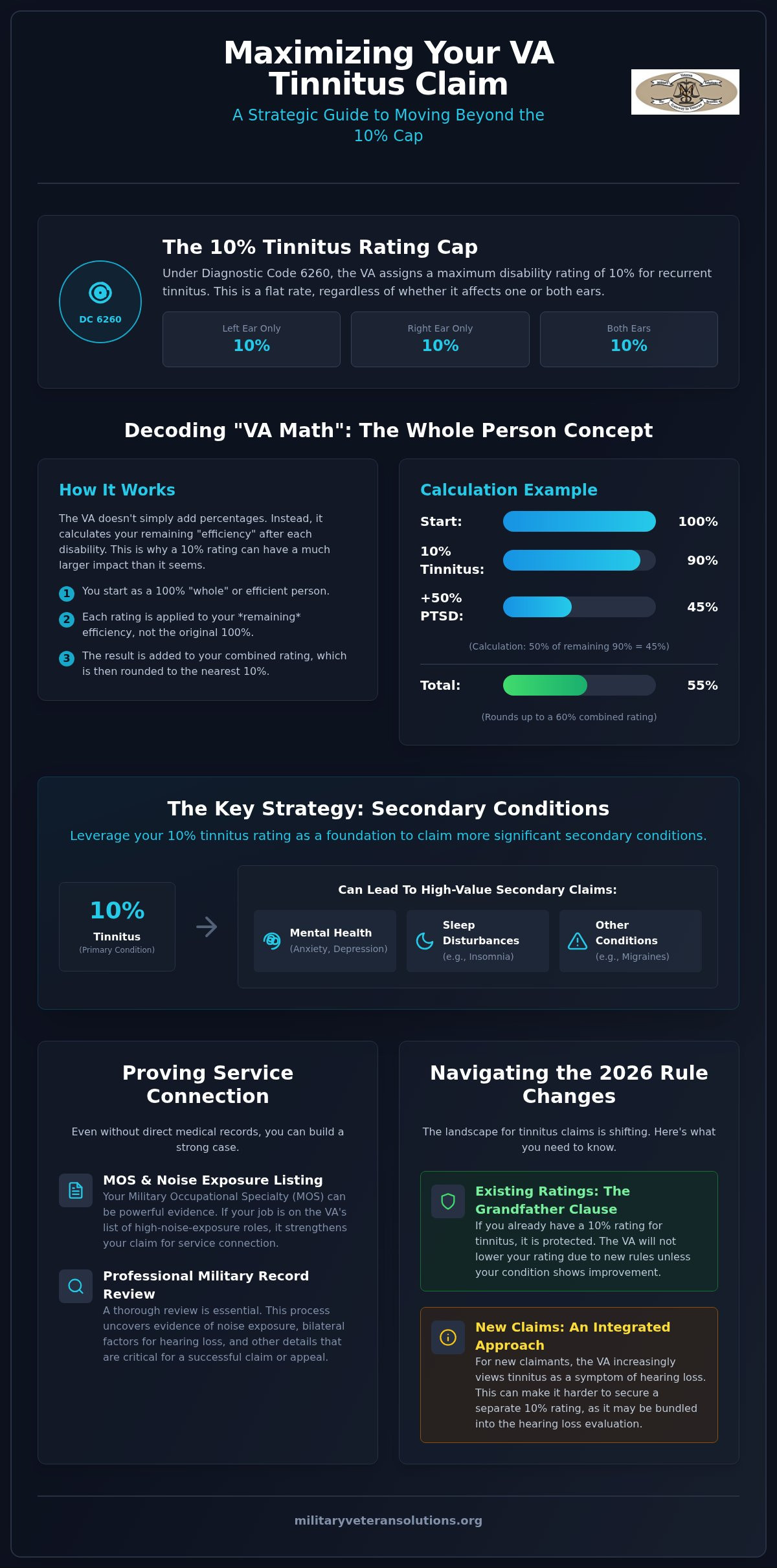
Understanding your VA rating for tinnitus starts with Diagnostic Code 6260. The VA defines this condition as recurrent tinnitus, characterized by persistent ringing, buzzing, hissing, or other sounds in the ears. It's one of the most common claims filed by veterans, yet it remains one of the most misunderstood. If you're wondering What is Tinnitus? from a clinical perspective, it is the perception of sound when no external sound source is present. For many, it's a constant companion that disrupts focus and sleep.
Currently, the VA applies a maximum rating of 10% for tinnitus. This is a flat rate. It doesn't matter if the ringing is in your left ear, your right ear, or both; the VA treats it as a single disability. This cap exists because the VA considers the condition a subjective symptom rather than an objectively measurable disease. Even if the sound is deafening or leads to severe distress, the rating for the condition itself will not exceed this 10% threshold. This ceiling often feels like an insult to veterans who deal with the reality of this condition every day, but it is the current legal limit under the schedule for rating disabilities.
Standalone vs. Integrated Ratings
For decades, tinnitus was almost always rated as a standalone 10% disability. However, the 2026 regulatory shift has changed the landscape for new claimants. The VA now increasingly views tinnitus as a symptom of underlying hearing loss rather than a separate condition. This means that for many new claims, the ringing is bundled into the hearing loss evaluation, which can make it harder to secure that extra 10% boost to your combined rating. Because there's no clinical test to measure the volume of the internal sound, the VA relies almost entirely on your personal report of the symptom's frequency and persistence.
The 2026 Grandfather Clause
If you already have a 10% rating, don't panic. The 2026 changes include a critical grandfather clause that protects veterans with existing service connections. Your current rating is secure as long as your condition doesn't improve, meaning the VA won't lower your percentage just because the rules for new applicants have changed. This protection is a relief, but it also creates a sense of urgency for those who haven't filed yet. If you're still waiting to submit your claim, you're navigating a closing window of opportunity. A professional VA Decision Letter Analysis can help you understand where you stand in this shifting regulatory environment and identify if your current rating is truly protected.
VA Disability Calculator: How Tinnitus Impacts Your Combined Rating
You've likely heard the term "VA Math" and felt the immediate headache that follows. When the VA evaluates your claims, they don't simply add percentages together. They use a "whole person" concept that measures your "remaining efficiency." Think of yourself as a 100% whole person. If you secure a 10% VA rating for tinnitus, you are now considered 90% efficient. If you later add a 50% rating for a secondary condition, the VA takes 50% of your remaining 90%, not 50% of the original 100%. This results in a 45% addition, bringing your total to 55%.
This math is why that 10% for tinnitus is such a critical stepping stone. It's rarely about the 10% on its own. It's about how that small slice of the pie interacts with your other conditions. For a veteran sitting at a 94% actual disability, that single 10% for tinnitus provides the mathematical push necessary to reach a 100% rounded rating. Without it, you're stuck at 90% and missing out on significant monthly compensation. Navigating these rules in the VA's Schedule for Rating Disabilities requires a strategic approach to your entire claim portfolio.
Tinnitus and the Bilateral Factor
Tinnitus is historically unique in the VA system. Even if the ringing screams in both ears, the VA typically issues a single 10% rating. However, the presence of bilateral hearing loss triggers a "bilateral factor" boost. This adds an extra 10% to the combined value of those specific ear ratings before they are factored into your "whole person" total. Identifying evidence of bilateral noise exposure is a core part of our Military Record Review, as it ensures you're utilizing every mathematical advantage the system allows.
Combined Rating Scenarios
Let's look at how this plays out in real-world scenarios. In Scenario A, a veteran with a 10% VA rating for tinnitus but 0% for hearing loss stays at a total 10% award. In Scenario B, that same veteran successfully links secondary sleep apnea at 50%. The 10% and 50% combine through VA math to reach 55%, which the VA rounds up to a 60% payment rate. This 10% tinnitus rating is often the deciding factor that moves a veteran from a 90% total rating to a life-changing 100% award.
Secondary Conditions: Moving Beyond the 10% Cap
If you've already secured a 10% VA rating for tinnitus, you might feel like you've hit a dead end. The VA's rigid schedule doesn't allow for an increase beyond that tenth percentile for the ringing itself, regardless of how loud the noise becomes. However, you should not view that rating as a ceiling. It is a tactical foundation. The real strategy for increasing your compensation lies in identifying conditions that are secondary to your tinnitus. This means proving that your service-connected ringing has either caused or aggravated another medical issue.
By linking new claims to an existing service connection, you can bypass the 10% limit and access the higher rating tiers your health reality requires. This approach shifts the focus from the sound in your ears to the systemic impact that sound has on your life. It's about ensuring the VA sees the whole person, not just a single diagnostic code.
Common Secondary Conditions to Tinnitus
Chronic ringing is rarely just a physical symptom. It often acts as a persistent psychological stressor that leads to significant mental health challenges. We frequently see veterans qualify for secondary ratings for anxiety, depression, or somatic symptom disorder. These mental health ratings typically range from 30% to 70%, providing a much more accurate reflection of the veteran's struggle than a standalone tinnitus award.
The constant noise can also shatter your ability to rest, creating a direct link to sleep apnea or chronic insomnia. A 50% rating for sleep apnea, when linked to your existing 10% base, can be life-changing for your monthly award and overall combined rating. Finally, many veterans suffer from debilitating migraines as a result of the constant auditory strain. To win these claims, you must prove the frequency and severity of prostrating attacks, which are those that force you to stop all activity and seek a dark, quiet room for relief.
The Nexus Requirement for Secondary Claims
Securing these higher ratings requires a nexus. This is the medical bridge that connects your secondary condition to your original VA rating for tinnitus. The VA won't simply take your word for it; they need evidence that your anxiety or migraines are at least as likely as not caused by the ringing in your ears. This is where most unrepresented claims fail.
A professional Military Record Review is the only way to find the specific evidence the VA missed, such as early complaints or documented sleep disturbances buried in your service records. We also emphasize the power of lay statements. These personal accounts from you, your spouse, or your coworkers provide the real-world context of how these symptoms impact your daily life and work performance. Using a professional VA Decision Letter Analysis ensures that every secondary connection is supported by the specific medical and legal language the VA requires for an approval.
Proving Your Claim: The Power of Military Record Reviews
Most veterans are stunned when they receive a denial for a condition as obvious as tinnitus. The VA often cites a lack of an "in-service" event or a formal diagnosis during your time in uniform as the primary reason for rejection. This hurdle is common, but it's often based on a superficial review of your file. The VA uses a tool called the Duty Qualifications and Noise Exposure Listing to cross-reference your MOS with presumptive levels of noise trauma. If your job isn't on that list, or if it's rated "low," the burden of proof shifts heavily to you to prove you were actually exposed to hazardous noise. Before you can fix a denied claim, you must understand exactly why it failed. Our VA Decision Letter Analysis acts as a forensic review of the VA's logic. It reveals which specific piece of the puzzle is missing, whether it's the service connection, a current diagnosis, or the medical link between the two.
Auditing Your Service Records
A deep-dive audit of your service treatment records is your strongest weapon in an appeal. We don't just look for the word "tinnitus" in your files. We search for documented evidence of acoustic trauma, treated ear infections, or even complaints of dizziness that the VA may have ignored or miscategorized. Identifying specific deployment dates and locations where you were exposed to high-decibel environments, such as flight lines, engine rooms, or artillery ranges, creates the necessary "nexus" the VA demands. Because these maritime environments are notoriously hazardous, you can read more about how SeaFleet Backbone provides critical safety inspections to help modern operators prevent similar injuries. Military Veteran Solutions, LLC specializes in identifying this "hidden" evidence that VSOs and less experienced representatives often overlook during a standard records check.
Overcoming the "Subjective" Barrier
Tinnitus is inherently subjective. Because there's no blood test or imaging that can hear the ringing in your ears, the VA relies heavily on your credibility and your ability to articulate the severity of the condition. During a Compensation and Pension (C&P) exam, you must be clear and consistent about how the symptom manifests. Don't downplay the impact. We recommend using VA Form 21-4138 to provide a formal Statement in Support of Claim. This document allows you to detail your noise exposure events in your own words, creating a permanent record of the "who, what, when, and where" of your injury. You don't have to navigate this complex evidence-gathering process alone. Our virtual consultations provide a direct line to advocates who understand these nuances and can help you secure the VA rating for tinnitus you deserve. You can start your journey toward a successful appeal today by scheduling a Virtual Consultation to discuss your specific case and record history.
Winning Your Tinnitus Appeal with Military Veteran Solutions, LLC
Filing for a VA rating for tinnitus on your own often feels like shouting into a void. You might manage to secure that initial 10%, but without a long-term strategic plan, that rating often becomes static. It sits in your file for years, never increasing, while the ringing persists and your quality of life declines. We don't want you to settle for a fraction of what you've earned. Military Veteran Solutions, LLC brings over 25 years of experience to the table, providing the advocacy advantage you need to navigate the maze of the VA appeals process. We've seen every tactic the VA uses to minimize claims; we know how to counter them with cold, hard evidence.
The goal isn't just to win a single claim. It's to build a comprehensive disability profile that accurately reflects the toll your service took on your health. By securing your 10% foundation for tinnitus, you open the door to the high-value secondary claims we discussed earlier. We stand as a bridge between a formal professional service and a personal mentor, ensuring you're never left to face the system alone.
Our Comprehensive Review Process
We begin every appeal with a deep-dive analysis of your previous VA decision letters. We don't just read the results; we hunt for procedural errors and logical inconsistencies that provide grounds for an appeal. Because Military Veteran Solutions, LLC was founded by a 10-year Army veteran, we understand the nuances of service records and the "Army way" of documenting injuries. This expertise allows us to identify secondary conditions you might not have realized were claimable. We turn overlooked details into the "nexus" evidence required to move your rating forward.
Ready to Secure Your Earned Benefits?
The window for maximizing your benefits is shifting. As we move through 2026, new regulatory implementations make it more critical than ever to establish your service connection now. Waiting only gives the VA more opportunities to change the rules in their favor. Our nationwide virtual consultations ensure that expert support is available to you regardless of your location. You've spent years dealing with the noise in your ears; it's time to let us handle the noise of the administrative process.
The first step is simple but essential. We'll conduct a Military Record Review to audit your service history and identify the strongest path forward. Don't let a static rating be the end of your story. Secure the benefits you were promised when you put on the uniform. Contact us today to schedule your virtual consultation and start building the case for the 100% rating you deserve.
Take Control of Your Disability Rating Journey
The persistent ringing in your ears shouldn't be the end of your claim journey. You've learned that your VA rating for tinnitus is more than just a 10% award; it's a strategic gateway to the higher combined rating you deserve. By identifying secondary conditions and uncovering hidden evidence through a professional record audit, you can finally move past the systemic caps that hold so many veterans back. The rules are shifting in 2026, and the window to secure your foundation under current regulations is narrowing.
Military Veteran Solutions, LLC was founded by a 10-year disabled Army veteran who understands the battle you're fighting. With over 25 years of advocacy experience, we provide the specialized record reviews and decision letter analysis needed to overturn denials. Whether you're just starting or facing a frustrating setback, our nationwide virtual consultations make expert support accessible to you right now. Don't let your service-connected injuries go unrecognized by a complex administrative system. Get a Professional VA Decision Letter Analysis and Start Your Appeal today. You earned these benefits through your sacrifice, and we're here to help you secure them.
Frequently Asked Questions
Is tinnitus a presumptive VA disability under the PACT Act?
Tinnitus isn't currently a presumptive condition under the PACT Act. While that legislation focuses primarily on toxic exposures and burn pits, tinnitus is almost always linked to acoustic trauma. You'll still need to provide evidence of noise exposure during your service to establish a direct connection. Our record reviews specialize in finding this evidence even when the VA claims it doesn't exist.
Can I get a 100% VA rating for tinnitus alone?
You can't receive a 100% rating for tinnitus by itself. The VA rating for tinnitus is legally capped at a maximum of 10% under Diagnostic Code 6260. To reach a higher total rating, you must use that 10% as a strategic base. Linking secondary conditions like anxiety, depression, or sleep disorders is the only way to move toward a 100% total disability award.
How much does the VA pay for a 10% tinnitus rating in 2026?
The monthly compensation for a 10% rating is determined by the 2026 VA benefit rates. These rates are adjusted annually based on cost-of-living adjustments. While a 10% award is the lowest paid tier, it provides a consistent, tax-free monthly payment and grants access to VA healthcare. It also serves as the mathematical foundation for your total combined disability rating.
What happens if the VA denies my tinnitus claim but grants hearing loss?
This usually happens because the VA acknowledges the noise trauma but claims the tinnitus isn't recurrent or chronic. If your hearing loss is granted, the "in-service" event is already proven. You should appeal this decision immediately. Providing a detailed lay statement about the frequency and persistence of the ringing can bridge the evidentiary gap the VA's examiner originally missed.
Can I file for tinnitus as a secondary condition to hearing loss?
You can certainly file tinnitus as secondary to hearing loss. If your hearing loss is already service-connected, it's often easier to prove that the ringing is a direct symptom of that existing ear damage. This is a powerful backup strategy if the VA denies your primary claim due to your MOS being categorized as a low noise exposure risk.
How do I prove my tinnitus started during my military service?
Proving service connection requires a nexus between your current ringing and a specific military event. You can use service treatment records, buddy letters, or your own sworn statement. We often find that a professional audit of your service history uncovers acoustic trauma events or ear infections that you might've forgotten or assumed were never properly documented in your file.
What is the "Noise Exposure Listing" and how does it affect my claim?
The Noise Exposure Listing is a VA guide that rates the probability of hearing damage based on your specific MOS. If your job is listed as high risk, the VA assumes you were exposed to hazardous noise. If your MOS is rated as low risk, we help you find specific deployment records or training events to prove your actual exposure levels.
Can I appeal a tinnitus rating if I was denied ten years ago?
You can absolutely appeal a denial from a decade ago by filing a Supplemental Claim. The key is providing new and relevant evidence that wasn't considered in your original filing. A fresh medical opinion or a more thorough review of your military records can be the catalyst that finally turns that old denial into a successful approval.


