
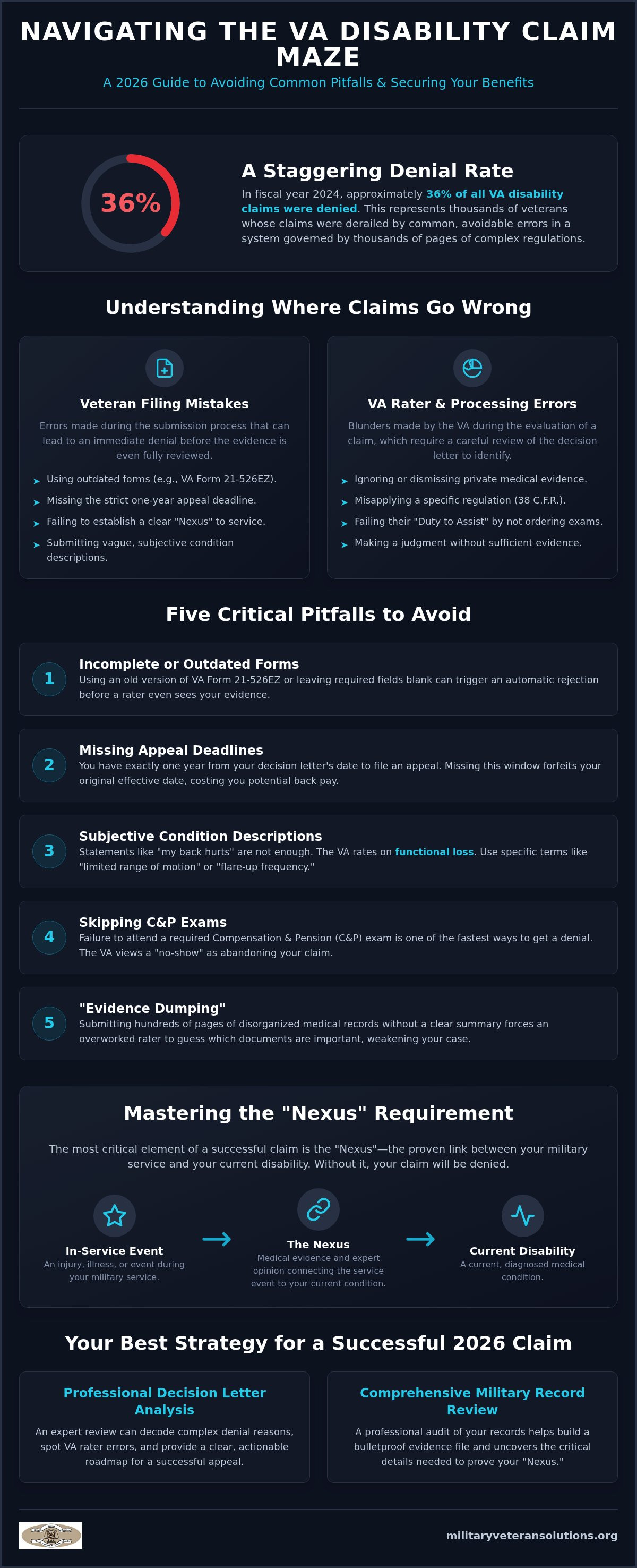
Did you know that approximately 36% of all VA disability claims were denied in fiscal year 2024? This statistic represents thousands of veterans who were derailed by common errors in VA disability claims that could've been avoided with the right approach. You've likely felt the frustration of navigating a complex system that seems more interested in rigid paperwork than your actual health. It's exhausting to provide your service records only to be met with a rejection that feels like a personal slight. You deserve better than a clerical oversight standing between you and the compensation you earned.
In this 2026 guide, you'll learn to identify these pitfalls and discover how to safeguard your benefits through strategic evidence and professional review. We'll show you exactly where most applications fall short, from missing medical links to misunderstanding the latest regulatory shifts. By the end of this article, you'll understand how to build a bulletproof evidence file and why a professional analysis of your decision letter is the audit you need to catch rater mistakes. Let's move past the confusion and get your claim on the right track today.
Key Takeaways
- Understand why the massive complexity of 2026 VA regulations leads to high denial rates and how you can stay ahead of the system.
- Identify the most common errors in VA disability claims, from simple form mistakes to missing critical one-year appeal deadlines.
- Learn to spot rater blunders, such as the dismissal of private medical evidence, so you can hold the VA accountable for every detail of your file.
- Master the "Nexus" requirement by using a comprehensive Military Record Review to prove the direct link between your service and your current health.
- Discover how a professional Decision Letter Analysis can decode complex denial reasons and provide a clear roadmap for a successful appeal.
Why VA Disability Claim Errors Are More Common Than You Think
The VA disability system isn't just a bureaucracy; it's a labyrinth. It's governed by 38 C.F.R., a massive collection of federal regulations spanning thousands of pages that dictate exactly how your injuries should be rated. Even a single missed checkbox or an ambiguous medical statement can trigger an immediate denial. While the VA reported a high accuracy rate recently, the reality on the ground is different. Approximately 36% of all disability claims were denied in fiscal year 2024. This suggests that common errors in VA disability claims are far more frequent than the official numbers might lead you to believe.
You've likely felt the weight of this complexity. It's exhausting to provide your service records only to be met with a rejection that feels like a personal slight. You deserve a system that recognizes your sacrifice, but the current administrative environment requires perfection. Understanding where these errors originate is the only way to protect your claim from becoming another statistic.
The High Cost of Simple Mistakes
Every mistake in your filing has a price tag. When you submit a claim with technical flaws, you risk more than just a rejection; you risk your effective date. A denial often means starting over or entering a multi-year appeal process, which can cost you thousands of dollars in lost back pay. The psychological toll is just as heavy. Receiving a "denied" letter because of a technicality can make you feel abandoned by the very system designed to support you. In 2026, "filing and hoping" is no longer a viable strategy. You need a methodical, evidence-based approach to ensure your paperwork is flawless from the start—a level of precision similar to how tax professionals rely on Apex Tax Solutions LLC to manage their complex filings.
The Difference Between a Mistake and a Rater Error
Winning your benefits requires you to identify errors on both sides of the desk. Common errors in VA disability claims typically fall into two distinct categories:
- Veteran Mistakes: These are submission errors, such as using an outdated VA Form 21-526EZ, missing the strict one-year appeal deadline, or failing to include a clear "nexus" connecting your condition to your service.
- VA Rater Errors: These are processing blunders. They occur when a rater ignores your private medical evidence, misapplies a specific regulation, or fails their "duty to assist" by not ordering the correct exams.
You can't simply assume the VA will catch their own mistakes. A thorough audit of your decision letter is the only way to determine if the denial was caused by your filing or their processing. By identifying these specific blunders, you can build a stronger case for your appeal and secure the compensation you've earned.
The VA process is unforgiving. While the system's complexity creates systemic hurdles, many denials stem from mistakes made during the initial filing phase. These are often categorized as common errors in VA disability claims because they happen to even the most diligent veterans who try to navigate the paperwork alone. You've fought for your country; you shouldn't have to fight a clerical error to get the support you need. Avoid these five critical pitfalls to keep your claim alive and moving forward.
- Incomplete VA Form 21-526EZ: Using an outdated version of this form or leaving required fields blank often triggers an automatic rejection before a rater even looks at your medical evidence.
- Missing Appeal Deadlines: You have exactly one year from the date of your decision letter to file a Supplemental Claim or Higher-Level Review. If you miss this window, your "effective date" disappears.
- Subjective Condition Descriptions: Using vague terms that don't align with the VA Schedule for Rating Disabilities makes it nearly impossible for a rater to assign an accurate percentage.
- Skipping C&P Exams: Failing to attend a Compensation & Pension exam is the fastest route to a denial. The VA views a "no-show" as an abandonment of your claim.
- Evidence Dumping: Submitting hundreds of pages of disorganized records without a summary or a "roadmap" forces an overworked rater to guess which documents matter most.
Vague Descriptions and the 'Subjective' Trap
If you tell a rater "my back hurts," you aren't giving them the data they need to grant a rating. The VA doesn't compensate for the presence of pain alone; it compensates for functional loss. You must describe your condition using terms found in the rating schedule, such as limited range of motion, instability, or specific flare-up frequencies. These are common errors in VA disability claims that lead to low ratings or outright denials. If your evidence doesn't speak the VA's technical language, your claim will likely be undervalued. You need to match your symptoms to the specific criteria the VA uses to evaluate your disability.
The Deadline Danger Zone
Timelines are the most rigid part of the VA bureaucracy. If you miss the one-year window to appeal a decision, your claim is closed, and your potential back pay is lost forever. Protecting your benefits requires a proactive stance on every notification you receive from the regional office. A comprehensive Military Record Review can identify these critical dates and ensure your evidence is organized long before the clock runs out. Don't let a calendar mistake erase years of entitled compensation. Staying ahead of these deadlines is the only way to ensure your file remains active and your effective date is preserved.
Identifying Frequent VA Rater Errors and Processing Blunders
While many denials stem from filing mistakes, a significant portion of rejected claims are actually caused by the VA's own processing failures. These are among the most frustrating common errors in VA disability claims because they happen even when you follow every instruction to the letter. Identifying these rater-side blunders is the first step in holding the system accountable. You shouldn't be penalized for a rater's "record fatigue" or their failure to follow established federal law. Understanding these systemic issues gives you the leverage needed to win an appeal.
Raters often overlook critical details when faced with thousands of pages of service treatment records. This leads to several recurring blunders:
- Ignoring Continuity of Symptoms: Raters may deny a claim by citing a gap in treatment, even if you've documented a clear "continuity of symptoms" from your discharge to the present day.
- Misinterpreting the PACT Act: Despite the clear guidelines for presumptive conditions, some raters still struggle to apply the correct service-connection criteria for toxic exposures.
- Failing the 'Benefit of the Doubt': Under 38 C.F.R. § 3.102, if the evidence for and against your claim is roughly equal, the tie must go to you. Raters frequently ignore this "pro-veteran" mandate in close cases.
- Overlooking Favorable Findings: A rater might focus on one negative C&P exam while completely missing a favorable diagnosis buried deep within your personnel file.
When the VA Ignores Your Private Doctor
Legally, the VA is required to weigh your private medical evidence with the same gravity as an opinion from a C&P examiner. However, raters frequently default to the VA's own contractors, even when your private physician has treated you for years. If a rater dismisses your private Disability Benefit Questionnaire (DBQ) without providing a specific, legally valid reason, they've committed a reversible error. You can challenge this by highlighting the examiner's lack of specialty or their failure to review your entire claims file. Your long-term doctor often has a much better understanding of your functional loss than a contractor who saw you for fifteen minutes. For healthcare providers managing these critical records, maintaining HIPAA-ready security is vital; you can visit ShieldForce Corporation to explore specialized cybersecurity solutions.
The 'Duty to Assist' Failure
The VA has a legal "Duty to Assist" you in gathering the evidence necessary to support your claim. This means they must make a reasonable effort to obtain relevant military and federal records, such as deck logs or specialized medical files from overseas deployments. When the VA denies a claim without attempting to locate these documents, they've failed their statutory obligation. Identifying these common errors in VA disability claims allows you to cite a "Duty to Assist" error during a Higher-Level Review (HLR), which can force the VA to reopen your claim and conduct a proper investigation. You deserve a partner who knows how to spot these procedural failures before they cost you your benefits.
The Evidence Problem: Inadequate Nexus and Medical Record Audits
Even if you have a clear medical diagnosis today, your claim will likely fail without a "nexus." This term describes the bridge between your time in uniform and your current disability. Many veterans are blindsided when their decision letter states "no service connection" despite obvious physical or mental struggles. This disconnect is one of the most significant common errors in VA disability claims because it involves complex medical-legal reasoning that most individuals aren't trained to provide. You know your body changed during service, but the VA needs a specific type of proof to agree with you.
Secondary conditions represent the most common area where nexus errors occur. For example, you might have service-connected knee issues that have led to back pain over time. If you don't explicitly link the back condition to the primary knee injury through a medical nexus, the VA will treat it as an unrelated, non-compensable issue. You deserve a file that reflects the full reality of your health, not just the parts that are easy to prove.
Finding the 'Smoking Gun' in Your Service Records
Your Service Treatment Records (STRs) often hold the key to a successful claim, but they are frequently hundreds of pages long and difficult to decipher. A single entry about a clinic visit in 2004 could be the "smoking gun" that establishes your service connection. When medical records are sparse, lay statements, often called buddy letters, can fill the gaps by providing eyewitness accounts of the event or injury. A nexus is the essential legal link for service connection that turns a medical diagnosis into a compensable benefit. Finding this link requires a meticulous eye and a deep understanding of what the VA looks for during a review.
Auditing Your Own Medical History
The VA often uses gaps in your treatment history to deny "continuity of symptoms." If you didn't see a doctor for several years after discharge, they may claim your current condition is unrelated to your service. Organizing your medical file is the only way to prevent a rater from missing the facts that prove your case. A professional audit goes beyond a simple record search by identifying these gaps and finding the evidence to bridge them. You shouldn't leave your financial security to chance when a Military Record Review can uncover the hidden evidence needed to win. This proactive approach ensures your common errors in VA disability claims are corrected before they lead to another denial letter.
Why a Professional VA Claim Review is Your Best Strategy for 2026
The 2026 landscape is defined by record-breaking claim volumes. While the VA is working to reduce backlogs, the speed of processing often comes at the expense of accuracy. You need a dedicated advocate to ensure your file isn't just another number in a stack of millions. A professional review provides the exhaustive analysis required to identify common errors in VA disability claims before they result in years of unnecessary appeals. You've served your country with honor; you shouldn't have to settle for a rushed decision that overlooks your sacrifice.
Decision Letter Analysis is the specific tool that bridges the gap between a denial and an approval. Unlike a volunteer VSO who may be managing hundreds of active files, professional representation offers the time needed to decode the technical reasons for your rejection. This "alphabet soup" of VA jargon can be intentionally confusing, but a professional analysis breaks down the legal requirements for service connection in plain English. Virtual consultations have removed the barriers to entry, allowing you to access high-level advocacy from anywhere in the country without leaving your home.
Strategic Advocacy: Beyond Just Filling Out Forms
Building a "theory of the case" is what separates a successful appeal from a repeated denial. At Military Veteran Solutions, LLC, our approach centers on a comprehensive Military Record Review to find the evidence the rater missed. We don't just look for what's there; we look for what's missing. By identifying gaps in your treatment records, we can suggest the exact types of secondary evidence needed to satisfy the rater's requirements. We analyze your medical history through the lens of the rating schedule to address potential roadblocks before the VA has a chance to cite them. This proactive strategy ensures your claim is built on a foundation of facts rather than hope.
Taking Action: From Denial to Entitlement
Moving from a denial to a rating requires a clear, methodical plan. Our step-by-step process begins with a virtual consultation where we review your decision letter and identify the missing links in your evidence. You'll need to gather your recent VA correspondence and any private records to help us build your roadmap to success. We'll examine every line of your medical history to ensure the VA's "Duty to Assist" was fully met. Don't leave your financial security to a system that's currently overwhelmed by volume. Secure your professional VA claim review and stop leaving your benefits to chance.
Secure the Benefits You've Earned in 2026
You've navigated the complexities of the VA system and identified the specific common errors in VA disability claims that often stand between veterans and their entitled compensation. From technical filing mistakes to systemic rater blunders, the path to approval requires precision and a deep understanding of the current regulatory landscape. You now know that a missing nexus or an overlooked medical entry can derail years of effort; however, you don't have to face these hurdles alone. You deserve an ally who speaks the VA's language and understands the gravity of your service.
Military Veteran Solutions, LLC was founded by a 10-year Army veteran to provide the specialized advocacy you deserve. With over 25 years of experience in veteran advocacy, we offer nationwide virtual representation to ensure no veteran is left behind by administrative bureaucracy. We specialize in auditing the VA's work to catch the mistakes that lead to denials. Request a Professional VA Claim Review and Decision Letter Analysis today to protect your effective date and secure your financial future. You've already done the hard work of serving. Let us handle the hard work of the paperwork. You're closer to your results than you think.
Frequently Asked Questions
What is the most common reason for a VA disability claim denial?
The most frequent reason for a denial is the lack of a clear medical nexus connecting your current diagnosis to your military service. Even if you're struggling with a documented illness, the VA will reject the claim if they don't see a direct link to an event or injury during your time in uniform. You can overcome this by providing specific service treatment records or buddy letters that bridge the gap between your discharge and today.
Can I fix an error in my VA claim after I have already submitted it?
You can correct common errors in VA disability claims after submission by filing a Supplemental Claim with new and relevant evidence. If your claim is still in the "gathering of evidence" phase, you may be able to upload additional documentation directly to your file. It's critical to act as soon as you spot a mistake to ensure the rater has the most accurate information before they draft your decision letter.
How do I know if the VA rater made a mistake on my decision letter?
You can identify rater mistakes by conducting a thorough VA Decision Letter Analysis to compare their findings against the evidence you provided. Look for instances where the rater ignored a private doctor's DBQ or failed to apply the "Benefit of the Doubt" rule in a close case. These technical blunders are often the most effective grounds for a successful Higher-Level Review or appeal.
What should I do if I missed the deadline to appeal my VA claim?
If you missed the strict one-year deadline to appeal, you generally lose the ability to protect your original effective date for back pay. However, you can still reopen the claim at any time by filing a Supplemental Claim with "new and relevant" evidence that the VA hasn't previously reviewed. This allows you to start the process over and secure the monthly compensation you're entitled to moving forward.
Is a nexus letter required for every VA disability claim?
A nexus letter isn't legally required for presumptive conditions, such as those covered under the PACT Act, but it's highly recommended for almost every other type of claim. Without a formal medical opinion stating your condition is "at least as likely as not" caused by your service, the VA has a simple path to denial. Providing this link upfront is the best way to safeguard your file from common errors in VA disability claims.
How does a professional VA claim review differ from a VSO's help?
A professional review involves a comprehensive Military Record Review and an exhaustive audit of your medical history, whereas a VSO often focuses on the administrative task of submitting forms. Professional representatives build a strategic "theory of the case" to identify rater-side blunders that a volunteer might miss. This specialized advocacy is designed to uncover hidden evidence and hold the VA accountable for processing errors.
Can the PACT Act help me fix a previously denied claim?
Yes, the PACT Act allows you to reopen claims for toxic exposure conditions that were previously denied but are now considered presumptive. If you were rejected in the past for respiratory issues or certain cancers, you can file a Supplemental Claim to have the VA re-evaluate your case under the latest 2026 guidelines. This regulatory shift has opened the door for thousands of veterans to finally receive their entitled benefits.
What happens if the VA ignores my private medical records?
If the VA ignores your private medical evidence, they've likely failed their legal "Duty to Assist" and committed a reversible error. Federal regulations require raters to weigh records from your private physicians with the same gravity as opinions from C&P examiners. You can challenge this failure through a Higher-Level Review by highlighting the specific documents the rater overlooked and demanding a corrected evaluation of your file.


