
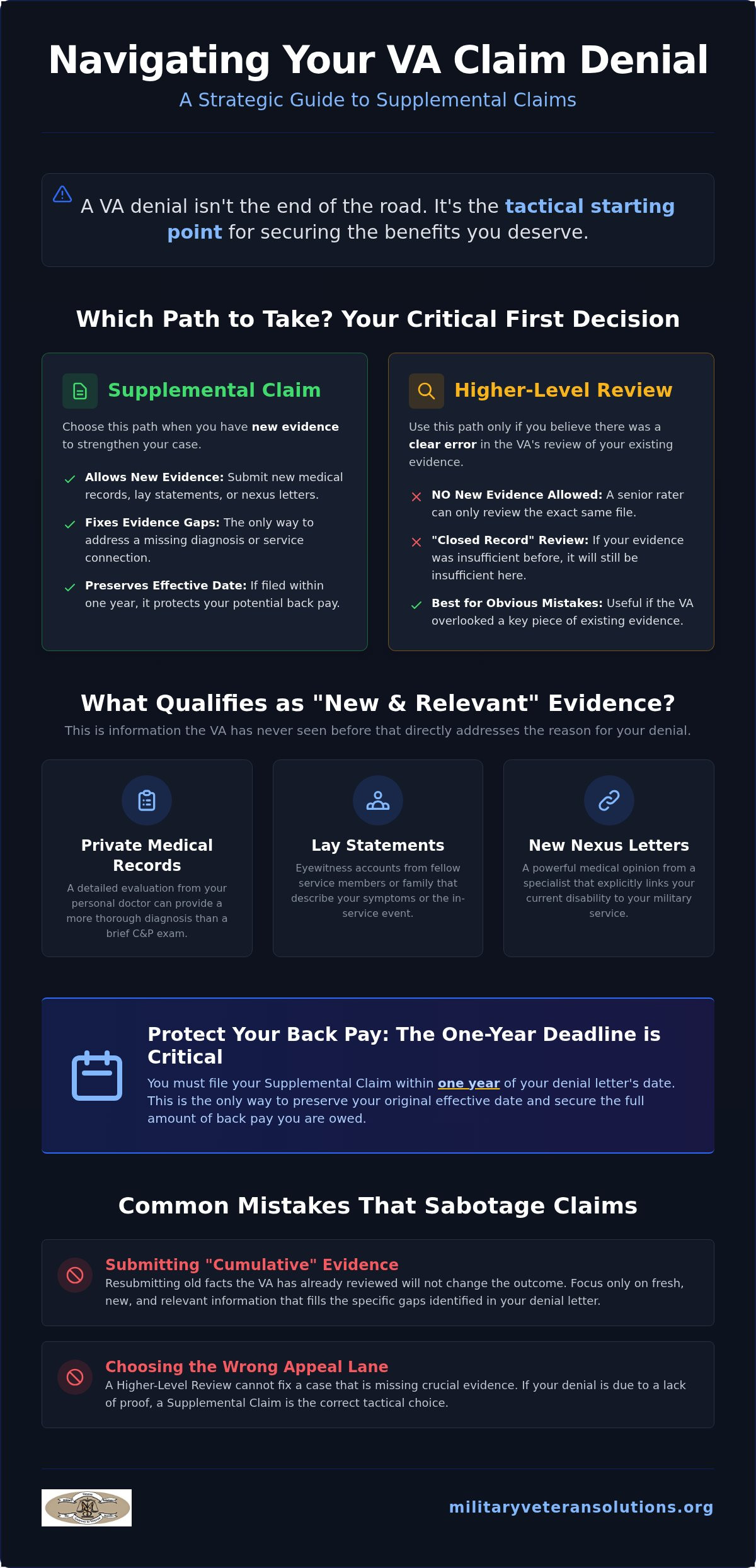
A VA denial isn't the end of your road; it's often the tactical starting point for the benefits you deserve. Many veterans view a rejection letter as a final judgment, but in reality, it's a signal to change your approach and reinforce your case. You've likely spent months waiting for a decision, only to open an envelope and find a rejection that seems to ignore your service history and medical reality. It's exhausting to face complex jargon and the constant fear that one wrong move could cost you years of back pay.
We understand that frustration because we've stood where you are. This guide provides the strategic VA supplemental claim help you need to navigate this administrative hurdle with confidence. You'll learn how to identify "new and relevant" evidence that actually moves the needle and why choosing the right appeal lane is a critical tactical decision. We'll preview the steps for a thorough military record review and show you how professional representation can handle the heavy lifting. By the end of this article, you'll have a clear path to secure the disability benefits you earned through your dedicated service.
Key Takeaways
- Distinguish between a Higher-Level Review and a Supplemental Claim to ensure you choose the tactical path that allows for new evidence submission.
- Identify the specific evidence gaps in your VA Decision Letter, such as a missing diagnosis or service connection, before you attempt to re-file.
- Utilize professional VA supplemental claim help to conduct an exhaustive review of your military records and find the critical details the VA previously missed.
- Protect your original effective date and potential back pay by filing your supplemental claim within the strict one-year deadline following your denial.
- Learn why submitting "cumulative" evidence that simply repeats old facts is a common mistake and how to focus exclusively on fresh, relevant data.
Understanding the VA Supplemental Claim: More Than Just a Re-Filing
The Appeals Modernization Act (AMA) fundamentally changed how you fight a denial. Under this system, the Supplemental Claim lane serves as a powerful tool when your initial evidence falls short. It isn't a simple re-filing of the same paperwork. Instead, it's a strategic opportunity to present fresh information that forces the VA to look at your case through a new lens. It's about movement and discovery. You're no longer just waiting for the system to work; you're taking control of the narrative.
Using this lane requires a psychological shift. You're no longer just requesting a benefit. You're proving a service connection using facts the VA previously ignored or lacked. If you're feeling overwhelmed by the process, seeking VA supplemental claim help can ensure you don't miss the critical window to protect your effective date. Filing within one year of your decision letter ensures you maintain your original claim date. This is the only way to secure the full amount of back pay you've earned through your service.
What Qualifies as New and Relevant Evidence?
The VA sets a specific bar for what they will consider. New evidence simply means information the agency did not have when they made their last decision. Relevant evidence is more targeted. It must directly address the specific reason the VA gave for your denial. If the VA denied you because they found no record of an in-service injury, a new medical report about your current pain won't help. You need evidence that proves the injury happened while you were in uniform.
- Private medical records: Documentation from your own doctors that provides a more thorough evaluation than a rushed C&P exam.
- Lay statements: Statements from fellow service members or family that provide eyewitness accounts of your symptoms or the in-service event.
- New Nexus letters: A medical opinion that explicitly links your current condition to your service.
When the Supplemental Lane is Your Best Strategic Move
Choosing this path is a tactical decision. If your denial was based on a lack of a formal diagnosis, and you've since seen a specialist who confirmed your condition, the supplemental lane is the correct choice. It's also the best move when a Compensation and Pension exam was unfavorable. You can counter a poor exam with private medical evidence that provides a more accurate picture of your disability. This forces the VA to weigh your evidence against their own findings.
You must avoid the "cumulative evidence" trap. Submitting more pages of the same medical notes the VA already reviewed won't change the outcome. It leads to an immediate secondary denial. You need fresh facts. Professional VA supplemental claim help focuses on identifying the missing link, such as a specific military record or a more detailed medical nexus, to ensure your appeal is built on a foundation of winning evidence.
Supplemental Claim vs. Higher-Level Review: Which Path to Take?
Choosing the wrong appeal lane can stall your benefits for years. When you receive a denial, you're faced with a tactical choice between a Higher-Level Review (HLR) and a Supplemental Claim. The fundamental difference lies in the evidence. An HLR is a request for a senior reviewer to look at the existing evidence and find a mistake. A Supplemental Claim is a fresh start that allows you to introduce new facts to the record. If your evidence was insufficient the first time, an HLR is often a dead end. You can't argue your way out of a missing medical nexus with a senior reviewer who isn't allowed to look at new documents.
Your VA Decision Letter is a tactical briefing that tells you exactly where your case is weak. We look for the "missing link" in every denial we review. If the VA acknowledges your in-service event but denies a diagnosis, an HLR won't fix that. You need a doctor to provide that diagnosis. This is where VA supplemental claim help becomes vital. By identifying the specific evidence gap, you can force the VA to reconsider your case based on a complete picture rather than a flawed, incomplete file. Our VA Decision Letter Analysis identifies exactly where the system failed you so we can build a stronger counter-attack.
The Higher-Level Review (HLR) Limitation
HLRs are strictly "closed record" reviews. This means the senior rater can only consider the evidence that was in your file the moment the previous decision was made. You cannot submit new doctor's notes, lay statements, or nexus letters during this process. This lane is reserved for "Clear and Unmistakable Errors" (CUE), such as the VA ignoring a service record that was already submitted. If your denial was based on a lack of medical evidence, filing an HLR is a waste of valuable time. It will almost certainly result in another denial because the reviewer's hands are tied by the existing record.
The Supplemental Claim Advantage
The Supplemental Claim lane offers unlimited opportunities to refine your case. As long as you provide "new and relevant" evidence, you can keep filing until you get the right result. This lane is particularly effective for "bridging the gap" using secondary conditions. For example, if your knee injury is denied, you might file a supplemental claim linking it to a service-connected back condition. This lane also triggers the VA's "Duty to Assist." If your new evidence creates a reasonable link, the VA may be forced to schedule a new C&P exam, giving you another chance to prove your case. At Military Veteran Solutions, we use over 25 years of experience to determine which lane offers the highest probability of success based on the specific language in your denial letter.
How to Prepare a Winning VA Supplemental Claim in 2026
Preparing a winning appeal is an evidentiary battle, not just a paperwork exercise. Many veterans fail because they treat the process as a simple request for reconsideration rather than a tactical presentation of facts. To succeed, you must approach your file with the precision of a military audit. You've already received a denial; now you need the right VA supplemental claim help to ensure the next decision goes in your favor. This process requires a methodical five-step approach to identify and fill the holes in your record.
Your first move is an exhaustive audit of your VA Decision Letter. This document is a roadmap that tells you exactly why the VA said "no." Once you identify the specific evidence gap, whether it's a missing diagnosis, a lack of an in-service event, or the absence of a medical link, you can begin gathering targeted proof. This involves securing high-quality medical evidence like Disability Benefits Questionnaires (DBQs) and Nexus letters. You should also draft impactful Lay Statements using VA Form 21-10210 to provide the personal context that medical codes often miss. Finally, file VA Form 20-0995 with a strategic cover letter that connects every piece of new evidence to the original reason for denial.
The Power of the Nexus Letter
A strong medical opinion is often the missing piece in supplemental claims. The VA requires a specific standard of proof known as "at least as likely as not," which means there is at least a 50% probability that your condition was caused by your service. A Nexus letter is the vital link between your current disability and your military service. Without this explicit connection from a qualified medical professional, the VA will likely maintain its denial regardless of how severe your symptoms are. We help you identify the specific medical logic needed to satisfy this legal requirement.
The Importance of a Military Record Review
Hidden evidence often sits buried in your Service Treatment Records (STRs) for decades. You might have forgotten a single clinic visit or a minor injury report that now serves as the foundation for your service connection. At Military Veteran Solutions, we conduct exhaustive record reviews to uncover these forgotten events. This is especially critical for conditions related to the PACT Act, where correlating your service dates and locations with presumptive conditions can turn a previously denied claim into a successful appeal. We don't just look at the records you have; we search for the ones the VA missed.
Common Mistakes That Sabotage Supplemental Claims
A denial letter often sparks an emotional reaction, but responding with frustration instead of strategy is a critical error. Many veterans fall into the "cumulative evidence" trap. They submit more pages of the same medical records the VA has already reviewed, hoping a different rater will reach a different conclusion. This doesn't work. Without fresh, relevant facts that address the specific "Reasons for Decision" in your letter, your claim will be rejected again. You need expert VA supplemental claim help to ensure your evidence actually moves the needle.
Timing is just as important as the evidence itself. You have exactly 365 days from the date on your decision letter to file a supplemental claim and protect your effective date. If you miss this window, you lose the potential for months or years of back pay. Another frequent mistake is relying on the VA to gather your private medical records. While they have a duty to assist, the system is backlogged and records often go missing. You should always obtain and submit your own private records to ensure the rater has a complete picture of your health.
Addressing Unfavorable C&P Exams
Don't just complain that a C&P examiner was rude or rushed. The VA won't overturn a denial based on a personality conflict. Instead, you must rebut their findings with objective medical facts. Use a supplemental claim to introduce a private medical rebuttal that specifically contradicts the examiner's logic. If the examiner claimed your condition isn't service-connected, your rebuttal should cite specific military records or specialized medical studies that prove otherwise. Challenging the "competency" of an examiner requires a professional touch, as you are essentially arguing that their medical rationale is flawed or incomplete.
The "Shotgun" Approach vs. Targeted Advocacy
Filing for 20 different conditions at once might feel like a thorough strategy, but it often leads to 20 denials. This "shotgun" approach overwhelms the rater and dilutes the strength of your most critical claims. A better tactic is to prioritize high-value conditions that offer immediate relief and a higher probability of success. Once those are secured, you can build on that momentum for secondary conditions. Professional representation streamlines this process by identifying which claims have the strongest evidentiary foundation. You can schedule a virtual consultation to begin a targeted analysis of your file and stop wasting time on a scattershot strategy.
Why Professional Representation is the Key to Your Appeal
Fighting the VA is an administrative war. You shouldn't have to face it alone. Military Veteran Solutions, LLC brings over 25 years of strategic advocacy to your corner. We aren't just filing paperwork. We're building a case based on two decades of navigating complex systems. Our firm is veteran-owned and founded by a 10-year Army veteran. We understand the gravity of your entitlements because we've lived it. We maintain a serious, advocacy-focused demeanor because we know what is at stake for your family's future.
Our approach goes beyond surface-level reviews. We provide a detailed VA Decision Letter Analysis for every client. This identifies the exact tactical failure in your original claim. Whether you're in California or Florida, our virtual consultations provide national access to expert record reviews. You get the specialized VA supplemental claim help you need without leaving your home. We bridge the gap between a formal professional service and a personal mentor to ensure your voice is heard.
Our Exhaustive Evidence Discovery Process
We don't just file; we audit. Our team conducts an exhaustive review of your entire military history to find missed connections. Many veterans focus on a single injury, but we look for secondary conditions that can significantly increase your overall rating. For example, a service-connected back injury often leads to nerve issues in the legs. If the VA didn't link those, we find the evidence to prove it. Having a professional ally in your corner provides the security that no detail is overlooked. This exhaustive discovery is what separates a professional audit from a volunteer service. We search for the specific medical logic and service events that fulfill the VA's requirements.
Ready to Fight for Your Earned Benefits?
A denial letter is a setback, not a defeat. It's a signal to regroup and attack from a different angle. Don't let a rater's mistake be the final word on your service. You've earned these benefits through your dedication and sacrifice. It's time to take control of your appeal with a battle-tested partner who knows how to win. We provide the expertise needed to turn a "no" into a "yes." Schedule a virtual consultation today to review your claim strategy and move forward with confidence. You've done the hard work of serving our country; now let us handle the heavy lifting of the appeal process. Get the professional VA supplemental claim help you deserve.
Take Control of Your VA Appeal Today
A VA denial is a temporary obstacle, not a final verdict. You now understand that the Supplemental Claim lane is a tactical opportunity to introduce the "new and relevant" evidence that was missing from your initial file. Whether you're correcting an unfavorable C&P exam or bridging the gap with a secondary condition, the key is a methodical approach to your medical records. Don't let the one-year deadline pass and risk losing the back pay you've earned through your service.
Professional VA supplemental claim help ensures your appeal is built on an exhaustive audit of your military history rather than guesswork. Founded by a 10-year disabled Army Veteran with over 25 years of VA claim experience, Military Veteran Solutions provides the battle-tested advocacy you need. We offer virtual consultations nationwide to help you navigate this complex administrative landscape with a trusted ally by your side. Secure Your Benefits with Professional Claim Representation.
You served your country with honor. Now, it's time to secure the benefits that honor that service.
Frequently Asked Questions
What is the deadline for filing a VA Supplemental Claim?
You have exactly one year from the date listed on your VA decision letter to file a Supplemental Claim. Missing this 365 day window means you lose the ability to protect your original effective date for back pay. If you miss the deadline, you can still file later, but the VA will likely treat it as a new claim with a new, later effective date.
Can I file a Supplemental Claim after a Higher-Level Review denial?
You can absolutely file a Supplemental Claim after receiving a Higher-Level Review denial. Since an HLR is a closed record review, a Supplemental Claim is often the only way to introduce the new evidence needed to fix the errors identified in that review. It's a strategic way to keep your claim alive while adding the missing facts the HLR reviewer wasn't allowed to see.
How long does it take the VA to process a Supplemental Claim in 2026?
The VA currently targets an average processing time of 125 to 150 days for Supplemental Claims in 2026. While some cases move faster, complex claims involving extensive record reviews may take longer depending on the current backlog. Working with professional VA supplemental claim help ensures your evidence is organized correctly the first time, which helps prevent unnecessary administrative delays and gets you a decision faster.
Do I need a new Nexus letter for every Supplemental Claim?
You don't always need a brand new Nexus letter, but you must provide evidence that is both new and relevant. If your previous Nexus letter was the reason for the denial because it lacked specific medical logic, you'll need an updated or more detailed opinion. The goal is to provide the medical link that the VA rater found missing in your last decision letter to prove your connection.
Will a Supplemental Claim protect my original back pay date?
A Supplemental Claim protects your original back pay date as long as you file it within one year of your last denial. This ensures your benefits are calculated from the time you first filed the claim rather than the date of the appeal. Maintaining this continuous pursuit is the most effective way to secure the full financial benefits you've earned through your dedicated service to our country.
What happens if my Supplemental Claim is denied again?
You can file another Supplemental Claim or move your appeal to the Board of Veterans' Appeals if you're denied again. There's no limit to how many times you can use the Supplemental lane as long as you provide fresh, relevant facts the VA hasn't seen before. Each denial provides a roadmap of what's missing, allowing you to refine your evidence and try again until you succeed.
Can I submit buddy letters as new and relevant evidence?
Buddy letters are considered new and relevant evidence and can be very effective in overturning a denial. These statements from fellow service members or family provide the personal context that medical codes often miss. They're especially powerful for proving in-service events or showing how your symptoms impact your daily life. Use VA Form 21-10210 to ensure these statements are officially recognized as part of your file.
Is it better to use a VSO or a professional advocacy firm like Military Veteran Solutions?
VSOs provide a valuable free service, but they often handle high caseloads that limit the time they can spend on your specific file. Military Veteran Solutions offers an exhaustive, veteran-led approach backed by over 25 years of experience. We specialize in deep-dive military record reviews and decision letter analysis to find the tactical path to victory that high-volume offices might overlook. Professional VA supplemental claim help ensures you don't face the system alone.


