
A Notice of Disagreement is a tactical strike, not just a bureaucratic requirement. While many veterans fear the Board of Veterans' Appeals is a black hole of waiting, your success in 2026 actually depends on how you utilize the va notice of disagreement form to match your evidence to the right lane. You've sacrificed for this country, and receiving a denial letter can feel like a personal betrayal. It's exhausting to face a system that seems designed to overwhelm you with technicalities and the threat of multi-year delays.
We understand the weight of these decisions and the pressure to get it right. This guide will help you master VA Form 10182 and strategically choose the appeal lane that secures your earned benefits. You'll learn how to navigate the June 2026 form updates, compare the processing times of the three dockets, and follow a precise roadmap toward your 100% disability rating. We'll move past the confusion of Supplemental Claims and focus on a Board strategy that puts you back in control of your claim's future.
Key Takeaways
- Protect your effective date by filing within the strict 365-day window to ensure you receive the full back pay you've earned.
- Navigate the va notice of disagreement form with precision by choosing the specific appeal lane that aligns with your current medical evidence and timeline goals.
- Prioritize accuracy in Section II of Form 10182, as this single choice determines whether a judge can review new records or if you're limited to existing evidence.
- Avoid the common "shotgunning" pitfall that delays claims; instead, focus on high-impact issues identified through a professional VA Decision Letter Analysis.
- Leverage a thorough military record review to uncover the "Nexus" between your service and your condition, providing the Board with a clear path to grant your benefits.
Understanding the VA Notice of Disagreement (NOD) and the Board Appeal
The va notice of disagreement form, officially known as VA Form 10182, is your formal gateway to the Board of Veterans’ Appeals (BVA). This document is a product of the Appeals Modernization Act (AMA), which was designed to give you more control over how your claim is reviewed. Unlike the old Legacy system that required multiple steps like a Statement of the Case and a Form 9, the AMA streamlines the process. If you received a decision letter from a VA regional office dated after February 19, 2019, you're eligible to use this modern pathway.
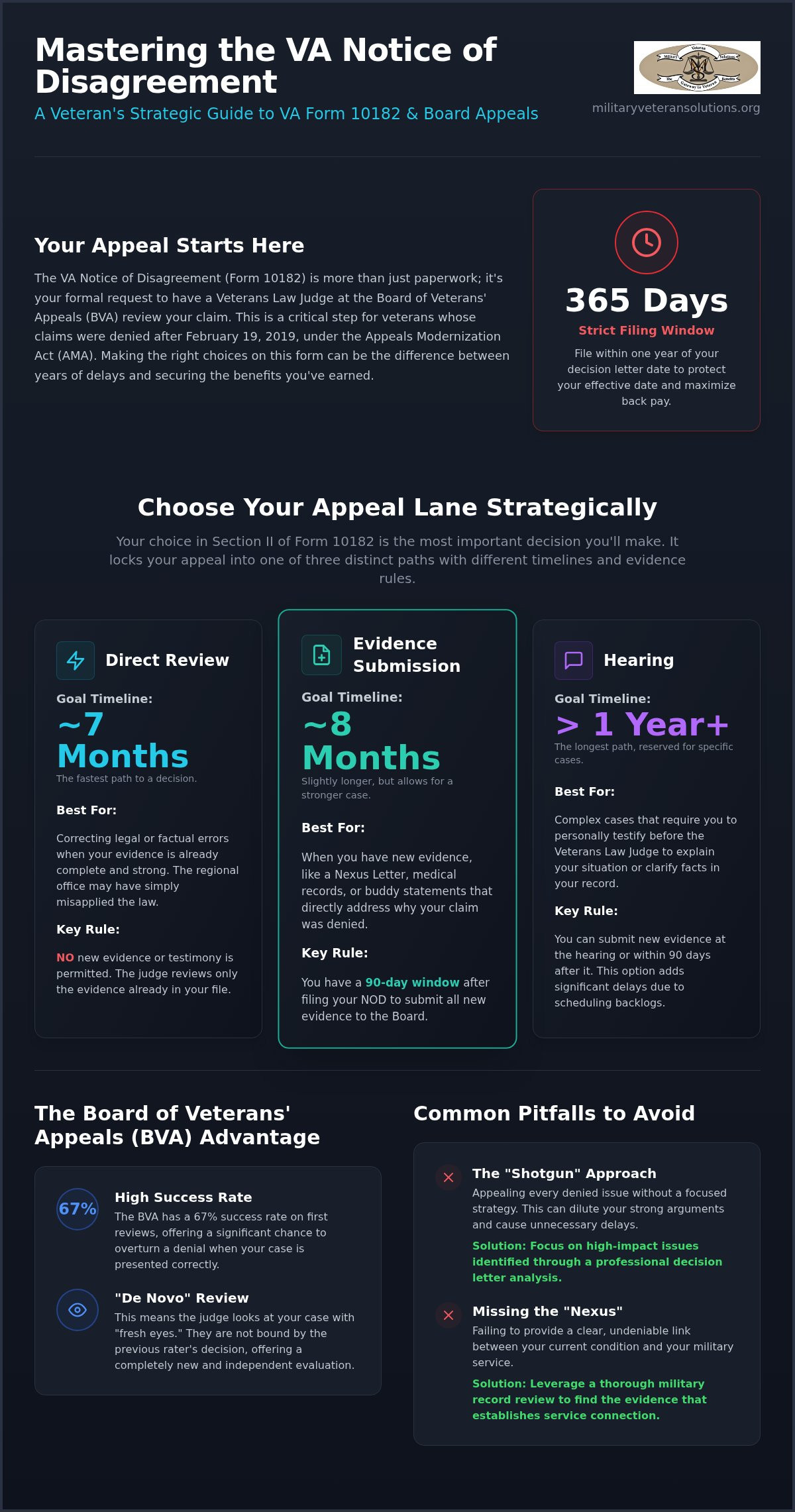
Timing is the most critical factor for your financial future. You have exactly one year, or 365 days, from the date stamped on your VA decision letter to file your NOD. If you miss this deadline, you lose the ability to keep your claim "continuously pursued." This means you could lose years of potential back pay because your effective date will reset. In 2026, with 100% disability rates reaching $3,930.96 for a single veteran, protecting that effective date isn't just paperwork; it's a significant financial safeguard for your family.
When to Choose a Board Appeal Over Other Decision Reviews
Deciding between a Supplemental Claim, a Higher-Level Review (HLR), and a Board Appeal is a strategic choice. A Supplemental Claim is useful if you have new medical evidence to submit. An HLR is faster but limits you to the evidence already in your file. You should choose the Board of Veterans' Appeals when you need a Veterans Law Judge to interpret complex legal issues or when the regional office has repeatedly ignored the "Nexus" in your records. Before you touch the va notice of disagreement form, we perform a comprehensive VA Decision Letter Analysis. This helps us determine if a judge's intervention is necessary to overturn a stubborn denial that a regional rater simply won't fix.
The Anatomy of the Board of Veterans’ Appeals (BVA)
Once you file Form 10182, your claim leaves the local regional office and moves to the Board in Washington, D.C. In 2026, the Board is processing between 600 and 700 decisions every month. The most important aspect of this process is the "de novo" review. This means the Veterans Law Judge looks at your case with fresh eyes. They aren't bound by whatever the previous rater decided. It's a completely independent evaluation of the facts and the law. Depending on the lane you select, the judge will either review your existing file, look at new evidence you provide, or listen to your testimony during a hearing to ensure every service-connected condition is accurately rated.
Selecting Your Board Appeal Lane: Evidence, Direct, or Hearing?
Choosing the right docket is the most important decision you'll make when filing your va notice of disagreement form. Each lane serves a specific purpose; picking the wrong one can stall your benefits for years. Understanding VA decision review options is essential before you check a box that locks you into a specific process. In 2026, the Board of Veterans' Appeals (BVA) is seeing a 67% success rate on first reviews, but your speed and outcome depend entirely on matching your evidence to the correct lane.
Direct Review: The Fastest Path to a Decision
If your medical evidence is already solid but the rater simply misapplied the law, the Direct Review lane is your best friend. It's the fastest route available. In 2026, the average processing time for this lane is just under 7 months. You can't submit new records or testimony, so this lane is purely for correcting legal mistakes. If you're confident your file contains everything needed to prove service connection, don't let the VA waste your time in slower lanes. We often find that a clear legal error is the only thing standing between a veteran and their rating.
Evidence Submission: Building a Stronger Record
Sometimes, you realize a critical piece of the puzzle is missing only after you receive your denial. The Evidence Submission lane allows you to add new medical records, Nexus letters, or lay statements within a 90-day window of filing your appeal. This is where a professional military record review becomes invaluable. We help you identify the specific service records that bridge the gap between your time in uniform and your current diagnosis. This lane takes close to 8 months on average. That extra month of waiting is a small price to pay if it provides the judge with the "missing link" required to grant your claim.
The Hearing Lane: Is It Worth the Wait?
Many veterans feel they need to "tell their story" to a judge to get a fair shake. While a hearing can be powerful, you must weigh that desire against the current timeline. As of July 2026, the average wait for a hearing is approximately 2.4 years. The Board offers virtual hearings, Travel Board sessions, and hearings at the Central Office in D.C., but all three suffer from significant backlogs. If your case can be won with a strong medical nexus and a clear record, the hearing lane might be an unnecessary delay. Reserve this option for complex cases where your personal testimony is the only way to clarify conflicting medical evidence.
Step-by-Step: Filling Out VA Form 10182 for 2026
Filing your va notice of disagreement form isn't just about filling in blanks; it's about building a legal record. The VA recently updated the official VA Form 10182 (Notice of Disagreement) in June 2026. Using an outdated version is one of the fastest ways to get your appeal rejected before a judge even sees it. Precision is your best defense against administrative delays that can push your benefits back by months.
Section I requires your basic identification. Ensure your Social Security number and VA file number are perfect. Section II is where you commit to your appeal lane. As we discussed, this choice is final once the one-year filing window closes. Section IV and V cover your representative information and your certification. Don't let a missing signature in Section V invalidate months of preparation. Every box matters when your financial security is on the line.
How to Describe Your Disagreement in Section III
Section III is the heart of the va notice of disagreement form. This is where you list each specific issue you're appealing. Vague statements like "I disagree with my rating" often lead to administrative hurdles or a rater missing the point of your appeal. Instead, use the results of your VA Decision Letter Analysis to pinpoint exactly where the regional office failed. Specificity forces the judge to address the exact error you've identified.
For example, if you're appealing a PTSD rating, don't just write "PTSD." Instead, write: "Disagreement with the 30% rating for PTSD; evidence supports a 70% rating based on occupational and social impairment." For a physical injury, be precise: "Appeal of denied service connection for lumbar spine strain; service treatment records from 2014 confirm the initial injury." This level of detail ensures the Board understands exactly what needs to be corrected.
Common Technical Errors That Cause Delays
Even a strong case can be derailed by simple mistakes. In 2026, the Board of Veterans’ Appeals processes hundreds of claims monthly, and they don't have time to chase down missing information. Avoid these common pitfalls:
- Outdated Form Versions: Always verify you're using the June 2026 revision of Form 10182.
- Premature Filing: You can only appeal issues that have a final decision from the regional office. Don't list "pending" claims that haven't been decided yet.
- Missing Signatures: Both you and your representative must sign the document. Digital signatures are accepted but they must be valid and verified.
- Incorrect Identifiers: A single transposed digit in your SSN or claim number can cause your appeal to be lost in the system for weeks.
Double-check every box before submission. A mistake here isn't just a minor delay; it's a direct threat to your effective date and your potential back pay. We've seen too many veterans lose ground because of a clerical error that could have been caught with a final review.
Strategic Pitfalls to Avoid When Filing Your Notice of Disagreement
Filling out the va notice of disagreement form is a tactical strike, but one wrong move can disarm your entire appeal. The most common trap is submitting "New and Relevant" evidence while selecting the Direct Review lane. If you check that box, the judge is legally prohibited from looking at anything not already in your file at the time of the original decision. You've essentially handed the VA a reason to ignore your new medical proof. Additionally, avoid "shotgunning" every minor disagreement. Listing dozens of low-value issues often buries your high-priority claims, like a 100% PTSD rating, under a mountain of bureaucratic noise.
Managing a partial grant requires a steady hand. If the VA grants you 30% for a condition you know deserves 70%, you can accept the payment while simultaneously appealing for the higher rating. Don't let the fear of losing what you've already "won" stop you from pursuing what you've earned. However, you must respect the 90-day window in the Evidence Submission lane. Missing this deadline by even one day means your new nexus letters or private doctor statements won't be considered. We've seen years of back pay vanish because of a simple calendar error.
Can You Change Your Appeal Lane After Filing?
You can change your lane, but it comes with a cost. To switch dockets, you typically must withdraw your current va notice of disagreement form and file a new one. This action usually resets your place in the BVA queue. For example, if you've been waiting for a hearing for over 2 years and decide to switch to Direct Review to get a faster result, you lose your seniority. This is a high-stakes decision that requires careful analysis of current Board processing times, which as of July 2026, show a massive gap between the 7-month Direct Review and the 2.4-year Hearing wait.
Understanding the "Duty to Assist" at the Board Level
The Board of Veterans’ Appeals operates under different rules than your regional office. Under the AMA, the "Duty to Assist", the VA's obligation to help you gather evidence, is significantly limited once your case reaches a judge. In the Direct Review and Evidence Submission lanes, the burden of proof rests squarely on your shoulders. The judge will not go looking for missing records or schedule new C&P exams for you. This evidence gap is exactly why we conduct deep-dive Military Record Reviews. We find the evidence the VA missed so you can present a complete, winnable case to the Board without relying on their help.
Winning Your Appeal with Professional Veteran Advocacy
Filing the va notice of disagreement form is only the first step in a high-stakes battle for your future. A simple "form-filler" will record your complaints and submit the paperwork, but a dedicated advocate does much more. We scrutinize your denial to find the exact moment the system failed you. Success at the Board of Veterans’ Appeals requires more than just disagreement; it requires a superior argument backed by evidence that the regional office rater was too busy to find. You deserve a partner who views your claim with the same gravity you do.
Our approach centers on deep-dive VA Decision Letter Analysis and comprehensive military record reviews. We don't just look at your current symptoms. We go back to your original service records to find the "Nexus" that connects your disability to your time in uniform. Founded by a 10-year Army veteran with over 25 years of experience in veteran advocacy, Military Veteran Solutions, LLC understands the technicalities of the 2026 appeals landscape. Through our Virtual Consultations, we provide national-level expertise to veterans everywhere, ensuring you have a powerful ally in your corner without ever needing to leave your home.
The Military Veteran Solutions, LLC Process for Appeals
We follow a methodical three-phase process to ensure your appeal is airtight before it reaches a judge's desk. First, we conduct an exhaustive review of your military service and medical records. We look for the small details, such as a single entry in a field medical card, that can prove service connection. Second, we perform a strategic lane selection. We analyze whether the 7-month Direct Review or the 8-month Evidence Submission lane is more advantageous based on the specific gaps in your file. Finally, we craft a sophisticated legal argument for the Veterans Law Judge, pinpointing exactly where the lower office misapplied the law or ignored critical evidence.
Taking the Next Step Toward Your 100% Rating
Many veterans remain stuck at a 70% or 90% rating because the VA failed to account for secondary conditions or miscalculated the severity of their symptoms. An NOD is your opportunity to correct these percentage errors and move closer to the 100% rating you've earned. Whether it's a physical injury that has caused secondary nerve damage or PTSD that has led to sleep apnea, we identify these connections to maximize your compensation. Don't let a flawed decision stand. Schedule your virtual consultation for a professional appeal review and let us help you turn your denial into a win.
Secure Your Benefits with a Strategic Board Appeal
Your journey toward a fair disability rating doesn't have to be a solo mission. By now, you understand that the va notice of disagreement form is a precision tool that requires careful lane selection and meticulous attention to detail. Whether you choose the speed of Direct Review or the depth of Evidence Submission, your success depends on a clear strategy and a deep understanding of your own military medical record. Protecting your effective date and maximizing your back pay requires moving beyond simple paperwork into the territory of dedicated advocacy.
Military Veteran Solutions was founded by a 10-year Army veteran who has navigated these exact hurdles and intimately understands the system. We bring over two decades of experience in winning complex appeals to your case. We don't just file paperwork; we conduct comprehensive military record reviews to uncover the vital evidence the VA often misses. You've fought for your country, and now it's our turn to fight for you. Don't let a technical error or a missed deadline stand between you and your 100% rating.
Get a Professional VA Decision Letter Analysis Today
You have already taken the first step by educating yourself on this process. Stay focused, stay persistent, and remember that with the right advocacy, the benefits you've earned are well within reach.
Frequently Asked Questions
What is the deadline to file VA Form 10182?
You have exactly one year, or 365 days, from the date on your VA decision letter to file the va notice of disagreement form. This timeline is rigid and essential for protecting your effective date. If your claim involves a contested matter, such as a dispute with another person over benefits, the deadline is much shorter at 60 days. Missing this window usually means you lose your right to appeal that specific decision.
Can I submit new evidence with a Direct Review Board Appeal?
No, you cannot submit any new evidence if you select the Direct Review lane on your va notice of disagreement form. A Veterans Law Judge will only review the evidence that was already in your file when the regional office made its decision. If you have new medical records or nexus letters, you must choose the Evidence Submission or Hearing lane instead to ensure that information is considered.
How long does a VA Board Appeal take in 2026?
Processing times vary significantly based on the lane you choose. In 2026, a Direct Review takes just under 7 months, while the Evidence Submission lane averages close to 8 months. If you request a hearing, prepare for a much longer wait of approximately 2.4 years. Selecting the correct lane is the most effective way to control how quickly you receive a final decision from the Board.
What is the difference between an NOD and a Higher-Level Review?
A Higher-Level Review (HLR) is a request for a senior rater at a regional office to look for errors, whereas an NOD sends your case to a Veterans Law Judge. HLRs are generally faster, taking 4 to 7 months, but they don't allow new evidence. An NOD provides a more thorough "de novo" review and offers lanes where you can submit new medical proof to support your claim.
Do I need a representative to file a Notice of Disagreement?
You aren't legally required to have a representative, but professional advocacy significantly improves your chances of success. In 2026, 67% of appeals are successful on the first review when handled correctly. An expert can perform a military record review to find the "Nexus" that a veteran might miss. This specialized support ensures your appeal is built on legal facts rather than just frustration with the system.
Can I appeal a Supplemental Claim decision with an NOD?
Yes, you can file an NOD to appeal a decision made on a Supplemental Claim. If the regional office denied your Supplemental Claim or gave you an unsatisfactory rating, moving to the Board of Veterans' Appeals is a common next step. This allows a judge to review the new evidence you previously submitted and determine if the regional rater made a legal or factual mistake.
What happens if I miss the one-year deadline for my appeal?
If you miss the 365-day deadline, the VA decision becomes final. You can no longer file an NOD for that specific decision. To move forward, you would typically need to file a new Supplemental Claim with new and relevant evidence. However, doing this resets your effective date to the new filing date, which often results in the loss of years of potential back pay.
How do I check the status of my Board Appeal?
You can check your appeal status online through the VA.gov website or the VA flagship mobile app. These tools provide real-time updates on whether your appeal is waiting for a judge, in the evidence-gathering phase, or if a decision has been mailed. If you're working with a representative, they can also access internal systems to provide more detailed updates on your case's progress.


