
What if the expensive medical opinion you purchased was never actually designed to survive the VA's scrutiny? You spent hundreds, perhaps thousands, on a professional opinion only to open your mail and find your va claim denied with nexus letter anyway. It is a crushing moment that leaves many veterans feeling like the system is rigged against them. You followed the advice, found a doctor, and submitted the paperwork, yet the Decision Letter still came back with a cold rejection. We know how exhausting this cycle is. You aren't just fighting for a check; you're fighting for the acknowledgment of what you endured during your service.
You don't have to accept a "no" as the final word. This guide will help you discover why your nexus letter failed and the exact steps to overturn a VA denial using expert record analysis. We are going to deconstruct the five most common myths that lead to these denials in 2026. You will learn how to identify the specific flaws in your current evidence and choose the right path, whether it is a Supplemental Claim or a Higher-Level Review, to finally secure the benefits you earned.
Key Takeaways
- Understand why a va claim denied with nexus letter often occurs when a medical provider fails to provide a detailed rationale or confirm a full review of your C-File.
- Learn how to decode the jargon in your VA Decision Letter to find the "missing link" that is preventing your service connection.
- Discover why the probative value of your evidence matters more than the source, and how to ensure your private medical opinion carries more weight than a negative C&P exam.
- Find out how a thorough Military Record Review serves as the foundation for building a winning Supplemental Claim or Higher-Level Review in 2026.
- Recognize the strategic advantage of having a veteran-owned ally audit your files to identify hidden evidence the VA missed.
Myth #1: A Nexus Letter Is a Guaranteed Win for Service Connection
Many veterans believe that once they hand over a medical opinion, the battle is over. It isn't. A nexus letter is simply a bridge. It connects your current disability to a specific event in your military history. If that bridge is built on sand, it will collapse under the weight of a VA review. This is why you see a va claim denied with nexus letter even when the doctor's signature is clear. The VA doesn't owe you a win just because you found a doctor to sign a form. They demand a clinical argument that stands up to their internal medical experts.
The Veterans Benefits Administration uses a standard called "probative value" to judge your evidence. They don't just check a box because you submitted a document. They look at the quality of the reasoning. If a doctor fails to state they reviewed your entire C-File or fails to explain the specific medical "why" behind their conclusion, the VA may grant the letter "zero weight." This means they acknowledge the letter exists but decide it has no power to prove your case. A letter is only as strong as the military records that support it.
The Three Pillars of a Successful VA Claim
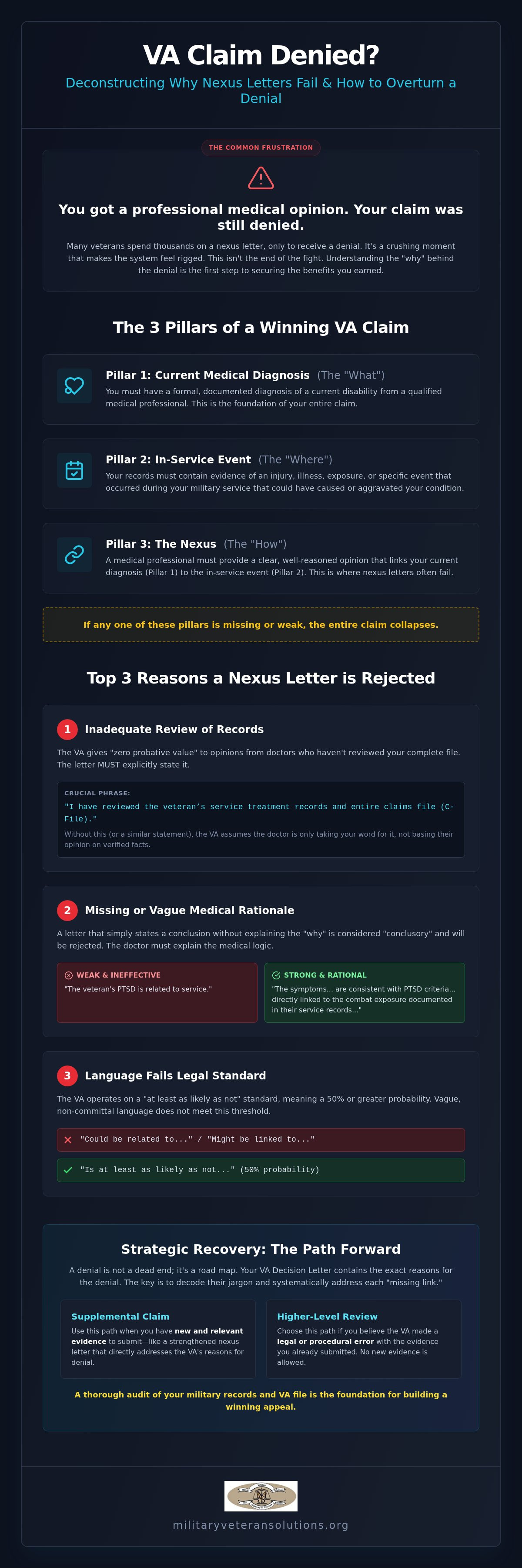
Winning your appeal requires more than just one good document. You must establish three distinct pillars to satisfy the VA's requirements. These include:
- Current medical diagnosis: You must have a formal, documented diagnosis of a disability. This is the "What" of your claim.
- In-service event: You need evidence of an injury, illness, or event that occurred during service. This is the "Where."
- The Nexus: A medical professional must link the current diagnosis to the in-service event. This is the "How."
If any of these pillars are missing or weak, the entire claim fails. Discovering your va claim denied with nexus letter is frustrating, but it usually points to a failure in one of these core areas. We often find that the "How" is the weakest link because the provider didn't have access to the full military record.
Why "Likely as Not" Isn’t Always Enough
The legal standard for VA claims is "at least as likely as not." This means there is a 50% or greater probability that your condition is service-connected. However, many doctors use vague language that sinks a claim before it starts. Phrases like "could be related" or "might be linked" are non-committal. They don't meet the legal threshold. A strong opinion uses specific peer-reviewed medical literature to back up its claims. Without this scientific foundation, the VA can easily dismiss the opinion as speculative. Your letter must be an airtight clinical argument, not just a friendly note from a physician.
Common Reasons the VA Rejects a Nexus Letter
Understanding why the VA rejects evidence is the first step toward winning your appeal. A va claim denied with nexus letter usually isn't a reflection of your doctor's skill. Instead; it often stems from technical omissions that give the rater a reason to discount the opinion. For example, if a general practitioner writes an opinion for a complex neurological condition, the VA may argue the author lacks the specialized expertise to provide a "competent" medical opinion. Similarly, if the letter contradicts your existing service treatment records without explaining why, the rater will almost always side with the historical military record.
The "Review of Records" Requirement
The VA places immense weight on whether a doctor has seen your full history. If a nexus letter doesn't explicitly state "I have reviewed the veteran’s service treatment records and entire claims file," the VA may grant it zero probative value. They assume the doctor is simply taking your word for what happened rather than basing their opinion on verified facts. When you follow the official VA claim filing process, the agency expects every piece of evidence to be grounded in your actual history. This is where many "Nexus Mills" fail you. They often provide boilerplate letters using templates that lack a deep dive into your specific records. We see this frequently with veterans who bought a cheap letter only to find their claim rejected because the rater realized the doctor never actually opened the veteran's C-File.
The "Detailed Medical Rationale" Gap
A "conclusory" statement is the fastest way to get a va claim denied with nexus letter. If your doctor simply writes, "The veteran's PTSD is related to service," the VA will reject it for lacking rationale. Medical rationale is the logical path from cause to effect. You need a narrative that explains how the in-service event triggered the biological or psychological change that led to your current diagnosis.
For a condition like Tinnitus, a strong rationale would cite specific acoustic trauma recorded in your MOS history and link it to current audiogram results using peer-reviewed studies. For PTSD, it would detail how specific stressors caused documented behavioral shifts. Our team performs a comprehensive Military Record Review to ensure every fact aligns with the clinical reasoning required for a win. Without this detailed "why," your nexus letter is just an unsupported opinion that the VA is legally allowed to ignore.
Myth #2: Private Medical Opinions Always Outweigh VA C&P Exams
It is a common and painful realization for many veterans. You submit a high-quality private medical opinion, only to have it dismissed in favor of a negative Compensation and Pension (C&P) exam. This is a primary reason for a va claim denied with nexus letter. The VA often treats their own examiners as the final word; even if that examiner only spent fifteen minutes in the room with you. You might feel like the scale is tipped against you, and in many cases, it is.
Legally, the VA is supposed to follow the principle of "Equipose." This means that if the evidence for and against your claim is roughly equal, the benefit of the doubt must go to the veteran. However; raters frequently bypass this by claiming the VA examiner's opinion has more "probative value." They might argue the VA doctor is more familiar with military standards or your specific records. To win, you must prove your private expert is more competent and better informed than the contractor the VA hired.
Nexus Letter vs. C&P Exam: How the VA Decides
When two medical opinions clash, the VA rater acts as a judge. They look at specific factors to decide which one to believe. These include:
- Credentials: A nexus letter from a board-certified specialist carries more weight than a C&P exam conducted by a general practitioner or a nurse practitioner.
- Depth of Record Review: We ensure our partners review your entire C-File. If the C&P examiner admits they didn't read your service treatment records, their opinion is legally vulnerable.
- Clinical Evidence: A winning letter doesn't just offer an opinion. It provides specific citations from medical journals that prove the link you're claiming.
Countering a Negative C&P Exam
You don't have to accept a biased C&P report. Your first step is to see exactly what the examiner wrote. You can request a copy of the exam through a Freedom of Information Act (FOIA) request. Once you have the results, look for factual errors. Did they claim you never deployed when your records show you did? Did they ignore a specific injury mentioned in your exit physical?
Using a Supplemental Claim allows you to introduce a formal rebuttal. This is where an advocacy expert can help you draft a statement that points out the examiner’s lack of logic or failure to consider key evidence. By highlighting these flaws, you can force the VA to reconsider your private nexus letter or order a new, fair exam. Don't let a single bad appointment end your pursuit of the benefits you deserve.
Strategic Recovery: Auditing Your VA Decision Letter
Opening the envelope and seeing "Denied" is a gut-punch. However, that document is more than just a rejection. It is a roadmap to your eventual approval. When you find your va claim denied with nexus letter, the VA is required to explain exactly why they didn't believe your evidence. You must distinguish between a factual denial and a medical opinion denial. A factual denial means the VA doesn't believe your in-service event occurred. A medical opinion denial means they acknowledge the event but don't believe your condition is related to it. Understanding this distinction changes your entire appeal strategy.
The Anatomy of a VA Denial
Decoding your letter starts with the Evidence section. Look closely at the list of documents the rater reviewed. If your nexus letter isn't listed, they didn't consider it. This is a clear administrative error. Next, scrutinize the "Reasons for Decision." This is where the VA reveals the "Missing Link." They might say your doctor’s rationale was "speculative" or that it lacked a "review of records" as we discussed earlier. Don't overlook the "Favorable Findings" section. These are the elements the VA has already conceded, such as a current diagnosis or proof of an in-service stressor. You don't need to prove these again; you only need to fix the broken link identified in their reasoning.
Choosing the Right Appeal Path in 2026
You generally have 365 days from the date on your letter to file an appeal. Missing this deadline can result in the decision becoming final, which might cost you years of back pay. If you have a va claim denied with nexus letter because the medical opinion was weak or ignored, a Supplemental Claim is often your best path. This allows you to submit new and relevant evidence, like a stronger, more detailed medical opinion that addresses the VA's specific objections.
If the evidence was already in your file but the rater made a legal error or ignored a fact, a Higher-Level Review (HLR) is a faster option. This involves a senior rater looking at the same evidence without allowing new documents. For the most complex cases, the Board of Veterans’ Appeals (BVA) remains an option, though wait times in 2026 currently range between 365 and 550 days. Stop guessing why you were rejected and start building a winning strategy. Our team provides a specialized VA Decision Letter Analysis to identify the exact errors the VA made in your case and determine which appeal path will get you to a "yes" fastest.
Professional Advocacy: How Military Veteran Solutions Overturns Denials
You don't have to navigate this complex system alone. Military Veteran Solutions was founded by a 10-year Army veteran who understands the personal weight of a va claim denied with nexus letter. We aren't just a service; we are your strategic ally. With over 25 years of experience in veteran advocacy, we know exactly where the VA sets the bar for approval. Our process always begins with a specialized VA Decision Letter Analysis. We find the specific technicality, missing link, or evidentiary gap that caused your denial. This targeted approach ensures your appeal isn't just another shot in the dark.
Our firm bridges the gap between your military history and the VA's clinical requirements. Many veterans lose their claims because their evidence lacks the depth required by modern standards. We specialize in identifying "hidden" service connections that other firms often miss. By looking at the totality of your service, we uncover the documented events that provide the necessary foundation for a successful appeal. We treat your claim with the gravity it deserves; because we have been in your boots.
Our Exhaustive Record Review Process
A thorough Military Record Review is the cornerstone of any winning appeal. We don't just skim your files. Our team performs an exhaustive audit to find the in-service events that private doctors and VA raters frequently overlook. This creates a powerful synergy between your actual history and the nexus evidence required for service connection. We focus on building a "fully developed" claim. This means that by the time your appeal hits the rater’s desk, every question has been answered and every medical rationale has been supported by your records. This level of preparation is designed to leave the VA with no choice but to grant the benefits you earned.
Virtual Consultations: Expert Help Nationwide
We believe that your location should never dictate the quality of your advocacy. Through our virtual consultations, we remove geographic barriers and provide high-quality representation to veterans across the country. This model allows us to maintain a calm, steady presence as we guide you through the evaluation process. You can schedule your initial analysis and record review with ease, knowing you are working with a veteran-owned firm that puts your interests first. Get your VA Decision Letter analyzed by experts today at Military Veteran Solutions.
Secure the Benefits You Earned
Finding your va claim denied with nexus letter is not the end of your journey; it is a signal to refine your strategy. You now know that a nexus letter is only as strong as the military records supporting it and that a negative C&P exam is a hurdle, not a wall. By auditing your Decision Letter and identifying the exact clinical gap, you turn a rejection into a roadmap for a successful appeal in 2026. Whether you choose a Supplemental Claim or a Higher-Level Review, your next move must be calculated and evidence-based.
You deserve a strategic ally who understands the system from the inside. Military Veteran Solutions was founded by a 10-year Army Veteran with over 25 years of dedicated advocacy experience. We provide exhaustive record reviews and virtual consultations nationwide to ensure every veteran has access to elite representation. Don't let technicalities or missing links stand between you and your rating. Schedule your VA Decision Letter Analysis and start your appeal today. Your service carried a cost, and it's time you received the support you were promised. We are ready to help you win.
Frequently Asked Questions
Can the VA deny a claim even if I have a nexus letter from my doctor?
Yes, the VA can and frequently does deny claims despite the presence of a nexus letter. Rejection usually happens because the rater determines the letter has low probative value. If the medical professional failed to review your entire C-File or if the clinical rationale is seen as speculative, the VA is legally allowed to discount the opinion. Simply having a letter is not enough; it must be a scientifically backed argument.
What makes a nexus letter "strong" enough to win an appeal?
A strong letter must explicitly state that the provider reviewed your complete service treatment records and use the legal standard "at least as likely as not." It should move beyond simple conclusions by providing a detailed medical rationale supported by peer-reviewed literature. Vague language like "could be related" often results in a va claim denied with nexus letter because it fails to meet the 50% probability threshold required by law.
Does a nexus letter have to be written by a medical doctor?
While Physician Assistants and Nurse Practitioners can provide nexus evidence, the VA often assigns higher weight to board-certified specialists. The author must be a qualified medical professional with specific expertise in the field related to your disability. For complex conditions like sleep apnea or neurological disorders, an opinion from a specialist in that discipline is far more persuasive than a general note from a primary care physician.
How much weight does the VA give to a private nexus letter vs. a C&P exam?
The VA does not have a legal requirement to favor its own examiners over private doctors. The deciding factor is the probative value of each opinion. A private medical opinion can successfully rebut a negative C&P exam if it is better reasoned, cites more specific evidence from your military records, and provides stronger clinical citations. We focus on ensuring your private evidence is more comprehensive than the VA’s brief exam.
Can I submit a new nexus letter as part of a Supplemental Claim?
Yes, submitting a new or improved nexus letter is an excellent strategy for a Supplemental Claim. This path requires "new and relevant" evidence that the VA hasn't considered before. If you had your va claim denied with nexus letter because of a weak rationale, a more detailed opinion that addresses the rater's specific objections can reopen the claim while preserving your original effective date and potential back pay.
What should I do if my nexus letter was ignored by the VA rater?
If your Decision Letter fails to list the nexus letter in the "Evidence" section, the rater made a clear administrative error. You should consider a Higher-Level Review (HLR) to point out this oversight to a senior rater. Since an HLR doesn't allow new evidence, it is the perfect tool for forcing the VA to actually look at the documents you already submitted but they chose to ignore.
How long do I have to appeal a VA denial with a nexus letter?
In 2026, you generally have exactly 365 days from the date stamped on your VA decision letter to file an appeal. Missing this one-year deadline can cause the decision to become final, which means you may lose your original effective date and years of tax-free back pay. Given that BVA timelines currently range from 365 to 550 days, starting your appeal immediately is a critical tactical decision.
Why is a military record review necessary if I already have a diagnosis?
A diagnosis only confirms your current health status, but it doesn't prove service connection. A thorough military record review identifies the specific in-service stressors, injuries, or environmental exposures that lead to that diagnosis. Without this audit, your doctor cannot provide a credible medical rationale. This review is the foundation of your claim, ensuring the "how" and "where" of your injury are documented as clearly as the "what."


