
Choosing the wrong lane for your claim can mean the difference between a one-year wait and a three-year struggle for the benefits you earned. You've likely spent months, or even years, feeling like your future is trapped in a filing cabinet while the BVA appeal timeline stretches on behind a curtain of administrative silence. It's natural to feel a sense of dread that your evidence might be overlooked after such a long delay, especially when financial instability looms over your daily life. You deserve a clear path forward and an ally who understands the gravity of your situation.
This guide provides a comprehensive breakdown of the Board's current processing speeds for 2026. We'll move past the vague estimates to offer you a realistic look at wait times for the Direct Review, Evidence Submission, and Hearing dockets. You'll learn how to strategically manage your appeal to prevent unnecessary delays and ensure a judge sees the full weight of your service history. We'll analyze the latest BVA processing trends and provide actionable steps to prepare your evidence for a successful outcome, giving you the peace of mind that comes with a definitive plan.
Key Takeaways
- Identify the specific processing speeds for the Direct Review, Evidence Submission, and Hearing dockets to set realistic expectations for your case.
- Discover how to strategically match your evidence strength to the correct lane to optimize your BVA appeal timeline and avoid unnecessary years of waiting.
- Learn about the critical variables, such as administrative remands and errors, that can unexpectedly stall or accelerate your path to a decision.
- Transform your waiting period into a proactive phase by mastering the tools needed to monitor your claim and keep your records ready for a judge’s review.
- Understand the immediate financial impact of a successful ruling, including how the Board’s decision triggers back pay and future benefit adjustments.
Understanding the BVA Appeal Landscape in 2026
The Board of Veterans' Appeals (BVA) stands as the final administrative authority within the VA system. It's the end of the road for your claim before it enters the federal court system. When you've faced repeated denials at the regional level, the Board offers a fresh start. A Veterans Law Judge (VLJ) reviews your case de novo. This means they look at your records with a clean slate, unburdened by the previous mistakes or narrow interpretations of a local rating specialist. This comprehensive review is often the only way to resolve complex service-connection issues that lower-level reviews simply can't handle.
You might wonder why anyone would choose this path when it's known for being lengthy. The reason is simple: authority. While a Higher-Level Review (HLR) is faster, it's restricted to the exact evidence used in your previous denial. The Board, particularly in the Evidence and Hearing lanes, allows you to introduce the "missing pieces" of your story. It's a calculated trade-off. You're trading a quick, potentially repetitive denial for a slower, more thorough evaluation that has a higher probability of correcting long-standing errors in your file.
The Shift to the AMA System
The 2019 Appeals Modernization Act (AMA) fundamentally restructured the BVA appeal timeline. Before this change, veterans were trapped in a linear, "Legacy" process that often took five to seven years. Today, the system is split into three distinct dockets designed to give you more control. You must file your appeal within one year of your rating decision to keep your claim active. If you miss this window, you risk losing your effective date and years of potential back pay. By 2026, the BVA has successfully cleared the vast majority of the Legacy backlog, meaning the Board can finally focus its full resources on modern AMA cases.
Why the Wait Exists: BVA Workload Factors
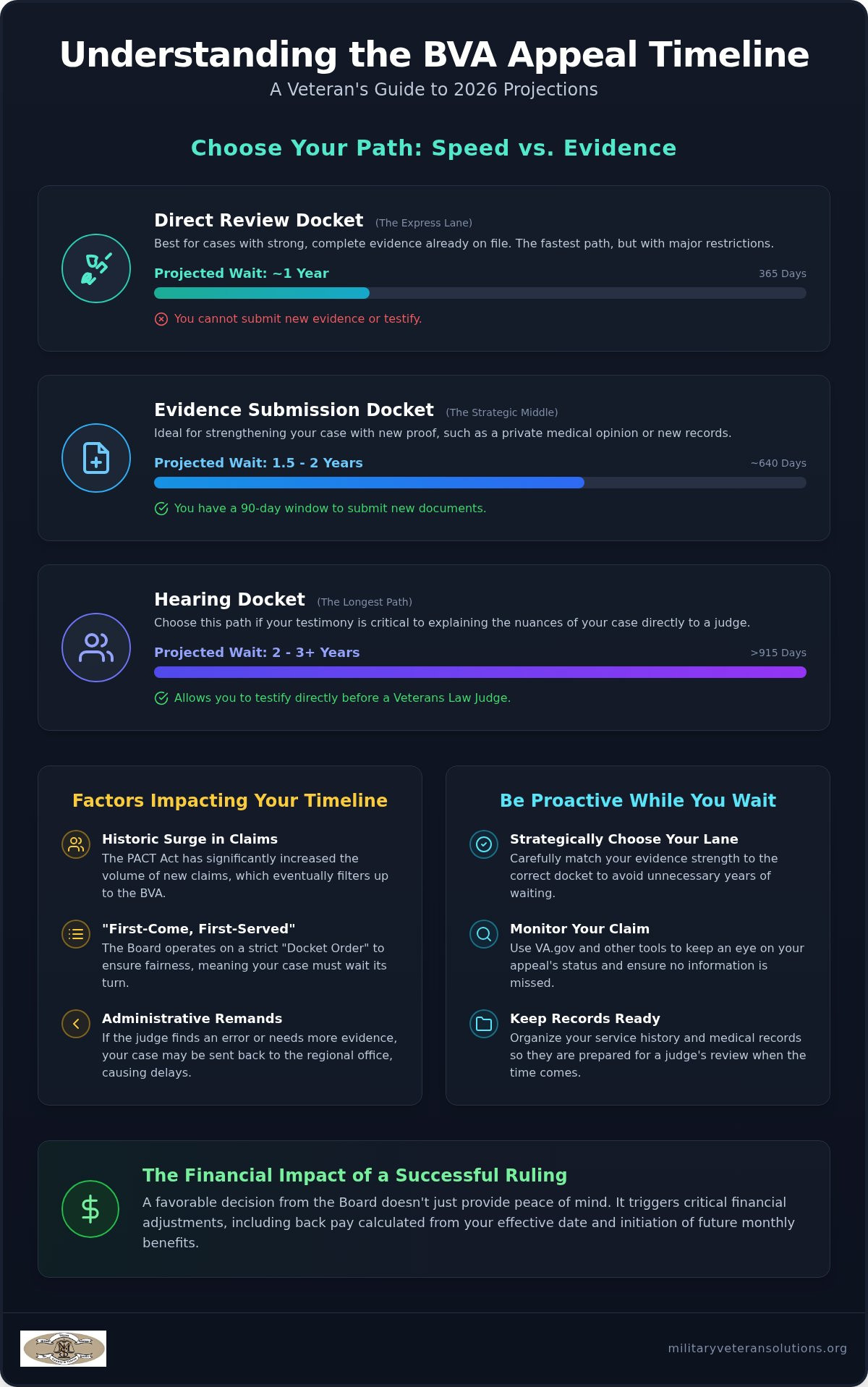
Even with a more efficient system, delays persist. The implementation of the PACT Act has triggered a historic surge in new claims, which naturally filters up to the Board. The BVA operates on a "Docket Order" principle. This is a first-come, first-served rule that ensures fairness, but it also means your case must wait its turn behind thousands of others. To combat this, the Board has launched aggressive hiring initiatives to bring on more judges and staff. While they are now processing 600 to 700 decisions monthly, the sheer volume of incoming appeals remains a significant challenge for the 2026 calendar year.
Comparing the Three AMA Dockets: Speed vs. Evidence
Navigating the Board requires a clear-eyed look at your evidence. You have three choices, and each impacts the BVA appeal timeline differently. Speed is tempting, but a fast denial helps no one. Think of these lanes as a strategic trade-off. You're balancing the urgency of your financial needs against the strength of your medical proof. Choose carefully. Once you select a docket, you generally cannot change it without withdrawing the appeal entirely and losing your place in line.
The Direct Review Docket: The Express Lane
This is the fastest route to a judge. In 2026, the projected wait is roughly 365 days, or one year. It's designed for veterans who are confident that their existing file already contains a clear nexus and sufficient medical evidence. However, there's a major constraint. You cannot submit new documents or testify before a judge. If your previous denial was based on a specific piece of missing evidence, this lane will likely lead to another denial. A VA decision letter analysis can help you determine if your current file is truly judge-ready before you commit to this lane.
The Evidence Submission Docket: The Strategic Middle Ground
This docket is for those who need to bolster their case with new proof. The timeline typically ranges from 1.5 to 2 years. It's the best option if you've recently secured a private medical opinion or discovered "hidden" evidence through a record audit. You have a strict 90-day window to submit these documents after filing your appeal. According to the official BVA decision wait times, this lane offers a balance between thoroughness and a manageable wait. It allows you to address the specific reasons for your previous denial without the extreme delays of a hearing.
The Hearing Docket: The Longest Path
The hearing docket is the marathon of the appeals process. Expect to wait 2 to 3 years, or even longer, for a resolution. This path allows you to testify directly before a Veterans Law Judge. You can choose a virtual hearing, a session at the Central Office in D.C., or a Travel Board hearing at your local regional office. It's best for complex cases where your personal credibility or a detailed explanation of your symptoms is the key to winning. While the wait is daunting, 67% of appeals are successful on the first review, making the persistence worthwhile for many who need their story heard.
Factors That Impact Your Specific BVA Timeline
National averages offer a baseline, but they don't tell the whole story of your individual claim. Your specific BVA appeal timeline depends heavily on the complexity of your medical history and the accuracy of your initial filing. If you're appealing multiple secondary conditions, the judge must conduct a de novo review for each one. This naturally takes more time than a single-issue appeal. Administrative accuracy is another silent factor. Simple errors, such as missing signatures or incomplete forms, can stall a case for months before it even reaches a judge's desk. Professional representation helps eliminate these unforced errors by ensuring your packet is legally sufficient from day one.
Advanced on Docket (AOD) Status
You don't always have to wait at the back of the line. The Board recognizes that some veterans face circumstances where a multi-year wait is impossible. If you're 75 or older, facing extreme financial hardship, or dealing with a terminal illness, you can file a motion for Advancement on Docket (AOD). You'll need to provide concrete evidence, such as past-due foreclosure notices or specific medical records, to support the motion. When granted, AOD status can slash your wait from several years to just a few months. It's a vital tool for those who need a resolution immediately to maintain their quality of life.
The "Remand" Loop: When the Timeline Resets
A remand is perhaps the most frustrating outcome in the appeals process. It isn't a denial, but it's not a win either. It happens when a judge determines that the record is incomplete or that the VA failed its "Duty to Assist." For instance, if a required medical exam was never performed, the judge sends the case back to the Regional Office to fix the mistake. This procedural hurdle is a core focus of the GAO report on appeals process challenges, which details how these loops create significant bottlenecks. Once the Regional Office completes the requested action, the case must travel back to the Board, often adding 12 to 18 months to the final resolution.
To avoid the remand loop, your evidence must be bulletproof before it reaches the judge. A thorough military record review can identify missing service records or clinical gaps that might otherwise trigger a remand. By addressing these issues early, you prevent the judge from having a reason to send your case back down the ladder. This proactive stance is the best way to keep your BVA appeal timeline as short as possible while maximizing your chances of a grant.
What to Do While You Wait: A Proactive How-To
The silence from the Board is often deafening. It's easy to feel like your life is on hold while the BVA appeal timeline unfolds in the background. However, viewing this period as a passive wait is a tactical error that could cost you your benefits. You must shift your mindset from waiting to preparing. This time is your final chance to ensure your file is a fortress that no judge can ignore. Instead of checking the VA portal daily, which only fuels anxiety, set a schedule to review your status once a month and spend the remaining time strengthening your evidence.
Conducting a Military Service Record Audit
Your service treatment records are the foundation of your claim, but they're often incomplete or misinterpreted by initial raters. A professional military record review with Military Veteran Solutions, LLC during the appeal period is one of the most effective ways to use your time. In 2026, a thorough military service record audit can uncover missed nexus links that were previously overlooked, such as a single entry about a clinic visit or a specific deployment location that triggers PACT Act eligibility. These "hidden" details are the keys to a grant in the Evidence Submission lane. If you find these links now, you can submit them within your 90 day window and bridge the gap between service and your current diagnosis.
Maintaining the Medical Paper Trail
Continuity of care is a primary factor in a judge’s final review. If your medical records show a gap in treatment while you're waiting for the Board, the VA may argue that your condition has improved or resolved. Don't let your treatment lapse. Every doctor's visit, physical therapy session, and prescription refill adds a fresh layer of proof to your file. If your condition worsens during the BVA appeal timeline, document it immediately. Organize these new records chronologically so they're ready for submission or for your representative to present during a hearing. This ongoing documentation proves the persistence and severity of your disability, making it much harder for a judge to deny your claim.
If you're in the Evidence Submission lane, use this checklist to stay on track:
- Review your original denial letter to identify the exact "missing link" the VA cited.
- Secure updated Disability Benefits Questionnaires (DBQs) from your treating physicians.
- Gather lay statements from family or service buddies that describe your daily struggles.
- Request a nexus letter if the connection to your service remains unclear.
Navigating the Decision: Outcomes and Next Steps
The arrival of your decision letter marks the conclusion of your wait, yet it often signals the beginning of a critical implementation phase. You've navigated the complexities of the BVA appeal timeline with patience; now you must handle the outcome with precision. A Veterans Law Judge will issue one of three rulings: a Grant, a Denial, or a Remand. While a full Grant is the primary objective, many veterans receive a Partial Grant or a Denial that requires a strategic pivot. You've fought too long to let a confusing letter prevent you from receiving the full compensation you're owed.
The Grant: Back Pay and Rating Increases
A Grant means the Judge has ruled in your favor on one or more issues. This victory triggers the calculation of retroactive pay, which is based on your "effective date." This date is typically the day you first filed your claim or the day the disability first manifested, provided you've kept the claim active. Once the Board issues a Grant, the file returns to the Regional Office for implementation. They are responsible for assigning a specific disability rating and issuing your back pay. Be vigilant during this stage. It's common for the Regional Office to assign an incorrectly low rating or an inaccurate effective date even after a Board victory. If the numbers don't align with your medical evidence, you must act quickly to correct the oversight.
Appealing a BVA Denial
A Denial is discouraging, but it isn't the end of your journey. You have 120 days from the date of the BVA decision to file a Notice of Appeal with the U.S. Court of Appeals for Veterans Claims (CAVC). This court provides an independent review of the Board’s decision to ensure no legal errors were made. Alternatively, if you've discovered new and relevant evidence that wasn't part of your Board file, you might choose to file a new Supplemental Claim. This allows you to re-enter the system while maintaining your original effective date. The choice between Court and a Supplemental Claim depends entirely on whether your case needs a legal correction or more medical proof.
Partnering for Success
Deciphering a VA decision letter requires a specialized eye. At Military Veteran Solutions, LLC, we conduct exhaustive VA decision letter analysis to identify the "hidden" errors that often lead to partial grants or denials. We don't just read the decision; we look for gaps in the Judge's logic or overlooked service records that could change the outcome. Our goal is to ensure the Board's decision translates into the actual benefits you need to secure your family's future. To discuss your specific ruling and plan your next move, Schedule a virtual consultation with Military Veteran Solutions, LLC today.
Take Control of Your BVA Appeal Strategy
The BVA appeal timeline doesn't have to be a period of passive uncertainty. You've learned that selecting the right docket is a strategic decision that balances speed with the depth of your evidence. Whether you choose Direct Review for a faster resolution or the Evidence Submission lane to anchor a broken nexus, your actions during the wait define your success. A proactive audit of your service records can uncover the hidden proof that turns a multi-year delay into a life-changing grant.
You don't have to navigate this daunting system alone. Military Veteran Solutions, LLC was founded by a disabled veteran with 10 years of Army service and brings over 25 years of advocacy experience to your corner. We specialize in finding the subtle evidence in military records that others miss, ensuring your claim is built on a foundation of facts rather than hope. Let us help you bridge the gap between a pending claim and the full benefits you earned through your service.
Get a Professional VA Decision Letter Analysis from Military Veteran Solutions, LLC
Stay focused and stay persistent. Your service matters, and your future is worth the fight.
Frequently Asked Questions
How long is the BVA appeal timeline in 2026 for Direct Review?
The Direct Review docket is currently the fastest route to a decision, typically taking approximately 365 days in 2026. This lane is reserved for cases where the evidence is already complete and no hearing is necessary. Because the judge only reviews the file as it existed during the initial decision, it avoids the administrative delays associated with gathering new documents. It's a precise, efficient option for veterans who have already established a solid medical nexus.
Can I speed up my VA Board appeal if I am facing financial hardship?
You can request to have your case advanced on the docket if you're experiencing extreme financial hardship, such as an active foreclosure or eviction. This status prioritizes your file ahead of others regardless of when it was submitted. To qualify, you must file a formal motion supported by clear evidence of your situation. When granted, this can significantly shorten the BVA appeal timeline from several years to just a few months, providing urgent relief. For veterans needing help with debt relief or navigating the path to homeownership after financial setbacks, the Law Offices of Matthew T. Desrochers, P.C. offers expert legal guidance.
The primary difference lies in how you present your case and the length of the wait. The Evidence Submission docket allows you to add new records within a 90 day window but does not include a hearing with a judge. In contrast, the Hearing docket allows you to testify directly, though it often takes two to three years or more. Choosing between them requires balancing the need for personal testimony against the desire for a faster resolution.
What happens if the BVA judge remands my case?
A remand occurs when a judge determines that more information is needed or that the VA failed its duty to assist you. Your case is sent back to the Regional Office to correct these specific errors, such as conducting a new medical exam. While a remand isn't a denial, it does reset part of your timeline. Once the local office completes the required actions, your file returns to the Board for a final decision.
Can I add new evidence to a Direct Review appeal?
No, you cannot add new evidence if you select the Direct Review docket. This lane is strictly for veterans who believe the evidence already in their file is sufficient to prove their claim. If you've discovered new medical records or service history after your initial denial, you should choose the Evidence Submission docket instead. Committing to Direct Review with an incomplete file often leads to a predictable denial that wastes valuable time.
Is it better to choose a Supplemental Claim or a Board Appeal?
The best choice depends on whether you have new evidence or need a legal correction. A Supplemental Claim is much faster, usually taking about 125 to 150 days, but it requires new and relevant evidence to be successful. A Board Appeal takes longer but provides a de novo review by a Veterans Law Judge. If your evidence is strong but was misinterpreted by the Regional Office, the Board is often the superior choice.
How far back does VA back pay go for a BVA grant?
How far back does VA back pay go for a BVA grant?
While the law doesn't require you to have a representative, navigating a hearing alone is incredibly difficult. An experienced advocate understands how to cross examine medical opinions and present your service history in a way that meets the legal requirements for a grant. They ensure that the judge hears the most relevant parts of your story. Having professional representation provides a layer of security and expertise that often makes the difference in complex cases.


