
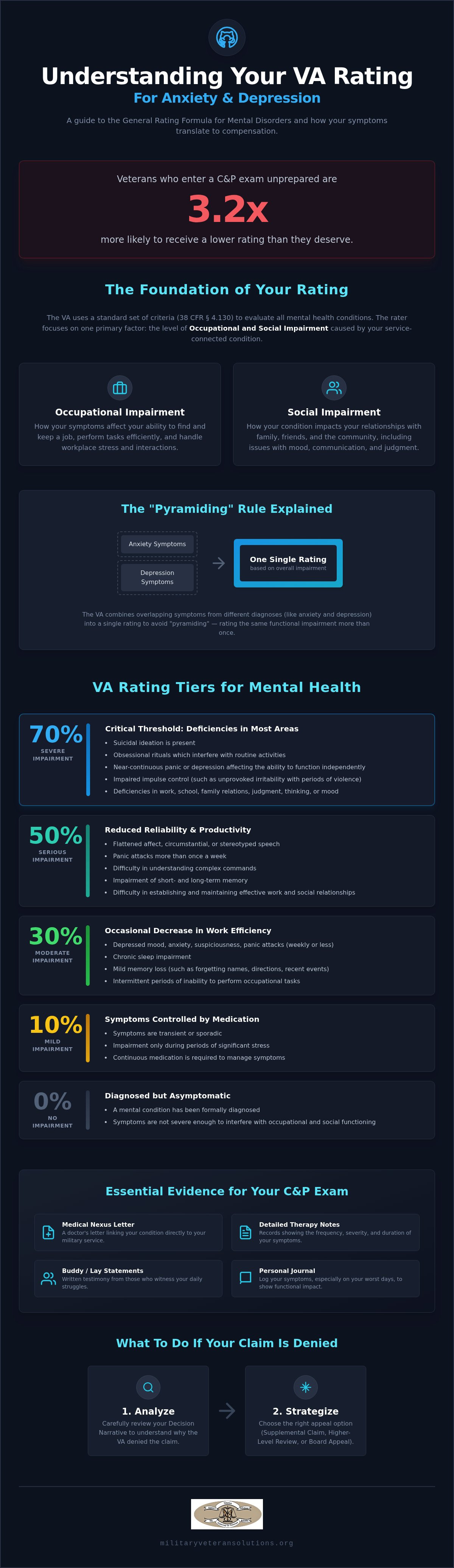
Veterans who enter a C&P exam unprepared are 3.2 times more likely to receive a lower rating than they deserve. It's a sobering reality that highlights the legitimate fear of being "lowballed" by a system that doesn't always seem to listen. You know your symptoms are real, but articulating that mental weight to an examiner is a different challenge entirely. You might also feel frustrated that the VA provides only one VA rating for anxiety and depression, even when you're struggling with both conditions simultaneously. We understand that this process often feels like an uphill battle against a complex administrative machine.
We're here to help you take control of your claim. This 2026 guide will help you master the VA’s General Rating Formula for Mental Disorders so you can understand how your specific symptoms translate into monthly disability compensation. You deserve a rating that reflects your true level of impairment. We'll break down the 38 CFR criteria, identify the specific evidence you need to prove a higher rating, and ensure you're fully prepared for your upcoming C&P examination. It's time to bridge the gap between your service history and the benefits you've earned.
Key Takeaways
- Master the General Rating Formula for Mental Disorders to see how your daily struggles translate into specific compensation levels.
- Identify the functional gaps between rating tiers so you can ensure your claim accurately reflects your worst days.
- Understand the "pyramiding rule" and why the VA combines symptoms into a single VA rating for anxiety and depression.
- Learn what evidence is required to turn a C&P exam into a success, from medical nexus letters to detailed therapy notes.
- Map out your path forward after a denial by analyzing your Decision Narrative and choosing the right appeal strategy.
How the VA Rates Anxiety and Depression: The General Formula
The VA doesn't view your mental health through the lens of a clinical label alone. Instead, they use a standardized set of criteria known as 38 CFR § 4.130, the General Rating Formula for Mental Disorders. This legal schedule ensures that whether you struggle with panic attacks, persistent sadness, or sleep disturbances, the evaluation remains consistent across the board. The VA groups anxiety, depression, and most other mental health conditions together because many symptoms overlap, and they want to avoid "pyramiding," which is the practice of rating the same symptom twice under different names. Occupational and Social Impairment is the VA’s measure of how your condition affects your ability to work and maintain relationships.
To better understand how these evaluations are evolving, watch this helpful video regarding recent updates:
The Role of Service Connection
Establishing a "nexus" is the foundation of your claim. You must prove your current mental health struggles are directly tied to your time in uniform. Direct service connection involves showing that an event during your service caused your condition. Alternatively, you might pursue a secondary service connection if a physical injury, like chronic back pain, led to your depression. Professional VA claim assistance is often the best way to identify these missing links in your records and ensure the VA sees the full picture of your service history.
Diagnosis vs. Functional Impact
A clinical diagnosis is only the starting point for your VA rating for anxiety and depression. While a doctor's note confirms the condition exists, the VA rater focuses on how that condition disrupts your daily life. They look for specific evidence regarding the frequency, severity, and duration of your symptoms. For example, occasional stress is weighted differently than chronic panic attacks that prevent you from leaving your home. Understanding VA benefits for mental health conditions requires looking past the name of the disorder and focusing on the functional impact it has on your career and family life. Your goal is to document your worst days, not just your average ones, to ensure the rating reflects the true depth of your impairment.
VA Rating Tiers for Anxiety and Depression (0% to 100%)
The VA rating for anxiety and depression is divided into specific percentages that reflect the severity of your functional impairment. A 0% rating confirms a service-connected diagnosis but recognizes no current impact on your social or work life. At 10%, your symptoms are generally transient or controlled by continuous medication. Many veterans find themselves at the 30% level, which the VA defines as having an occasional decrease in work efficiency or intermittent periods of inability to perform tasks. This tier often involves chronic anxiety or depressed mood that interferes with social interaction but doesn't completely stall your productivity. These tiers determine your eligibility for monthly VA disability compensation benefits.
The 50% rating represents a significant shift toward regular impairment. At this level, you likely experience reduced reliability and productivity. Symptoms might include panic attacks more than once a week, difficulty understanding complex instructions, or a flattened affect that makes social cues hard to read. If you feel like you're constantly "treading water" just to stay employed or maintain a marriage, you may be stuck in this middle ground. If you're unsure if your current rating matches your daily reality, a professional record review can help clarify your standing.
The 70% Rating: A Critical Threshold
The 70% rating is a major jump in both compensation and symptom severity. To meet this criteria, your symptoms must cause deficiencies in most areas, such as work, school, family relations, judgment, thinking, or mood. Common symptoms at this level include suicidal ideation, near-continuous panic, and an inability to maintain effective relationships. This rating is particularly critical because it often serves as the gateway to Total Disability based on Individual Unemployability (TDIU). Many veterans are underrated at 50% because they hesitate to share the full extent of their "worst days" with examiners, even when they meet the 70% threshold.
Total Disability: The 100% Mental Health Rating
A 100% schedular rating for mental health is reserved for "total occupational and social impairment." This means you're likely unable to work in any capacity and may struggle with basic self-care, disorientation, or persistent delusions. It's a high bar to clear, and the VA rarely grants it without exhaustive clinical evidence. It's important to distinguish between a 100% schedular rating and TDIU; both pay at the 100% rate, but the paths to achieving them differ. For those with multiple service-connected conditions, understanding how to combine va disability ratings for 100 can provide a more strategic route to maximum benefits than relying on a single mental health diagnosis alone.
The Pyramiding Rule and Mental Health Claims
The VA has a strict rule against "pyramiding," which is essentially getting paid twice for the same symptom. For mental health, this means you won't receive separate percentages for each diagnosis you have. Whether you are dealing with PTSD, panic disorder, or a VA rating for anxiety and depression, the VA consolidates these into a single evaluation. This approach is rooted in the VA's General Rating Formula for Mental Disorders, which looks at your overall level of social and occupational impairment rather than the specific name on your clinical chart.
Don't get hung up on the specific label of your condition. The VA rater typically chooses the diagnosis that best captures your most severe symptoms as the primary one. However, you should report every symptom you experience. While the VA won't stack ratings for mental health, these conditions often cause or aggravate physical issues, such as:
- Gastroesophageal Reflux Disease (GERD)
- Sleep Apnea
- Irritable Bowel Syndrome (IBS)
- Tension Headaches
These secondary conditions can receive their own separate ratings, which ultimately increases your total disability compensation beyond what a single mental health rating provides.
Anxiety and Depression as Secondary Conditions
Linking mental health to physical service-connected disabilities is a powerful strategy for many veterans. If you have chronic back pain that prevents you from sleeping and leads to severe irritability or hopelessness, your depression may be service-connected on a secondary basis. This is often called the "aggravation" theory, where a service-connected physical injury makes a non-service-connected mental condition worse. Finding the specific evidence for these links requires a deep dive into your history through professional military record reviews. This process ensures that every connection between your physical health and mental well-being is documented and presented clearly to the rater.
Why Your Primary Diagnosis Might Change
It's common for your primary diagnosis to shift over time. This "comorbidity" just means you have more than one condition occurring at once. When a medical examiner sees overlapping symptoms, the "benefit of the doubt" rule should apply. This means if the evidence is equal between two different ratings or diagnoses, the VA is legally required to lean toward the higher benefit for the veteran. Your focus must remain on ensuring your most severe symptoms, like social isolation, work-related panic, or cognitive fog, are accurately captured in your file so the rater can assign the correct percentage regardless of the diagnostic label.
Evidence Needed: Preparing for Your C&P Exam
Securing a fair VA rating for anxiety and depression requires more than just a doctor's note. You must build a mountain of evidence that proves both the existence of your condition and its direct link to your military service. While the Disability Benefits Questionnaire (DBQ) serves as the examiner's primary checklist, a medical nexus letter is often the deciding factor. This letter, written by a qualified professional, explicitly connects your current mental health struggles to specific in-service events or injuries. Without this bridge, the VA may acknowledge your diagnosis but deny the claim for lack of service connection.
While many competitors focus solely on clinical records, we know that lay evidence is often the missing piece of the puzzle. Personal statements on VA Form 21-4138 allow you to describe the symptoms that doctors don't see, such as social withdrawal or the inability to handle household chores. Buddy letters from family, friends, or former coworkers on VA Form 21-10210 are equally vital. These statements document behavioral changes from the perspective of those who knew you before and after your service. They provide a chronological roadmap of your decline that medical charts frequently overlook.
Tactics for the C&P Examination
The Compensation and Pension (C&P) exam is a high-stakes snapshot of your mental health. A common mistake is showing up and trying to "tough it out" or appearing overly composed. You must describe your "worst days" to the examiner, not just how you feel in the moment. When the examiner asks the standard "How are you doing today?", answering with a polite "I'm fine" can lead to an immediate lowball rating. Be prepared to discuss your most difficult symptoms in detail. You should bring a list of symptoms to ensure nothing is forgotten during the stress of the exam.
Reviewing Your Military Records for "Markers"
If your medical records from active duty don't explicitly mention mental health, don't lose hope. Evidence of struggle often hides in personnel files through "markers." These include sudden drops in performance evaluations, frequent disciplinary actions, or an unusual number of sick days. These behavioral shifts serve as indirect proof of an emerging condition. If you have already received a denial, a professional VA decision letter review service can help identify these missed opportunities in your records. To ensure your evidence is airtight before your next exam, schedule a virtual consultation with our team today to review your strategy.
What to Do if Your Anxiety or Depression Claim is Denied
Receiving a denial letter feels like a personal setback, but it's actually a strategic invitation to refine your approach. You must look past the "denied" status and dive into the Decision Narrative to find the specific reasoning behind the VA’s choice. This document reveals exactly what was missing, whether it was a lack of a formal diagnosis, a missing nexus, or an examiner who failed to capture the true depth of your VA rating for anxiety and depression symptoms. This narrative is the blueprint for your next move, allowing you to build a targeted counter-argument rather than just resubmitting the same paperwork.
You have exactly one year from the date of your decision letter to file a VA disability appeal and preserve your original effective date. A Higher-Level Review is appropriate if you believe the rater had all the necessary evidence but misapplied the law. If you have gathered new medical records, buddy statements, or a stronger nexus letter since your last filing, a Supplemental Claim is the correct path. Professional advocacy ensures you don't miss these technical windows or leave critical evidence on the table.
Identifying "Clear and Unmistakable Errors" (CUE)
Sometimes the VA makes a mistake so obvious it qualifies as a Clear and Unmistakable Error. This happens when the rater ignores their own regulations or completely misses evidence that was already in your C-file. A CUE is more than just a difference of opinion; it's a legal failure that would have changed the outcome if the rules had been followed correctly. Challenging these errors requires a surgical analysis of your decision letter to prove the VA failed its own standard of review.
The Advantage of Virtual Advocacy
You shouldn't have to navigate this complex system alone or settle for local advice that may lack specialized mental health expertise. Military Veteran Solutions, LLC acts as a bridge between your lived experience and the complex VA bureaucracy. We bring over 25 years of advocacy experience to every record review and decision letter analysis. As a veteran-owned firm, we understand the stakes because we've been in your boots. Reach out for a virtual consultation today to discuss your next steps and let us help you turn a denial into the successful outcome you earned.
Take Control of Your VA Mental Health Claim
The path toward a fair VA rating for anxiety and depression is rarely a straight line. From mastering the nuances of functional impairment to navigating the complexities of the pyramiding rule, you now have the tools to advocate for yourself with confidence. Remember that your medical records and lay evidence are your strongest allies in proving the true daily impact of your service-connected conditions. Whether you are preparing for an initial examination or challenging a previous denial, being informed is what prevents being lowballed by a rigid administrative system.
Military Veteran Solutions, LLC was founded by a 10-year Army Veteran who understands that the VA system can often feel like an adversary. With over 25 years of advocacy experience, we provide the steady, expert presence you need to navigate these hurdles successfully. We offer virtual consultations nationwide to ensure every veteran has access to dedicated, personalized representation regardless of their location. Don't let a complex process stand between you and the security you earned through your sacrifice. Get a Professional Analysis of Your VA Decision Letter today and take a definitive step toward the successful outcome you deserve.
Frequently Asked Questions
Can I get a 100% VA rating for anxiety and depression alone?
Yes, it's possible to receive a 100% VA rating for anxiety and depression alone, but the criteria are extremely strict. You must demonstrate "total occupational and social impairment." This usually includes symptoms like persistent delusions, hallucinations, or an inability to perform activities of daily living. Because this bar is so high, many veterans find it more practical to reach a 100% total rating by combining multiple disabilities or pursuing TDIU benefits.
What is the average VA disability rating for anxiety and depression?
The most common VA rating for anxiety and depression is 30%. At this level, the VA acknowledges you have a service-connected condition that causes occasional decreases in work efficiency. While many veterans start at this tier, it often fails to account for the full severity of their "worst days." If your symptoms cause regular impairment in your relationships or reliability at work, you may be eligible for a higher rating tier.
How do I prove my anxiety is service-connected if I never went to medical?
You can establish service connection through "markers" and lay evidence even without a medical record from your time in service. Buddy statements from those you served with can document behavioral changes or specific stressors. You should also look for non-medical evidence in your personnel file, such as sudden drops in performance evaluations or frequent disciplinary actions. These shifts provide a clear trail of your mental health struggles during your service years.
Does the VA rate anxiety and depression separately or together?
The VA rates these conditions together under a single evaluation to prevent "pyramiding." They use the General Rating Formula for Mental Disorders to assign one percentage based on your overall level of impairment. It doesn't matter if you have separate diagnoses for anxiety, depression, and PTSD; the rater looks at the totality of your symptoms. This ensures you're compensated for the combined impact these conditions have on your daily life.
What symptoms are required for a 70% VA mental health rating?
A 70% rating requires documented "deficiencies in most areas" of your professional and personal life. Required symptoms often include suicidal ideation, near-continuous panic, or an inability to maintain effective relationships. You might also experience impaired impulse control or a neglected sense of personal hygiene. This level represents a critical threshold where your condition makes it nearly impossible to sustain traditional employment or function consistently in a social environment.
Can I lose my VA rating for anxiety if I start feeling better?
Your rating can be reduced if the VA finds evidence of "sustained improvement" in your condition. However, they can't lower your percentage based on a single good day; they must show you've improved in both work and social settings over time. If you've held your rating for five years or more, it's considered "stabilized." This means the VA must prove your improvement is permanent before they can legally reduce your benefits.
What happens if my C&P examiner was dismissive of my symptoms?
If your examiner was dismissive, you should immediately file a memorandum for record with the VA to document the inadequate exam. You have the right to request a new examination or a Higher-Level Review. Examiners are required to follow the DBQ and review your medical history; if they fail to do so, their findings can be challenged. Professional advocacy can help you navigate this process and ensure your symptoms are accurately recorded.
How does the PACT Act affect mental health claims for anxiety?
The PACT Act helps mental health claims primarily through secondary service connection. While it focuses on toxic exposures, the physical illnesses caused by those exposures often lead to severe anxiety or depression. If you have a PACT Act condition like a respiratory illness, you can claim your mental health struggles as being "aggravated by" or "secondary to" that physical disability. This creates a clear path to service connection even without direct combat records.


