
Winning a higher disability rating isn't about burying the agency in paperwork or filing endless new claims. It's about auditing your military records to find the specific evidence the VA missed the first time. You know your body better than any examiner, yet you're likely sitting with a rating that feels like an insult to your service. If you're looking for increase VA disability rating help, you've probably felt the sting of "VA Math" or the anxiety that a re-evaluation might actually lower your benefits.
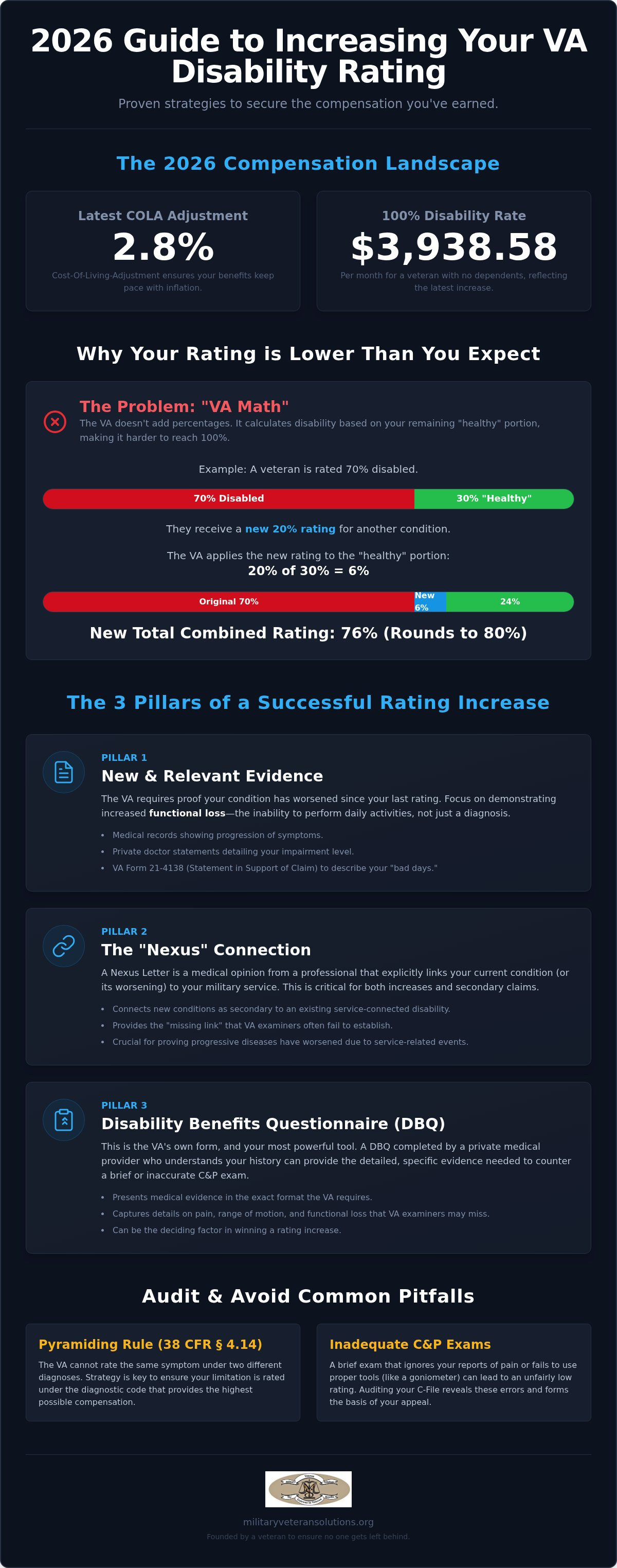
We understand that frustration because we've been in your boots. Military Veteran Solutions, LLC was founded by a veteran with 10 years of Army service to ensure no one gets left behind by a complex system. In this 2026 guide, you'll discover the proven strategies and evidentiary requirements needed to successfully increase your rating and secure the compensation you earned. We will break down the latest 2.8% COLA adjustments that brought the 100% disability rate to $3,938.58 per month and show you how to build a bulletproof case using the nexus evidence already in your files.
Key Takeaways
- Learn why understanding functional loss is more important than just having a diagnosis when proving your condition has worsened over time.
- Discover how to get professional increase VA disability rating help by identifying the "Nexus" evidence hidden within your existing military records.
- Explore the strategy of filing for secondary service connections to link new health complications to your original service-connected injuries.
- Understand the critical importance of auditing your C-File to see exactly what evidence the VA is using, or ignoring, in your current rating.
- Master the evidentiary requirements for 2026 to ensure your monthly compensation reflects the latest COLA adjustments and your true level of impairment.
Why Your Current VA Disability Rating Might Be Too Low
Many veterans receive their initial rating and feel a sense of confusion rather than relief. You might have been granted a 30% rating when your daily pain and limitations feel closer to a 70% level of impairment. The Veterans Benefits Administration (VBA) often relies on a narrow snapshot of your health rather than the full, lived experience of your service. If you feel stuck or undervalued, seeking professional increase VA disability rating help is often the only way to break through the barriers created by "VA Math."
This complex calculation is the first hurdle most veterans face. The VA doesn't simply add percentages together; it subtracts from your remaining "whole" self. If you're 70% disabled, the system views you as 30% healthy. A new 20% rating applies only to that 30% healthy portion, adding only 6% to your total. This results in a 76% rating, which rounds to 80%. It's a frustrating logic that makes reaching the 100% threshold incredibly difficult without a precise, evidence-based strategy.
The Reality of Progressive Conditions
Your health isn't a static point in time. Conditions like Degenerative Disc Disease or PTSD are often progressive, meaning they naturally decline as the years pass. In the context of VA 38 CFR Book C, a progressive disability is defined as a disease process that involves a continuous or intermittent worsening of symptoms and functional impairment over time. If your condition has moved beyond the original diagnosis, your rating must move with it.
Many veterans fail to get the rating they deserve because they describe an "average" day during their evaluation. You must document your "flares." If your back locks up three times a month or your anxiety prevents you from leaving the house for days at a time, that's your true level of impairment. The VA is required to rate you based on functional loss, which is the inability to perform the working movements of the body with normal stability and quickness.
Common Pitfalls in Initial Ratings
The system has built-in traps that can keep your rating lower than it should be. One major issue is the "pyramiding" rule found in 38 CFR § 4.14. This prevents the VA from rating the same symptom under two different diagnostic codes. If you have two separate conditions that cause the same type of limitation, the VA will only grant one rating. We specialize in identifying which code offers the maximum possible compensation for your specific symptoms.
Inadequate Compensation and Pension (C&P) exams are another frequent culprit. We often see examiners who fail to use a goniometer to measure range of motion or who ignore subjective reports of pain during movement. When you seek increase VA disability rating help, we start by looking for these procedural failures in your VA Decision Letter. That letter is the roadmap to your increase. It tells us exactly what evidence the examiner ignored and what medical nexus is still missing from your file.
The 3 Pillars of a Successful VA Rating Increase
Filing for an increase isn't a guessing game; it's a tactical operation. To win, you must understand how the About VA disability ratings criteria apply to your specific health changes. Many veterans expect the VA to connect the dots on their behalf, but the burden of proof rests entirely on you. If you want to secure the maximum compensation allowed in 2026, you need a strategy built on three essential pillars: evidence, the nexus, and the Disability Benefits Questionnaire (DBQ).
The DBQ is your most powerful weapon in this fight. While the VA often relies on contracted examiners who may only spend minutes reviewing your file, a private medical opinion can provide the exhaustive detail necessary to prove your case. These private DBQs often capture the nuances of your impairment that a rushed VA exam might overlook. If your current rating doesn't match your reality, obtaining professional increase VA disability rating help can ensure your medical evidence is presented in the language the VA requires.
Gathering New and Relevant Evidence
The VA only considers "new and relevant" evidence that wasn't part of your previous rating decision. This typically means medical records or statements showing your condition has worsened since your last evaluation. While VA medical records are important, they are often brief and focus on treatment rather than disability levels. Private doctor statements can bridge this gap by providing a longitudinal view of your symptoms. You should also use VA Form 21-4138, the Statement in Support of Claim, to describe how your disability affects your daily life. For a deeper dive into organizing these files, see our VA Claim Assistance: 2026 Resource Guide.
The Critical Importance of the Nexus
The Nexus is the legal link between your current worsening symptoms and your military service. You must meet the "at least as likely as not" standard of proof, which means there's a 50% or greater chance your condition is service-connected. If the clinical records from your time in uniform are sparse, lay evidence becomes vital. Buddy letters from fellow service members or family members can provide the "before and after" context that medical charts often miss. If you've been denied before, a professional VA decision letter review service can identify exactly where that link was broken so you can fix it in your next filing.
Strategies for Increasing Your Rating: Primary vs. Secondary Conditions
Most veterans focus solely on the injuries they sustained in uniform. They miss the ripple effects those injuries have on the rest of the body over decades. To truly secure the compensation you deserve, you must look beyond your initial diagnosis. Winning an increase requires a two-pronged strategy: proving your existing conditions have worsened and identifying the secondary issues those conditions have triggered. If you feel your current compensation doesn't cover the full scope of your health, getting professional increase VA disability rating help can reveal these often-overlooked paths to a higher rating.
When to File for an Increase
Before you ask for an increase, you must audit your current symptoms against the 38 CFR rating schedule. This legal document defines exactly what symptoms qualify for each percentage tier. If you're rated at 30% for a back injury but your range of motion has decreased to a point that meets the 50% criteria, it's time to file. However, you should approach this with caution. When you request an increase, the VA has the right to re-evaluate your entire condition. If they find evidence of improvement, they could actually lower your rating. It is often more effective to learn how to combine va disability ratings to get 100 by adding new, secondary claims rather than just challenging a single static rating.
Unlocking Secondary Service Connections
Secondary service connections are disabilities caused or aggravated by an existing service-connected condition. This is where most veterans find the evidence they need for a substantial increase. Consider these common 2026 pairings:
- GERD or Ulcers: Often secondary to chronic NSAID use for service-connected joint pain.
- Sleep Apnea: Frequently linked secondary to PTSD or weight gain caused by physical service-connected limitations.
- Depression or Anxiety: Often secondary to the chronic pain of a physical injury.
- Radiculopathy: Nerve pain in the legs or arms secondary to service-connected spinal issues.
The "Aggravation" theory is another powerful tool. If your service-connected knee injury causes you to walk with a limp that makes a non-service-connected hip condition worse, that hip condition can now be rated. Additionally, the PACT Act continues to provide a path for presumptive conditions related to toxic exposures. If you served in designated areas, the VA now presumes certain cancers and respiratory issues are service-connected. Identifying these "hidden" links requires an exhaustive Military Record Review. Military Veteran Solutions, LLC brings 25 years of experience to this process, acting as a "battle buddy" to ensure every secondary effect of your service is documented and rated accurately.
Preparation Checklist: What You Need Before Filing in 2026
Submitting a claim for an increase without a rigorous pre-filing review is a gamble you shouldn't take. The VA operates on a strict "check-the-box" mentality. If your evidence doesn't align perfectly with their internal criteria, your request will be rejected regardless of your actual pain levels. Before you hit submit, you need a tactical checklist to ensure your file is bulletproof. This begins with a "Disability Journal" where you track the frequency, duration, and severity of your symptoms over several months. This personal log provides the subjective data that medical charts often miss. If you're feeling overwhelmed by the paperwork, seeking professional increase VA disability rating help can provide the objective second set of eyes needed to catch errors before they become rejections.
The Power of the C-File
Your Claims File (C-File) is the repository of every document the VA has ever generated regarding your service and previous claims. You can request this through a Freedom of Information Act (FOIA) request, though it often takes months to arrive. Reviewing this folder allows you to identify Clear and Unmistakable Errors (CUE) from past decisions that might be worth challenging. Relying on an outdated understanding of your C-File is a primary cause for denials. If you don't know exactly what medical evidence or examiner opinions the VA is currently using against you, your new evidence might inadvertently contradict your existing records or fail to address the specific gaps that led to previous rejections.
Clinical Evidence and Independent Medical Opinions
The VA cannot rate a condition that hasn't been officially diagnosed. While VA doctors treat your symptoms, they aren't always looking to link them to your service or evaluate their severity for compensation purposes. This is where an Independent Medical Opinion (IMO) becomes invaluable. A private specialist can spend the time necessary to use VA-approved terminology, such as "functional loss" or "prostrating attacks," which triggers the specific rating criteria you need. When you finally attend your Compensation & Pension (C&P) exam, remember to describe your symptoms on your worst days. Don't push through the pain for the examiner; show them the reality of your impairment. We recommend a thorough Military Record Review to ensure your clinical evidence is complete before the VA ever schedules that exam.
How Military Veteran Solutions, LLC Secures Your Entitlements
Military Veteran Solutions, LLC isn't just another administrative service. We are a veteran-led firm, founded by a disabled veteran with 10 years of Army service. This background means we speak the language of service and understand the physical and mental toll of your time in uniform because we've lived it. When you seek increase VA disability rating help from our team, you aren't just getting a representative; you're getting a battle buddy who knows the system from the inside out. We focus on the details that matter, ensuring your sacrifice is recognized by the agency that manages your benefits.
For over 25 years, we've specialized in analyzing complex military and medical records to find the evidence the VA often misses. Our process centers on identifying the specific "Nexus" evidence required to win appeals and rating increases. We don't just file forms. We perform a deep-dive VA Decision Letter Analysis to turn a "No" into a "Yes." By pinpointing exactly where the VA's previous logic failed, we build a clear bridge between your service records and your current level of impairment. Our Virtual Consultation model ensures that veterans across the nation have access to this level of expert advocacy from the comfort of their own homes.
Professional Advocacy vs. Going It Alone
Many veterans start their journey with Veteran Service Officers (VSOs). While VSOs are dedicated, their high caseloads often prevent them from performing the exhaustive analysis needed for complex increases or secondary conditions. This is why many veterans fail when filing on their own or with overextended representation. Our veteran advocacy services provide a meticulous alternative. We limit our engagement to ensure every file receives a thorough military record review, identifying the functional losses and medical nuances that others often overlook due to time constraints.
Your Next Steps to a Higher Rating
Taking the next step shouldn't feel daunting. During your initial virtual consultation, we'll discuss your current rating and the specific goals you have for your compensation. From there, we move into a comprehensive military record review. We look for the missing links, the misread C&P exams, and the undocumented flares that justify a higher rating under the 2026 criteria. You've fought for your country; let us fight for the benefits you've earned. Reach out to Military Veteran Solutions, LLC today to start your path toward a rating that truly reflects your sacrifice.
Secure the Compensation You Earned for Your Service
Your current rating doesn't have to be the final word on your health or your future. By focusing on functional loss, identifying secondary conditions, and meticulously auditing your C-File, you can build a case that the VA cannot ignore. Success in 2026 requires moving beyond "average" days and documenting the true severity of your impairment through specific clinical evidence and nexus statements. You've fought the battles; you shouldn't have to fight the system alone when seeking increase VA disability rating help.
Military Veteran Solutions, LLC was founded by a 10-year Army Veteran who understands exactly what's at stake. With over 25 years of advocacy experience, we specialize in winning appeals through exhaustive record analysis and deep-dive decision letter reviews. We're ready to act as your "battle buddy" to ensure your sacrifice is accurately reflected in your monthly compensation. Schedule your virtual consultation with Military Veteran Solutions, LLC today to start your rating increase journey. You earned these benefits through your service. We're here to help you secure them.
Frequently Asked Questions
Can the VA reduce my rating if I ask for an increase?
Yes, the VA has the legal right to re-evaluate your entire service-connected condition whenever you request an increase. If an examiner finds that your symptoms have improved since your last rating, the agency could issue a proposal to reduce your benefits. This is why seeking professional increase VA disability rating help is vital. You must ensure your clinical evidence clearly supports a higher tier of impairment before opening your file for review.
How long does it take for the VA to process a rating increase claim in 2026?
As of August 2026, the average time to complete a VA disability-related claim is approximately 78 days. This timeline has decreased significantly as the agency focuses on faster processing, but complex claims involving multiple secondary conditions may take longer. You can help speed up the process by submitting a fully developed claim that includes all necessary medical records and private doctor statements at the time of your initial filing.
What is the best evidence to submit for a PTSD rating increase?
What is the best evidence to submit for a PTSD rating increase?
The strongest evidence for a PTSD increase includes recent therapy notes that document a worsening of social and occupational impairment. You should also submit a private Disability Benefits Questionnaire (DBQ) that uses the specific terminology found in the VA rating schedule. Specialized services such as Global Vets Consulting (GVC4Vets) can provide these detailed assessments to support your claim. Lay evidence, such as "buddy letters" from family or coworkers, is also essential. These statements provide a real-world look at how your symptoms affect your daily life and workplace performance.
You generally don't need a new nexus letter for an increase on a primary condition that is already service-connected. However, if you're looking for increase VA disability rating help by adding secondary conditions, a nexus letter is mandatory. This document must prove that your new health issue is "at least as likely as not" caused or aggravated by your existing service-connected disability to secure the additional compensation you deserve.
How many secondary conditions can I link to one primary disability?
There is no legal limit to the number of secondary conditions you can link to a single primary disability. If a service-connected back injury leads to nerve pain in your legs, depression from chronic pain, and gastrointestinal issues from long-term medication use, all of these can be rated. The key is providing medical evidence that proves each new condition is a direct result or an aggravation caused by the primary injury.
What happens if my request for a VA rating increase is denied?
If your request is denied, you have exactly one year from the date of your decision letter to file an appeal. You can choose a Higher-Level Review if you believe the evidence was misread, or a Supplemental Claim if you have new medical information to share. Military Veteran Solutions, LLC specializes in analyzing these decision letters to identify the exact gaps in evidence that led to the denial, helping you build a stronger appeal.
Is a 100% VA disability rating permanent and total?
A 100% rating is not automatically Permanent and Total (P&T). A 100% rating reflects your current level of impairment, while P&T status is granted only when the VA determines your conditions are unlikely to improve for the rest of your life. P&T status is highly desirable because it protects you from future re-evaluations and unlocks additional benefits for your dependents, such as CHAMPVA medical insurance and educational assistance programs.
Can I work while receiving a 100% VA disability rating?
You can work full-time while receiving a 100% schedular disability rating with no income limits. However, if your 100% rating is based on Total Disability Based on Individual Unemployability (TDIU), you are generally restricted from "substantially gainful" employment. It's important to verify which type of 100% rating you have before returning to the workforce to ensure your monthly compensation remains secure and your benefits aren't accidentally jeopardized by your income.


