
A law degree doesn't guarantee a win in the VA's administrative trenches, and in many cases, a specialized agent is the more lethal tactical choice for your appeal. It's deeply frustrating to feel like a number in a system that currently manages a backlog of over 100,000 claims. You've served your country, and now you're stuck navigating a maze of bureaucracy just to get the disability rating you earned. You're likely worried about losing a massive chunk of your hard-earned back pay to high fees, or worse, hiring someone who doesn't understand the difference between a combat MOS and a support role.
We understand that choosing between a VA accredited agent vs attorney is one of the most important decisions you'll make for your financial future. This article provides a clear, strategic framework to help you determine which professional advocate is best equipped to win your specific disability appeal in 2026. We'll dive into the nuances of fee structures, the critical importance of medical nexus evidence, and how to find a representative who truly speaks the language of the VA. By the end, you'll have the confidence to choose an ally who protects your interests and understands the reality of your service.
Key Takeaways
- Understand the core difference between a licensed lawyer and a non-attorney specialist who has passed the VA's rigorous examination on benefits law.
- Learn to select the right advocate based on your current appeal stage, whether you're filing a Supplemental Claim or heading to the Board of Veterans’ Appeals.
- Compare the unique strengths of a VA accredited agent vs attorney, including their access to real-time claim monitoring through the VBMS system.
- Navigate the 2026 fee guidelines to protect your back pay, ensuring your representative's costs fall within the VA's reasonableness thresholds.
- Discover how exhaustive military record reviews by fellow veterans can identify the critical service connections that generic law firms often miss.
Understanding the Roles: What is a VA Accredited Agent vs. Attorney?
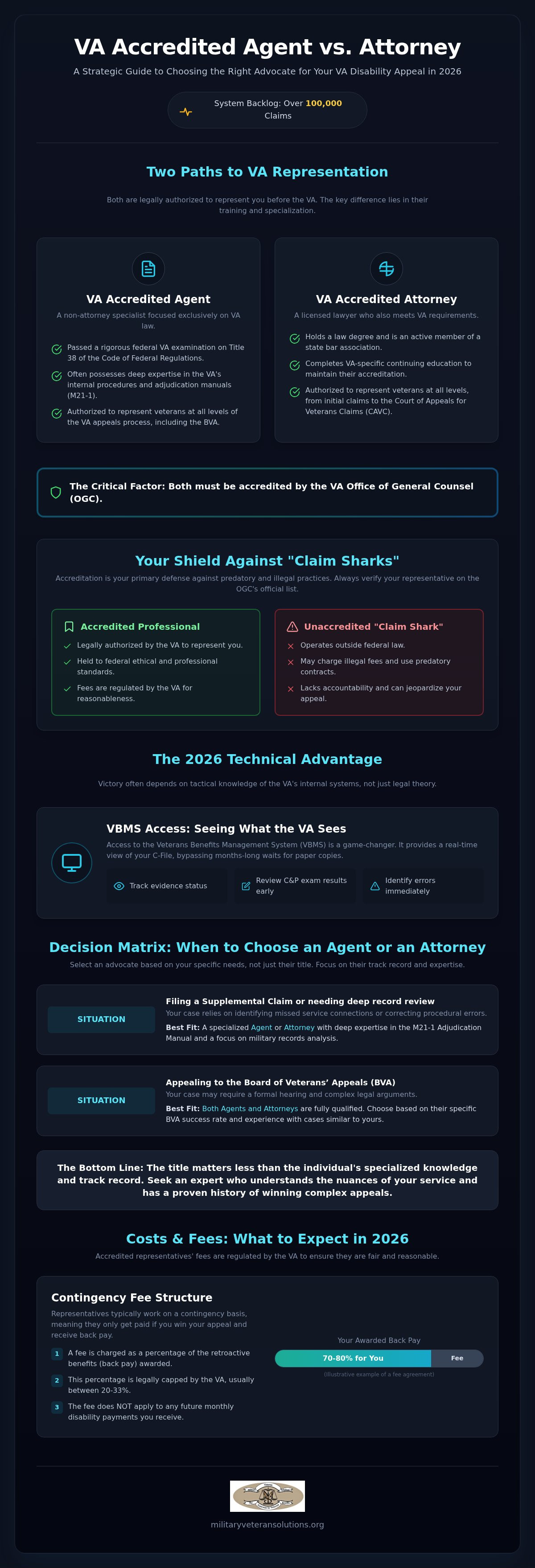
Choosing your representative is a strategic decision that affects the outcome of your life's work. The debate of VA accredited agent vs attorney isn't about which title sounds more impressive. It's about who has the tactical knowledge to secure your veterans' benefits. A VA Accredited Attorney is a licensed lawyer who has completed specific VA requirements to practice within this specialized legal niche. Conversely, a VA Accredited Agent is a non-attorney specialist who has proven their mastery of the system by passing a rigorous federal examination. Both professionals share a critical common denominator: they must be accredited by the VA Office of General Counsel (OGC). This status grants them the legal authority to represent you throughout the appeals process.
Accreditation is your primary line of defense. It separates legitimate advocates from "claim sharks" or unaccredited consultants who operate outside federal law. These unauthorized groups often charge illegal fees or lack the professional accountability required to handle your sensitive military records safely. If an individual isn't on the OGC's official list, they don't have the legal right to represent you before the VA. Working with an unaccredited consultant leaves you vulnerable to predatory contracts and poor advice that could derail your appeal for years.
The Accreditation Process for Agents and Lawyers
The path to becoming a representative is demanding for both groups. Attorneys must hold a law degree and maintain active membership in a state bar. They're also required to complete VA-specific continuing education to stay current on evolving regulations. Accredited Agents take a different, highly focused path. They must pass a comprehensive federal exam that tests their knowledge of Title 38 of the Code of Federal Regulations. This exam is notoriously difficult and ensures the agent understands the complex legal framework of the VA system. The VA's Office of General Counsel provides ongoing oversight for both groups, monitoring their ethical compliance and professional conduct to protect the veterans they serve.
Why the Title Matters Less Than the Accreditation
The VA operates as an administrative system. It isn't a traditional courtroom where trial tactics or jury persuasion win the day. In this environment, deep knowledge of the M21-1 Adjudication Procedures Manual is often more valuable than a general law degree. Both agents and attorneys have the same authority to file appeals and represent you before the Board of Veterans' Appeals (BVA). VA Accreditation is the federal seal of approval for veteran advocacy. It signifies that the individual is recognized by the government as qualified to handle your case. When weighing a VA accredited agent vs attorney, focus on their specific track record with claims like yours. Your priority is finding an expert who understands the nuances of your service connection and has the technical access to move your file forward.
Technical Capabilities: Training, System Access, and Expertise
The effectiveness of a VA accredited agent vs attorney often comes down to their technical proficiency with the VA's internal systems. While a lawyer might focus on high-level legal theory, a specialized agent often spends more time "under the hood" of the VA's digital infrastructure. Both roles are overseen by the VA Accreditation Program, which ensures they maintain the standards required to represent you effectively. However, the true advantage in 2026 lies in real-time visibility and a deep understanding of the M21-1 Adjudication Procedures Manual. This manual is the very playbook used by VA raters to decide your fate, and mastering its technical rules allows an advocate to hold the VA accountable to its own standards.
VBMS Access: Seeing What the VA Sees
Access to the Veterans Benefits Management System (VBMS) is a game-changer for your appeal. It allows your advocate to view your C-File instantly, bypassing the months-long wait for a paper copy. This digital transparency is essential for navigating a system that processed over 2 million claims by June 2026. Proactive visibility allows your representative to:
- Track the status of evidence in real-time to prevent delays.
- Review C&P exam results before the final decision letter arrives.
- Identify missing service records or incorrect data entries immediately.
Proactive advocacy beats reactive filing every time. It ensures your case moves forward with accuracy rather than waiting for a rejection to fix a preventable error. This level of access is often what separates a successful appeal from one that lingers in the backlog.
Military Record Mastery vs. Legal Theory
Success often hinges on proving facts buried in thousands of pages of medical history. A representative who understands military acronyms and MOS-specific duties can identify "nexus" points that a general attorney might overlook. For example, knowing the specific physical toll of a combat MOS helps build a stronger case for secondary service connections that a civilian lawyer might not recognize. This level of detail is why a Professional Military Record Review Service is such a critical component of a winning strategy.
We focus on finding the "why" and "how" of your injury, not just arguing the "what" of the law. Proving the facts in a medical record is often more persuasive to a rater than a complex legal argument. If you feel your service history hasn't been fully explored, a virtual consultation can help determine if your records hold the key to a successful appeal. This virtual model allows you to access elite representation regardless of your location, stripping away the traditional law firm overhead that often inflates costs and slows down communication.
The Decision Matrix: When to Choose an Agent or an Attorney
Determining the right path forward requires a clear-eyed look at your current standing within the VA's hierarchy. The choice between a VA accredited agent vs attorney often hinges on whether your battle is still administrative or has moved into the federal court system. While some law firms focus heavily on judicial review, most veterans find their resolutions much earlier in the process. You need an advocate whose expertise matches the specific hurdles of your current appeal stage. Don't hire a specialist for a court battle you haven't reached yet, but don't settle for a generalist when your medical records require a tactical expert.
Administrative Appeals vs. Judicial Review
Accredited agents are often the most effective choice for Supplemental Claims and Higher-Level Reviews (HLR). These stages are about correcting factual errors and submitting new evidence, tasks that require a deep dive into your medical records rather than complex legal litigation. Most claims resolve here if the evidence is presented correctly. The BVA is the final administrative stop before the court system. If a case moves beyond the BVA to the U.S. Court of Appeals for Veterans Claims (CAVC), a licensed attorney is legally required. Attorneys are also the right choice if your case involves rare constitutional issues that fall outside standard VA regulations.
Case Complexity and Medical Evidence
Your specific medical condition should dictate who represents you. For claims involving the PACT Act, PTSD, or MST, the challenge isn't usually a point of law. It's a point of evidence. You need a representative who provides a thorough VA decision letter analysis to pinpoint exactly where the rater went wrong. Specialized agents are trained to identify "unfilled" gaps in medical evidence that a general lawyer might miss, such as a missing nexus statement or an overlooked secondary condition. They focus on the clinical and service-connected facts that drive a higher rating.
The "Peer Advantage" cannot be overstated. Veterans often prefer advocates who have "worn the boots" because they understand the reality of service life. They know that a back injury in the infantry isn't just a medical code; it's a career-ending reality. This shared background creates a level of trust and dedication that a traditional law firm simply cannot replicate. You aren't just a case file to a fellow veteran. You're a peer who deserves the benefits you earned. This grassroots perspective ensures that no detail of your service history is treated as "routine" or "standard."
Costs and Fees: What Veterans Should Expect in 2026
The financial aspect of hiring a VA accredited agent vs attorney often causes the most anxiety for veterans waiting on an appeal. You've fought for your country, and now you're fighting for your livelihood. It's vital to understand that both agents and attorneys typically operate on a contingency fee model. This means you don't pay a dime upfront; to see how this model works in other complex legal fields, you can explore Contingency-Based Legal Representation Fees at Cowper Law. Your representative only collects a fee if they win your appeal and secure your back pay. In the last 12 months, the VA paid out $422.2 million in these professional fees, showing just how common and necessary expert representation has become in a complex system.
The amount of your final settlement depends heavily on your "Effective Date." This is the date the VA determines your disability began or when you first filed the claim. Because the VA is currently processing over 2 million claims at a record pace, the back pay can accumulate significantly while you wait for a decision. VA regulations provide clear guidelines on what is considered reasonable to protect your interests. A fee of up to 20% of past-due benefits is presumed reasonable by the VA. Conversely, any fee exceeding 33 1/3% is generally presumed unreasonable. Representatives cannot charge for work done on the initial claim filing, only for the appeal itself. If your appeal is denied, you typically owe nothing for the representative's time. This risk-free structure ensures that your advocate is as motivated as you are to win.
Comparing Value Over Just the Price
When weighing the choice of a VA accredited agent vs attorney, don't just look for the lowest percentage. A 20% fee for a 100% rating is a far better investment than a 0% fee for a denial. Large, "bloated" law firms often use a volume filing approach, spending minimal time on each file to maximize their own returns. In contrast, a specialized virtual advocacy model reduces the physical overhead of a traditional office. This allows for a more exhaustive analysis of your records without passing unnecessary costs on to you. During your virtual consultation, ask about potential hidden costs like medical nexus letters or independent medical exams. While the representation fee is contingency-based, these external medical reports often require separate payment to the doctors who write them. A transparent advocate will explain these costs upfront so you aren't blindsided. Choosing a peer-led firm ensures your back pay is protected by someone who understands the value of every dollar you've earned through your service.
Why Specialized Advocacy Wins Complex VA Appeals
Winning an appeal isn't just about filing paperwork. It requires a relentless, tactical approach that anticipates the VA's objections before they're even written into a decision letter. At Military Veteran Solutions, LLC, we've spent over 25 years navigating this administrative labyrinth from the inside out. Our foundation is built on the 10-year Army service of our founder, a disabled veteran who understands that your service treatment records are more than just ink on paper. They are the evidence of your sacrifice. This perspective allows us to review your files with a level of clinical and operational detail that generic, high-volume law firms simply cannot match.
When you weigh the choice of a VA accredited agent vs attorney, remember that the most effective advocate is the one who speaks the VA's language fluently. We don't just fill out forms; we build a comprehensive case strategy designed to overturn denials. By focusing on exhaustive record audits, we find the service connection "nexus" points that others overlook. Our virtual model ensures that you get this elite level of Veteran Claims Representation regardless of where you live, providing national support without the delays of a traditional legal practice.
The Strategy of Winning Denied Claims
The path to a successful appeal begins with a surgical analysis of your denial. We use detailed VA decision letter analysis to pinpoint exactly where the agency failed to follow federal law or ignored its own internal procedures. Often, the evidence needed to win is already in your file, but it's buried under thousands of pages of routine military records. We specialize in finding this "lost" evidence to prove your service connection beyond a doubt. For those just starting the process or looking for tactical filing tips, our VA Claim Assistance guide provides essential insights into managing your file effectively.
Your Next Steps Toward Entitled Benefits
You don't have to settle for a representative who isn't producing results. If your current advocate is unresponsive or lacks the technical expertise to move your case forward, you have the right to switch. Speed is critical. Every day you wait is a day your effective date and potential back pay could be at risk. The VA system is currently moving at a record pace, and you need an advocate who can keep up with that momentum. Don't let your appeal languish in the backlog because of a lack of specialized attention. You've earned these benefits through your service and sacrifice. It's time to secure the rating you deserve. Schedule a virtual consultation with Military Veteran Solutions, LLC today and let a fellow veteran take the lead on your appeal.
Secure Your Financial Future with Tactical Advocacy
Your service was unique. Your appeal deserves a representative who treats it that way. The choice between a VA accredited agent vs attorney depends on where you stand in the process and how deeply your medical records need to be mined for evidence. You've learned that technical system access and a shared military background can often be more impactful than a general law degree. Protecting your back pay and securing a higher rating requires a tactical ally who knows the VA's playbook inside out.
Don't let a generic firm overlook the critical "nexus" points that prove your service connection. Military Veteran Solutions, LLC was founded by a 10-year Army veteran with over 25 years of advocacy experience. We specialize in exhaustive record reviews and decision letter analysis to find the definitive path to victory. Through our nationwide virtual consultations, we bring elite expertise directly to you. Secure the advocacy you've earned. Contact Military Veteran Solutions, LLC for an appeal review. You served with honor; now let us fight for the rating you deserve.
Frequently Asked Questions
Can a VA accredited agent charge more than an attorney?
No, both professionals are bound by the same federal regulations regarding fee reasonableness. The VA's Office of General Counsel oversees these standards to ensure you aren't exploited. A fee up to 20% is generally seen as reasonable, while anything exceeding 33 1/3% faces heavy scrutiny. Since agents and attorneys operate under the same rules, an agent won't charge more than a lawyer for the same level of administrative appeal work.
What is the main advantage of hiring an accredited agent over a lawyer?
The primary benefit is often a deeper, more tactical focus on the VA's internal adjudication manual. While a lawyer might split their time between different legal practices, an accredited agent lives and breathes the M21-1 playbook. This specialized expertise is critical when identifying service connections in complex medical records. Many veterans find that this grassroots, hands-on experience leads to more precise evidence gathering than a general legal approach provides.
Do I have to pay my representative if I don't win my VA appeal?
You don't have to worry about out-of-pocket costs if your appeal isn't successful. Most accredited representatives work on a contingency basis, meaning their payment is tied directly to your victory. If you don't receive back pay, they don't collect a fee for their representation services. This alignment of interests ensures your advocate is fully committed to winning your case. It provides you with a risk-free path to elite representation.
Can an accredited agent represent me at a BVA hearing?
Yes, an accredited agent has full authority to represent you before the Board of Veterans' Appeals. This includes preparing your case, submitting evidence, and presenting arguments during your hearing. They're qualified to handle every administrative step of the process. The only level they cannot reach is the U.S. Court of Appeals for Veterans Claims, which requires a licensed attorney to handle judicial reviews in the federal court system.
How do I verify if someone is actually a VA accredited agent?
You can easily verify any individual's status through the VA's OGC accreditation search tool. This is a vital step to protect yourself from "claim sharks" who aren't legally authorized to charge fees. Simply enter the person's name to confirm they've met the federal requirements for representing veterans. If they aren't listed, they don't have the legal standing to represent you or access your sensitive records through the VA's digital systems.
Is it better to have a local attorney or a national accredited agent for my VA claim?
A national accredited agent with a virtual model is often the superior choice for complex appeals. Since the VA is a federal system, your representative's physical location doesn't impact your outcome. What matters is their specific expertise and their ability to review your records exhaustively. National firms often have more resources and a wider range of experience with diverse conditions than a local attorney who might only handle a few cases.
What happens to my appeal if I want to switch from an attorney to an agent?
You have the right to change your representative at any point during the process. To make the switch, you'll need to submit a new appointment form to the VA. Your previous attorney might file a claim for a portion of the fees based on the work they already performed. It's a straightforward administrative move that shouldn't derail your timeline if handled correctly. Acting quickly ensures your new advocate can start finding missed evidence immediately.
Does the VA pay the accredited agent directly from my back pay?
Yes, the VA typically handles the payment process directly to ensure transparency. If you have a valid, written fee agreement on file, the VA will withhold the agreed-upon percentage from your back pay. They then pay that amount directly to your VA accredited agent vs attorney. This system protects you from having to manage large payments yourself and ensures that all financial transactions remain within the VA's strict regulatory oversight and guidelines.


