
Did you know that the VA denies roughly six out of every ten initial disability claims? It is a staggering figure that leaves thousands of veterans feeling ignored and abandoned by the very system designed to support them. You've served your country, yet you're now stuck staring at a decision letter that feels like a door slammed in your face. It is exhausting to deal with the confusion of appeal lanes while fearing that another submission will only lead to another rejection. We know the frustration of trying to gather medical records that seem to disappear into a bureaucratic void.
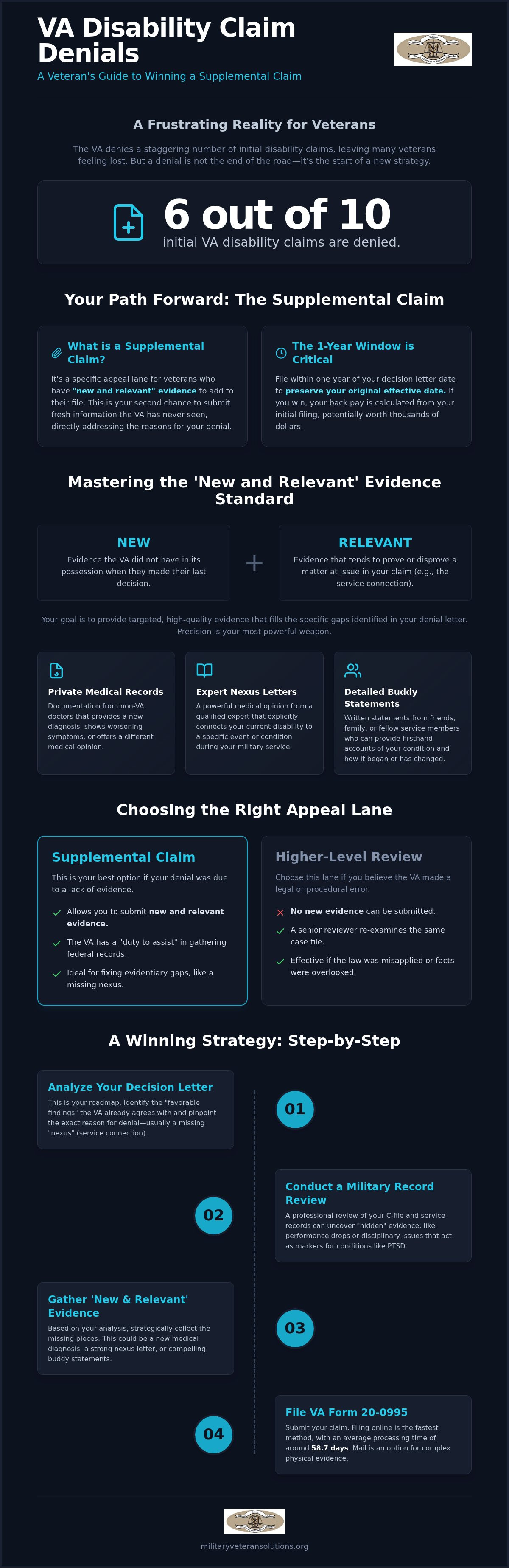
A denial is not the end of the road, but it does require a change in tactics. If you are seeking VA supplemental claim help, you've found an ally who understands that winning requires more than just resubmitting the same paperwork. You'll discover how to identify "new and relevant" evidence and build a strategic framework to overturn your denial. We will walk through how a professional VA decision letter analysis and a thorough military record review can reveal the service connections the VA missed. This guide provides a clear, actionable path to winning the disability rating you earned so you can move forward with the financial security you deserve in 2026.
Key Takeaways
- Learn why filing your appeal within the 12-month window is critical to preserving your original effective date and protecting your potential back pay.
- Master the "new and relevant" evidence standard to ensure your submission provides the specific facts the VA missed during their initial review.
- Determine whether a Supplemental Claim or a Higher-Level Review is the most effective strategic lane based on the specific reasons for your denial.
- Access professional VA supplemental claim help by starting with a detailed analysis of your decision letter to pinpoint exact evidentiary gaps.
- Discover how a comprehensive military record review can reveal secondary service connections and overlooked medical evidence to strengthen your overall strategy.
What is a VA Supplemental Claim and How Does it Work?
Receiving a denial from the Veterans Benefits Administration (VBA) can feel like a devastating blow, but it's often just the first step in a longer strategic process. A supplemental claim is a specific decision review lane designed for veterans who have "new and relevant" evidence to add to their file. Unlike other appeal options, this path allows you to submit fresh information that the VA hasn't considered yet. It's a second chance to fix what went wrong the first time.
Timing is everything. If you file your supplemental claim within one year of the date on your decision letter, you preserve your original effective date. This means if you win, your back pay is calculated all the way back to when you first filed. Missing this window doesn't prevent you from filing, but it could cost you thousands in lost benefits. You've earned that compensation; don't let a deadline take it away.
The PACT Act has significantly shifted the landscape for many. If you were denied in the past for toxic exposure or burn pit related issues, the supplemental claim lane is your primary tool to apply under new presumptive rules that cover more than 20 conditions. Your goal isn't just to "try again." You are specifically addressing the reasons for denial listed in your previous letter with targeted, high-quality evidence.
The Core Requirements of VA Form 20-0995
To succeed, you must meet the legal standard for evidence. "New" means the VA didn't have the information when they made the last decision. "Relevant" means it directly addresses the matter at issue, such as proving a service connection. If a condition has worsened since your last exam, a supplemental claim is the right choice to document that increased severity. In 2026, filing online is the fastest way to get your claim into the system, with average processing times sitting around 58.7 days, though traditional mail remains an option for complex physical evidence.
Why the Decision Letter is Your Roadmap
Don't ignore the fine print in your denial. Your decision letter contains "favorable findings," which are facts the VA already agrees with, such as your veteran status or a current diagnosis. Your job is to find the missing link, usually the "nexus" or service connection. A professional VA decision letter analysis reveals the VA's logic and highlights the exact evidentiary gap you need to fill. Seeking VA supplemental claim help ensures you don't waste time submitting evidence the VA already has, but instead focus on the specific missing pieces that lead to a win.
The 'New and Relevant' Evidence Standard: Building Your Case
To win your appeal, you must master the "new and relevant" evidence standard. It is the gatekeeper of the supplemental claim lane. "New" evidence is simply information that wasn't in your file when the VA made its last decision. "Relevant" evidence is any information that tends to prove or disprove a point at issue in your claim. While the official VA guidance on Supplemental Claims suggests this is a more accessible threshold than the old "material" standard, don't mistake accessibility for simplicity. Precision is still your most powerful weapon. If you submit a mountain of records that don't address the specific reason for your denial, you'll likely face another rejection.
Successful claims often rely on a combination of private medical records, expert nexus letters, and detailed buddy statements. When you seek VA supplemental claim help, the focus shifts from just gathering paper to curating proof that speaks directly to the VA's previous objections. You are not just asking for a second look; you are providing the missing pieces that make a denial impossible to maintain.
Finding 'Hidden' Evidence in Military Service Records
Many veterans believe they've already seen everything in their C-file. That's rarely the case. A professional military record review service often uncovers "markers" that the untrained eye misses. For instance, a sudden drop in performance or a series of minor disciplinary issues can serve as evidence for PTSD or MST stressors, even if they aren't labeled as medical events. These personnel records provide the "relevant" link needed to establish a service connection for conditions that lack a traditional paper trail. If you feel stuck, a virtual consultation can help you build a strategy rooted in exhaustive record analysis.
The Power of Lay Evidence and Buddy Statements
Medical records tell one story, but lay evidence tells another. VA Form 21-10210, the "Statement in Support of Claim," allows those who know you best to describe the daily reality of your condition. A well-structured buddy statement provides a chronological account of your symptoms that medical logs might lack. It can document the progression of a condition or the occurrence of an in-service event that was never officially recorded. If you are struggling to prove a secondary condition, a spouse's statement describing how your service-connected back pain has led to depression can be the "relevant" evidence that bridges the gap for the rater.
Supplemental Claim vs. Higher-Level Review: Choosing the Right Lane
Selecting the wrong appeal lane is a common mistake that costs veterans months of unnecessary waiting. You have three primary options: the Supplemental Claim, the Higher-Level Review (HLR), and the Board Appeal. While the Board Appeal is a "long road" involving a judge and complex legal disputes, most veterans find success within the first two lanes. Deciding between them depends entirely on the specific reason your claim was denied. You don't want to waste time in a lane that cannot provide the outcome you need.
A Supplemental Claim is your best choice when you need to introduce fresh information to your file. Conversely, an HLR is a request for a more experienced rater to review the existing evidence for clear legal or factual errors. You cannot submit new evidence during an HLR. If you have found a missing link, you must go the supplemental route. There is a critical strategic pivot to understand: you can file a Supplemental Claim after receiving an HLR denial, provided you have new evidence. However, you cannot move from a Supplemental Claim denial into a Higher-Level Review if you intend to add more evidence to the record. Choosing the right lane is about more than just speed; it's about preserving your path to victory.
When to Choose a Supplemental Claim
If your decision letter cited a "lack of nexus" or a missing diagnosis, the Supplemental Claim is usually the correct path. This lane allows you to submit a formal nexus letter from a specialist or military records you recently discovered. It is also the primary vehicle for veterans claiming new presumptive conditions under the PACT Act. Because this lane relies on the new and relevant evidence standard, it gives you the flexibility to build a stronger case than your initial submission. When you need VA supplemental claim help, this is often where we start to address the gaps identified in your military record review.
When an HLR is the Better Strategy
Choose a Higher-Level Review if you believe the VA already has everything they need but simply made a mistake. If a rater ignored a specific medical report in your C-file or if the C&P examiner applied the wrong medical standard, an HLR allows a senior reviewer to correct the oversight. This process is faster because it bypasses the evidence-gathering phase. However, it is a high-stakes move because you are locked into the evidence already on record. Consulting with a VA claim assistance expert is the best way to determine if an HLR or a Supplemental Claim offers the highest probability of success for your specific situation.
Step-by-Step Guide to Filing Your Supplemental Claim in 2026
Filing a supplemental claim is a calculated strike against a previous denial. It isn't just about resubmitting paperwork; it's about addressing the specific failures of your previous attempt. Your first step must be a deep dive into your Decision Narrative. Locate the "Reasons for Decision" section in your letter. This is where the VA rater explains exactly why they said no. If they cite a lack of a current diagnosis, your strategy must center on obtaining one. If they claim there's no link to your service, your focus shifts to the nexus. Once you've identified these gaps, gather the "new and relevant" evidence that fills them. Precision here is non-negotiable.
When you're ready to submit, use VA Form 20-0995. Ensure the "Issues" list matches the denial letter exactly to avoid administrative delays. In August 2026, the average processing time for supplemental claims was approximately 58.7 days. To stay within this faster window, you should submit your packet via the official VA.gov portal. After submission, track your status daily. Be prepared for a follow-up C&P exam, as the VA often uses your new evidence to justify a fresh medical evaluation. If you're unsure how to translate your medical history into a winning packet, a virtual consultation can provide the clarity you need to move forward confidently.
Preparing Your Evidence Packet
Organization is your best friend when seeking VA supplemental claim help. Organize your medical records chronologically so the rater can see the clear progression of your condition. Include a strong Statement in Support of Claim (Form 21-4138) to provide the human context that medical codes often miss. If you're using private doctors, ensure they complete the correct Disability Benefits Questionnaires (DBQs). A properly completed DBQ speaks the VA's language and makes it much harder for a rater to ignore your evidence. We've seen that a well-organized packet significantly reduces the risk of a "duty to assist" error later in the process.
Navigating the Online Filing Tool
The 2026 online filing tool on VA.gov uses an interview-style format that simplifies the process. Use the "Save Progress" feature frequently. This allows you to step away and double-check your facts before final submission. When uploading documents, ensure they are in a secure, searchable PDF format to prevent data corruption or legibility issues. If the online tool doesn't recognize your specific issue, don't force it. You may need to submit a paper copy via certified mail to ensure every detail of your claim is preserved. Accuracy at this stage prevents months of back-and-forth communication with the regional office.
Why Professional Advocacy is the Key to Winning Your Appeal
Winning an appeal is rarely about submitting more paper; it's about submitting the right paper. When you seek VA supplemental claim help, you're looking for a strategy that addresses the specific evidentiary gaps identified by the VA. Military Veteran Solutions, LLC specializes in analyzing these decision letters to find the subtle legal or factual errors that lead to improper denials. Having a second set of eyes on your file ensures that no detail is overlooked. We don't just look at what's in your medical records; we look at what's missing to ensure your case is bulletproof.
A professional record review often uncovers secondary conditions that veterans didn't even know were claimable. For example, your service-connected knee injury might be causing back pain or depression, yet these links are frequently missed during a "DIY" filing. By auditing your military and private records, we identify these connections to build a more comprehensive and robust case. It's about maximizing the benefits you've earned through your service and ensuring the VA recognizes the full impact of your injuries. We provide a calm, steady presence to help you navigate this daunting environment with confidence.
The Advantage of Peer-Led Representation
Civilian raters often struggle to interpret the nuances of military records. They may miss the significance of a specific deployment marker or a non-traditional stressor. As a veteran-owned and operated firm with over 25 years of experience, we speak the language of your service. We combine deep-seated empathy with technical expertise to ensure your story is told accurately and persuasively. Avoiding repetitive denials requires moving beyond basic forms and toward a seasoned, advocacy-focused approach. We understand the hurdles you face because we've navigated them ourselves.
Next Steps: Securing Your Earned Entitlements
You don't have to navigate this complex administrative system alone. Scheduling a virtual consultation is the first step toward a thorough evaluation of your case. During a professional VA decision letter analysis, we'll break down the VA's logic and pinpoint the exact path to overturning your denial. Whether you need help gathering records or drafting a statement, our nationwide virtual consultations provide expert filing VA appeals help regardless of your location. Don't let a denial be the final word on your benefits; contact Military Veteran Solutions, LLC today for expert advocacy.
Take Command of Your VA Appeal Strategy
A VA denial is a temporary setback rather than a final judgment. By mastering the new and relevant evidence standard and conducting a thorough analysis of your decision letter, you turn a rejection into a roadmap for victory. You now understand how to differentiate between appeal lanes and why organizing your medical records chronologically is essential for a faster decision. Every piece of evidence you uncover brings you one step closer to the rating you deserve.
Professional VA supplemental claim help ensures that no service connection is overlooked and no administrative error goes unchallenged. Military Veteran Solutions, LLC is a veteran-owned advocacy firm with over 25 years of claims experience dedicated to supporting our peers. We offer nationwide virtual consultations to provide the expert record auditing and strategic guidance needed to build a winning case. You've served your country with honor; now let us help you secure the benefits you earned. Get Expert Help with Your Supplemental Claim Today. Your path to a successful appeal starts with a single, decisive step toward better representation.
Frequently Asked Questions
How long does a VA supplemental claim take to process in 2026?
The average processing time for disability compensation supplemental claims was 58.7 days in August 2026. While the VA's official target remains 125 days, the system has seen significant efficiency gains recently. Your specific timeline depends on the complexity of the new evidence and whether the VA needs to order additional exams. Filing online typically results in faster acknowledgement and processing compared to traditional mail or in-person submissions.
Can I file a supplemental claim if I missed the one-year deadline?
Yes, you can file at any time, but missing the one-year window impacts your back pay. Filing within 365 days of your decision letter preserves your original effective date. If you wait longer, your new effective date will likely be the day you submit the supplemental claim. It's vital to act quickly to secure the full financial compensation you've earned through your service.
Do I need a new C&P exam for a supplemental claim?
The VA will determine if a new Compensation and Pension (C&P) exam is necessary after reviewing your submission. If your "new and relevant" evidence provides a fresh medical perspective or indicates your condition has worsened, a rater will often order a new evaluation. Preparing for this possibility is a key part of VA supplemental claim help, as the results of this exam are critical to the final decision.
What happens if my supplemental claim is denied again?
You still have options if your claim is rejected a second time. You can submit another supplemental claim if you have additional evidence, or you can pivot to a Higher-Level Review or a Board Appeal. This is where strategic VA supplemental claim help becomes essential. Analyzing the second denial letter helps identify if the rater made a legal error or if there's still an evidentiary gap to fill.
Can I file a supplemental claim online for all types of benefits?
No. Online filing is currently restricted to disability compensation claims. As of September 2026, other benefit types, such as pension or survivor benefits, must be filed using VA Form 20-0995 via mail, fax, or in person at a regional office. Always verify the current submission requirements for your specific benefit type on the official VA portal to ensure your appeal is received and tracked correctly.
Is a nexus letter required for a supplemental claim?
A nexus letter isn't legally required, but it's often the "relevant" evidence that wins the case. If your initial denial was due to a lack of service connection, a specialist's opinion linking your condition to your time in uniform is incredibly persuasive. While buddy statements and medical records are helpful, a formal nexus letter provides the professional medical logic that raters need to approve a previously denied claim.
How much does it cost to get professional help with a supplemental claim?
Professional fees for advocacy and record reviews depend on the depth of the analysis and the level of representation required. Every veteran's case is unique, featuring different medical histories and service records. We focus on providing exhaustive evaluation and dedicated advocacy to ensure your appeal is built on a solid foundation. You should discuss specific service structures during a virtual consultation to understand the best path forward for your situation.
Can I add new conditions to a supplemental claim?
No, you cannot use this process to introduce entirely new conditions. A supplemental claim is strictly for issues that the VA has previously denied. If you have a new medical issue that hasn't been claimed before, you must file a new initial claim using the standard application process. However, you can use a supplemental claim to argue for a higher rating if a previously service-connected condition has significantly worsened.


